Bengal Tiger
The Majestic Bengal Tiger: Conservation Success in the Sundarbans
The Sundarbans, the world’s largest mangrove forest, straddling the border of Bangladesh and India, is a vital stronghold for the Bengal tiger (Panthera tigris tigris). In a really engaging interview with the UNB digital team on August 4, 2025, Prof. Dr. Md. Anwarul Islam, the CEO of Wildteam, gave some eye-opening updates about the tigers living in this incredible place and other areas, sharing stories of conservation triumphs and a bit of historical context.
Rising Tiger Numbers in the Bangladesh Sundarbans
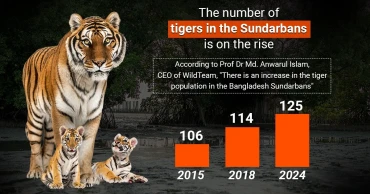
Recent surveys indicate a promising upward trend in the tiger population within the Bangladesh portion of the Sundarbans. According to Prof Islam, the Forest Department recorded 106 tigers in 2015 using camera trapping techniques. By 2018, a collaborative effort between the Forest Department and Wildteam counted 114 tigers. The most recent survey in 2024, conducted by the Forest Department, reported 125 adult tigers, reflecting a nearly 10% increase since 2018 and a 17.92% rise since 2015. This growth is attributed to enhanced conservation measures, including anti-poaching patrols and habitat protection initiatives.
The Sundarbans ecosystem is divided between Bangladesh and India, with approximately 60% of the forest located in Bangladesh and 40% in India. Prof Islam noted that while Bangladesh hosts 125 tigers, the Indian Sundarbans is estimated to have around 100 tigers, based on the latest available data from 2022. This brings the total tiger population in the Sundarbans to an estimated 225-250. The mangrove forest, a UNESCO World Heritage Site, is the only mangrove habitat in the world inhabited by tigers, making it a critical conservation area.
Read more: Poacher held with 300 deer traps in Sundarbans
Table 1: Tiger population distribution in the Sundarbans.
Region
Estimated Tiger Count
Percentage of Sundarbans Area
Bangladesh
125 (2024)
60%
India
100 (2022)
40%
Total
225-250
100%
.
Global Tiger Population and India’s Role
According to Prof. Islam, Globally, the tiger population is estimated at approximately 5,500, with India accounting for about 70% of this total, or roughly 3,850 tigers. According to a 2022 census, India’s tiger population stood at 3,682, with key reserves like Jim Corbett (260 tigers), Bandipur (150), and the Sundarbans (100) contributing significantly. This dominance underscores India’s pivotal role in global tiger conservation, supported by initiatives like Project Tiger and the expansion of tiger reserves.
Historical Presence of Tigers in Bangladesh
Prof Islam reflected on the historical distribution of tigers in Bangladesh, noting that they once roamed freely in regions such as Gazipur, Sylhet, Modhupur, and other areas. However, habitat loss, deforestation, and human encroachment have restricted their range to the Sundarbans. He cited an example of a tiger killed in Gazipur approximately 100 years ago, illustrating the significant contraction of tiger habitats over time. Today, the Sundarbans remains the last refuge for tigers in Bangladesh, emphasizing the need to protect this critical ecosystem.
Read more: UNESCO World Heritage Sites in Bangladesh
Clarifying the Royal Bengal Tiger
A common misconception is that the "Royal Bengal tiger" is a distinct subspecies. Prof Islam clarified that the term refers to the habitat rather than a unique taxonomic classification. The Bengal tiger (Panthera tigris tigris) is found across Bangladesh, India, Myanmar, Nepal, and Bhutan, thriving in diverse environments from mangrove swamps to deciduous forests. The Sundarbans’ tigers are morphologically distinct due to their adaptation to the mangrove habitat, but they are part of the broader Bengal tiger population.
Tiger Subspecies and Habitat Loss
Historically, there were nine recognized tiger subspecies, but only six remain today due to extinction events over the past century. These include:
Bengal tiger (Panthera tigris tigris): Found in India, Bangladesh, Nepal, Bhutan, and Myanmar.Indochinese tiger (Panthera tigris corbetti): Inhabits Cambodia, Laos, Myanmar, Thailand, and Vietnam.Malayan tiger (Panthera tigris jacksoni): Found in peninsular Malaysia.Siberian tiger (Panthera tigris altaica): Resides in the Russian Far East and parts of China.Sumatran tiger (Panthera tigris sondaica): Found only on the Indonesian island of Sumatra.South China tiger (Panthera tigris amoyensis): Functionally extinct in the wild, with small populations in captivity.
Prof. Islam’s words stayed with me. The Sundarbans’ 125 tigers in Bangladesh are a sign of hope, thanks to years of hard work. But the fight isn’t over. We need to keep protecting this forest. The Bengal tiger, with its quiet strength, depends on the Sundarbans and on us. This interview reminded me why we can’t look away from this fight to save a piece of our wild heritage.
Read more: Govt to ban new industrial units within 10km of Sundarbans ECA
1 year ago

Transboundary Collaboration with India needed for Bengal Tiger conservation: Environment Minister
Environment, Forest and Climate Change Minister Md. Shahab Uddin stressed the need for strengthening the transboundary collaboration with India for the conservation of tigers and leopards in Bangladesh as the two countries have shared tiger and leopard habitat.
“Considering the conservation importance of seven big cat species on earth and two critically endangered big cat species in Bangladesh, we in principal support the creation of the International Big Cats Alliance (IBCA) with a membership of the range of countries harboring these species,” he said.
The minister said this at an event organized on the occasion of the International Conference on Tiger Conservation as part of 50 years of Project Tiger held on Sunday at Mysuru University in Mysuru, Karnataka, India after the inauguration of the event by Prime Minister of India Narendra Modi.
Sahab Uddin said Bangladesh government is working with the determination to double the number of wild tigers by achieving zero poaching target with the active participation of local community.
It’s a matter of hope that wild tiger numbers are starting to tick upward he said adding that government has taken several remarkable initiatives for conserving the national animal and other wild species.
Shahab Uddin said Bangladesh government is implementing National Tiger Recovery Program (2022 to 2034) and second-generation Bangladesh Tiger Action Plan (2018-2027) which include tiger survey; genetic study; SMART patrolling and monitoring by drone inside the Sundarbans; capacity building programs for frontline staffs of the Forest Department as well as local community to ensure protection & conservation of the Sundarbans and Bengal tiger.
The Minister said, a protocol was signed between Bangladesh and India for strengthening collaboration for the Conservation of Royal Bengal Tiger in the Sundarbans in 2011.
The Minister said to mitigate tiger human conflicts, our government has engaged the local community in tiger conservation activities by forming Village Tiger Response Team, Co-management Committee and Community Petrol Group.
Wildlife Victim Compensation Rules, 2021 has the provision to give compensation up toTk 3 lakh for person killed by tiger, he said.
Wildlife Crime Control Unit has been established under Forest Department to combat illegal wildlife trade and to strengthen the capacity of wildlife education, research and training, Sheikh Kamal Wildlife Center has been established which is working as a center of excellence, said the minister.
Prime Minister of India Narendra Modi launched the International Big Cats Alliance (IBCA) which will focus on protection and conservation of seven major big cats of the world such as tiger, lion, leopard, snow leopard, puma, jaguar, and cheetah in collaboration with the countries concerned.
The Environment and Forest Ministers of the countries harboring these species were present on the occasion.
3 years ago