Adviser Fouzul Kabir
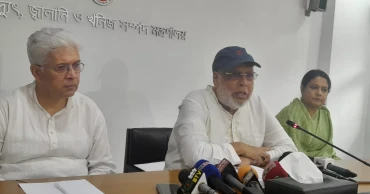
NBR officials' protests turned into anti-govt movement aiming to harm economy: Adviser
The general protests by officials of the National Board of Revenue (NBR) had eventually turned into an anti-government movement aimed at disrupting the country’s economy, claimed Adviser Muhammad Fouzul Kabir Khan on Sunday.
Fouzul, who leads the ministries of Power, Energy and Mineral Resources; Road Transport and Bridges; and Railways, made the remarks at a press conference at the Secretariat.
He also heads the Advisory Council Committee formed to speed up business, industry, ports and revenue collection.
Committee members Industries Adviser Adilur Rahman Khan, Environment Adviser Syeda Rizwana Hasan were also present at the press conference.
Regarding the NBR officials’ protest demanding repeal of the Revenue Policy and Revenue Management Ordinance, Fouzul said, “It was initially a harmless movement, but later turned into an anti-government one. The aim shifted towards causing economic damage and disrupting revenue collection.”
NBR first secretary Tanzina suspended
Quoting a newspaper report, he cited evidence from a WhatsApp group suggesting a political motive behind the protest.
“Despite provocation, the government showed immense patience,” he said, adding that business leaders questioned why the protest was allowed to continue for so long. “We tried to resolve the issue without repression, but it didn’t work," the Adviser said.
The Advisory Committee has held five meetings so far with stakeholders, including VAT and income tax associations, NBR officials, the Reform Commission and business leaders.
“We’ll monitor field-level activities of income tax, customs and VAT operations,” he said.
Fouzul also said that businesses suffered badly during the two-month-long protest and frequently faced harassment by tax officials. However, they fully support the government’s reform agenda.
He also mentioned that the Anti-Corruption Commission is investigating some NBR officials and disciplinary actions have already been taken.
The advisory committee will provide recommendations for formulating policies on how to appoint secretaries in two departments (Revenue Policy and Revenue Implementation) to resolve the issues arising with NBR.
Govt has no hand in ACC probe of six NBR officials: Finance Adviser
The five-member Advisory Council was formed on June 30 through a Cabinet Division notification.
Its other members are Brig Gen (Retd) M Sakhawat Hossain (adviser to the Shipping and Labour Ministries) and Sk. Bashiruddin (adviser to the Commerce, Textiles and Civil Aviation Ministries).
1 year ago

Govt working to ease public suffering: Adviser Fouzul Kabir
Road Transport and Bridges Adviser Muhammad Fouzul Kabir Khan has assured that the interim government is committed to alleviating public suffering through proactive measures.
“Marking Victory Day, the government has introduced a new commuter train service on the Dhaka-Joydebpur-Dhaka route. This initiative aims to provide an affordable and efficient travel option between Dhaka and Gazipur,” he said on Sunday.
Adviser Fouzul made the remarks during the inauguration of four pairs of commuter trains on the Dhaka-Joydebpur route, alongside the launch of an air-conditioned BRTC bus service operating on the Bus Rapid Transit (BRT) corridor from Shibbari to Airport and Gulistan.
Karnaphuli Tunnel a wasted investment: Adviser Fouzul
Fouzul Kabir, who also serves as Adviser to the Ministry of Railways, revealed that additional commuter train services are being planned for the Dhaka-Narsingdi-Dhaka and Dhaka-Narayanganj-Dhaka routes.
These services are expected to commence ahead of Independence Day on March 26.
Highlighting broader goals, he called for collective action to create a discrimination-free and corruption-free Bangladesh. “Transparency and accountability must be maintained in all institutions, whether public or private.”
New commuter train service launched on Dhaka-Gazipur route
Fouzul kabir also drew attention to pedestrian safety, urging both the public and authorities to remain vigilant in preventing accidents.
He hoped that the remaining work on the BRT project, which aims to streamline transportation and reduce travel-related inconveniences, will complete soon.
1 year ago

No more IPP in power sector with govt guarantee to buy electricity: Adviser
The government will not allow any more independent power producer (IPP) plants to be set up in the private sector as the private sector will have to set up power plants under merchant power plant policy (MPPP) from which the government will purchase a maximum 10-20 percent power from the plant.
Power and Energy Adviser Dr Fouzul Kabir Khan said this while addressing a seminar titled ‘Rapid Transition to Renewables: Role of Domestic Financial Institution’, organised by Economic Reporters Forum (ERF) at its auditorium on Saturday.
Currently, the government provides a guarantee to buy the total electricity of an IPP power plant, set up under private power generation policy.
under the new policy, the adviser said, the private producer has to sell electricity through his own buyer through the government grid system by paying a wheeling charge. During the previous Awami League regime, banks have financed many projects seeking the faces of the people, not based on the assets of the investors, he added.
Future projects to prioritise feasibility, people’s welfare: Adviser Fauzul
The adviser went on to say, “Now, when these loans are defaulting, the banks are checking their balance sheets like those of S Alam and Beximco and finding the balance sheets are empty and there is no asset.”
Fouzul Kabir said the interim government’s focus on promoting renewable energy (RE) and stressed that there is no alternative to RE to get electricity as it has been a compulsion for the country’s export-oriented garment sector.
Held with ERF President Mohammad Refayet Ullah Mirdha in the chair, the seminar was also addressed by Centre for Policy Dialogue’s research director Dr Khondaker Golam Moazzem, the City Bank’s business country manager Ashanur Rahman and chief executive officer of CLEAN Hasan Mehedi.
Chairperson of Centre for Environment and Participatory Research (CEPR) Gouranga Nandy made a presentation on the topic of the seminar and ERF general secretary Abul Kashem conducted the event.
Rooftop solar can reduce reliance on grid electricity: Energy Adviser
Dr Kabir said that is not true the scarcity of land has been the main bottleneck in promotion of the solar power projects, and noted that there are huge lands in different government departments that remain unutilised and empty. “Those thousands acres of land could be utilised for the solar power plants.”
The adviser opposed the idea of tax exemption for importing different components of solar power like inverter, panel and structures saying that these should not be imported from abroad. Rather, these should be produced locally like those are in India, he added.
Dr Kabir also opposed the demand for reconsidering the cancelled 37 solar power plants which were selected on the basis of Speed Increase of Power and Energy Supply (Special Provision) Act 2010 and issued letter of intent (ILO) by the previous regime. “There is no scope for reconsidering those projects as the High Court has already scrapped the Law.”
Fouzul Kabir urged the businesspeople to invest in different sectors including power and energy on the basis of business competition. “The government has opened up all businesses for all businessmen to get jobs through competition. Now the days of obtaining business through favour and faces have gone.”
Energy sector contracts will be free from political influence: Adviser
Dr Khondaker Golam Moazzem said that the local banks often are not interested in financing the RE projects as those are long-term ones and banks collect deposits on a short-term basis. So, there is a risk in financing the long term projects and the central bank takes initiative to cover the risk, he added.
Gouranga Nandy said that though the banks are doing green financing to implement renewable energy projects, there is no upward trend in the investment in solar energy as there is no specific guideline for the banks to invest in the sector.
1 year ago