Smart agriculture
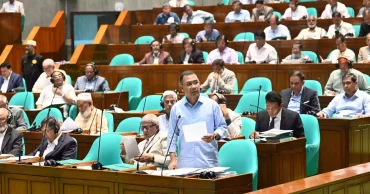
PM outlines seven-point plan aimed at ensuring smart agriculture
Prime Minister Tarique Rahman on Wednesday informed Parliament that the government has adopted a time-befitting seven-point plan to boost agricultural development and transform the sector into a sustainable and profitable one.
He came up with the information while replying to a starred question from treasury bench member Md Robiul Awal (Tangail-6) in the House.
The Prime Minister said Bangladesh is an agriculture-dependent country and the role of this sector is very crucial in ensuring food security, poverty reduction and overall economic growth. “But agriculture is facing various challenges, including climate change, population growth, shrinking arable land and technological limitations.”
“To face these challenges, the government is working to increase agricultural production and productivity, and turn the sector into a sustainable and profitable one,” he said.
Tarique Rahman said the government has already started distribution of “Farmers’ Card” on April 14 in line with the BNP’s electoral manifesto.
Through the card, farmers will receive 10 types of services, including fair-priced agricultural inputs, subsidies and incentives, affordable farm machinery, irrigation support, easy agricultural loans, crop insurance, fair market access, training, and digital access to weather and market information along with pest control advice, he said, adding that all farmers of the country will be brought under the scheme in phases.
The Prime Minister detailed the government’s seven-point plan, which includes expansion of modern irrigation systems, bringing fallow land under cultivation and introducing crop zoning to ensure optimal land use, diversification of agricultural products, ensuring transparent and accountable incentives through farmer cards, providing low-interest agricultural loans and crop insurance, building modern cold storage and warehouses, and promoting research for high-yielding, disease-resistant and short-duration crop varieties.
He said the government has taken plans to expand modern irrigation systems alongside the use of improved and high-yielding seeds and balanced fertiliser to increase agricultural production and productivity. In this regard, the government has already undertaken a programme to excavate 20,000 kilometres of canals, which will be implemented over the next five years.
Tarique Rahman said the current government has also planned to make various agricultural machinery, including tractors, harvesters and reapers, easily accessible to farmers by providing subsidies for agricultural mechanisation.
Govt to distribute jute school bags, uniforms among primary students
“Crop zoning” has been introduced to bring fallow land under cultivation and ensure optimal use of land, he said, adding that through this system, crops suitable for the soil, climate and environment of specific regions are determined, which helps reduce land wastage and increase production. “At the same time, various programmes have been taken to identify fallow land and bring it under cultivation,” he said.
Highlighting the government’s emphasis on diversification of agricultural products, the Prime Minister said the country’s once rice-dependent farming system is now gradually being expanded to include fruits, vegetables, pulses, oilseeds, spices and flowers.
“To ensure transparency and accountability in incentives and support programmes for farmers, subsidies will be provided through the Farmers’ Card for seeds, fertilisers, agricultural machinery and other inputs,” he said.
Besides, initiatives are being taken to introduce low-interest agricultural loans and crop insurance, Tarique Rahman said, adding that special assistance programmes are also being implemented to rehabilitate farmers affected by natural disasters.
He said modern cold storage facilities and warehouses are being constructed to preserve agricultural produce. Besides, initiatives have been taken to install mini cold storage units for fruits and vegetables and to distribute air-flow machines for onion preservation.
“There are also plans to establish agricultural export zones and procurement centres in the northern region to boost the export of agricultural products,” the Prime Minister added.
He also highlighted the government’s activities in agricultural research and innovation.
Tarique Rahman said the government has a plan to implement climate-smart agriculture to cope with the climate changes adversity as well as to promote environment-friendly farming with reduced use of irrigation, chemical fertilisers and pesticides, and introduce prepaid meters and farming apps.
Replying to a supplementary question from the same lawmaker, he said the government has taken a plan to enhance soil fertility.
“Due to the use of chemical fertilisers, soil fertility has declined. So, we want to increase the use of nano fertilisers in the country through soil testing. We aim to establish a practice so that fertiliser costs are reduced and soil fertility is not degraded,” the Prime Minister said.
In reply to another supplementary question from opposition bench member Masum Mustafa (Netrokona-5), he said agricultural labourers will also receive support. “Marginal and small farmers have been brought under the Farmers’ Card support programme. Through the support, we will also try to ensure that agricultural labourers receive support,” he said.
4 months ago

Smart agriculture can break agricultural product syndicates in Bangladesh: Experts
Smart agriculture holds great potential in Bangladesh, as it can significantly enhance agricultural productivity and contribute to the country’s economy and agricultural system, according to experts.
Talking to UNB, they explained that smart agriculture involves the direct delivery of agricultural products from farmers to consumers through digital platforms, reducing the interference of middlemen and allowing farmers to receive fair prices for their produce.
“This approach could help dismantle the syndicates responsible for high prices of agricultural products,” said Dr Md Shahiduzzaman, Director of the Smart Agriculture Department and a Professor in the Department of Parasitology at Bangladesh Agricultural University (BAU).
Dr Shahiduzzaman said that smart agriculture refers to the use of information technology and innovative agricultural practices to make farming more efficient, profitable and sustainable.
"Techniques like satellite imaging, drones, sensors, and GPS technology collect data on soil quality, moisture, and temperature, allowing farmers to apply irrigation, fertilisers, and pesticides accurately. Data analytics also helps predict crop yields, understand climate change impacts, and anticipate pest infestations, aiding effective planning," he added.
Discussing the benefits of smart agriculture, Dr Shahiduzzaman said that it could address challenges posed by climate change, floods and droughts, and ensuring food security.
By utilising advanced seeds and agricultural practices, he said, farmers can cultivate more productive and climate-resilient crops, boosting agricultural production in Bangladesh. Innovative technologies enable farmers to thrive even in adverse environmental conditions, Dr Shahiduzzaman added.
Read: Action against price-hiking syndicates under Special Powers Act
He highlighted that smart tractors, robotic harvesters, and automated irrigation systems can significantly reduce costs and time in agricultural operations. “These innovations help increase production while decreasing dependency on labour. The Internet of Things (IoT) allows smart sensors and devices to collect real-time data on soil health, moisture levels, and other environmental parameters, facilitating swift decision-making.”
According to Dr Shahiduzzaman, the various smart agriculture technologies are making agricultural processes simpler and more effective while creating new opportunities that can advance agricultural production and sustainable farming.
Prof Dr Mohammad Mofizur Rahman Jahangir from the Soil Science Department and Dr M Wakilur Rahman from the Rural Sociology Department of BAU also emphasised the role of smart agriculture in soil preservation and employment generation.
Highlighting the significance of pesticides in smart agriculture, Dr Jahangir mentioned that the appropriate use of pesticides is integral to this approach.
Smart agricultural technologies enable timely detection and management of pest attacks and crop diseases. It also helps determine the right amount, timing, and method for pesticide application, ensuring that farmers ultimately benefit, he said.
Dr Jahangir explained that while organic fertilisers enhance soil fertility by increasing microbial populations, they do not eliminate weeds, posing a challenge for agricultural production. The use of pesticides may affect some non-target microorganisms, but generally, their populations stabilise after initial exposure, he added.
Prof Jahangir cited an example from his research, stating that when herbicides were applied to soil with nitrifying microbial populations, the population initially decreased slightly over the first 15 days. However, after that period, the population numbers returned to normal.
Read more: Interim Government committed to curbing essential commodity prices by breaking syndicates: Mahfuj Alam
On the employment aspect of smart agriculture, Prof Dr Wakilur Rahman remarked that widespread implementation would not lead to job losses but would foster the emergence of new entrepreneurs.
He noted that many currently engaged in agriculture are transitioning to other professions, leading to an increase in uncultivated land. Commercialising smart agriculture could make previously unused land arable and secure economic benefits.
He also stressed that the agricultural sector faces significant gaps that must be addressed to avoid future challenges. Controlled environments, such as greenhouses, can provide opportunities for demand-driven agricultural production. Making agriculture profitable and commercially viable is crucial, necessitating extensive implementation of smart agriculture.
Dr Shahiduzzaman, however, pointed out that effective implementation of smart agriculture in Bangladesh requires government and private sector initiatives.
"Infrastructure improvements (internet and electricity), along with training and support for farmers, are critical. Many farmers lack familiarity with modern agricultural technologies, and the fragmentation of arable land complicates the effective deployment of drones and advanced machinery, increasing production costs," he added.
1 year ago