13th parliamentary election
EC had no ‘design’ other than holding fair election: CEC
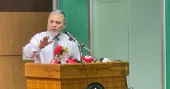
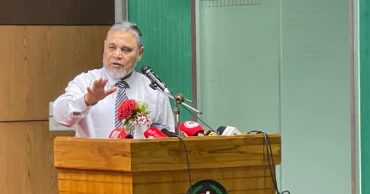
Chief Election Commissioner AMM Nasir Uddin on Monday said his commission didn't work with any particular ‘design’ to conduct the 13th parliamentary election held on February 12.
“We didn't work with any design. Our design was only to hold a free, fair and credible election,” he said.
The CEC made the remarks, while addressing the inaugural ceremony of the newly elected Executive Committee of Reporters' Forum for Election and Democracy (RFED) at the Electoral Training Institute (ETI) in the city's Agargaon area.
Nasir Uddin said they received full support and cooperation from the interim government during the February-12 general election.
The Election Commission faced no interference from the then interim government during the parliamentary election, he added.
He said the chief adviser of the former interim government asked his administration not to interfere in the activities of the Election Commission at that time.
About the upcoming local government elections, the CEC stressed the need for full cooperation from political parties for fair and peaceful elections.
He asked the political parties, if necessary, to sit in discussions for the sake of holding the local government elections in peaceful and fair manners. “We want to establish a culture of good elections,” he said.
About the tentative timetable for the local body polls, Nasir Uddin said the timetable has not been finalised yet and the EC is now working on amendments to rules and electoral codes now.
Responding to allegations of ‘election engineering’ raised at the same event by National Citizen Party (NCP) Chief Coordinator Nasir Uddin Patwary, the CEC said Patwary is known for his outspoken remarks and the commission has become accustomed to hearing such remarks from him.
“We’ve developed a kind of resistance hearing such remarks from him. During the election, he often met us and criticised us, just going outside the door…. Believe me, I sincerely say that I didn’t feel even the slightest hurt,” the CEC said.
Speaking about the journalists, Nasir Uddin said the commission tried to extend as much freedom as possible to the media during the February election, as it had “nothing to hide.”
“We tried to give you as much freedom as possible because we had nothing to conceal,” he said.
The CEC also said the commission maintained the same policy for all political parties, regardless of whether they were small, medium or large.
At the event, ruling party Whip Mia Nuruddin Ahmed Opu praised the Election Commission for conducting what he described as a credible election, while Jamaat-e-Islami Assistant Secretary General AHM Hamidur Rahman Azad and NCP Chief Coordinator Nasir Uddin Patwary criticised different aspects of the polls.
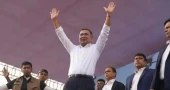
Mia Nuruddin Ahammed Opu said the February election reflected the aspirations of the people and described it as one of the most inclusive and widely credible elections in the country’s history.
“After people had been deprived of voting rights in the previous three elections, the current Election Commission gave the country an acceptable electoral system,” he said.
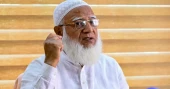
Jamaat leader Hamidur Rahman Azad acknowledged what he described as greater transparency at the policy level and noted qualitative improvements in voter participation, particularly among first-time voters, but not in publication of election results.
“There has been a qualitative change in the election. Voters went to polling stations and cast ballots, especially new voters who were able to vote for the first time,” he said.
However, he said some flaws in the election process should also be acknowledged to avoid hiding the truth.
Azad said more political parties participated in the latest election than in previous polls, although the Awami League could not join due to legal reasons. “This time we witnessed no violence in the polling stations,” he said.
“Only casting votes is not enough for fair election, the fair process also should be maintained in the declaration of election results,” said the Jamaat leader.
About the local government elections, he urged the Election Commission to address shortcomings and ensure that the polls do not witness violence or political interference similar to what he termed the “fascist era.”
Meanwhile, NCP Chief Coordinator Nasir Uddin Patwary said bringing changes in the EC from top to bottom is his first target.
"Bangladesh has witnessed how the DGFI, NSI and other intelligence agencies can engineer an election nakedly in the DC offices on election day," he said.
Referring to a previous remark by an election commissioner that loan defaulters had been allowed to contest the election “with a heavy heart,” Patwary said the EC can’t violate the Constitution even with a heavy heart. “It is your commitment that you don’t allow them,” he said.
Four election commissioners Abdur Rahmanel Masud, Tahmida Ahmad, Anwarul Islam Sarker and Brig Gen (Retd) Abdul Fazal Md Sanaullah, President of the National Press Club Hasan Hafiz, RFED newly elected President Kazi Amad Uddin Jabel and general secretary Ekram-Udd Dowla, among others, were present in the event.
5 months ago
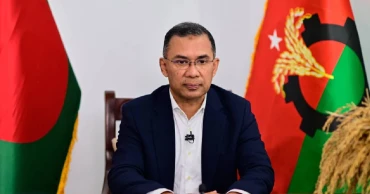
Tarique to address media at 3 pm after BNP’s landslide victory
After a resounding victory in the 13th parliamentary election, BNP Chairman Tarique Rahman will address a press conference this (Saturday) afternoon.
The press conference will be held at 3:00pm in the ballroom of Hotel InterContinental Dhaka, said BNP Secretary General Mirza Fakhrul Islam Alamgir.
This will be Tarique Rahman’s first press conference after returning to the country following nearly one and a half decades abroad and after the BNP’s sweeping victory in the 13th parliamentary election.
Tarique Rahman wins both Dhaka-17, Bogura-6 seats
According to the unofficial results, the BNP won 209 seats in the parliamentary polls. Tarique Rahman was elected from Dhaka-17 and Bogura-6 constituencies.
Members of the party’s Standing Committee will also remain present at the press conference.
8 months ago
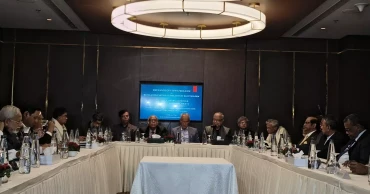
No reason for voter turnout to dip below 60pc: Mahbub Ullah
Economist Mahbub Ullah on Wednesday expressed optimism that Bangladesh’s will be participatory and credible ones, saying there is no reason for voter turnout to fall below 60 percent if the overall situation remains stable.
“I think the voter turnout in this election will not be less than 60 percent; it may even be higher. Although it is often said that the 87 percent turnout in 2008 was the highest in Bangladesh’s history, that election was controversial. I hope there will be no such criticism about the upcoming election,” he said.
Mahbub Ullah was speaking at a discussion on the national election held at city a hotel, organised by the Foundation for Strategic and Development Studies (FSDS).
He said there is concern in some quarters that the absence of the Awami League from the electoral contest could reduce turnout. However, the large number of people leaving Dhaka to cast their votes suggests that the party’s absence is unlikely to have a negative impact on voter participation, he added.
Noting that people across the country are eagerly awaiting a fair election, he said political parties will bear a major responsibility to accept the results once announced.
“There are high expectations among the people regarding this election. The next government must ensure that it does not fail to meet those expectations in any way,” he said.
Referring to what he described as institutional deterioration during the Awami League’s over one-and-a-half-decade rule, the former Dhaka University economics professor said reviving weakened state institutions, including the economy, judiciary and administration, will be the biggest challenge for the incoming government.
He also urged the new government to safeguard Bangladesh’s independence and sovereignty while pursuing a positive new beginning.
Speakers at the programme expressed multifaceted concerns over the country’s economic outlook, saying the next government will face immediate and significant challenges.
They stressed the need for prioritising a clear economic action plan.
Grameen Bank Chairman Abdul Hannan Chowdhury said prolonged economic mismanagement over the past 17 years has left the economy fragile and distressed. “All parties have announced ambitious pledges in their manifestos. But the first priority should be economic restraint.”
Investment Corporation of Bangladesh Chairman Abu Ahmed, however, said that despite mounting economic challenges, the economy could rebound quickly if the new government adopts sound policies.
Bangladesh Polls: Electioneering ends as parties leave voters with promises
Security analysts at the event underscored the importance of ensuring robust security measures both on election day and in the post-election period. They stressed the need to assess preparedness to address any untoward incidents nationwide, beyond just securing polling centres.
Former Additional Inspector General of Police Mazharul Haque said adequate preparation is essential to maintain law and order after the announcement of results. “Even if the situation remains manageable on polling day, a lack of preparation could lead to disorder once results are declared.”
Emphasising security in rural areas as well as urban centres, former ambassador M Shahedul Haque said that a form of ‘mafia-style control’ has emerged in villages following the fall of the Awami League government on August 5, 2024.
He said the rising incidents of violence and extortion in rural areas must be addressed to ensure a credible election.
Expressing concern over possible post-election reprisals against minorities, Prof Sukomal Barua of the Department of Pali and Buddhist Studies at Dhaka University said minority communities fear potential attacks after the results.
He urged the government and law enforcement agencies to prevent any such incidents at all costs.
Former Dhaka University Pro-Vice Chancellor Prof Anwarullah Chowdhury and FSDS Chairman Major General (retd) Fazle Elahi Akbar also voiced hope for a free, competitive and inclusive election.
8 months ago
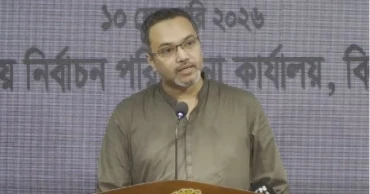
Saidpur Airport incident exposed evil efforts to ‘obstruct BNP’s victory’: BNP
BNP on Wednesday described the incident at Saidpur Airport involving the arrest of a Jamaat district leader with a large amount of cash as a political conspiracy to ‘obstruct BNP’s inevitable victory’.
“A quarter is trying to create various obstacles to prevent the BNP’s inevitable victory. This morning, we saw media reports that police detained the Thakurgaon district Jamaat ameer at Saidpur Airport after he travelled from Dhaka with more than Tk 50 lakh in cash,” said BNP’s Election Steering Committee spokesperson Mahdi Amid.
Speaking at a press conference at the BNP’s Gulshan election office, he raised questions about the source and intended use of the money at a time when banking and financial transactions remain largely closed to prevent illegal election spending.
“When all business activities across the country have remained closed for four consecutive days, it does not require an expert to understand what business purpose such a large amount of money could serve. This clear violation of the code of conduct shows the political and moral bankruptcy of a disconnected political group and its attempt to exert unethical influence,” Mahdi said.
He claimed that such incidents point to attempts at unlawful financial influence and moral manipulation of voters, which he said contradict anti-corruption rhetoric of Jamaat. “It is fair to ask those who speak of justice and campaign against corruption how buying votes with money is consistent with their anti-corruption stance.”
“There is no scope to view the Saidpur Airport incident as an isolated incident. Similar illegal and unethical financial activities have also been observed in Dhaka-15, the electoral constituency of the Jamaat ameer, as well as in many other parts of the country, including Cumilla, Noakhali and Khulna,” the BNP spokesperson said.
In the past, he said, the leaders and activists of Jamaat went door to door across the country collecting voters’ mobile financial service numbers and voter IDs.
Mahdi, however, said religious-minded people have already rejected any attempt to send illegal money through bKash, Rocket or Nagad or to lure people with promises of ‘tickets to paradise’.
“We call upon the Election Commission and law enforcement agencies to further strengthen monitoring across the country against any attempt to buy votes with money,” he said.
Citing media reports, Mahdi alleged that activists of Jamaat are gathering locally made weapons, bamboo sticks, pipes and stamps in many parts of the country to spread fear among voters.
He also claimed that incidents of violence, sudden attacks, arson, voters’ intimidation and distribution of money have been reported in different districts, and many people involved in creating disorder and engaging in unethical activities in the electoral field had already been arrested by law enforcement agencies.
As an example, Mahdi said, a tragic incident occurred in Nandigram of Bogura-4, where Khalta Machhram Union BNP president Masud Rana was seriously injured in an attack by identified Jamaat cadres.
As the news spread that Masud Rana lost vision in his eye, he said the BNP leader’s mother suffered a stroke and passed away.
He strongly condemned the painful incident and demanded swift justice, calling upon the Election Commission, returning officers and law enforcement agencies across the country to treat each such incident with the highest priority and take necessary measures.
Mahdi also urged them to strengthen monitoring across the country to prevent any attempt to buy votes with money.
He also called for vigilance against fake voting, saying voter identity must be properly verified in accordance with electoral rules where necessary.
Jamaat leader Belal Uddin hospitalised after arrest ‘with Tk 74 lakh’
The BNP leader appealed to all political parties to help ensure a peaceful election atmosphere free from violence, fraud and irregularities, stressing that people’s participation is essential for restoring democratic rights.
He called upon the country’s voters to come to polling centres early; he said the upcoming vote should reflect the will and victory of the people of Bangladesh.
Several members of the BNP’s central election steering committee, including Prof Moudud Hossain Alamgir Pavel, Atikur Rahman Rumon and Zubair Babu, were present at the briefing.
8 months ago
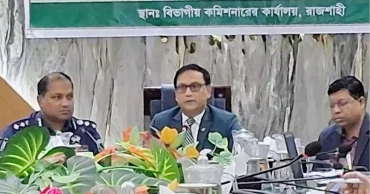
Law enforcers to respond within five minutes to any incident at polling centres: Rajshahi DC
Law enforcement agencies will reach any polling centre within five minutes if any untoward incident occurred on election day, said Rajshahi Divisional Commissioner ANM Bazlur Rashid on Wednesday.
ANM Bazlur said this while speaking at a press conference held at his office around 12pm over the overall preparations for the 13th National Parliamentary Election and referendum in the Rajshahi division.
“We have deployed law enforcers in such a way and are monitoring through technology that the possibility of any unwanted incident is minimal,” he said.
There are 39 parliamentary constituencies in the Rajshahi division with a total of 16,377,096 voters. There are 5,504 polling centres in the division, including 1,767 identified as important.
A total of 218 executive magistrates and 39 judicial magistrates will perform duties during the election.
Besides, 1,04,066 members of different law enforcement agencies have been deployed, including 10,000 army personnel, 4,123 BGB members, 13,796 range police, 2,405 Rajshahi Metropolitan Police personnel, 1,006 RAB members and 72,736 Ansar members.
On average, 2,668 law enforcers will be deployed in each constituency.
BGB seizes arms consignment at Rajshahi Border
To ensure voters’ security and transparency at polling centres and prevent untoward incidents, CCTV cameras have been installed at 5,266 centres and 2,318 body-worn cameras have been arranged, he added.
Rajshahi Range DIG Mohammad Shahjahan, Rajshahi Metropolitan Police Commissioner Dr Md Zillur Rahman and officials of various government departments were present at the press conference.
8 months ago
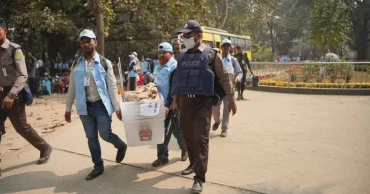
Polling centres receiving election materials as Bangladesh set for landmark election
The distribution of ballot papers and other election materials to polling centres began Wednesday morning, ahead of voting in the Bangladesh national election and referendum, which is set to start at 7:30 am Thursday.
Presiding officers in charge of polling centres are receiving ballot papers and other materials, according to reports sent by UNB correspondents of different districts including Sylhet, Gazipur, Lalmonirhat, Chapainawabganj, Barishal, Habiganj, Faridpur and Cumilla .
Ballot boxes, indelible ink, stamps and other necessary equipment were handed to the presiding officers of each centre after 9am.
Earlier Chief Election Commissioner AMM Nasiruddin said all electoral materials including ballot papers have already been distributed to the returning officers for the respective constituencies and the ballot papers are currently being distributed to the polling centers.
Distribution of ballot papers and election materials from assistant returning officers’ offices will begin on Wednesday morning and is expected to reach the polling stations by evening, Election Commissioner Abul Fazal Md Sanaullah said at a press briefing on Tuesday.
On February 2, the Election Commission started sending ballot papers with candidates’ names and symbols to returning officers.
Other election materials were also sent across the country in phases along with the ballot papers.
The materials were preserved at the offices of the returning officers and are now being delivered to polling centres a day before voting.
UNB Barishal correspondent reports: 36 candidates are contesting across six constituencies.
Khairul Alam Sumon, Barishal’s Returning Officer and Deputy Commissioner, said all measures have been taken to ensure a free, fair, and peaceful election. “The delivery of ballot boxes, ballot papers, and other election materials will be completed today. We will not compromise on a neutral election under any circumstances,” he added.
Sylhet Deputy Commissioner and Returning Officer Md Sarwar Alam formally inaugurated the distribution process around 10:30am, handing over materials to assistant returning officers and presiding officers.
In Gazipur, 935 polling centers in five parliamentary constituencies are receiving materials under strict security.
Sazzad Hossain, Assistant Returning Officer and Upazila Nirbahi Officer of Gazipur Sadar Upazila, said all preparations have been completed to ensure a free and fair election.
Under the leadership of presiding and assistant presiding officers, ballot papers, ballot boxes, and other materials have been sent to the centers. “We hope voting will be conducted peacefully tomorrow,” he added.
A total of 127,298,522 voters (in 299 constituencies) are eligible to cast their ballots in this election. Of them, 64,620,077 are male voters, 62,677,232 are female voters and 1,213 are third-gender voters.
CEC Nasir Uddin reaffirms commitment to peaceful, credible elections
The country has a total of 127,711,899 voters (in 300 constituencies) –64,825,154 males, 62,885,525 females and 1,220 third-gender.
Nearly 800,000 officials will be engaged in election duties in more than 42,600 polling stations in the 299 constituencies, while nearly another 800,000 security personnel will protect the polling stations.
Meanwhile, some 50,000 observers from 80 registered domestic organisations will monitor the election, while nearly 500 foreign observers are expected to oversee the election.
8 months ago
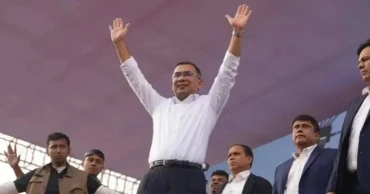
Tarique keeps up momentum, spends busy day with party work
BNP Chairman Tarique Rahman spent a busy Tuesday after wrapping up his election campaigning by remaining engaged in organisational and coordination activities.
Throughout the day, Tarique spoke over the phone with party leaders, activists and candidates across the country to take updates on the overall situation in different constituencies, said BNP Media Cell member Atikur Rahman Rumon.
Rumon said the BNP chief arrived at his office around noon, where he also spoke with several foreign journalists and carried out organisational work.
“The BNP chairman is currently working from his Gulshan office. Since morning, he has been receiving updates from candidates across the country and speaking directly with party leaders and activists. He wanted to know about the overall situation nationwide,” Rumon said in the afternoon.
He said Tarique remained busy throughout the day, while the party’s election messages were also sent across the country through SMS and voice calls.
In the evening, Rumon said, the BNP chief is scheduled to attend an exchange-of-views meeting with foreign journalists at a hotel in Banani.
Tarique Rahman is leading BNP in the 13th parliamentary election.
In this election, BNP’s electoral symbol, the ‘Sheaf of Paddy’, is contesting 291 seats, while the party has reached seat-sharing arrangements with like-minded parties in nine constituencies.
Key in your hands, use it wisely: Prof Yunus tells voters
Tarique conducted continuous electioneering that began on January 22 from Alia Madrasah in Sylhet.
He later addressed election rallies in Moulvibazar, Habiganj, Brahmanbaria, Kishoreganj, Narsingdi, Narayanganj’s Mouchak, Chattogram, Feni, Cumilla’s Chauddagram, Sonagazi, Daudkandi, Narayanganj’s Sonargaon, Mymensingh, Gazipur, Uttara in Dhaka, Rajshahi, Naogaon, Bogura, Rangpur, Sirajganj, Tangail, Barishal, Faridpur, Thakurgaon, Nilphamari and Dinajpur, as well as 14 constituencies in Dhaka.
Overall, Tarique Rahman addressed 41 public rallies across Dhaka and other parts of the country over nine days.
He formally wrapped up his election campaign by visiting the graves of his parents at around 11:00 pm on Monday.
8 months ago
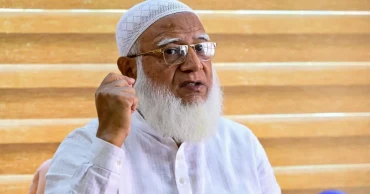
Bangladesh election to be among world’s most closely watched this year: Jamaat Ameer
Bangladesh’s February-12 national election is expected to be one of the most closely watched polls globally this year, with international media monitoring not only the results but also the conduct of the electoral process, Jamaat-e-Islami Ameer Dr Shafiqur Rahman has said.
In a Facebook post, Shafiqur Rahman said global attention is focused on whether the election will be held in a free, fair and credible manner.
Outlining his vision for the country’s political culture, he said he wants a Bangladesh where political debate is driven by policies and ideas, rather than muscle power, and where voters are able to exercise their franchise without fear or pressure.
The Jamaat Ameer said Bangladesh Jamaat-e-Islami is no longer a marginal political force, claiming the party has now emerged as a mainstream political actor. Through a free and fair electoral process, the party would accept and carry out whatever responsibility the people assign to it, he added.
State responsibility a sacred trust, not for personal gain: Jamaat Ameer
Shafiqur Rahman said that if his party were elected to power, he would be prepared to work with all political parties in the national interest, with the aim of ensuring political stability and good governance.
He also said the public has the right to know whether the party’s main political opponents would respect the people’s verdict if they fail to win the election, play a constructive role in opposition, and continue to serve the country regardless of the outcome.
8 months ago
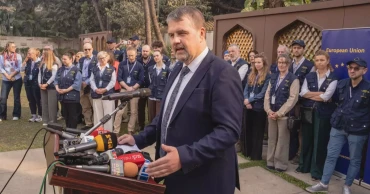
Hopeful mood, positive electoral climate in Bangladesh: EU chief observer
Highlighting the importance of a participatory nature of election, Chief Observer of the European Union Election Observation Mission (EU EOM) to Bangladesh Ivars Ijabs on Tuesday said the general atmosphere and expectations are very hopeful with a positive electoral environment in place.
"We have emphasised the participatory nature of the electoral process which is very much desirable," he told reporters, stressing the importance of inclusion of all communities, minorities and also participation of women in the electoral process.
He said most of their interlocutors have emphasised that there should be a new page in the history of Bangladesh and its democracy. "I would say the electoral environment is very positive. The general atmosphere is very hopeful," Ijabs said.
He, however, said there are many issues that they have discussed and reiterated that they remain neutral without getting involved in any political process. "We are here not to comment on Bangladesh’s politics. We are here to check and observe the process."
In terms of the security situation, the chief observer said their overall perception is that the situation is still under control of the authorities.
They deployed 90 short-term observers (STOs) to observe the election day proceedings in all 64 administrative districts of the country.
The short-term observers will observe opening of polling centres, voting, closing, as well as counting of the ballots and the tabulation of results.
“The short-term observers will be present in cities, towns and villages in almost every constituency. Their observations and reports throughout the day will be a critical element of our impartial and fact-based assessment of these historic elections,” Ijabs told reporters.
With a total of 200 observers deployed across the country, he said they are contributing to the transparency of these historic elections.
"This large and dedicated mission attests to the European Union’s unwavering commitment to the democratic governance of Bangladesh,” said the chief observer.
The deployment of short-term observers builds on the work of 56 long-term observers, who have been in Bangladesh since mid-January, observing the pre-election environment, including preparations by the election administration, campaign activities, voter education efforts, and who have engaged with electoral stakeholders across the political and civil society spectrum.
A delegation of Members of the European Parliament is further reinforcing the mission, and 35 locally recruited short-term observers from the diplomatic missions of the EU Member States, as well as Canada, Norway and Switzerland are also joining the mission.
At full strength, the EU EOM will comprise more than 200 observers, drawn from all 27 EU member states, as well as Canada, Norway and Switzerland.
The EU EOM will present its preliminary findings in a statement at a press conference, on February 14, in Dhaka.
Security, voter participation, level playing field: EU's 3 areas of focus in election
A final report, including recommendations for future electoral processes, will be presented to the authorities after the completion of the entire electoral process. Both documents will be public and will be made available on the Mission’s website.
The EU EOM is bound by a code of conduct, which requires strict neutrality and non-interference.
It undertakes its work in accordance with the Declaration of Principles for International Election Observation, endorsed under UN auspices in 2005.
8 months ago

Bangladesh Polls: Electioneering ends as parties leave voters with promises
The curtain fell on Bangladesh’s election campaign on Tuesday morning as political parties wrapped up weeks of intense electioneering.
In the final hours, leaders made a series of promises and pledges, leaving voters to reflect on those ahead of the February-12 national election.
The restriction on campaigning came into effect at 7:30am as per the parliamentary election code of conduct for political parties and candidates’ rule, 2025.
According to the code of conduct, any political party, candidate or any person on their behalf can’t carry out any sort of electioneering three weeks before the balloting day and the electoral campaign must be completed 48 hours before the balloting starts.
The official election campaign by political parties and candidates started on January 22 after the allocation of election symbols on the previous day.
The voting in Thursday's election will start at 7:30 am and continue till 4:30 pm without any break.
The 13th parliamentary election and referendum will be held on February 12 in 299 constituencies across the country using transparent ballot boxes and ballot papers.
Voting will be held in 299 seats instead of 300 as the Election Commission cancelled the election in Sherpur-3 following the death of a Jamaat-e-Islami candidate.
Ban on Vehicular Movement
The EC imposed restrictions on the plying of motorcycles across the country three days before and after the national election. Motorbike movement will remain prohibited from midnight on February 10 until midnight on February 13, according to the EC directives issued on January 27.
Besides, the movement of four types of vehicles —trucks, microbuses, taxi-cab and motorcycles — will remain suspended for 24 hours on election day.
Meanwhile, the restriction was also imposed on the movement of vessels on Election Day.
Besides, no candidate or their supporters will be allowed to set up election camps or conduct campaigns within 400 yards of any polling station.
Candidates or anyone on their behalf cannot use any vehicles to bring voters to the polling station on the voting day.
Law Enforcers’ Deployment
Nearly one million members from the armed forces and different law enforcement agencies remain deployed across the country for seven days from February 8 (Sunday) to maintain law and order as well as contain violation of electoral code of conduct in the referendum and parliamentary elections scheduled for February 12.
Besides, 1,051 executive magistrates were deployed throughout the country for the seven days from February 8 to 14 to prevent and punish the violation of the election code.
A total of 970,948 security persons were deployed from February 8 for election duty, according to the statistics of the Election Commission.
The security personnel include 100,003 Army personnel, 5000 Navy personnel, 3730 Air Force members, 37,453 BGB personnel, 3,585 Coast Guard members, 187,603 police members, 9,349 Rab members, 576,483 Ansar and VDP members, 1922 BNCC cadets and 45,820 Chowkidar and Dafadar.
According to a recent government circular, the armed forces, BGB, Coast Guard, Rab, police, Armed Police Battalion (APBn) and Ansar Battalions would work as mobile and striking forces to maintain peace and order in the election areas.
BGB, Rab, APBn and Ansar battalions would operate on district, upazila and thana levels, while the Coast Guard would be deployed in coastal areas.
Outside the metropolitan areas, a team of 16–17 police and Ansar members will be deployed at each normal polling station, while 17–18 personnel will be posted at every vulnerable polling station, according to the EC.
In metropolitan areas, 16 security personnel –police and ansar members-- will be deployed at a normal polling station and 17 personnel at each vulnerable polling station.
In remote areas of 25 districts, a team of 16–18 police and Ansar members will be deployed at each polling station.
1M Cast Votes by Post
The Election Commission, led by Chief Election Commissioner AMM Nasir Uddin, introduced an IT-supported hybrid postal balloting system, combining digital registration with manual voting, for expatriate Bangladeshis living in more than 120 countries for the first time.
The new postal balloting system is also being used by government employees working outside their constituencies, polling officials and individuals under legal custody within the country. More than one million people have already cast their votes through postal ballots.
As of 8:00pm on Monday, a total of 1,031,269 voters including 511,757 expatriates cast their votes through postal ballots in the 13th parliamentary election.
A total of 1,528,131 voters, including 767,233 expatriates under the Out-of-Country Voting (OCV) programme and 760,898 government officials, polling personnel and prisoners under the In-Country Postal Voting (ICPV) programme, were registered for postal voting.
A total of 127,298,522 voters (in 299 constituencies) are eligible to cast their ballots in this election. Of them, 64,620,077 are male voters, 62,677,232 are female voters and 1,213 are third-gender voters.
The country has a total of 127,711,899 voters (in 300 constituencies) –64,825,154 males, 62,885,525 females and 1,220 third-gender.
Bangladesh Election: Over one million vote through postal ballots
Nearly 800,000 officials will be engaged in election duties in more than 42,600 polling stations in the 299 constituencies on Thursday next, while nearly another 800,000 security personnel will protect the polling stations.
Meanwhile, some 50,000 observers from 80 registered domestic organisations will monitor the election, while nearly 500 foreign observers are expected to oversee the election.
The Election Commission announced the election schedule on December 11 last year to hold the 13th parliamentary election and the referendum on the July National Charter (Constitutional Reform) Implementation Order simultaneously on February 12, 2026.
8 months ago