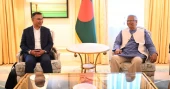
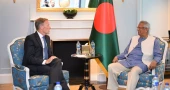
Deputy Press Secretary Abul Kalam Azad Majumder
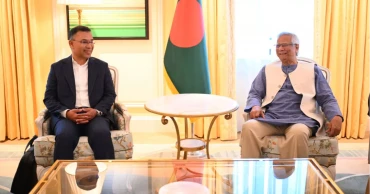
Prof Yunus-Tarique meeting begins in London
A high-stake political meeting between Chief Adviser Professor Dr Muhammad Yunus and BNP Acting Chairman Tarique Rahman has officially begun in London, amid hopes for a breakthrough in the ongoing political crisis ahead of the general election.
The meeting began at the Dorchester Hotel in London at 2:00 pm Bangladesh time on Friday, said Chief Adviser’s Deputy Press Secretary Abul Kalam Azad Majumder. The meeting is scheduled to end at 4pm (BST).
The two-hour meeting—expected to be one-on-one but open to expansion if the leaders choose—comes at a time of rising tension over the timing of the next national election.
National Security Adviser Dr Khalilur Rahman, along with Chief Adviser’s Press Secretary Shafiqul Alam, received Tarique Rahman upon his arrival at the hotel around 1:50 pm.
BNP media cell member Sayrul Kabir Khan said, Tarique, accompanied by BNP Standing Committee member Amir Khosru Mahmud Chowdhury and International Affairs Adviser Humayun Kabir, left his London residence around 1:00 p.m. for the meeting venue.
Several hundred leaders and activists from the BNP’s UK Chapter, who had gathered in front of The Dorchester earlier in the morning, warmly welcomed Tarique as he arrived.
Meanwhile, Dr Khalilur Rahman and BNP leader Amir Khosru also held a separate meeting at The Dorchester Hotel, said Chief Adviser’s Deputy Press Secretary Abul Kalam Azad Majumder.
BNP media cell convener Dr. Moudud Hossain Alamgir Pavel said Amir Khosru will brief reporters on the outcome of the meeting between the Chief Adviser and the BNP Acting Chairman.
The high-profile meeting has already sparked significant interest in the country’s political arena. All eyes are now on London, as many see this as a potential turning point in Bangladesh’s political landscape ahead of the upcoming election.
BNP senior leaders and political analysts believe several key issues are likely to be raised.
These include the election timeline, proposed reforms, the July Charter, justice for the victims of the July–August mass uprising, a safe and orderly transfer of power, ratification of decisions made by the interim government, a dignified exit strategy for the interim administration, and the possible return of Tarique Rahman to Bangladesh.
Prof Yunus-Tarique meeting: What may dominate agenda?
“This is going to be a very important meeting for Bangladesh ahead of the election,” said CA’s Press Secretary Shafiqul Alam. “One of them is the chief of the interim government, and the other is the chief of the largest political party of Bangladesh.”
The meeting follows Professor Yunus’ recent national address, in which he announced that the 13th general election would be held in the first half of April next year.
The BNP, which has repeatedly demanded the election be held by December this year, reacted with disappointment, calling the decision unilateral and unrealistic.
BNP leaders consider this meeting a significant step towards resolving the deadlock over the election schedule, suggesting that adjusting the timeline will be a central issue in the talks.
BNP insiders believe Tarique Rahman will argue that holding the election in April is not practical, citing weather conditions, Ramadan, and public examinations. A compromise date in January or February may be proposed, should the Chief Adviser show willingness.
Another sensitive issue is the possible return of Tarique Rahman to Bangladesh, ending his 17 years of exile in London.
Prof Yunus-Tarique meeting to usher in a fresh breeze for democracy: Rizvi
1 year ago
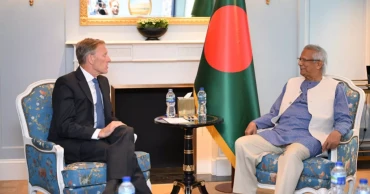
Aviation giants Airbus, Menzies seek long-time partnership with Bangladesh
European aircraft- manufacturing company Airbus and British aviation giant Menzies Aviation on Tuesday expressed their eagerness to build a long-term partnership with Bangladesh.
The two companies placed their offers as Airbus Executive Vice President Wouter van Wersch and Menzies Aviation Executive Vice President Charles Wyley called on Chief Adviser Professor Muhammad Yunus successively at his hotel in London, CA's Deputy Press Secretary Abul Kalam Azad Majumder told UNB.
“We have identified Bangladesh as a key priority country,” van Wersch told the Chief Adviser, adding that the company was keen to build a partnership with Bangladesh’s national carrier, Biman Bangladesh Airlines, and make it profitable.
Van Wersch said Airbus, which supplies 800 aircraft annually, also has expertise in manufacturing helicopters and fighter jets.
Airbus, Menzies Aviation executives meet Prof Yunus in London
The Chief Adviser said Bangladesh was willing to listen to all offers to modernise the Biman fleet but could not rush a decision.
“I am very eager to understand what can be done, what should be done. So, we will listen to you. But don’t expect any decision soon. We have to look at everything in a very fresh way,” said the Chief Adviser.
Van Wersch said if Bangladesh decides to add Airbus to the Biman fleet, 85 per cent of the funding could be arranged through Export Credit Agency (ECA) financing.
London-based Menzies Aviation said it was willing to join the competition with others to provide ground handling and air cargo services to the third terminal of Dhaka’s Hazrat Shahjalal International Airport, using its experience of providing similar services to more than 300 airports in at least 65 countries.
“We would like to support Bangladeshi airports besides your national carrier,” Menzies Executive Vice President Wyley told the Chief Adviser.
Considering Airbus’s offer of passenger planes seriously, Biman’s outgoing MD says
1 year ago
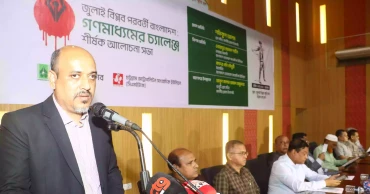
Govt committed to independent journalism, says Deputy Press Secretary
Chief Adviser’s Deputy Press Secretary Abul Kalam Azad Majumder on Friday reaffirmed the interim government's commitment to press freedom, saying that they always wanted journalists to practise truthfully and independently, free from influence by the state, businesspeople, or any other powerful groups.
“We believe that if the Media Reform Commission’s recommendations are implemented, journalists and the media will be able to operate more freely,” he said while delivering the keynote speech at an event marking World Press Freedom Day that falls on May 3.
The programme was organised by the Chittagong Press Club and Chittagong Metropolitan Journalists Union.
Chief Adviser’s Press Secretary Shafiqul Alam attended the programme as chief guest, with senior journalist Kader Gani Chowdhury and others also speaking.
People want to see a new era in journalism: Adviser Nahid
Azad said the current interim government has established a Media Reform Commission, which has already submitted its report.
The government has initiated the process of implementing its recommendations, he said.
Referring to the recent dismissal of three journalists from separate television channels and the temporary suspension of news broadcasting by one, Azad said while the channels have not offered official explanations, some social media users have blamed the government.
“We find it inappropriate to blame the government,” he said.
Investigative journalism on the brink of extinction without state support: Quader Gani
“No state authority directed these actions. The decisions were made independently by the respective channels," he said.
He said a day prior to their dismissals, the three journalists had questioned Adviser Mostafa Sarwar Farooki in a way some perceived as intentional.
Farooki responded during a press conference, and the government did not react further.
Despite this, attempts have been made to justify the journalists' dismissals by linking them to the government—an approach that is not acceptable, Azad said.
“Whether the questions were fair or not is now being openly debated in the media and on social platforms," he said.
Azad stressed that the public’s right to access information is critical for combating corruption, injustice, and maladministration- principles the interim government supports.
“However, we also expect the media to exercise this right responsibly," he said.
He said some media outlets have recently spread misinformation under the guise of press freedom.
“Fact-checkers have flagged several stories that mislead the public,” he said. “The spread of fake news and rumors through digital platforms remains a major challenge.”
Syeda Rizwana stresses importance of fearless, impartial journalism for democracy
Azad said the government has taken multiple steps to curb misinformation, with some success. “But this is a vast area, and the government alone cannot fight it,” he acknowledged.
The government’s primary strategy to combat misinformation, he said, is to ensure a free flow of accurate information.
“We have always tried to make information accessible to as many journalists as possible,” he added.
“Our press conferences are open, and even members of the public have occasionally asked questions," he added.
“Like everyone else, we believe journalists have the right to ask any question—whether popular or not—and we remain committed to answering them,” Azad said.
1 year ago
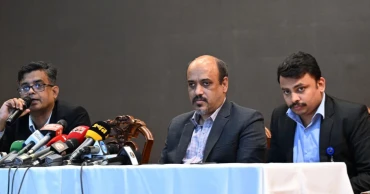
Textbooks distribution to be completed by this month: CA’s DPS Azad
The interim government on Tuesday expressed optimism that all the textbooks, as targeted, will be printed and distributed among students by this month and regretted the inconvenience caused by the delay.
“Interim government expects that printing and publication of all the textbooks will be possible by this month,” Chief Adviser’s Deputy Press Secretary Abul Kalam Azad Majumder told reporters at a media briefing at the Foreign Service Academy.
CA’s Press Secretary Shafiqul Alam, Senior Assistant Press Secretary Foyez Ahammad, Assistant Press Secretary Suchismita Tithi were present.
He referred to an unscrupulous group that emerged during the previous government which remained active this time too.
And from the very beginning, Azad said, the government faced non-cooperation that caused disruption to some extent in terms of timely printing of textbooks. “In the future, this problem will hopefully be fully overcome.”
Read: Don’t know when all students will get textbooks: Education Adviser
The Deputy Press Secretary said most of the textbooks were printed from India in the past but this time the interim government decided to print these textbooks from Bangladesh.
“There are some positive aspects of this decision,” Azad said, adding that one of the positive aspects is 10-12 lakh workers involved in this printing process who are getting benefited economically.
“The government sincerely regrets this temporary problem and delay,” he said, acknowledging the problems faced by the students for the time being.
Azad said around 40,15,67,000 textbooks were supposed to be printed and distributed among the students.
Until January 6, a total of 11, 01, 44,716 textbooks have been printed and distributed among the students.
Textbooks are also being made available online.
Read more: New textbooks to reach upazila level by November: Primary and Mass Education Secretary
Most students did not receive new textbooks on the first day of the year mainly because of printing and other relevant delays.
1 year ago