Palestinian-crisis
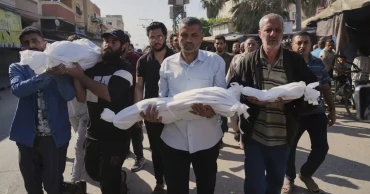
45 killed in Gaza attack, emergency aid fails to reach Palestinians
Hospitals in Gaza say Israeli strikes overnight and into Wednesday killed at least 45 people, including several women and a week-old infant.
The fresh strikes come as Israel’s war on Hamas shows no signs of relenting, despite a surge in international anger at Israel’s widening offensive.
Israel began allowing dozens of humanitarian trucks into Gaza on Tuesday, but the aid has not yet reached Palestinians in desperate need, according to aid groups. U.N. spokesperson Stéphane Dujarric said Tuesday evening that although the aid has entered Gaza, aid workers were not able to bring it to distribution points where it is most needed, after the Israeli military forced them to reload the supplies onto separate trucks and workers ran out of time.
Israel eases Gaza blockade slightly; only 5 aid trucks enter since Monday
Internal notes circulated among aid groups Wednesday and seen by The Associated Press said that no humanitarian trucks had left Kerem Shalom, the border crossing in southern Gaza that is operated by Israel. The notes said 65 trucks moved from the Israel side of the crossing to the Palestinian side, but hadn’t made it into Gaza.
The Israeli defense body that oversees humanitarian aid to Gaza said trucks were entering into Gaza on Wednesday morning, but it was unclear if that aid was able to continue into Gaza for distribution. The U.N. agency for Palestinian refugees said they waited several hours to collect aid from the border crossing in order to begin distribution but were unable to do so on Tuesday.
On Tuesday, the U.K. suspended free trade talks with Israel over its intensifying assault, a step that came a day after the U.K., Canada and France promised concrete steps to prompt Israel to halt the war. Separately, European Union foreign policy chief Kaja Kallas said the bloc was reviewing an EU pact governing trade ties with Israel over its conduct of the war in Gaza.
Israel says it is prepared to stop the war once all the hostages taken by Hamas return home and Hamas is defeated, or is exiled and disarmed. Hamas says it is prepared to release the hostages in exchange for a full Israeli withdrawal from the territory and an end to the war. It rejects demands for exile and disarmament.
Israel called back its senior negotiating team from ceasefire talks in the Qatari capital of Doha on Tuesday, saying it would leave lower-level officials in place instead.
Meanwhile, Israeli strikes continued to pound Gaza. In the southern city of Khan Younis, where Israel recently ordered new evacuations pending an expected expanded offensive, 24 people were killed, 14 of them from the same family. A week-old infant was killed in central Gaza.
The Israeli military did not immediately comment on the strikes but has said it is targeting Hamas infrastructure and accused Hamas militants of operating from civilian areas.
At least 85 Palestinians killed in Israeli strikes, more aid allowed
The war in Gaza began when Hamas-led militants attacked southern Israel, killing some 1,200 people, mostly civilians, and abducting 251 others. The militants are still holding 58 captives, around a third of whom are believed to be alive, after most of the rest were returned in ceasefire agreements or other deals.
Israel’s retaliatory offensive, which has destroyed large swaths of Gaza, has killed more than 53,000 Palestinians, mostly women and children, according to Gaza’s Health Ministry, which doesn’t differentiate between civilians and combatants in its count.
1 year ago
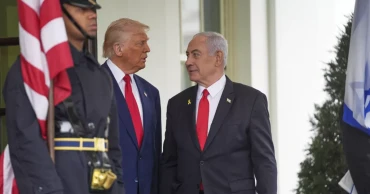
Netanyahu-Trump meeting reveals unexpected gaps on key issues
Israeli Prime Minister Benjamin Netanyahu traveled to Washington for a hastily organized White House visit bringing a long list of concerns: Iran's nuclear program. President Donald Trump's tariffs. The surging influence of rival Turkey in Syria. And the 18-month war in Gaza.
Netanyahu appeared to leave Monday's meeting largely empty-handed — a stark contrast with his triumphant visit two months ago. During an hourlong Oval Office appearance, Trump appeared to slap down, contradict or complicate each of Netanyahu’s policy prerogatives.
On Tuesday, Netanyahu declared the meeting a success, calling it a “very good visit” and claiming successes on all fronts. But privately, the Israeli delegation felt it was a tough meeting, according to a person familiar with the matter who spoke on condition of anonymity in line with regulations.
Netanyahu “didn’t hear exactly what he wanted to hear, so he returns back home with very little,” said Nadav Eyal, a commentator with the Yediot Ahronot daily, who added that the visit was still friendly, despite the disagreements.
Netanyahu's second pilgrimage to Washington under Trump's second term was organized at short notice and billed as an attempt to address the new U.S. tariff regime. But it came at a pivotal time in Middle East geopolitics. Israel restarted the war in Gaza last month, ending a Trump-endorsed ceasefire, and tensions with Iran are rising over its nuclear program.
Netanyahu and his allies were thrilled with Trump's return to office given his strong support for Israel during his first term. This time around, Trump has not only nominated pro-Israel figures for key administration positions, he has abandoned the Biden administration's criticism of Israel's conduct in Gaza and the West Bank, and of Netanyahu's steps to weaken Israeli courts.
Monday's meeting showed that while Trump remains sympathetic to Israel, Netanyahu's relationship with the president during his second term is more complicated and unpredictable than he may have expected.
Here is a look at where Trump and Netanyahu appear to have diverged.
Netanyahu has long pushed for military pressure against Iran
Israeli strike on media tent outside Gaza Hospital kills reporter, injures journalists
With Netanyahu's strong encouragement, Trump in 2018 unilaterally withdrew the United States from the agreement between world powers and Iran over its nuclear program. That deal, negotiated by the Obama administration, put curbs on Iran's nuclear program. It was denigrated by Netanyahu because he said it did not go far enough to contain Iran or address Iran's support for regional militant groups.
Netanyahu has long maintained that military pressure was the best way to prevent Iran from obtaining nuclear weapons. Israel struck Iran last year in the countries' first direct conflict ever. But it did not target Iran's nuclear facilities, something Israel would likely need U.S. military assistance to do in order to strike targets buried deep underground.
Trump has suggested, including on Monday, that the U.S. could take military action if Iran doesn’t agree to negotiate. But his announcement Monday that talks would take place between the U.S. and Iran this weekend flew in the face of Netanyahu’s hawkish views.
Netanyahu gave a tepid endorsement, noting that both leaders agree that Iran cannot develop a nuclear weapon. He said he would would favor a diplomatic agreement similar to Libya's deal in 2003 to destroy its nuclear facilities and allow inspectors unfettered access. However, it is not clear if Trump will set such strict conditions.
Eyal said the announcement with Netanyahu by Trump's side was meant to show the transparency between the countries' leadership.
Netanyahu hoped for tariff relief and appeared to be rebuffed
A day before Trump's so-called Liberation Day unleashed global tariffs on the world last week, Israel preemptively announced that it would eliminate all levies on U.S. goods. But that didn't spare Israeli products from being slapped with a 17% tariff by its largest trading partner.
Netanyahu was summoned to Washington ostensibly to make Israel's case against the levy. He was the first international leader to do so, in an encounter that may have set the stage for how other world leaders approach the tariffs.
While Trump repeatedly praised the Israeli leader, he did not appear to budge on Israel's share of the burden. Asked if he might change his mind, he said “maybe not.” He cited the billions of dollars the U.S. gives Israel in military assistance each year — money that is seen as the bedrock of the U.S.-Israel relationship and an insurance policy for U.S. interests in the region.
“We give Israel $4 billion a year. That’s a lot,” he said, as though to suggest Israel was already getting enough from the U.S., and congratulated Netanyahu on that achievement.
Netanyahu was told to be reasonable on Turkey
Since the fall of the Assad dynasty in Syria late last year, Israel and Turkey have been competing in the country over their separate interests there. Israel fears that Syria's new leadership, which has an Islamist past, will pose a new threat along its border. It has since taken over a buffer zone in Syrian territory and said it will remain there indefinitely until new security arrangements are made.
Turkey has emerged as a key player in Syria, prompting concerns in Israel over the possibility of Turkey expanding its military presence inside the country. Netanyahu said Tuesday that Turkish bases in Syria would be a “danger to Israel.”
Once strong regional partners, ties between Israel and Turkey have long been frosty and deteriorated further over the war in Gaza. Turkish President Recep Tayyip Erdogan has been an outspoken critic of the war, prompting angry reactions from Israeli officials.
Netanyahu sought to hear support from his stalwart ally Trump on a country Israel perceives as increasingly hostile. Instead, Trump lavished praise on Erdogan for “taking over Syria,” positioned himself as a possible mediator between the countries and urged Netanyahu to be “reasonable” in his dealings with the country.
Hamas rocket attack injures 3 in Israel; Israel responds with strikes on central Gaza
“Israel is not provided with a blank check here,” said Udi Sommer, an expert on U.S.-Israel relations at Tel Aviv University. “There’s no unconditional love here. It is contingent. It is contingent on Israel behaving a certain way.”
Trump wants the war in Gaza to end
While both addressed the ongoing war in Gaza and the Israeli hostages who remain held there, the topic appeared to take a backseat to other issues.
Netanyahu spoke of the hostages' plight and an emerging deal to free them, as well as the need to end the “evil tyranny of Hamas.” Trump sympathized with the hostages and made another pitch for his plan to “own” Gaza and remove its Palestinian population, a once fringe idea in Israeli discourse that has now found acceptance among mainstream politicians, including Netanyahu.
However, there were signs of differences on the horizon.
Netanyahu broke the ceasefire last month and has been under major pressure from his governing allies to keep up the fighting until Hamas is crushed. He has appeared to be in no rush to end the war or bring home the remaining hostages.
Trump, however, made it clear that he'd like to see the hostages freed and for the war to end. “And I think the war will stop at some point that won’t be in the too distant future,” he said.
Source: With input from agency
1 year ago
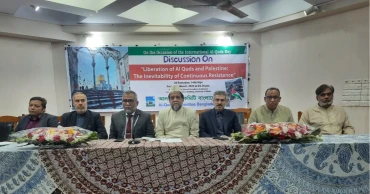
Palestinian crisis is a crisis for entire Islamic world: Speakers
Speakers at a discussion on Friday said that the Palestinian crisis is not only a struggle for the Palestinian people but a crisis for the entire Islamic world.
During the discussion titled ‘Liberation of Al Quds and Palestine: The Inevitability of Continuous Resistance,’ the speakers condemned Israel for violating the ceasefire, asserting that this action has led to a renewed wave of violence, resulting in the worst genocide across Palestine, particularly during the holy month of Ramadan.
The speakers condemned the ongoing injustice and massacre taking place in Baitul Muqaddas, the first Qibla, and referred to the situation as a grave violation of sacred lands.
The discussion was organised by the Al-Quds Committee Bangladesh in observance of International Al-Quds Day, and held at the Muzaffar Ahmed Chowdhury Auditorium at Dhaka University.
Professor Dr. Naqib Muhammad Nasrullah, Vice Chancellor of the Islamic University, was present as the chief guest while Iranian ambassador to Bangladesh Mansour Chavoshi and Dean of the Faculty of Arts of Dhaka University Professor Dr. Mohammad Siddiqur Rahman Khan attended the discussion as special guests.
Other notable discussants included Sayyed Reza Mirmohammadi, Cultural Counselor of the Iran Cultural Center in Dhaka, AKM Badruddoja, a Supreme Court lawyer of Bangladesh, and Islamic scholar Dr. AKM Anwarul Kabir. Senior journalist and founder of ChangeTV.Press, Amirul Muminin Manik, presented the keynote address.
Chaired by Shah Kawthar Mustafa Abululayee, president of the Al-Quds Committee Bangladesh and chairman of Dhaka University’s Philosophy Department, Mustafa Tariqul Hasan, General Secretary of the Al-Quds Committee Bangladesh, delivered the welcome address.
The speakers said that Baitul Muqaddas, a land of immense historical and religious significance, is deeply intertwined with the memories of many prophets and is referred to in the Holy Quran as the ‘holy land.’ As such, the love for Al-Aqsa Mosque, the Holy Land, and Palestine is deeply ingrained in the hearts of every believer.
They also reiterated that the Palestinian crisis is a shared challenge for the entire Muslim world.
They called for unity among Muslims worldwide to address this crisis, stating that the oppression faced by the Palestinian people will not last forever.
Despite numerous hardships, the resistance fighters continue their struggle against the illegal occupation of Zionist Israel, and they firmly believe that the holy land of Palestine will one day be free.
1 year ago