USA-China
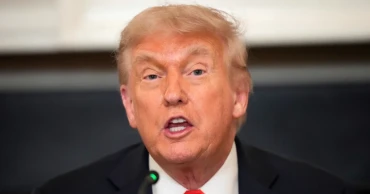
US, Chinese officials to meet in London next week for new round of trade talks
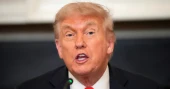
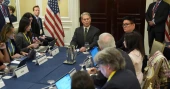
Senior US administration officials will meet with a Chinese delegation on Monday in London for the next round of trade negotiations between Washington and Beijing, President Donald Trump said Friday.
The meeting comes after a phone call between Trump and Chinese leader Xi Jinping on Thursday, which the US president described as a “very positive” conversation as the two countries attempt to break an impasse over tariffs and global supplies of rare earth minerals, reports AP.
Treasury Secretary Scott Bessent, Commerce Secretary Howard Lutnick and US Trade Representative Jamieson Greer will represent the US side in the trade talks.
“The meeting should go very well,” Trump wrote on his social media platform Friday afternoon.
Speaking to reporters on Air Force One Friday, Trump said Xi had agreed to restart exports of rare earth minerals and magnets to the US which China had slowed, threatening a range of US manufacturers that relied on the critical materials. There was no immediate confirmation from China.
China's market remains a magnet for foreign investment: FM spokesperson
The Thursday conversation between Trump and Xi, who lead the world's two biggest economies, lasted about an hour and a half, according to the US president. The Chinese foreign ministry has said Trump initiated the call.
The ministry said Xi asked Trump to “remove the negative measures” that the US has taken against China. It also said that Trump said “the US loves to have Chinese students coming to study in America,” although his administration has vowed to revoke some of their visas.
1 year ago
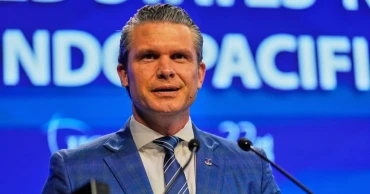
China slams US defence secy Hegseth for 'cold war mentality'
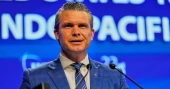
China on Sunday denounced US Defence Secretary Pete Hegseth for calling the Asian country a threat, accusing him of touting a Cold War mentality as tensions between Washington and Beijing further escalate.
The foreign ministry said Hegseth vilified Beijing with defamatory allegations the previous day at the Shangri-La Dialogue, a global security conference. The statement also accused the United States of inciting conflict and confrontation in the region, according to AP.
“Hegseth deliberately ignored the call for peace and development by countries in the region, and instead touted the Cold War mentality for bloc confrontation,” it said, referring to the post-World War II rivalry between the US and the former Soviet Union.
“No country in the world deserves to be called a hegemonic power other than the US itself,” it said, alleging that Washington is also undermining peace and stability in the Asia-Pacific.
US defense secretary warns Indo-Pacific allies of 'imminent' threat from China
Hegseth said in Singapore on Saturday that Washington will bolster its defences overseas to counter what the Pentagon sees as rapidly developing threats by Beijing, particularly in its aggressive stance toward Taiwan.
China’s army “is rehearsing for the real deal,” Hegseth said. “We are not going to sugarcoat it — the threat China poses is real. And it could be imminent.”
A ‘provocation’ by Hegseth
The Chinese statement said the matter of Taiwan is China’s internal affair and that the US should “never play with fire” with it. The statement also alleged Washington had deployed offensive weaponry in the South China Sea, was “stoking flames and creating tensions in the Asia-Pacific” and "turning the region into a powder keg.”
Spokesperson Zhang Xiaogang of China's defense ministry called Hegseth's comments a provocation and said they distorted China’s policy positions.
The US and China had reached a deal last month to cut US President Donald Trump’s tariffs from 145 per cent to 30 per cent for 90 days, creating time for negotiators from both sides to reach a more substantive agreement.
China also reduced its taxes on US goods from 125 per cent to 10 per cent.
1 year ago
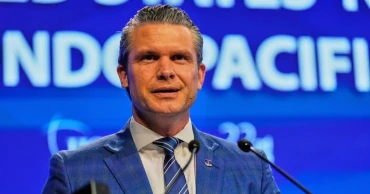
US defence secy warns Indo-Pacific allies of 'imminent' threat from China
US Defence Secretary Pete Hegseth reassured allies in the Indo-Pacific on Saturday that they will not be left alone to face increasing military and economic pressure from China, while insisting that they also contribute more to their own defence.
He said Washington will bolster its defences overseas to counter what the Pentagon sees as rapidly developing threats by Beijing, particularly in its aggressive stance toward Taiwan.
China has conducted numerous exercises to test what a blockade would look like of the self-governing island, which Beijing claims as its own and the US has pledged to defend, reports AP.
China's army “is rehearsing for the real deal,” Hegseth said in a keynote speech at a security conference in Singapore. “We are not going to sugarcoat it — the threat China poses is real. And it could be imminent.”
China has a stated goal of having its military have the capability to take Taiwan by force if necessary by 2027, a deadline that is seen by experts as more of an aspirational goal than a hard war deadline.
Hamas still weighing US ceasefire proposal as Israeli airstrikes continue in Gaza
But China also has built sophisticated man-made islands in the South China Sea to support new military outposts and developed highly advanced hypersonic and space capabilities, which are driving the United States to create its own space-based “Golden Dome” missile defenses.
Speaking at the Shangri-La Dialogue, a global security conference hosted by the International Institute for Security Studies, Hegseth said China is no longer just building up its military forces to take Taiwan, it's “actively training for it, every day.”
Hegseth also called out China for its ambitions in Latin America, particularly its efforts to increase its influence over the Panama Canal.
He urged countries in the region to increase defense spending to levels similar to the 5% of their gross domestic product European nations are now pressed to contribute.
“We must all do our part,” Hegseth said.
1 year ago
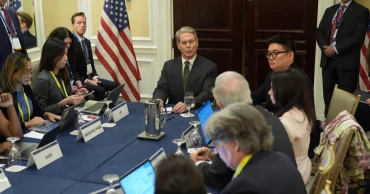
Bessent criticises IMF, World Bank; sees ‘big deal’ opportunity with China
Treasury Secretary Scott Bessent levelled harsh criticism at the operations of the World Bank and the International Monetary Fund on Wednesday even as he tried to reassure nervous investors that the United States would maintain its global leadership role.
“America first does not mean America alone,” he said in a speech to the Institute of International Finance. "To the contrary, it is a call for deeper collaboration and mutual respect among trade partners.”
Although Bessent said the IMF and the World Bank are “falling short,” he stopped short of calling for the US to withdraw from the institutions as some conservatives have advocated.
It was the latest example of how Bessent, a former hedge fund manager who keeps a close eye on the financial markets, has tried to calm the economic turmoil as President Donald Trump tries to rewire international trade through aggressive tariffs.
After Bessent's remarks, reporters asked him about a Wall Street Journal article that said the huge US tariffs that the Republican president has levied on China could be cut in half, citing unidentified people familiar with the matter.
Bessent said: “I’d be surprised if that discussion is happening." However, he said he expects “there’d have to be a de-escalation” from Washington and Beijing’s trade confrontation.
Trump had said on Tuesday that the 145% tariffs on China could “come down substantially." And then on Wednesday, he told reporters that “everybody wants to be a part of what we're doing" and “everyone's going to be happy.”
Bessent's speech in Washington represented a broadside against the IMF and the World Bank, which provide loans and other financial support around the world.
He said the Trump administration “will leverage US leadership and influence at these institutions and push them to accomplish their important mandates.”
EVs in the spotlight as China claims a leading global role at Shanghai's auto show
Some of Bessent's criticisms echoed the Trump administration's efforts to root out progressive ideology from federal institutions. Bessent said the IMF “has suffered from mission creep” and “devotes disproportionate time and resources to work on climate change, gender and social issues.”
He said there were similar problems at the World Bank, which he said “should no longer expect blank checks for vapid, buzzword-centric marketing accompanied by half-hearted commitments to reform.”
One of the problems, Bessent said, is that China is still treated like a developing country, which gives it more favorable treatment from global institutions. With China as the second-largest economy in the world, he said, “it's an adult economy.”
Despite growing friction between Beijing and Washington, Bessent said “there is an opportunity for a big deal here.”
Bessent wants the US to boost manufacturing while China increases consumption, making its economy less reliant on flooding the globe with cheap exports.
“If they want to rebalance, let’s do it together,” he said. “This is an incredible opportunity.”
Beijing said Wednesday that “exerting pressure is not the right way to deal with China and simply will not work.”
1 year ago
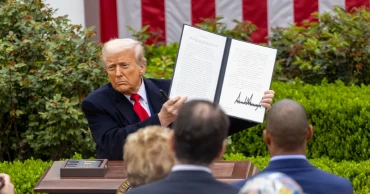
China files lawsuit with WTO following US new tariffs
China's Ministry of Commerce said on Friday that China has filed a lawsuit with the World Trade Organization's (WTO) dispute settlement mechanism following the announcement by the United States on Thursday to slap "reciprocal tariffs" on all trading partners.
"By imposing the so-called 'reciprocal tariffs,' the United States gravely violates WTO rules, seriously undermines the legitimate rights and interests of WTO members, and seriously damages the rules-based multilateral trading system and the international economic and trade order," a ministry spokesperson said.
"It is a typical unilateral practice of bullying that jeopardizes the stability of the global economic and trade order, and China is firmly opposed to this," the spokesperson said.
China to impose 34% tariff on all US imports from April 10
China has always been a staunch defender of the international economic and trade order and a firm supporter of the multilateral trading system, said the spokesperson. "We urge the US side to immediately correct its wrongdoings and cancel its unilateral tariff measures."
1 year ago
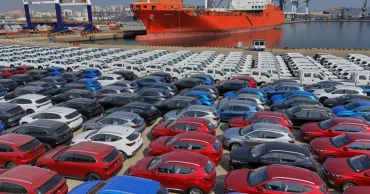
China to impose 34% tariff on all US imports from April 10
China announced Friday that it will impose a 34 per cent tariff on imports of all US products beginning April 10, part of a flurry of retaliatory measures following US President Donald Trump’s “Liberation Day” slate of double-digit tariffs.
The new tariff matches the rate of the US "reciprocal" tariff of 34 per cent on Chinese exports that Trump ordered this week, AP reports.
The Commerce Ministry in Beijing also said in a notice that it will impose more export controls on rare earths, which are materials used in high-tech products such as computer chips and electric vehicle batteries.
Included in the list of minerals subject to controls were samarium and its compounds, which are used in aerospace manufacturing and the defence sector. Another element called gadolinium is used in MRI scans.
China's customs administration said it had suspended imports of chicken from some US suppliers after detected furazolidone, a drug banned in China, in shipments from those companies.
Separately, it said had found high levels of mold in the sorghum and salmonella in poultry meat from some of the companies. The announcements affect one company exporting sorghum, C&D Inc., and four poultry companies.
Additionally, the Chinese government said it had added 27 firms to lists of companies subject to trade sanctions or export controls.
Among them, 16 are subject to a ban on the export of “dual-use” goods. High Point Aerotechnologies, a defense tech company, and Universal Logistics Holding, a publicly traded transportation and logistics company, were among those listed.
Beijing also announced it filed a lawsuit with the World Trade Organization over the tariffs issue.
“The United States’ imposition of so-called ‘reciprocal tariffs’ seriously violates WTO rules, seriously damages the legitimate rights and interests of WTO members, and seriously undermines the rules-based multilateral trading system and international economic and trade order,” the Commerce Ministry said.
“It is a typical unilateral bullying practice that endangers the stability of the global economic and trade order. China firmly opposes this,” it said.
1 year ago