ban on US states
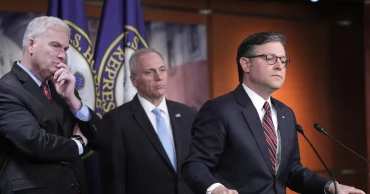
House Republicans include a 10-year ban on US states regulating AI in ‘big, beautiful’ bill
House Republicans caught the tech industry by surprise and sparked backlash from state governments after inserting a provision into their flagship tax bill that would block state and local regulation of artificial intelligence for the next ten years.
This short but impactful addition, included in the House Energy and Commerce Committee’s broad legislative package, represents a significant victory for the AI industry. Tech companies have long pushed for consistent, minimal regulation as they advance technologies they claim will revolutionize society.
Despite its potential scope, the measure faces an uncertain future in the Senate, where procedural constraints may prevent its inclusion in the final version of the GOP bill.
“I’m not sure it’ll survive the Byrd Rule,” said Senator John Cornyn, R-Texas, referring to the requirement that all elements of a budget reconciliation bill must primarily relate to fiscal matters rather than broader policy initiatives.
“That sounds to me like a policy change. I’m not going to speculate what the parliamentarian is going to do but I think it is unlikely to make it,” Cornyn said.
Senators in both parties have expressed an interest in artificial intelligence and believe that Congress should take the lead in regulating the technology. But while lawmakers have introduced scores of bills, including some bipartisan efforts, that would impact artificial intelligence, few have seen any meaningful advancement in the deeply divided Congress.
RobinRafan named Best Content Creator of 2025 at Kidlon-Powered 4th BIFA Awards
An exception is a bipartisan bill expected to be signed into law by President Donald Trump next week that would enact stricter penalties on the distribution of intimate “revenge porn” images, both real and AI-generated, without a person’s consent.
“AI doesn’t understand state borders, so it is extraordinarily important for the federal government to be the one that sets interstate commerce. It’s in our Constitution. You can’t have a patchwork of 50 states,” said Sen. Bernie Moreno, an Ohio Republican. But Moreno said he was unsure if the House’s proposed ban could make it through Senate procedure.
The AI provision in the bill states that “no state or political subdivision may enforce any law or regulation regulating artificial intelligence models, artificial intelligence systems, or automated decision systems.” The language could bar regulations on systems ranging from popular commercial models like ChatGPT to those that help make decisions about who gets hired or finds housing.
State regulations on AI’s usage in business, research, public utilities, educational settings and government would be banned.
The congressional pushback against state-led AI regulation is part of a broader move led by the Trump administration to do away with policies and business approaches that have sought to limit AI’s harms and pervasive bias.
Half of all U.S. states so far have enacted legislation regulating AI deepfakes in political campaigns, according to a tracker from the watchdog organization Public Citizen.
Most of those laws were passed within the last year, as incidents in democratic elections around the globe in 2024 highlighted the threat of lifelike AI audio clips, videos and images to deceive voters.
California state Sen. Scott Wiener called the Republican proposal “truly gross” in a social media post. Wiener, a San Francisco Democrat, authored landmark legislation last year that would have created first-in-the-nation safety measures for advanced artificial intelligence models. The bill was vetoed by California Gov. Gavin Newsom, a fellow San Francisco Democrat.
“Congress is incapable of meaningful AI regulation to protect the public. It is, however, quite capable of failing to act while also banning states from acting,” Wiener wrote.
A bipartisan group of dozens of state attorneys general also sent a letter to Congress on Friday opposing the bill.
“AI brings real promise, but also real danger, and South Carolina has been doing the hard work to protect our citizens,” said South Carolina Attorney General Alan Wilson, a Republican, in a statement. “Now, instead of stepping up with real solutions, Congress wants to tie our hands and push a one-size-fits-all mandate from Washington without a clear direction. That’s not leadership, that’s federal overreach.”
As the debate unfolds, AI industry leaders are pressing ahead on research while competing with rivals to develop the best — and most widely used —AI systems. They have pushed federal lawmakers for uniform and unintrusive rules on the technology, saying they need to move quickly on the latest models to compete with Chinese firms.
Sam Altman, the CEO of ChatGPT maker OpenAI, testified in a Senate hearing last week that a “patchwork” of AI regulations “would be quite burdensome and significantly impair our ability to do what we need to do.”
“One federal framework, that is light touch, that we can understand and that lets us move with the speed that this moment calls for seems important and fine,” Altman told Sen. Cynthia Lummis, a Wyoming Republican.
And Sen. Ted Cruz floated the idea of a 10-year “learning period” for AI at the same hearing, which included three other tech company executives.
“Would you support a 10-year learning period on states issuing comprehensive AI regulation, or some form of federal preemption to create an even playing field for AI developers and employers?” asked the Texas Republican.
Altman responded that he was “not sure what a 10-year learning period means, but I think having one federal approach focused on light touch and an even playing field sounds great to me.”
1 year ago