Nikkei Forum
Bangladesh, Japan sign MoUs to boost skilled manpower migration
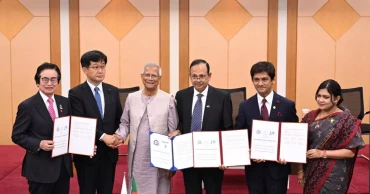
Bangladesh and Japan on Thursday signed two Memorandums of Understanding (MoUs) to enhance the skills of Bangladeshi manpower and facilitate their employment in Japan, as the country faces a shortage of workers.
The agreements were signed at a human resources seminar hosted by the Bangladesh Embassy in Japan, held at Hirakwacho Chiyoda City in Tokyo, in the presence of Chief Adviser Professor Muhammad Yunus.
Saleh Ahmed Mujaffor, Director General of the Bureau of Manpower Employment and Training (BMET), a government institution under the Ministry of Expatriates’ Welfare and Overseas Employment, Bangladesh, and Jun Oneda, Chairman of Kaicom Dream Street BD Co. Ltd. (KDS), a Japan-Bangladesh joint venture company, signed the MoUs on behalf of their respective sides.
Under the agreement, with the cooperation of KDS and BMET, a specialised training unit will be established at the Monohardi Technical Training Centre (MTTC) as a model facility for Japan's Technical Intern Training Programme (TITP) and Specified Skilled Workers (SSW) programme. The centre will operate under the name 'Dream Street Business Training Center (DSBTC)'.
KDS will introduce its 'Dream Education' programme—an education model designed to help learners discover their own dreams and work diligently to realise them—at MTTC as the standard training curriculum.
Japan to recruit one lakh Bangladeshi workers in five years
The MoU will remain valid for five years from the date of signing, with the possibility of an extension through mutual consultation.
Besides, a tripartite Memorandum of Understanding (MoU) on the establishment of a strategic framework for the placement of skilled Bangladeshi workers has been signed between the Bureau of Manpower, Employment and Training (BMET), the National Business Support Combined Cooperatives (NBCC) of Japan, and the Japan Bangla Bridge Recruiting Agency Ltd. (JBBRA).
The MoU was signed by BMET Director General, Saleh Ahmed Mujaffor; Chairman of the Board of Directors of NBCC, Mikio Kesagayama; and JBBRA Managing Director, Moinul Tahmid, on behalf of their respective organisations.
The purpose of this MoU is to establish a strategic framework for placing skilled Bangladeshi workers in Japan under Japan’s Technical Intern Training Programme (TITP) and Specified Skilled Workers Programme (SSW).
In cooperation with NBCC, JBBRA, and BMET, a technical centre will be developed as a model training centre for Japan's TITP and SSW programmes, to be operated under the name Bhalojob Training Centre (BJTC). The training centre, developed by JBBRA, will introduce a model training programme to other TTCs in phases.
The MoU aims to foster mutual cooperation in training, certification and the development of technical skills, thereby facilitating the mobility and employment of Bangladeshi nationals in Japan.
It also ensures compliance with Japanese labour market standards for workers trained under the terms of this agreement.
Transform Asia into a beacon of shared prosperity: Prof Yunus tells Nikkei Forum in Tokyo
According to the MoU, Japan plans to accept 100,000 Bangladeshi workers over the next five years.
The agreement is valid for five years and may be renewed through mutual consultation.
Earlier at the programme, Japanese authorities and businesses announced plans to recruit at least 100,000 workers from Bangladesh in the next five years to meet the country's growing workers' shortage.
1 year ago
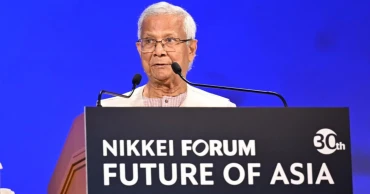
Transform Asia into a beacon of shared prosperity: Prof Yunus tells Nikkei Forum in Tokyo
Urging Asian nations to chart a new course of cooperation, inclusion, and sustainability, Chief Adviser Professor Muhammad Yunus on Thursday outlined a seven-point agenda aimed at transforming Asia into a beacon of shared prosperity by unlocking new opportunities.
"As we look to the future, I believe Asian nations can work together even more closely to address shared challenges and unlock new opportunities for prosperity," he said while delivering his keynote speech at the inaugural session of the 'Nikkei Forum: 30th Future of Asia' held here this morning.
"We need to build a clear path towards a shared future and shared prosperity," he added, presenting seven proposals to achieve this goal.
Highlighting the importance of transforming Asia’s interdependence into cooperation, Prof Yunus said Asia’s diversity—of economies, cultures, and political systems—is both its strength and its test.
"Our fates are increasingly intertwined. A supply chain disruption in one country ripples across borders," the chief adviser observed.
CA Prof Yunus looks forward to meeting with Japanese PM
He said environmental degradation in one part of Asia affects rainfall patterns in another while political instability in one region impacts global energy and trade flows.
"Our job is to convert this interdependency into cooperation, not conflict; to invest in shared prosperity, not zero-sum rivalries," said Prof Yunus, also a Nobel laureate.
He advocated for forging robust economic and technical cooperation saying Asia needs a stronger and sustainable way to finance its development. “Regional development banks and financial institutions should take the lead in funding our growing needs.”
Stating that Asia is still one of the least connected regions in terms of trade, the chief adviser said, this lack of integration holds back investment and business opportunities. "We must act now to improve trade partnerships across the region. Asia should build a strong technology ecosystem—one that is inclusive, fair, and sustainable.
Emphasising the need to promote inclusion, empowerment, and sustainability, he said, 'We must not forget the billions who still live on the margins—disconnected from opportunity, vulnerable to shocks.'"
"My life’s work has shown that poverty is not created by the poor; it is created by the system. We must redesign that system. The world we inherited was built on assumptions of trickle-down economics, centralised control, and the maximisation of wealth,” Prof Yunus said.
He said there was a need to build a new architecture—one that promotes inclusion, empowerment, and sustainability at every level, adding that this is where Asia could lead.
1 year ago
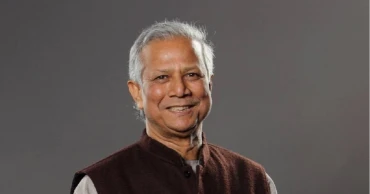
CA Prof Yunus looks forward to meeting with Japanese PM
Chief Adviser Professor Muhammad Yunus on Thursday said that he was looking forward to his meeting with Japanese Prime Minister Shigeru Ishiba to extend the ongoing collaboration between the two countries in different sectors.
“There are so many areas of collaboration between Japan and Bangladesh; I want to build on this,” the Chief Adviser said.
The Chief Adviser, who meets Ishiba on Friday, on the third day of his visit to Japan, made the remarks when President and CEO of Nikkei Inc. Tsuyoshi Hasebe called on him at the Imperial Hotel, Tokyo, ahead of the Nikkei Forum Future for Asia.
Hasebe thanked the Chief Adviser for attending the programme despite his busy schedule.
Prof Yunus in Tokyo to join Nikkei Forum, hold bilateral talks
Professor Yunus said he was a regular visitor to Japan until a break due to the Covid-19 pandemic and thanked the Nikkei Forum for helping him make so many friends in the country.
Hasebe hoped that the Chief Adviser would continue the endeavour in the future.
“In Japan we have a proverb about picking chestnuts out of fire,” he said, thanking the Chief Adviser for his time.
The meeting was followed by the Chief Adviser's address to the Nikkei Forum Future of Asia.
1 year ago