proportional representation
PR election system may fuel instability, autocracy, warns Salahuddin
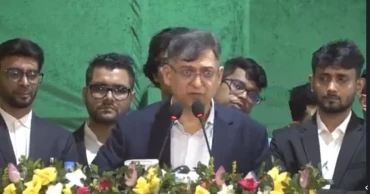
BNP senior leader Salahuddin Ahmed on Thursday said the Proportional Representation (PR) system of elections would create political instability and help establish autocracy by political parties.
“Around the world, PR is practised in many ways and through different methods. From their experience, it can be said that PR means ‘Permanent Restlessness,’ and Nepal is the latest example of it,” he said.
Salahuddin, a BNP Standing Committee member, made the remarks while speaking at a seminar organised by the Bangladesh Nationalist British Students’ Alliance at the Supreme Court Bar Auditorium.
He said in many countries where PR was introduced, it took a long time to form a government. “In some cases, it took a year or even a year and a half after the election. Even when a government was finally formed, it did not last long.”
The BNP leader questioned who is trying to introduce the PR system in Bangladesh and what their real motives are, and said one of the main aims of those advocating it is to gain a few extra seats, while another is to keep the country in constant instability so that no government can remain stable.
“It would benefit those who want Bangladesh to remain unstable. That means some of our neighbouring countries do not want Bangladesh’s stability, they do not want Bangladesh’s economic prosperity, and they do not want Bangladesh’s political stability. The reason is their own interests are involved,” Salahuddin said.
He warned that if division and instability always prevail in Bangladesh, another fascist like Sheikh Hasina could emerge, who would serve the interests of others, as with a weak government, almost any demand could be imposed.
“We gave our lives to end autocracy—will it now be re-established through PR? Under this system, if votes are cast for a party, the public will not know who will become an MP. That decision will be made by the party’s top leaders, such as the president, secretary, standing committee or Majlis-e-Shura. In this way, party autocracy will be established,” Salahuddin said.
He also said voters will lose their importance and their right to choose if party leaders alone decide who becomes a parliament member.
“Since 1970, we have fought for direct elections—one person, one vote—which led to the creation of Bangladesh. Introducing PR undermines that system. Party autocracy will dominate, and individual autocracy will also be reinforced. Those chosen by the party leaders will become MPs, while the people’s choice will no longer matter. The public will only be allowed to cast votes, but will have no real say in who represents them,” the BNP leader said.
BNP to finalise nominations soon; Tarique’s return ‘imminent’: Dr Zahid
Salahuddin criticised PR-related surveys, saying they were misleading. “One survey shows 56 per cent of people do not understand PR, yet another claims 70 per cent want PR. How can 70 per cent want it if 56 per cent do not even understand it? Such misleading claims only confuse the nation.”
He also warned that the PR system would weaken direct democratic participation. “If people cannot know in advance which candidates will be elected, where is direct democratic involvement? Accountability of elected representatives will suffer.”
The BNP leader said the constitution clearly defines the method of voting, specifying that representatives must be elected through direct votes for candidates, not for any election symbol.
He said any political reform must take into account Bangladesh’s democratic structure, social conditions, political history, and electoral history.
Salahuddin called for reforms that respect the constitution and ensure transparency, accountability and citizen participation in elections.
“Those who want to run the country by law, constitution, and legality, I urge them not to put the nation into crisis by accepting any political party’s non-political, illegal, or unconstitutional demand,” he said.
The BNP leader also said the current interim government is operating by maintaining constitutional continuity and the Chief Adviser himself has stated this many times.
Salahuddin Ahmed, a former student of Dhaka University’s Law Department, explained and analysed constitutionally that the interim government is functioning under the existing constitution, and anything outside it cannot be considered acceptable.
He said a fully independent election commission, an independent judiciary, a caretaker government, and freedom of the press must be ensured so that the rule of law is upheld and all state organs function properly within constitutional boundaries.
1 year ago
71’s defeated forces using PR to disrupt election: BNP leader
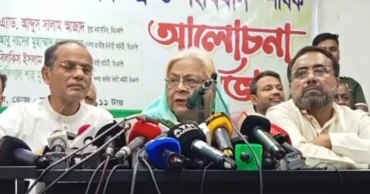
BNP senior leader Selima Rahman on Tuesday alleged that the defeated forces of 1971 are trying to obstruct the upcoming national election through street protests in the name of demanding a Proportional Representation (PR) system.
“We are observing that even after the announcement of the election roadmap, there is still a plot to stop or delay the election. The conspirators are the defeated forces of 1971. They are talking about PR, which ordinary people neither know nor understand,” she said while speaking at a discussion.
Selima, a BNP Standing Committee member, said Jamaat and some Islamist parties have taken to the streets for the PR system to destabilise the country.
She alleged that those who are agitating for the PR system mainly want to bring back fascism and rehabilitate the fascists.
“We have already seen how the voting system was manipulated once through the EVMs—when you pressed one button, the vote would go straight into the Awami League’s account. Now what is this PR system? Even I don’t understand it, and I don’t know whether the people of Bangladesh understand it either,” the BNP leader said.
Under the PR system, she said there would be no particular candidate as people would only be able to vote for a party.
The BNP leader said their party is against the PR system since it will only destroy people’s voting rights.
Gonotantra Rokkha Andolon organised the discussion programme titled ‘Democracy and Constitution of Bangladesh in the Current Context’ at the Dhaka Reporters Unity (DRU).
Selima argued that if citizens could not vote for the candidate of their choice, then there is no point in voting at all, as that would mean their voting right is lost.
She said the people of the country have struggled for all these years and many BNP leaders and workers have suffered immense repression to establish a government truly elected by them through their votes.
BNP yet to approve candidates for national election: Rizvi
“But now, what do we see? Jamaat—those who once killed people of this country, who betrayed the nation by siding with Pakistan, who acted as Razakars and Al-Badr, who raped women and handed them over to the occupation forces—today they may appear holy in their words, but they have not forgotten their past ideology,” the BNP leader said.
She said Jamaat is now trying to destroy the achievement the nation gained through a long struggle for democracy. “Their aim is to stop the election, to delay it, or to create instability in the country. But the people of Bangladesh will not allow this. BNP is a large party, and it will never let that happen.
“The election will be held, people will cast their votes, and an accountable government will be established. That is our promise,” Selima said.
She called upon BNP leaders and activists to remain united and campaign for the party’s electoral symbol, the sheaf of paddy. “No matter who gets the nomination, our focus must be on securing votes for the sheaf of paddy. That is our symbol of people’s politics, of production-based politics, and of our struggle for independence and democracy.”
1 year ago
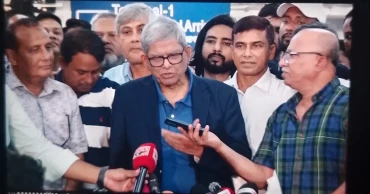
Fakhrul calls Islamic parties ‘undemocratic’, slams street programmes
BNP Secretary General Mirza Fakhrul Islam Alamgir on Thursday said the joint street programmes announced by several Islamist parties, including Jamaat-e-Islami, to press for demands such as proportional representation in elections are ‘not good for democracy’.
“I think such programmes are unnecessary. The talks (with the Consensus Commission) have not ended yet. Talks are still going on… At a time when discussions are underway, calling such programmes only means creating unnecessary pressure,” he said.
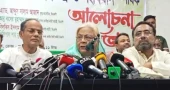
Talking to reporters at Hazrat Shahjalal International Airport upon his return from Singapore, Fakhrul also said, “In my view, this (movement by Islamic parties) is neither good for democracy nor helpful for taking the right decisions.”
When his attention was drawn to Jamaat-e-Islami Secretary General Mia Golam Porwar’s remark that they have taken to the streets as problems are not being resolved at the discussion table, the BNP leader countered with a question about whether problems will be solved by coming to the streets. “My counter question is – will coming to the streets actually resolve anything?”
He said BNP is still the largest political party and, after the fall of the Awami League, it has not taken to the streets over any issue. “We are trying to resolve everything through discussions. We believe this will be settled through talks,” the BNP leader observed.
Fakhrul, who went to Singapore along with his wife for her treatment on September 10, returned home in the evening on a regular Biman Bangladesh Airlines flight.
Jamaat reiterates demand for elections under PR system
Reiterating BNP’s stance on the proportional representation (PR) system, he said the party is not in favour of such an electoral system. “We think there is no need for PR in Bangladesh. “Discussions are ongoing at the July Charter. We have agreed on several issues… and those matters can be addressed when the time comes.”
He said the most important requirement for any action is public support, which comes through elections and Parliament, as only Parliament has the authority to amend or change the constitution.
When asked about the possibility of banning the 14-party alliance, including the Jatiya Party, Fakhrul said BNP has clearly stated in the past and continues to maintain that it is not in favour of banning any political party.
Khosru warns of political consequences for attempts to destabilise country
Replying to another question, he also said that BNP Acting Chairman Tarique Rahman will return very soon.
Asked about his possible participation at the 80th UN General Assembly with Chief Adviser Professor Muhammad Yunus, Fakhrul said he did not yet know what his role would be.
“Because I have not discussed this matter with Dr Muhammad Yunus or other political leaders… I think the focus there will be on the progress of democracy in the country, as well as on the country’s development,” he said.
Responding to another question about whether decisions for the country are often made externally, the BNP leader said he does not think so. “We must take our decisions ourselves through coordinated and united efforts.”
He said Bangladesh has always made its decisions within the country and will continue to do so, with the people of the country taking those decisions. “I believe there is no need for any external intervention.”
1 year ago
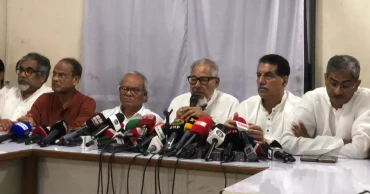
PR demand ‘suspicious, unrealistic’, says BNP’s Nazrul
BNP senior leader Nazrul Islam Khan on Wednesday described the demand by some political parties for introducing a proportional representation (PR) election system in the next national election as ‘unrealistic and suspicious’.
“When such insistence is placed on this matter (PR), it creates doubts that this could be an unreasonable attempt, leading to serious negative consequences for holding the election,” he said.
The BNP leader made the remarks while responding to a reporter’s question at a press conference at the party’s Nayapaltan central office.
Nazrul, a BNP Standing Committee member, said those who are demanding PR are not clearly explaining what kind of system they want for the election.
He questioned whether anyone had ever asked the people of the country about the PR system.
“Just go to Keraniganj near Dhaka and tell someone there that we want to change the way you have been electing your representatives. Say that we want a new system where your vote will be for a party, not a person. The party will then choose the MPs. There won’t be any specific MP for your area,” Nazrul said, pointing at the parties demanding the PR system.
Elections only way to restore political rights, resist fascism: Tarique
He said the political parties should also tell people that they will not vote for any particular candidate in their area. “Have you told people in villages these things? Have you asked if they agree or not on the matter?”
The BNP leader said some political parties were forcefully trying to impose the PR system on the voters despite its weak basis.
Since ordinary people haven’t been involved in it or made aware of it, he said the political parties will not be able to create much trouble over the PR issue.
Nazrul also questioned how the PR system could be introduced by discarding the traditional voting system without amending the constitution in parliament.
“Even if you agree on introducing PR, you still can’t apply it in the coming election, because the constitution would need to be amended first. Only parliament has the authority to do that. So, if you want to introduce it at all, it would only be possible in the following election,” the BNP leader said.
Nazrul said any political party or leader could have their own ideas, which might even be very good or groundbreaking, and there was no doubt about that.
“But the question is, whether the idea is good or bad, whether it comes from a wise person or an ordinary one—unless it is accepted by the people, it cannot and should not be applied for the people,” he observed.
People eagerly waiting to cast votes: Amir Khosru
In Bangladesh, the BNP leader pointed out, debates have continued for years over whether people should cast their votes by stamping a ballot paper or by pressing a button on an EVM machine, yet no final decision has been reached on the matter.
“But now you want to change the entire election system. People have always voted for individuals to represent them. But in the PR system, you will no longer vote for a specific person. No one will represent a particular area. The party will decide who becomes an MP—not the people,” he said.
In the PR system, the BNP leader said, MPs will not belong to a specific constituency as they will be MPs of the whole country.
“So if someone has a problem, who will they go to? That won’t be clear. This is such a major change, but you are not properly explaining it to the people, the real owners of the country,” he said.
1 year ago

NCC backs 100-member upper House thru proportional representation
The National Consensus Commission (NCC) on Thursday decided in favour of forming a 100-member Upper House through the Proportional Representation (PR) system based on the percentage of votes, amid opposition from BNP and several like-minded parties.
NCC Vice Chair Prof Ali Riaz informed the decision in the 23rd session (last day) of the second-round dialogue between the NCC and the political parties at the city's Foreign Service Academy in the afternoon.
Under the NCC’s proposal, the Upper House will not have the authority to enact any law on its own. However, all bills, except financial bills, must be introduced in both the Lower and Upper Houses.
The Upper House will not be allowed to keep any bill pending permanently. If any bill remains pending for more than a month it will be considered approved by the Upper House.
NCC’s last-day reform dialogue begins to reach decisions on several issues
The Upper House will review and analyse the bills passed by the Lower House and must approve or reject them within a stipulated time.
If approved, the bill will move to the President for assent. If rejected, the Upper House will return it to the Lower House with recommended amendments, which the Lower House may accept in full, in part, or reject entirely.
The candidates with at least 10pc woman aspirants for the Upper House shall be announced alongside that of the national parliamentary election.
Before the lunch break, BNP, Labour Party, NDM, the 12-Party Alliance and the Nationalist Alliance had voiced opposition to the Upper House under the PR system.
After the break, BNP Standing Committee member Salahuddin Ahmed voiced strong opposition to the proposal to elect 100 Upper House members. “BNP and several other parties and alliances disagree with both the PR system and the proposed powers of the Upper House. We will not endorse this unless our dissent is officially recorded,” he said.
BNP leader Salahuddin questions mandatory consensus on NCC proposals
Some leftist and Islamist parties, including CPB, BSD, Jamiat Ulema-e-Islam, and the Aam Janatar Dal, opposed the very idea of an Upper House, citing Bangladesh’s socio-economic realities.
Despite lengthy discussions on several days, the matter of the Upper House formation was entrusted to the commission due to differences of opinion among the parties.
The commission announced this decision on Thursday.
Consensus Commission seeks final decision on NCC in today’s meeting: Ali Riaz
1 year ago