Deaths in Iran
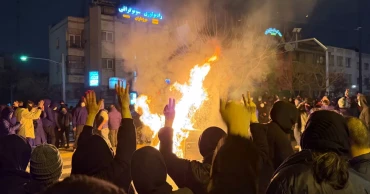
Iran protest death toll jumps to 2,571
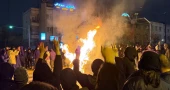
The death toll from a crackdown on protests in Iran jumps to at least 2,571, activists said early Wednesday.
The figure came from the U.S.-based Human Rights Activists News Agency, which has been accurate in multiple rounds of unrest in Iran in recent years.
The activist group said 2,403 of the dead were protesters and 147 were government-affiliated. Twelve children were killed, along with nine civilians it said were not taking part in protests. More than 18,100 people have been detained, the group said.
With the internet down in Iran, gauging the demonstrations from abroad has grown more difficult. The Associated Press has been unable to independently assess the toll. Iran’s government has not offered overall casualty figures.
Trump urges Tehran to show humanity toward protesters
That death toll dwarfs the death toll from any other round of protest or unrest in Iran in decades and recalls the chaos surrounding the country’s 1979 Islamic Revolution.
Iranians reach out, but world can't reach in
Several people in Tehran were able to call the AP on Tuesday and speak to a journalist. The AP bureau in Dubai, United Arab Emirates, was unable to call those numbers back. Witnesses said text messaging was still down, and internet users in Iran could connect to government-approved websites locally but nothing abroad.
Anti-riot police officers wore helmets and body armor while carrying batons, shields, shotguns and tear gas launchers, according to the witnesses. Police stood watch at major intersections. Nearby, witnesses saw members of the Revolutionary Guard's all-volunteer Basij force, who carried firearms and batons. Security officials in plainclothes were visible in public spaces.
Several banks and government offices were burned during the unrest, witnesses said. Banks struggled to complete transactions without the internet, they added.
Trump tells Iranians “help is on its way” amid deadly protests
Shops were open, though there was little foot traffic in the capital. Tehran's Grand Bazaar, where the demonstrations began Dec. 28 over the collapse of Iran's rial currency, opened Tuesday. A witness described speaking to multiple shopkeepers who said security forces ordered them to reopen no matter what. Iranian state media did not acknowledge that order.
The witnesses spoke on condition of anonymity for fear of reprisal.
It also appeared that security service personnel were searching for Starlink terminals, as people in northern Tehran reported authorities raiding apartment buildings with satellite dishes. While satellite television dishes are illegal, many in the capital have them in homes, and officials broadly had given up on enforcing the law in recent years.
On the streets, people also could be seen challenging plainclothes security officials, who were stopping passersby at random.
State television also read a statement about mortuary and morgue services being free — a signal that some likely charged high fees for the release of bodies amid the crackdown.
Khamenei, in a statement carried by state TV, praised the tens of thousands who took part in pro-government demonstrations nationwide on Monday.
Russia strikes Ukraine with drones and missiles amid freezing winter
“This was a warning to American politicians to stop their deceit and not rely on traitorous mercenaries,” he said. “The Iranian nation is strong and powerful and aware of the enemy.”
State TV on Monday aired chants from the crowd, which appeared to number in the tens of thousands. They chanted “Death to America!” and “Death to Israel!” Others cried out, “Death to the enemies of God!” Iran’s attorney general has warned that anyone taking part in protests will be considered an “enemy of God,” a death-penalty charge.
8 months ago
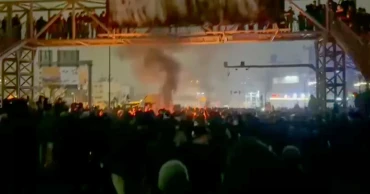
Deaths in Iran top 500 amid escalating crackdown, activists say
The death toll in the crackdown on nationwide protests in Iran spiked Sunday to at least 538 people, activists said.
Over 10,600 people have been detained, said the U.S.-based Human Rights Activists News Agency.
Of those killed, 490 are protesters and 48 are members of the security forces, it said, warning the toll is likely to go up.
With the internet down in Iran and phone lines cut off, gauging the demonstrations from abroad has grown more difficult.
The activist group, which relies on activists in Iran crosschecking information, has offered accurate tolls in previous rounds of unrest in the Islamic Republic.
The Iranian government has not offered any overall casualty figures for the demonstrations. The Associated Press has been unable to independently assess the toll, given that internet and international phone calls are now being blocked in Iran.
Parliament rallies
Iranian state television broadcast the parliament session live. Qalibaf, a hard-liner who has run for the presidency in the past, gave a speech applauding police and Iran's paramilitary Revolutionary Guard, particularly its all-volunteer Basij, for having “stood firm” during the protests.
He went on to directly threaten Israel, “the occupied territory” as he referred to it, and the U.S. military, possibly with a preemptive strike.
“In the event of an attack on Iran, both the occupied territory and all American military centers, bases and ships in the region will be our legitimate targets,” Qalibaf said. “We do not consider ourselves limited to reacting after the action and will act based on any objective signs of a threat.”
Lawmakers rushed the dais in the Iranian parliament, shouting: “Death to America!”
It remains unclear just how serious Iran is about launching a strike, particularly after its air defenses were destroyed during the 12-day war in June with Israel. Any decision to go to war would rest with Iran's 86-year-old Supreme Leader Ayatollah Ali Khamenei.
The U.S. military has said in the Mideast it is “postured with forces that span the full range of combat capability to defend our forces, our partners and allies and U.S. interests.” Iran targeted U.S. forces at Al Udeid Air Base in Qatar back in June, while the U.S. Navy's Mideast-based 5th Fleet is stationed in the island kingdom of Bahrain.
Israel, meanwhile, is “watching closely” the situation between the U.S. and Iran, said an Israeli official, who spoke on condition of anonymity due to not being authorized to speak to journalists. Israeli Prime Minister Benjamin Netanyahu spoke with U.S. Secretary of State Marco Rubio overnight on topics including Iran, the official added.
“The people of Israel, the entire world, are in awe of the tremendous heroism of the citizens of Iran,” said Netanyahu, a longtime Iran hawk.
The U.S.-based Human Rights Activists News Agency, which relies on activists in Iran cross-checking information, offered the new death toll of 203 on Sunday, a large jump. Of those killed, 162 are protesters and 41 are members of the security forces, it said. The agency also acknowledged receiving claims of far more deaths that it was still assessing as over 3,280 others have been arrested.
The group has offered accurate tolls in previous rounds of unrest in the Islamic Republic. The Iranian government has not offered any overall casualty figures for the demonstrations.
The Associated Press has been unable to independently assess the toll, as communications with Iran have been cut.
At the Vatican, Pope Leo XIV mentioned Iran as a place "where ongoing tensions continue to claim many lives."
“I hope and pray that dialogue and peace may be patiently nurtured in pursuit of the common good of the whole of society,” he said.
Protests in Tehran and Mashhad
Online videos sent out of Iran, likely using Starlink satellite transmitters, purportedly showed demonstrators gathering in northern Tehran's Punak neighborhood. There, it appeared authorities shut off streets, with protesters waving their lit mobile phones. Others banged metal while fireworks went off.
“The pattern of protests in the capital has largely taken the form of scattered, short-lived, and fluid gatherings, an approach shaped in response to the heavy presence of security forces and increased field pressure,” the Human Rights Activists News Agency said. “Reports were received of surveillance drones flying overhead and movements by security forces around protest locations, indicating ongoing monitoring and security control.”
In Mashhad, Iran's second-largest city some 725 kilometers (450 miles) northeast of Tehran, footage purported to show protesters confronting security forces. Protests also appeared to happen in Kerman, 800 kilometers (500 miles) southeast of Tehran.
Iranian state television on Sunday morning had their correspondents appear on the streets in several cities to show calm areas with a date stamp shown on screen. Tehran and Mashhad were not included.
Government rhetoric also ratcheted up Sunday. Ali Larijani, a top security official, accused some demonstrators of “killing people or burning some people, which is very similar to what ISIS does,” referring to the Islamic State group by an acronym.
State TV aired funerals of slain security force members while reporting another six had been killed in Kermanshah. In Fars province, violence killed 13 people, and seven security forces were killed in North Khorasan province, it added. It also showed a pickup truck full of bodies in body bags and later a morgue.
Even Iran's reformist President Masoud Pezeshkian, who had been trying to ease anger before the demonstrations exploded in recent days, offered a hardening tone in an interview aired Sunday.
“People have concerns, we should sit with them and if it is our duty, we should resolve their concerns,” Pezeshkian said. “But the higher duty is not to allow a group of rioters to come and destroy the entire society.”
More demonstrations planned Sunday
Iran’s exiled Crown Prince Reza Pahlavi asked in his latest message for demonstrators to take to the streets Sunday.
Demonstrators have shouted in support of the shah in some protests, but it isn’t clear whether that’s support for Pahlavi himself or a desire to return to a time before the 1979 Islamic Revolution. Pahlavi’s support of and from Israel has drawn criticism in the past, particularly after the 12-day war.
The demonstrations began Dec. 28 over the collapse of the Iranian rial currency, which trades at over 1.4 million to $1, as the country’s economy is squeezed by international sanctions in part levied over its nuclear program. The protests intensified and grew into calls directly challenging Iran’s theocracy.
8 months ago