EU EOM
EU EOM shares 6 priority recommendations; seeks more efforts for electoral inclusion
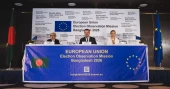
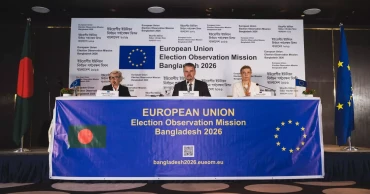
Chief observer of European Union Election Observation Mission (EU EOM) Ivars Ijabs on Tuesday identified six priority recommendations for Bangladesh, noting that more efforts are needed to foster accountability and electoral inclusion.
“Now, it is time to turn the focus to the reform process to strengthen transparency and rule of law, to show political will in promoting women in public and political life and to foster an environment for a pluralistic and secure public debate, both online and offline,” Ijabs said at a press briefing at a city hotel in the afternoon.
Women candidates were almost absent from these elections, signaling a lack of political will to promote women in decision making positions, said the Mission.
Ijabs said the European Union stands ready to support Bangladesh in those efforts, in line with the recently initialled Partnership and Cooperation Agreement, and reaffirming their unwavering commitment to democratic principles.
"In this spirit, we offer our final report, and its 19 recommendations with the hope of contributing positively to future elections in Bangladesh," he told reporters, noting that the work of improving and refining electoral process remains an essential ongoing exercise in any country also here in Bangladesh.
The chief observer said they are looking forward to discussing these recommendations with the national stakeholders, as it is essential to continue an inclusive dialogue in the next steps, to strengthen democracy, and uphold the rule of law, and build public trust.
“These credible and competently managed elections marked a pivotal step toward restoring democratic governance and the rule of law, reflecting a shared commitment to democratic processes among all stakeholders," Ijabs said.
Although elections bolstered public trust, legal and procedural gaps remain, signaling the need to continue the reform process in line with the July National Charter and beyond, he said, adding that the European Union stands ready to support national partners in implementing these recommendations.
"The work of our mission is now finished, but let me assure you that the European Union Delegation here remains committed to working with Bangladeshi partners on the democratic processes," said the chief observer.
Six Priority Recommendations
The EU EOM has put forward six priority recommendations and those include a comprehensive revision of electoral legal framework, introduction of robust campaign financing rules and oversight, introduction of affirmative action to enhance women participation in public and political right, as well as wide-ranging reforms to promote a safe digital environment.
The mission also recommended the EC take steps to ensure transparency throughout all stages of the vote tabulation and to consider extending eligibility for postal voting to other categories of voters.
The report called for revising the legal framework governing parliamentary elections to address inconsistencies and loopholes, reduce fragmentation, strengthen legal certainty, and ensure closer alignment with international standards for democratic elections.
Ensuring consistent arrangements for maintaining transparency during the tabulation of votes at the sub-district and district levels, such as projection of data entry on screens, as well as prompt publication of complete preliminary and final election results, including online, are among the five others priority recommendations.
The report called for amending the Representation of the People Order (RPO) to include strict monitoring and enforcement measures for implementation of Article 90B(1)(b)(ii), ensuring that all political parties achieve the goal of 33 per cent women as members of all internal party committees by 2030; and consider requiring that all political parties nominate at least one-third women candidates for national and local elections.
The report also called for promoting a safer and more transparent digital space by amending the Cyber Security Ordinance to establish binding legal obligations for social media platforms, aimed at safeguarding informational and electoral integrity.
Those obligations may encompass defined collaboration protocols, special measures around elections, algorithmic transparency, and regular reporting on content moderation activities.
In its fifth priority recommendation, the report called for reviewing and strengthening campaign finance provisions to ensure that spending limits and reporting obligations are realistic, enforceable and subject to effective verification and oversight.
The RPO could require candidates and political parties to submit audited election expenditure accounts in a standardised format, provide for systematic controls by the Election Commission during and after the campaign, and set clear deadlines for the publication of financial reports.
The report recommended considering extending eligibility for postal voting to other categories of voters in Bangladesh who are unable to cast their ballot in person on election day, such as homebound voters and persons with disabilities, internally displaced persons, migrant labourers and students, while retaining existing integrity safeguards and exploring additional ones.
Additional voting arrangements, such as early voting, suitable for enfranchising other categories of voters could also be introduced.
The report is based on a two-month-long, country-wide observation and offers a detailed analysis and assessment of the entire electoral process.
As part of this report, the mission offered 19 recommendations aimed at reinforcing the integrity of future electoral processes, in line with Bangladesh’s international commitments to democratic elections.
The mission noted several positive developments, attesting to the resilience of Bangladesh’s democracy.
The renewed legal framework was largely aligned with international standards for democratic elections, the Bangladesh Election Commission (EC) worked professionally, demonstrated openness and successfully enfranchised some 770,000 voters living abroad.
The Electoral Enquiry and Adjudication Committees were pro-active in upholding the campaign rules.
The mission also saw a revitalised civic space and took note of important national initiatives to counter disinformation.
The inconsistent enforcement of the EC’s campaign regulations and limited accountability and oversight in campaign finance laws contributed to an uneven playing field, the EU team said.
Incidents of digital-led violence and harassment alongside inadequate police protection curbed media freedom and social media platforms appeared ill-prepared to safeguard digital information integrity.
The EU EOM was present in Bangladesh between 28 December 2025 to 4 March 2026, at full strength comprising 223 international observers from all EU Member States, Canada, Norway and Switzerland, deployed to all 64 administrative districts of Bangladesh.
5 months ago
EU chief observer shares final report with 19 recommendations for future elections
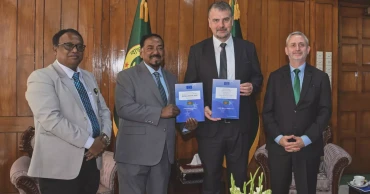
Chief observer of the European Union Election Observation Mission (EU EOM) Ivars Ijabs on Sunday shared a final report with Bangladesh including recommendations for improving future elections.
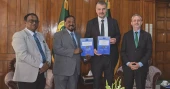
He met Speaker Hafiz Uddin Ahmad, and presented the mission’s final report and recommendations.
The final report is based on a long-term, independent observation of the electoral process across all 64 districts of Bangladesh, while the 19 recommendations offered by the EU EOM aim at reinforcing the integrity of future elections, officials told UNB.
The Chief Observer expressed hope that those recommendations will be considered by all relevant stakeholders, including Bangladesh Parliament.
The Chief Observer, the Head of EU Delegation to Bangladesh, Ambassador Michael Miller and the Speaker of the Parliament also discussed the new avenues for cooperation between the EU and Bangladesh that has opened and the support the EU is ready to offer in the implementation of these recommendations.
The Chief observer is scheduled to hold a press conference on Tuesday at a city hotel.
The EU EOM has been present in Bangladesh since the end of 2025 and on election day - February 22 - comprised 223 international observers, drawn from all EU Member States, as well as Canada, Norway and Switzerland, deployed across all 64 administrative districts.
The EU EOM presented the mission's preliminary statement on the 12 February parliamentary elections on February 14.
The 2026 parliamentary elections were described as "credible and competently managed, marking a pivotal step" towards restoring democratic governance and rule of law.
"This historic contest was genuinely competitive, with fundamental freedoms broadly respected. The electoral legal framework largely accords with international standards, while the Bangladesh Election Commission worked independently and transparently, maintaining the confidence of stakeholders and lending integrity to the polls,” said Chief Observer Ijabs.
Ambassador and Head of Delegation of the European Union to Bangladesh Michael Miller on Saturday said last week they saw the 'initialling' of the new Bangladesh-EU Partnership and Cooperation Agreement (PCA).
"And this coming week sees the return visit of our Chief Observer from our Election Observation Mission, as well as the holding of EU Bangladesh diplomatic consultations," said the Ambassador in a video shared by the EU Embassy, marking the 600th day in Bangladesh for him and his family in Bangladesh.
Ambassador Miller said he will also speak at events dealing with human rights and judicial reforms.
"And next week, I'm looking forward to travelling by train from Dhaka to the beautiful region of Sreemangal," he said.
5 months ago
EU Chief Observer calls twin polls a big day for Bangladesh democracy
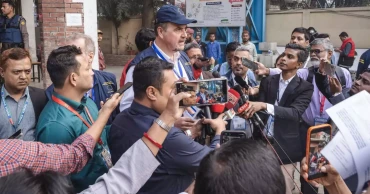
Chief Observer of the European Union Election Observation Mission (EU EOM) to Bangladesh Ivars Ijabs on Thursday said it is really a big day for Bangladesh’s democracy as they observed the country’s twin elections-- national election and referendum - across the country.
"I think this really a big day for Bangladesh’s democracy," he told reporters at Siddheswari Girls' College at New Bailey Road after observing the opening of the vote casting.
Ijabs said they were all looking forward to have 'participatory, credible and trusted' elections in Bangladesh in this historical moment.
He said they will continue to monitor the vote counting process.
Talking to reporters after visiting Curzon Hall polling centre at Dhaka University, Ijabs said the EU mission is closely monitoring voting across the country through its observers deployed nationwide.
“We have seen a lot of positive enthusiasm and participation on behalf of Bangladeshi citizens, and let us all hope that it’s going to stay like that until the very end of the voting,” he said.
They deployed 90 short-term observers (STOs) to observe the election day proceedings in all 64 administrative districts of the country.
The short-term observers will observe opening of polling centres, voting, closing, as well as counting of the ballots and the tabulation of results.
With a total of 200 observers deployed across the country, he said they are contributing to the transparency of these historic elections.
The EU EOM chief said the mission is maintaining online contact with its observers stationed across Bangladesh and receiving regular updates on the opening of polling stations, voter turnout and overall conduct of the election process.
“They are reporting on how the polling stations are being opened, how many people participate. And, of course, we are getting the reports from everywhere in the country where all our observers are,” he said.
Ijabs reiterated that the EU mission remains strictly neutral. “We are absolutely neutral. We are not taking part in any political process. We are observing,” he said.
He said the mission has deployed over 200 observers across Bangladesh, covering cities, towns and rural areas, to ensure a comprehensive and fact-based assessment of the election.
According to him, most polling stations observed so far opened on time, while the voting process was continuing peacefully.
Responding to queries from journalists, the chief observer said the mission receives various types of information as part of its observation work but would refrain from making comments during the ongoing voting process.
“As for our comments on the process, we will produce them later on, because otherwise, that would be involvement in the politics and the voting process,” he said.
The EU EOM is expected to release its preliminary report at 12pm on February 14, following completion of its assessment of polling, counting and tabulation processes.
7 months ago
Very important to see whole picture of electoral process holistically: EU EOM
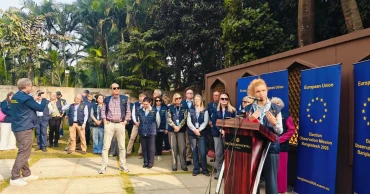
European Union Election Observation Mission (EU EOM) Deputy Chief Observer Inta Lase on Saturday (January 17, 2026) said it is very important to see the whole picture of electoral process holistically to present their report impartially, stressing that this is a historic moment for Bangladesh.
"Let us observe and let us wait until a holistic assessment is done," she told reporters at a city hotel, noting that they all know there is no perfect election anywhere in the world.
Lase said their assessment and report with recommendations in the spirit of friendship and cooperation will help improve the future electoral process in the country.
She said their observers are very experienced though many of them are coming to Bangladesh for the first time.
EU to allocate €60B military, €30B economic aid to Ukraine
Addressing the observers, Lase said, "You are the ones who are in the field, seeing the realities, telling us here in Dhaka how the situation is unfolding in each and every district. We are really looking forward to your report and assessment from the field."
She said she knows observers' hours on the ground will be longer but it will be rewarding.
"Trust me, we are all very privileged to hear from you and see this historical election," Lase said.
200 Observers Altogether
At full strength the EU EOM will comprise 200 observers drawn from all 27 EU member states, Canada, Norway and Switzerland.
The EU EOM will present its preliminary findings in a statement at a press conference on 14 February in Dhaka.
8 months ago