Electricity tariffs
Utilities propose distribution costs between Tk 0.85 and Tk 2.05 per unit
Power distribution companies on Thursday proposed revisions to retail electricity tariffs before the Bangladesh Energy Regulatory Commission (BERC), with estimated distribution costs ranging from Tk 0.85 to Tk 2.05 per unit for the 2025–26 fiscal year.
The proposals were placed on the final day of a two-day public hearing at the Krishibid Institution Bangladesh auditorium in Dhaka, chaired by BERC Chairman Jalal Ahmed.
The Bangladesh Power Development Board (BPDB), Bangladesh Rural Electrification Board (BREB), Dhaka Power Distribution Company (DPDC), Dhaka Electric Supply Company (DESCO), West Zone Power Distribution Company (WZPDCL), and Northern Electricity Supply Company (NESCO)submitted separate proposals for retail tariff revisions.
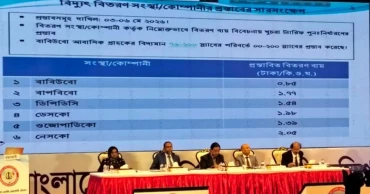
According to the submissions, BPDB proposed a distribution cost of Tk 0.85 per unit, BREB Tk 1.77, DPDC Tk 1.54, DESCO Tk 1.98, WZPDCL Tk 1.39, and NESCO Tk 2.05 per unit.
However, BERC’s technical evaluation committee recommended lower cost estimates, saying the weighted average net distribution cost of the six utilities would be Tk 1.25 per unit.
The committee estimated BPDB’s net distribution cost at Tk 0.75 per unit, BREB’s at Tk 1.39, DPDC’s at Tk 1.18, DESCO’s at Tk 1.16, WZPDCL’s at Tk 1.33, and NESCO’s at Tk 1.43.
It said the combined net distribution cost for FY2025–26 would stand at Tk 11,927 crore against projected electricity sales of 95,613 million units.
According to the committee, the six utilities together served more than 49.8 million consumers as of March 2026, including over 42.5 million residential users and nearly 28 million lifeline consumers.
BREB alone accounted for more than 39.1 million customers.
The technical committee also made several recommendations, including conducting an independent regulatory impact assessment before reducing the approved load limit for low-tension consumers from 80 kilowatts to 50 kilowatts.
It further recommended that private educational institutions, hospitals and medical colleges should not be categorised as commercial consumers for tariff purposes.
The committee also advised utilities not to determine excess load for non-demand meter consumers solely based on electricity consumption patterns, suggesting periodic load measurements and gradual introduction of demand meters instead.
In addition, it proposed consideration of a flat residential tariff for slum-area consumers and measures to prevent commercial charging of auto-rickshaws through residential electricity connections.
During the hearing, consumer rights activists, academics and business representatives strongly opposed any fresh increase in electricity prices, blaming inefficiency, system losses, inflated project costs and capacity payments for the sector’s financial burden.
Daffodil International University teacher Syed Mizanur Rahman criticised the inclusion of rate of return and corporate taxes in electricity pricing, saying monopoly public services should operate ona cost-to-cost basis instead of a profit-oriented model.
Former Communist Party of Bangladesh general secretary Ruhin Hossain Prince called for reducing electricity prices instead of increasing them and proposed free electricity for poor consumers using up to 75 units monthly.
Speakers also urged the government to reassess contracts with independent power producers and rental power plants, citing excessive capacity charges as a major burden.
At the end of the hearing, BERC Chairman Jalal Ahmed said all opinions and documents submitted during the hearing would be reviewed before a final decision is taken.
He invited stakeholders to submit further written observations by May 23.
He also warned that future power, gas and oil sector projects involving financial liabilities must obtain BERC’s opinion before being sent to the Planning Commission, adding that rising capacity payments had become “harmful for the nation.”
5 months ago

Electricity tariffs of three state-run power plants revised downwards
In a move aimed at reducing public expenditure on electricity procurement the interim government has revised the tariffs of three state-run gas-based power plants in Ashuganj, Siddhirganj and Haripur.
The officials concerned are expecting annual savings of about Tk 119.06 crore through this pragmatic move.
The approvals were given at a recent meeting of the Advisers Council Committee on Government Purchase held at the Secretariat.
According to the Power Division, the tariff rationalisation initiative is part of the government’s broader effort to ensure more efficient use of public funds, reduce the financial burden of power purchases on the Bangladesh Power Development Board (BPDB), and improve overall fiscal discipline in the energy sector.
The committee approved the proposal to re-determine the levelised tariff of the 412MW Haripur Combined Cycle Power Plant operated by the Electricity Generation Company of Bangladesh Limited (EGCB).
Under the revised structure, the tariff has been reduced from Tk 4.7796 to Tk 4.7588 per kilowatt-hour, which will come into effect from August 2025.
Once implemented, BPDB is expected to save around Tk 36.68 crore annually from electricity purchases from the plant.
The Haripur plant currently supplies about 305.33 crore units of electricity each year, for which BPDB pays nearly Tk 1,453.01 crore annually.
Over the remaining contract tenure of 13 years, 8 months and 5 days, BPDB will have to pay an estimated Tk 19,864.12 crore for electricity from this facility.
EGCB is a government-owned generation company, with 95.80 per cent ownership under the Power Division and 4.20 per cent held by BPDB.
Any profit generated by the company is treated as government revenue, making cost optimisation within such plants directly beneficial to the public exchequer.
The committee also approved a proposal to revise the tariff of the 335MW Siddhirganj Combined Cycle Power Plant, also operated by EGCB.
Following the revision, the tariff has been reduced from Tk 5.5216 to Tk 5.4204 per kilowatt-hour, effective from August 2025. The adjustment is expected to save BPDB approximately Tk 63.13 crore annually.
The plant currently produces around 248.27 crore units of electricity each year, with BPDB spending about Tk 1,345.70 crore annually to procure power from the facility.
Over the remaining contract period of 16 years, 1 month and 9 days, BPDB’s total payment obligation is estimated at Tk 21,675.03 crore.
In another decision, the committee approved the re-determination of the levelised tariff for the 450MW Combined Cycle Power Plant operated by Ashuganj Power Station Company Limited (APSCL).
Energy experts, economists oppose govt plan to raise electricity tariff
The tariff has been reduced from Tk 5.7844 to Tk 5.7634 per kilowatt-hour. With the revised rate, BPDB is expected to save around Tk 19.25 crore annually.
BPDB currently pays approximately Tk 1,593.17 crore each year to procure electricity from this plant. Over the remaining contract tenure of 14 years, 11 months and 22 days, total payments are projected to reach about Tk 23,880.02 crore.
APSCL is also a government-owned power generation entity, and its earnings are treated as state revenue.
Officials said the combined tariff revisions for the three plants will result in significant annual savings for the government while maintaining uninterrupted electricity supply from reliable, gas-based facilities.
They noted that since the plants are operated by state-owned companies, the revised tariffs strike a balance between ensuring financial sustainability of the generation companies and reducing BPDB’s expenditure.
The move is seen as part of the interim government’s broader strategy to rationalise energy costs, curb subsidy pressures, and safeguard public money through more efficient procurement decisions.
8 months ago