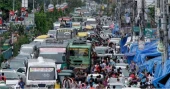
broken roads in narayanganj
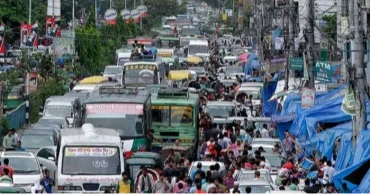
Narayanganj’s daily battle with traffic and broken roads
For thousands of residents in Narayanganj, a short journey across town has become an exhausting daily trial.
What was once a 10-minute commute now routinely stretches beyond an hour, as chronic traffic congestion, pothole-ridden roads and ongoing development works converge to choke the city’s main arteries.
From dawn until late at night, vehicles inch forward in long, unmoving lines, a scene that has become all too familiar to commuters, students and workers alike.
The situation has worsened in recent weeks, residents say, as the Narayanganj City Corporation presses ahead with a deep drainage renovation project.
Several key roads have been closed or narrowed, compounding pressure on alternative routes already strained by unregulated vehicles, easy bikes and illegal auto-rickshaws.
Footpaths, meant to provide relief to pedestrians, are often occupied by hawkers, forcing people to step onto the road and into the congestion.
An office worker from Bandar described his daily crossing of Bandar Ghat as unpredictable and frustrating. Though his workplace lies only 10 minutes away, frequent gridlock means the journey can take an hour or more.
“It’s impossible to plan,” he said, explaining that delays have repeatedly made him late for work.
Motorcycle riders echo similar concerns. One rider blamed unplanned road digging and the unchecked presence of illegal vehicles for deepening the crisis.
With pavements encroached upon, he said, both motorists and pedestrians are left competing for the same limited space.
For students, the strain is physical as well as mental.
A student travelling from Panchabati to Chashara for private tuition said it recently took her nearly an hour to reach her destination, a journey made more taxing while fasting during Ramadan.
Livelihoods Under Pressure
The congestion is not only costing time; it is eroding incomes.
Rickshaw-pullers report that trips which once took 30 minutes now stretch to nearly two hours.
The extended travel time means fewer passengers per day and reduced earnings, a significant blow for those dependent on daily wages.
“Earlier we could complete several trips in a day,” one puller said, adding, “Now the roads keep us stuck.”
Structural Limits
Officials acknowledge the scale of the problem but point to structural constraints.
Superintendent of Police Mizanur Rahman Munshi said traffic police, supported by volunteers from BKMEA and the City Corporation, are working from 9am to 10pm to manage congestion.
Special efforts are being made, he said, to help residents return home in time for iftar during Ramadan.
Deputy Commissioner Raihan Kabir identified the busy Chashara intersection as a persistent bottleneck.
Joint drives involving traffic police and executive magistrates are continuing in an attempt to keep the roads operational.
Yet he conceded that these measures are not a long-term solution.
Illegal hawkers, a high volume of auto-rickshaws and ongoing road development works remain major obstacles.
Fake ‘family cards’ sold in Narayanganj, husband and wife held
For now, residents say they are caught between necessary development and immediate hardship.
While authorities express hope that traffic conditions will improve once the drainage and road projects are completed, many commuters are left navigating a city where time is lost in traffic and patience runs thin.
Until a lasting solution emerges, Narayanganj’s streets remain a daily reminder of the growing pains of an expanding urban centre, and of the human cost of congestion, according to residents.
7 months ago