Jamdani

Weaving Dreams: A Jamdani artisan’s tale of passion and perseverance in Chandpur
In the quiet corners of Bangladesh’s rich heritage, where artistry meets tradition, the ethereal beauty of Jamdani sarees continues to enchant generations.
A delicate interplay of threads weaves not just fabric, but stories—of dedication, craftsmanship and an undying love for heritage.
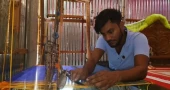
Among these silent storytellers stands Roni Patowary, a young artisan from Paschim Char Krishnapur, a remote village in the South Algi Durgapur union of Haimchar, Chandpur.
With deft hands and an indomitable spirit, he breathes life into the centuries-old craft of Jamdani weaving, turning fine threads into dreams draped in elegance.
A Journey Etched in Determination
Roni’s tale is one of resilience, woven through the struggles of time. Two decades ago, hardship forced him to leave his beloved hometown in search of sustenance.
The bustling looms of Narayanganj became his classroom, where he mastered the intricacies of Jamdani weaving—a skill passed down through generations, delicate yet demanding, poetic yet precise.
Bumper tomato yields bring no joy to Sunamganj farmers
Fate, however, had written a different pattern for him. The call of home proved stronger than the allure of distant opportunities, and Roni returned to his village with newfound expertise.
His modest tin-roofed home transformed into a sanctuary of artistry, where every warp and weft sings a song of tradition.
"It takes me three to four days to craft a single Jamdani saree by hand," Roni shares, his voice a blend of pride and patience. "Though I receive orders from various places, each piece requires meticulous attention. There are no shortcuts in this craft."
His father, Billal Patowary, beams with quiet pride. "Roni’s return has not just brought prosperity to our home but has rekindled a dying tradition in our village," he says.
His mother, Salma Begum, speaks of the delicate process, a dance between hands and loom. "The art requires threads, wooden frames, spools, and scissors. Every motion is deliberate, every design an act of love."
From Threads to Treasures
Though formal education eluded him due to financial constraints, Roni found wisdom in the rhythm of the loom. Each saree he weaves is a labour of love, its value dictated by the intricacy of design and the fineness of the yarn.
"Jamdani saree prices range from Tk 3,700 to Tk 8,000, but the masterpieces—custom designs with intricate details—can fetch Tk 4-5 lakh," Roni explains.
The magic lies in the selection of threads. The higher the thread count, the smoother the fabric, creating a piece that whispers elegance with every fold.
The design yarn, woven with precision, emerges in contrast against the texture yarn, lending clarity and depth to the motifs. Once completed, each saree is starched and wrapped in bamboo, preserving its crispness and sheen—a final touch before it adorns a woman with grace.
Dreams Beyond the Loom
Yet, Roni’s aspirations extend beyond personal success. He envisions a future where his craft becomes a source of livelihood for many, where the looms hum with the dreams of his fellow villagers.
Naogaon to see bumper mango harvest worth Tk 3,500 cr this year
"I hope for support from both government and private sectors to scale up this initiative," he shares with quiet determination. "With the right assistance, I can employ more hands, ensuring that our local economy thrives through this age-old craft."
His vision has not gone unnoticed. Sardar Abdul Jalil, Chairman of South Algi Durgapur Union Parishad, affirms, "We deeply appreciate Roni’s initiative. We are committed to helping him expand his enterprise so that this industry flourishes."
Haimchar Upazila Nirbahi Officer (UNO) Umme Salma Nazneen Trisha echoes this sentiment. "There are few industries in this region, so initiatives like Roni’s are invaluable. The upazila administration will provide the necessary support to help his business thrive."
A Legacy Woven in Hope
Roni Patowary’s journey is more than just a tale of artistic mastery—it is a testament to the resilience of Bangladesh’s cottage industries. His story reminds us that beyond every finely woven thread lies the spirit of a craftsman, the pulse of a culture, and the soul of a nation.
As his loom continues to whisper stories of heritage, Roni stands as a beacon of inspiration, proving that dreams—when woven with passion and perseverance—can become an enduring legacy.
1 year ago

Rupganj Jamdani weavers, traders eye Tk 150-160 cr Eid sale
Jamdani weavers are working round the clock at Noapara Jamdani palli in Rupganj upazila of Narayanganj to make new and fashionable Jamdani sarees with hope of good sale during Eid.
Visiting the Jamdani palli, the correspondent found that weavers are working relentlessly spinning the yarn with hands. The workers are not getting a chance to rest. This busyness runs from 5 am to 10 pm every day. Sometimes the clock goes past 10 pm to 11pm or even 12 pm. Such busyness is going on almost every day as Eid-ul-Fitr is around the corner.
Jamdani traders and BSCIC officials concerned expect a sale of Tk 150-160 crore on the occasion of Eid.
According to official sources, there are 407 entrepreneurs in 407 plots in the area under BSCIC Jamdani industrial estate. They have total 1,665 looms and about 3,500 people have been employed here. They have to do all the work without machines.
Eid Shopping: Popular Bangladeshi Clothing Brands for Families
Maidul Islam, who has been weaving sarees at Jamdani palli for 20-22 years, said that the work pressure has increased a lot due to upcoming Eid. “There is no opportunity to rest amid the pressure of work,” he added.
Weaver Nadeem said, “I have been weaving Jamdani sarees for 17 years. On the occasion of the upcoming Eid, the work has increased like every year. We want the work to increase. If the work increases, it will be good for the owners, financiers and workers.”
Shamim, a worker of Jamdani palli, said, “Earlier I used to come to the workplace at 9 am. Now I have to come at 5 am. Earlier I used to go home in the evening. Now I have to return home sometimes at 10 pm or 11 pm. Now the workload has increased.”
Ruhul Amin, owner of Junaid Jamdani Weaving, said, "Our market is being destroyed due to Indian Jamdani. They weave jamdani by machine. They can sell at lower prices as their production costs are lower. But we can't. They can sell a saree for Tk 2000. But we need yarns of Tk 2000 to weave a Jamdani saree. We cannot sell a saree below Tk 5000.”
"Earlier we used to sell 100 sarees every month, but now our sales have reduced to half because of Indian sarees," he added.
Shah Alam, son of a Jamdani artisan family, said, “Now I see that Jamdani is sold online. But many people don't know about Jamdani saree. India's machine-made sarees are being sold as Jamdani. Actually those are not Jamdani sarees. If you want to buy original Jamdani sarees, you have to come to BSCIC.", “Our Jamdani sarees are being exported. We are weaving new sarees targeting Eid. Now if you come to the palli, you will get a good saree,”he added.
How to Identify an Authentic Bangladeshi Jamdani Saree?
Zahirul Islam, officer of Rupganj Jamdani Industrial City, said that there are all kinds of entrepreneurs here. Some sell more and some less.
“It can be assumed that those who have 15-20 looms will sell sarees worth Tk 1-1.5 crore during Eid-ul-Fitr. And those who have fewer looms will sell a little less. We are expecting total sales of Tk 150-160 crore this year in Jamdani Industrial Estate,” he said.
2 years ago

How to Identify an Authentic Bangladeshi Jamdani Saree?
Jamdani saree, an emblem of Bangladeshi tradition, symbolises cultural richness and artisanal finesse. Distinguishing a real Jamdani from cheaper replicas necessitates keen attention to intricate details and a deep understanding of its defining characteristics. This ensures preservation of the material’s true essence and craftsmanship.
Why Jamdani Saree is Unique
The Jamdani saree originated from the Bengal region. It represents the pinnacle of meticulous craftsmanship. Crafted with fine cotton, it boasts intricate designs often inspired by nature or folklore, defining its renowned elegance and desirability.
An authentic Jamdani saree is a masterpiece. It showcases exquisite craftsmanship, with seamlessly woven intricate motifs that reflect the expertise of skilled artisans and the traditional weaving technique. This hallmark garment is coveted for its delicate patterns and holds an essence that resonates deeply with its authenticity.
Read more: Personal Grooming Tips and Tricks for Better Life and Career
Tips to Recognise an Authentic Jamdani Saree
To discern the authenticity of a Jamdani saree, careful scrutiny of various elements is essential.
Weaving
The weave is a critical factor. Authentic Jamdani sarees are distinguished by their supplementary weft technique. It boasts flawless structure, free from loose threads or irregularities. They show the diligent interlacing of extra weft threads.
An authentic Jamdani’s borders are a testament to supreme craftsmanship. They feature distinct patterns that complement the overall design flawlessly, devoid of fraying or uneven edges. Rough or uneven designs may hint at a saree's lack of authenticity.
Read more: Gemstones Guide: Precious, Semi-precious Stones Used in Jewellery
2 years ago

Generative Jamdani: A trailblazing research on Jamdani motif generation by AUST students
Jamdani, the strikingly patterned textile heritage of Bangladesh is globally popular now but many of its motifs have been lost with time with demise of artisans as their lineage could not preserve all of it in just memory.But think about a dataset of Jamdani motifs with which newer Jamdani patterns can be generated or some old ones with just a few hand strokes imitating the pattern itching your mind.A research team of students from the Department of Computer Science and Engineering at Ahsanullah University of Science and Technology (AUST) recently developed such a prototype called Generative Jamdani using Machine Learning to bring that idea to reality.
Also read: Jamdani brings Sonargaon in the limelight againThe research aims at preserving the motifs of Jamdani and to get the country a step ahead in making the geometric motifs woven craftsmanship influential on modern textile and fine art industry and generating entirely new Jamdani motifs from a user's input.
4 years ago

Jamdani brings Sonargaon in the limelight again
Narayanganj, Oct 13 (UNB) – Sonargaon, one of the old capitals of the historic region of Bengal, has been recognised as the ‘World Craft City’ for being the birthplace of Jamdani, opening the door of creative tourism.
In a landmark decision, the World Craft Council (WCC) gave the recognition through a letter on Friday, said Upazila Nirbahi Officer of Sonargaon Anjan Kumar Sarkar.
“The recognition will widen the door of creativity, talents and experiences,” he said.
The recognition came after the Bangladesh Folk Art and Crafts Foundation and Bengal Foundation, which organises Jamdani Festival, jointly appealed to the WCC seeking recognition of the city, located near the old course of the Brahmaputra River, as a world craft city for Jamdani and Weaving.
6 years ago
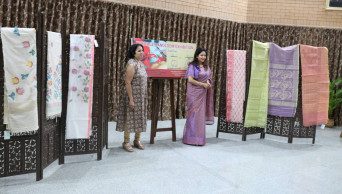
Jamdani fair turns heads in Delhi
Dhaka, Sept 13 (UNB) - A day-long fair of Bangladesh’s Jamdani, muslin and other handloom saris attracted a large crowd in Delhi on Thursday.
7 years ago