SDG
SDG implementation must improve quality of life for every citizen: Khosru
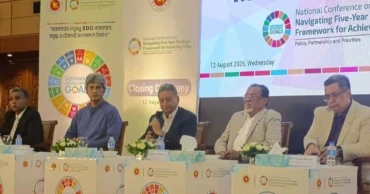
Finance Minister Amir Khosru Mahmud Chowdhury on Wednesday said the government is committed to implementing the Sustainable Development Goals (SDGs) in a manner that goes beyond the existing targets, with a focus on improving the quality of life and economic participation of every citizen.
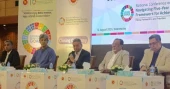
“SDG is already built into the BNP election manifesto. If we can implement the manifesto 100 percent, the SDGs will be fully implemented. In fact, we are beyond SDGs,” he said while addressing the closing ceremony of the three-day National Conference on Five-Year Strategy and SDG at the China Friendship Centre.
He said successful implementation of the SDGs requires coordinated efforts by all stakeholders, including ministries, ordinary citizens, private sector organisations and NGOs.
“We have to work together to deliver the SDGs. Ministries are being coordinated, consultations are being held with ordinary people, and pilot projects are being undertaken to identify and correct defects and errors before wider implementation,” he said.
Khosru said SDG implementation is not merely a matter of policy formulation or resource allocation, stressing the need for a “humanitarian government” capable of putting people at the centre of development.
He said the government has prioritised socially focused programmes including the Family Card and Farmer Card initiatives, despite the difficult economic situation.
“These projects have been designed keeping the low-income people, the poorest sections of society, rural communities and persons with disabilities in mind,” he said.
The minister said allocating resources for such programmes during a difficult economic period was not easy as the government has to reduce allocations for some other development projects to prioritise programmes directly benefiting disadvantaged people.
Khosru also stressed that SDGs should not be viewed as charity for poor people.
“SDG is not charity. It is about improving the quality of life of every citizen and ensuring their economic, social and civic rights,” he said.
He said the government’s concept of “democratisation of the economy” was closely aligned with the core objectives of the SDGs.
“The political democratisation will only be successful if the economy is democratised,” he said, adding that every citizen should have the opportunity to participate in economic activities and benefit from economic growth.
The Finance Minister said the government is also promoting a “creative economy” to help rural communities move beyond traditional economic activities.
“For generations, many people in rural Bangladesh have been engaged in the same activities without being able to graduate from those conditions. We want to monetise these activities so that they become sustainable, create value addition and generate markets,” he said.
He said products developed through such initiatives should not be confined to the domestic market but should eventually be made marketable globally.
Khosru said the government alone cannot provide design, inputs, financing and market access to people in every village.
“That is why we have brought the private sector and NGOs on board as partners. They have outreach and existing links with these communities,” he said.
He said an executive committee has been formed involving designers, NGOs and organisations capable of delivering inputs and other services to ensure effective implementation.
“Making policies and allocating resources in the budget is one thing, but delivery is another. Inshallah, we are working on the entire process in this way,” he said.
The Finance Minister expressed optimism that Bangladesh would be able to move beyond the SDGs through coordinated efforts and a development approach centred on human potential.
State Minister for Planning Zonayed Abdur Rahim Saki said the government’s five-year development strategy goes beyond achieving the Sustainable Development Goals (SDGs), aiming instead at broader economic, social and democratic transformation of Bangladesh.
“The SDGs are not merely an international obligation for us. Improving the lives of the people of Bangladesh is the government’s commitment, and this is clearly reflected in the election manifesto and the strategic framework,” he said.
He said the government, following the Prime Minister’s directives, has been preparing a five-year strategic framework based on its election manifesto, with instructions for ministries and institutions to realign their activities and development projects accordingly.
He said Bangladesh faces a financing gap of about US$421 billion, equivalent to more than Tk 50 lakh crore, to achieve the SDGs, making financing a major challenge for the country.
Saki said the government is therefore working to reform the statistical and data management system so that accurate information can be collected and actual progress measured.
1 month ago
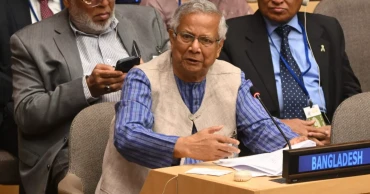
Prof Yunus calls for smarter financing to close $4 trillion SDG gap with five priorities
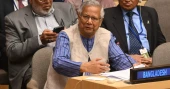
Chief Adviser Prof Muhammad Yunus on Wednesday suggested five priorities for better financing the Sustainable Development Goals (SDGs), including mobilisation of domestic resources fairly, supported by international assistance.
"Tax systems must be progressive, transparent, and ensure multinational corporations pay their share. Negotiations under the UN Framework on International Tax Cooperation must address these inequities," he said.
Prof Yunus shared the five priorities while delivering the speech at the opening segment of ‘First Biennial Summit for a Sustainable, Inclusive and Resilient Global Economy: Implementing Commitments on Financing the Sustainable Development Goals’ at the UN headquarters.
Prof Yunus said UN budget cuts or shrinking (Official Development Assistance (ODA) would be counterproductive for countries like Bangladesh that hosts 1.3 million Rohingyas amid several other crises like battling climate shocks, and economic turbulence. ‘Gloobal support must expand.’
1 year ago
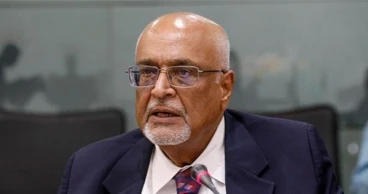
SDGs unlikely to be achieved with only announcements: Dr Debapriya
Dr Debapriya Bhattacharya, a distinguished fellow at the Centre for Policy Dialogue (CPD), has said that the Sustainable Development Goals (SDGs) will not be fulfilled solely through announcements and stressed the importance of holding the state accountable for their implementation.
Dr Bhattacharya made the remarks during a dialogue on the Bangladesh Voluntary National Review (VNR) and Citizen Platform for SDG Implementation, held in the capital on Sunday.
The event, organised by the Citizen Platform for SDG Implementation, focused on fostering citizen participation in the process.
The dialogue was chaired by Dr Debapriya Bhattacharya, with Lamiya Morshed, Chief Coordinator (Senior Secretary) of the Chief Adviser on SDGs, attending it as the chief guest.
Members of the Citizen Platform’s core group, including Ahmad Mushtaq Raja Chowdhury, Rasheda K Chowdhury, Professor Mostafizur Rahman, and Shaheen Anam, were also present.
Bangladesh loses Sundarbans honey’s GI status due to negligence: CPD
As head of the ‘White Paper Drafting Committee,’ Dr Bhattacharya highlighted the VNR as one of the central pillars of SDG implementation.
He emphasised that the state should be held responsible, alongside the establishment of an accountability framework to track progress.
“We committed to the Sustainable Development Goals, one of the key elements of which was this accountability mechanism, known as the VNR. We are executing this program amidst a vastly different political, social, and institutional landscape, which creates a new qualitative situation,” he noted.
Dr Bhattacharya described this as an opportunity, saying, “We have engaged with ordinary citizens and received a positive response from the government.”
He also underlined the need for a nationally driven self-assessment, distinct from official surveys, that incorporates diverse public perspectives and reflects both developmental strides and challenges. “The opinions of people from all classes and professions should be incorporated into such an assessment.”
Highlighting the importance of addressing data gaps, he said, “Covid-19 has weakened the SDG data tracker, so we need a comprehensive assessment of this data. We look forward to an action plan for data integration.”
1 year ago

FM visiting India to attend G20 development ministers' meeting
Bangladesh's Foreign Minister Dr AK Abdul Momen is visiting India at the invitation of his Indian counterpart, Dr S Jaishankar.
He will attend the G20 Development Ministers’ Meeting under the G20 Indian Presidency which will end on June 13 in Varanasi, Uttar Pradesh.
Dr Momen is expected to make interventions in different sessions of DMM on June 12, according to the Ministry of Foreign Affairs.
Union Minister of External Affairs Dr S. Jaishankar will chair the meeting.
Read: Bangladesh, UN to work closely to achieve SDGs
The Varanasi Development Ministers’ Meeting takes place amidst mounting developmental challenges that have been further aggravated by economic slowdown, debt distress, impacts of climate change, pollution and biodiversity loss, growing poverty and inequality, food and energy insecurity, cost-of-living crisis, global supply-chain disruptions, and geo-political conflicts and tensions.
The G20 Development Ministerial meeting will be an opportunity to collectively agree on actions for accelerating achievement of the SDGs and foster synergies between the development, environment and climate agendas while avoiding costly trade-offs that hold back progress for the developing countries, according to MEA.
The meeting follows the Voice of the Global South Summit that was hosted by India in January 2023, and the decisions taken at the Varanasi meeting will also contribute to the United Nations SDG Summit which will take place in September in New York.
Read: Awami League's policy unchanged despite allowing Jamaat rally: Home Minister
The meeting will consist of two main sessions, one on "Multilateralism: Collective Actions for Accelerating Progress towards SDGs” and another on "Green Development: A LiFE (Lifestyle for Environment) Approach”.
The Development Ministers’ Meeting was preceded by the fourth and final Development Working Group (DWG) Meeting, which was held in Delhi from June 6-9.
The DWG, while building on the crucial work done by previous G20 presidencies, has carried forward its mandate of enhancing G20's contribution to accelerating progress towards SDGs and strengthening G20 long-term vision in this regard including by strengthening G20 efforts towards fostering sustainable, inclusive and resilient economic growth.
Cultural programmes, exhibitions and excursions have also been organized to provide the delegates a glimpse into the rich culture and traditions of Varanasi, one of the oldest cities in the world.
Read more: With G20 event, India seeks to project normalcy in disputed Kashmir
A total of 200 delegates are expected to attend the meeting.
3 years ago
.jpg)
Report: Bangladesh among 3 top performers in sustainable development
Bangladesh and two other countries – Afghanistan and Cote d’Ivoire have progressed the most on the SDGs Index score since the adoption of the 2030 global agenda in 2015, according to the Sustainable Development Report 2021.
The report was launched on Monday by the Sustainable Development Solution Network (SDSN).
The report said East and South Asia has progressed more on the SDGs than any other region, both since 2010 and since the adoption of the goals in 2015.
By contrast, the three countries that have declined the most are Venezuela, Tuvalu and Brazil.
READ: Utilise SDGs as a framework to address youth agenda: Dialogue
However, the global average SDG index score has decreased for the first time since the adoption of the SDGs in 2015. The global decline in performance, including in OECD countries, was driven to a large extent by increased poverty rates and unemployment in 2020.
In the report, Bangladesh has been ranked 109th with an overall score of 63.5 in the 2021 SDG index.
Finland has been ranked 1st with 85.9 score. The four other countries in the top five positions are Sweden (85.6), Denmark (84.9), Germany (82.5) and Belgium (82.2).
READ: SDGs: 'Youth voice missing in policy process'
In South Asia, Bhutan (70) is in 75th position, Maldives (69.3) in 79th, Sri Lanka (68.1) in 87th position, Nepal (66.5) in 96th, India (60.1) in 120th, Pakistan (57.7) in 129th, and Afghanistan (53.9) in 137th position.
5 years ago
.jpg)
Fortify action-oriented approach to attain green growth: PM tells P4G Summit
Prime Minister Sheikh Hasina on Sunday put forward three suggestions before the Partnering for Green Growth and the Global Goals 2030 (P4G), including strengthening campaign about its action-oriented approach by engaging more financiers, innovators, policymakers and creative entrepreneurs in its focus areas.
“P4G needs to campaign more about its action-oriented approach, engaging more financiers, innovators, policymakers and creative entrepreneurs in the five P4G focus areas (food, water, energy, cities and circular economy), and share best practices,” she said in her recorded statement played in the 2021 P4G Seoul Summit.
The two-day summit is being held on the theme of ‘Inclusive Green Recovery towards Carbon Neutrality’ in Seoul, the capital city of South Korea, aiming to position P4G as a delivery mechanism to build back better and greener in this decade of action.
Also read: Bangladesh has to keep friendship with all to attain development: PM
The second suggestion Sheikh Hasina placed is the need for a whole-of-world attitude in addition to a whole-of-society approach for achieving green growth and global goals 2030.
Placing the third suggestion, she said, “We, the participating leaders in the P4G Summit, need to work more closely towards a greener future for our next generation.”
In the statement, the Prime Minister said Bangladesh’s key focus is to promote locally-led adaptation solutions to address the adverse impact of climate change.
“As the chair of the Climate Vulnerable Forum-CVF and the host to the South Asian office of Global Centre on Adaptation, Bangladesh’s key focus is to uphold the interests of the climate vulnerable countries and promote locally-led adaptation solutions,” she said.
The Prime Minister said water, an area of work for P4G, is one of the most valuable assets of Bangladesh. “So, we’ve adopted a 100-year sustainable development plan styled as Delta Plan 2100 that focuses on efficient use and preservation of water.”
She said Bangladesh is the first LDC to establish a ‘Climate Change Trust Fund’ from its own resources. “Every year we spend about 5 billion US dollars on climate adaptation and mitigation measures.”
Bangladesh, a member of the P4G, pursues a low carbon development path. “Our National Solar Energy Action Plan 2021-2041 predicts generation of up to 40 Giga Watt of renewable energy by 2041,” she added.
Sheikh Hasina said Bangladesh, the second largest exporter of readymade garments, is exploring efficient options of circular fashion and textiles as part of the overall circular economy.
“Despite the ongoing Covid-19 pandemic with its many challenges, we’ve the opportunity to build back better through inclusive green recovery and green growth,” she said.
The second P4G summit is expected to culminate in the adoption of the Seoul Declaration, and will serve as a stepping stone towards the Glasgow Climate Change Conference (COP 26).
The P4G global initiative was launched in 2017 to accelerate the response to climate change and implementation of the SDGs.
Also read: SDGs: 'Youth voice missing in policy process'
UK Prime Minister Boris Johnson, French President Emmanuel Macron, Chancellor of Germany Angela Markel, South Korean Prime Minister Charles Michel, UN Secretary-General António Guterres, Chinese Premier Li Keqiang, Indonesian President Joko Widodo, Mongolian President Khaltmaagiin Battulga, New Zealand Prime Minister Jacinda Ardern, Uzbek President Shavkat Mirziyoyev and Chile President Sebastian Piñera, among other world leaders, spoke at the virtual Leaders’ Session of the summit.
5 years ago
.jpg)
Sending money through legal channels boosted remittance inflow: Webinar
The recent remittance inflow went up in Bangladesh amid the coronavirus pandemic due to coming through a formal channel instead of informal process.
5 years ago

43 pc female RMG workers suffering from malnutrition
Speakers in a programme on Tuesday said that about 43 percent female workers at ready-made garments (RMG) sector are victim of malnutrition.
5 years ago

Post-pandemic recovery depends on reliable data
The recovery of the country’s economy following the coronavirus crisis is long and slow due to data scarcity, experts say.
5 years ago
.jpg)
Citi, UNDP support young entrepreneurs to achieve SDGs in Bangladesh
United Nations Development Programme (UNDP) and Citi Foundation have co-created Youth Co:Lab as a platform for young entrepreneurs in Asia Pacific towards achieving Sustainable Development Goals (SDGs) through innovative business solutions.
5 years ago