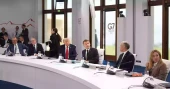
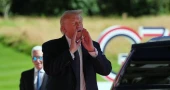
G7 leaders
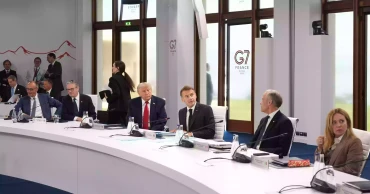
G7 leaders endorse Trump’s Iran deal, urge swift implementation
Leaders of the Group of Seven (G7) nations have voiced support for US President Donald Trump’s proposed agreement with Iran aimed at reopening the Strait of Hormuz and extending a fragile ceasefire, although details of the deal remain largely undisclosed.
In a joint declaration issued at the summit in France, G7 leaders described the proposed agreement as a “historic opportunity” to prevent Iran from acquiring nuclear weapons and address concerns related to its regional influence and ballistic missile programme.
The leaders pledged support for implementing the agreement, despite the fact that neither Washington nor Tehran has officially released the text.
According to leaked versions of the interim accord, Iran would immediately move to reopen the Strait of Hormuz after the deal is signed and would be permitted to resume unrestricted oil exports. The agreement is expected to be formally signed in Switzerland on Friday.
The proposed framework also envisions the United States working toward lifting American and United Nations sanctions on Iran if a comprehensive agreement on Tehran’s nuclear programme is reached.
Speaking on the sidelines of the summit during a meeting with Egyptian President Abdel-Fattah el-Sissi, Trump said the agreement remained confidential but described it as a strong memorandum of understanding.
“Nobody knows what it is but it’s very strong,” Trump told reporters, adding that the United States could abandon the deal if it proves unsatisfactory.
While backing the initiative, G7 leaders acknowledged the importance of restoring maritime traffic through the Strait of Hormuz, through which around one-fifth of globally traded oil and natural gas passed before the conflict began.
The summit declaration said a maritime mission led by France and the United Kingdom could help secure commercial shipping routes, protect merchant vessels and support efforts to clear any remaining threats in the waterway.
The proposed agreement also includes an immediate halt to hostilities in Lebanon between Israel and the Iran-backed Hezbollah group. However, questions remain over Israel’s military presence in parts of southern Lebanon, a point that has generated disagreement between Tehran and Tel Aviv.
G7 leaders expressed support for efforts to strengthen Lebanon’s sovereignty and implement a robust ceasefire while advancing the disarmament of Hezbollah.
Trump also criticised the prolonged fighting in Lebanon, saying too many lives had been lost during the conflict.
The final day of the summit focused on economic growth, artificial intelligence and concerns over global trade, with leaders from India, South Korea, Kenya and Brazil also participating in discussions.
4 months ago
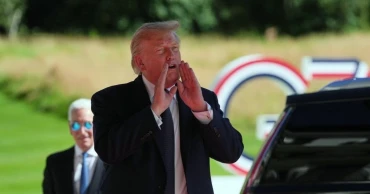
G7 leaders begin talks on Ukraine and Middle East as Zelenskyy joins summit in France
Leaders of the Group of Seven (G7) nations began their first full day of summit talks on Tuesday with major global crises at the top of the agenda, including Russia’s war in Ukraine and efforts to stabilize the Middle East.
Ukrainian President Volodymyr Zelenskyy joined the discussions at the invitation of host nation France, as world leaders looked for ways to advance peace efforts in Ukraine and maintain momentum following a recent US-Iran agreement.
The talks come after US President Donald Trump announced a deal aimed at ending the 3½-month conflict between the United States and Iran. The crisis in the Middle East has dominated international attention in recent weeks, pushing the Ukraine war lower on the global agenda.
Trump said he held productive phone conversations on Sunday with both Zelenskyy and Russian President Vladimir Putin and indicated that Washington would now focus more closely on efforts to end the Ukraine conflict.
French President Emmanuel Macron said he would urge Trump to maintain support for Ukraine and increase pressure on Russia to move toward a peace agreement.
Just hours before the summit opened, Russia launched hundreds of drones and dozens of missiles at major Ukrainian cities. The attacks killed at least 11 people and damaged several sites, including a religious landmark.
A key session on Tuesday focused on ending regional conflicts and promoting stability in the Middle East. Leaders from Egypt, Qatar and the United Arab Emirates were invited to join those discussions.
Trump has repeatedly expressed frustration over the slow progress in efforts to end the war in Ukraine. During his presidential campaign, he said he could resolve the conflict quickly, but later acknowledged that reaching a settlement has proven more difficult than expected.
Macron stressed that any lasting peace process must involve both Ukraine and Russia, with European and American participation.
Meanwhile, Ukraine officially launched negotiations on Monday to join the European Union, beginning what is expected to be a lengthy process requiring major political and institutional reforms.
Kyiv views EU membership as an important safeguard for its future after the war. Ukraine also seeks membership in NATO, but the Trump administration has ruled out that possibility while the conflict continues.
The summit is also taking place against the backdrop of recent tensions between Trump and several European leaders over US military action against Iran. Differences emerged after Washington moved ahead without consulting key allies, including France, Britain, Germany and Italy.
Despite those disagreements, leaders in Evian appeared eager to work together, particularly as they seek to reduce the economic impact of higher energy prices caused by disruptions in the Strait of Hormuz.
Trump said recent developments in the Middle East were encouraging, noting that oil prices had fallen and stock markets had responded positively.
Ahead of the summit, France, Germany, Italy and the United Kingdom, joined by Canada, issued a joint statement welcoming the US-Iran agreement and calling it a diplomatic breakthrough. The countries urged rapid implementation of the deal to allow the reopening of the Strait of Hormuz, a critical route for global oil shipments.
Macron said France and its partners stand ready to help restore safe navigation through the strait, while France and Britain continue to support plans for a maritime security mission in the region.
Trump, however, suggested that a large international military deployment may not be necessary, although he welcomed limited support from allied countries.
In addition to the Ukraine and Middle East discussions, Trump’s schedule on Tuesday includes meetings with Qatar’s emir and the president of the UAE, followed by a cultural event and a dinner with fellow G7 leaders.
The G7 comprises France, the United States, Canada, Germany, Italy, Japan and the United Kingdom. Several non-member countries, including Brazil, India, Kenya and South Korea, were also invited to participate in selected discussions as partner nations.
4 months ago
.jpg)
G7 leaders wrap up summit meant to bolster Ukraine support
The Group of Seven developed economies on Tuesday wraps up a summit intended to send a strong signal of long-term commitment to Ukraine’s future, ensuring that Russia pays a higher price for its invasion while also attempting to alleviate a global hunger crisis and show unity against climate change.
The leaders of the U.S., Germany, France, Italy, the U.K., Canada and Japan on Monday pledged to support Ukraine “for as long as it takes” after conferring by video link with Ukrainian President Volodymyr Zelenskyy.
Read: G7 countries to provide $19.8 billion in aid to Ukraine
The summit host, German Chancellor Olaf Scholz, said he “once again very emphatically set out the situation as Ukraine currently sees it.” Zelenskyy’s address, amid a grinding Russian advance in Ukraine’s east, came hours before Ukrainian officials reported a deadly Russian missile strike on a crowded shopping mall in the central city of Kremenchuk.
Officials have said during the summit that leaders of the major economies are preparing to unveil plans to pursue a price cap on Russian oil, raise tariffs on Russian goods and impose other new sanctions.
From the secluded Schloss Elmau hotel in the Bavarian Alps, the G-7 leaders will continue straight to Madrid for a summit of NATO leaders — where fallout from Russia’s invasion of Ukraine will again dominate the agenda. All G-7 members other than Japan are NATO members, and Japanese Prime Minister Fumio Kishida has been invited to Madrid.
Zelenskyy has openly worried that the West has become fatigued by the cost of a war that is contributing to soaring energy costs and price hikes on essential goods around the globe. The G-7 has sought to assuage those concerns.
While the group’s annual gathering has been dominated by Ukraine and by the war’s knock-on effects, such as the challenge to food supplies in parts of the world caused by the interruption of Ukrainian grain exports, Scholz has been keen to show that the G-7 also can move ahead on pre-war priorities.
The summit host has been keen to secure agreement on the creation of a “climate club” for countries that want to speed ahead when it comes to tackling global warming.
Read:Biden urges Western unity on Ukraine amid war fatigue
After a meeting Monday with leaders of five developing nations, a joint statement issued by Germany emphasized the need to accelerate a “clean and just energy transition” that would see an end to the burning of fossil fuels without causing a sharp rise in unemployment.
In the cautiously phrased statement, the leaders tentatively endorsed the global “climate club” idea.
4 years ago
UK to donate 100 mn coronavirus vaccine doses
British Prime Minister Boris Johnson has announced that the UK will donate at least 100 million surplus coronavirus vaccine doses within the next year, including 5 million beginning in the coming weeks.
The donation is in addition to the UK work to support Oxford-AstraZeneca’s contribution to fighting COVID and the UK's financial backing to COVAX.
The UK will donate 5 million doses by the end of September, beginning in the coming weeks, primarily for use in the world’s poorest countries.
Read:Tireless advocate of migrant refugees Swing passes away
The Prime Minister has also committed to donating a further 95 million doses within the next year, including 25 million more by the end of 2021.
Some 80% of the 100m doses will go to COVAX and the remainder will be shared bilaterally with countries in need.
By sharing 5 million doses in the coming weeks the UK will meet an immediate demand for vaccines for the countries worst affected by coronavirus without delaying completion of our initial domestic vaccination programme.
Last week the British Prime Minister asked fellow G7 leaders to help vaccinate the entire world by the end of next year.
By vaccinating more people around the world not only will we help bring an end to the global coronavirus pandemic, we will reduce the risk to people in the UK.
This includes significantly reducing the threat posed by vaccine-resistant variants emerging in areas with large-scale outbreaks.
The UK helped to establish COVAX last year and is its fourth-biggest donor, pledging £548 million to the scheme.
Read:FM's NY Visit: Dhaka to press for early repatriation of Rohingyas
5 years ago

G7 leaders to host videoconference on COVID-19 next week
Leaders of Group of Seven (G7) will hold a videoconference on COVID-19 early next week, the White House said on Friday.
6 years ago