Teesta River
Teesta River rises above danger level, raising flood fears in low-lying areas
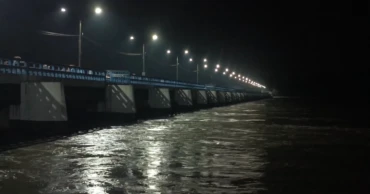
The water level of the Teesta River has risen above the danger mark at the Dalia Barrage point following fresh upstream inflows, prompting fears of flooding in low-lying areas downstream.
Although the river's water level had declined slightly over the past few days, it started rising again on Thursday. At 6 pm, the water level at the Dalia point of the Teesta Barrage, the country's largest irrigation project, was just 1 centimetre below the danger level. By 9 pm, however, it had crossed the danger mark and was flowing 3 centimetres above it.
According to data recorded at 9 pm, the river's water level at the Dalia point stood at 52.18 metres against the danger level of 52.15 metres.
The rising water level has renewed concerns among residents of char areas and other low-lying regions, who have already been alerted about the possibility of flooding.
Local people said they had begun to feel relieved as the river receded slightly over the past few days, but Thursday night's rise above the danger level has once again heightened fears of inundation.
Nurul Islam, in-charge of the Dalia Barrage point, said the Teesta's water level was fluctuating depending on the volume of upstream inflow.
He said the Bangladesh Water Development Board (BWDB) is monitoring the situation round the clock and has advised people living in vulnerable riverside areas to remain alert.
The BWDB warned that the river's water level could rise further if heavy rainfall continues upstream, adding that necessary preparations have been taken to deal with any flood situation.
3 months ago
6,000 families stranded in northern districts as flood submerges low-lying areas
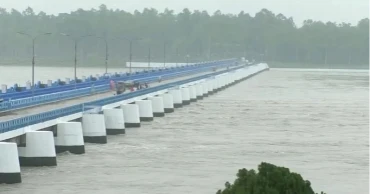
Water levels in the Teesta River continued to rise on Tuesday due to heavy rainfall and upstream inflows, bringing the river close to the danger mark and inundating low-lying areas in several northern districts.
At least 6,000 families living in char areas of Rangpur, Lalmonirhat, Kurigram and Gaibandha districts have become stranded by floodwaters, said Ahsan Habib, Superintendent Engineer of Bangladesh Water Development Board (BWDB).
With water pressure increasing, authorities have opened all 44 gates of the Teesta Barrage at Dalia in Lalmonirhat's Hatibandha upazila to regulate the flow.
BWDB officials said the river was flowing 15 centimetres below the danger level at the Dalia point at 12pm on Tuesday, with a recorded water level of 52.00 metres.
Earlier, the water level was recorded at 52.05 metres at 9am, 10 centimetres below the danger mark, and just 5 centimetres below the danger level at 6am.
Residents along the Teesta river fear further flooding if water levels continue to rise.
Several low-lying areas in Hatibandha upazila in Rangpur, including Goddimari, Doani, Saniyajan, Nij Sheikh Sundar, Bagher Char, Singimari, Dhubni, Sindurna, Patikapara and Dauabari, as well as Shailmari, Char Bairati and Rudreshwar in Kaliganj upazila and Mahishkhocha, Gobardhan and Sparbandh areas of Aditmari upazila, have already been inundated.
Agricultural lands in Teesta char areas of Rangpur's Gangachara, Kaunia and Pirgachha upazilas, along with parts of Kurigram and Gaibandha districts, have also gone under water.
Peanut fields, Aman seedbeds, sweet pumpkin plantations and other crops have been damaged, causing concern among farmers.
Farmers said fluctuating river levels have added to their worries, as many seedbeds prepared for the upcoming Aman cultivation season are being damaged by floodwater, forcing them to consider replanting.
Rangpur Divisional Commissioner Shahidul Islam said some families living on riverine chars have become stranded and local union parishad chairmen have been instructed to prepare lists of affected households.
"Dry food assistance will be distributed as soon as we receive the lists," he said.
Amitav Chowdhury, Executive Engineer of Water Development Board in Dalia, said the Teesta's water level remained below the danger mark but could rise further during the day due to continued rainfall and upstream flows.
"The river was flowing 10 centimetres below the danger level at 9am and is now 15 centimetres below the danger mark. Water levels may increase further as rainfall continues," he said.
3 months ago
Silt-borne fertility transforms northern Bangladesh
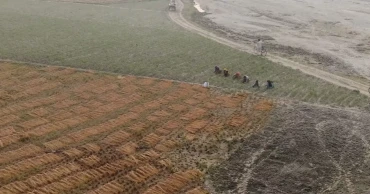
As floodwaters receded across northern Bangladesh, the newly deposited silt has turned the sandy river islands of the Teesta, Dharla, Saniyazan and Brahmaputra—known locally as chars—into fertile land, sparking a surge in cultivation.
According to the Department of Agricultural Extension, the northern rivers contain nearly 786 char areas and communities living there have begun to rebuild their livelihoods following the recent floods.
Agriculturist Sirajul Islam, Additional Director of the Rangpur agricultural region, says this year’s cultivation target for the chars has been set at 36,911 hectares, with an expected output of 362,000 tonnes of various crops.
“Char residents are likely to recover through this year’s harvest. A single crop can sustain many families for an entire year,” he explains.
A Season of Intense Activity
Across the Teesta’s char zones in Lalmonirhat, Rangpur, Kurigram, Gaibandha and Nilphamari, farmers are working round the clock, Sirajul Islam said.
Read more: Overuse of chemical fertilisers threatens soil health in northern Bangladesh
Large tracts have already been planted with potatoes, aubergines, chillies, onions, ginger, garlic, beans, coriander, carrots, cabbages, radishes, gourds, wheat, sesame, linseed, mustard and maize, he said.
Growers say they anticipate good yields from almost all varieties this season.
In Ichli char of Gangachara, Rangpur, farmer Hossain Mia has planted potatoes on three bighas of land, aubergines on another three bighas and coriander on 20 decimals.
“If the yields are satisfactory, I expect to earn around Tk 1.5 lakh after covering costs,” he said.
Local growers Habibur, Rahim and Khairul echo similar expectations, noting that each of them could make Tk 60,000 to Tk 70,000 in profit if the season is favourable.
Storage and Market Access Remain Major Obstacles
Abdullah Al Hadi, Chairman of Lakshmitari Union Parishad, describes the Teesta’s chars as a “growing agricultural zone”, with fresh produce already reaching local markets.
Many more farmers have begun cultivating again.
Read more: Sand syndicates tighten grip on Bangladesh's northern region
He, however, highlights a persistent challenge: the lack of storage, processing facilities and proper market access.
“This is the biggest frustration for char farmers. Without cold storage, transportation and processing facilities, they are deprived of fair profits,” he said.
He believes the region requires two to three cold storages, while Gangachara currently has only one. Poor connectivity also prevents farmers from transporting goods easily to nearby markets.
Power of Nutrient-Rich Silt
Agriculture officer Tushar Kanti explains that the silt deposited on the Teesta’s chars has made the soil exceptionally fertile.
Many crops are flourishing even without chemical fertilisers. Maize, wheat, potatoes, chillies, onions, garlic, mustard, sesame, linseed and a wide range of vegetables are being grown in abundance, he said.
Read more: Hidden hands in the fields: Dealers blamed for artificial fertiliser shortage in north
Dr Tuhin Wadud, Professor at Begum Rokeya University and a long-time researcher on char lands, says that the post-flood silt left behind on these islands is “extremely fertile”.
As a result, he said, farmers in the region often witness bumper harvests following floods. But he points out that limited transport links continue to hinder farmers from securing fair prices.
He believes dredging the Teesta and other major rivers could bring long-term benefits: “If the rivers were properly excavated, more char lands would emerge, offering northern communities significant economic opportunities.”
Prospects Worth Tk 200 Crore
Agricultural officials estimate that crops from more than 786 char areas across eight northern districts could generate Tk 200 crore in revenue this season.
Field officers from the agricultural department are providing technical assistance and financial incentives, and officials say support has already been extended to char farmers affected by the floods.
Read more: Polyshade tomato farming reviving Narail’s rural economy
10 months ago
Teesta Dam ‘renovation’ in Rangpur turns into a 'sand bonanza'
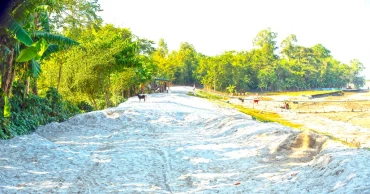
A Tk 1.5-crore project to renovate a vulnerable Teesta River dam in Nohali Union, Rangpur, has turned into a hub of illegal sand extraction, political involvement and profit-making, raising concerns among locals.
Instead of reinforcing the embankment, influential groups and contractors are allegedly using the project to extract sand illegally. Locals describe it as a ‘sand looting festival’.
The Water Development Board (Rangpur Zone) said the UNDP allocated Tk 1,38,94,085 to renovate a 1,206-metre stretch.
Read more: Govt moves to modernise BSTI labs with Tk 851.93cr project
Contractor Hasibul Hasan was officially in charge, but subcontractor Bharat Prasad is actually doing the work. Multiple irregularities have already been reported. No public notice board, required by law, was displayed at the site.
Locals claim the work is proceeding secretly with the knowledge of PAUBO Executive Engineer Rabiul Islam.
The official plan called for profiling the embankment with bamboo, pegs, and coconut-husk ropes, bringing soil from distant areas, and planting grass and tree seedlings. Instead, a 300-metre stretch has been filled only with sand, and a dredger is being prepared to extract sand directly from the river.
Day labourer Serajul Islam said, “Four of us work here extracting sand for Tk 3,000 per day. The Executive Engineer knows about it.”
Residents say local political figures, including UP Chairman Ashraf, former member Wahed, UP member Bakul (BNP), and member Azharul, are involved in the illegal sand removal. Most of the sand is sold outside, not used for the embankment.
A 70-year-old former WDB employee warned that continued sand extraction could destroy homes in future floods. Attempts to protest were reportedly stopped by the Executive Engineer.
Read more: Project launched to boost climate resilience, food security in Cox’s Bazar
Subcontractor Bharat Prasad admitted he is managing the work through local political leaders and had paused site visits due to disputes over bamboo supply. UP member Azharul Islam claimed, “We are all working together; there is no problem.”
Other local political leaders, including Ashraf Ali (Jatiya Party), Chand Sarker (BNP), Rifat Chowdhury (NCP), and Nayebuzzaman (Jamaat-e-Islami), denied involvement.
PAUBO Executive Engineer Rabiul Islam initially defended sand extraction but later admitted irregularities and said he halted the work, ordering sand removal and proper reconstruction.
UNO Mahmud Hasan Mridha said an investigation will be conducted, with action taken as needed, supported by Rangpur Deputy Commissioner Mohammad Enamul Ahsan.
Read more: Teesta cries for survival as northern Bangladesh’s lifeline runs dry
10 months ago
Sand syndicates tighten grip on Bangladesh's northern region
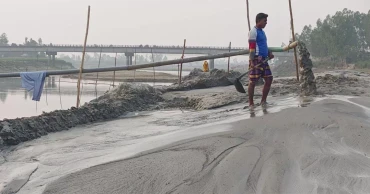
Once vibrant lifelines for northern Bangladesh, the Teesta, Dharla and Jamuneswari rivers are now being ruthlessly stripped of sand by illegal dredging syndicates operating under the shadow of political protection and administrative inaction.
Despite a standing government ban on sand extraction from these ecologically sensitive rivers, dredgers continue to roar day and night, turning riverbeds into pits as deep as 60 to 70 feet in some areas and transforming others into barren, desert-like highlands.
Locals allege that the trade in stolen sand thrives not just because of political shelter, but also due to police complicity and the negligence of local administrations.
“Police and administration officials take commissions at night. Everyone gets their share,” said one sand lifter in Badarganj upazila, requesting anonymity.
During a recent visit to the Rajarampur Kashiganj area in Rangpur’s Badarganj upazila, dredgers were seen extracting sand openly from the Jamuneswari River.
Legal notice served to stop sand extraction from Kalidas Pahalia in Feni
Local residents claimed the operation has continued for nearly six years — first under the influence of local Awami League leaders and now reportedly under a local BNP leader’s patronage, after ‘managing’ the police.
“Even when the UNO raids in the morning, dredgers return by afternoon with police help,” said a villager.
Local administration officials, however, insist that they are actively working to stop illegal dredging.
“Sand extraction is completely prohibited. Mobile courts are being conducted wherever we receive reports,” said Rangpur Divisional Commissioner Shahid Islam.
Gongachara Upazila Nirbahi Officer (UNO) Mahmudul Hasan Mridha said several dredgers were recently seized and destroyed during operations in the Teesta.
26 dredging machines seized for illegal sand extraction from Feni River
11 months ago
Teesta cries for survival as northern Bangladesh’s lifeline runs dry
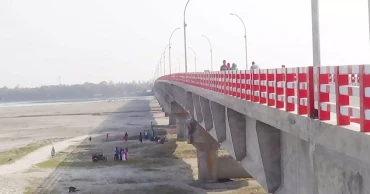
Once a mighty river that breathed life into northern Bangladesh, the Teesta now lies silent and broken, as its shimmering waters replaced by stretches of sand and its flow reduced to a faint memory for the millions who once depended on it.
The lifeline of two crore people lies gasping for breath as its waters vanishing, its banks eroding and its people left clinging to the memories of a river that once defined their existence.
Once a symbol of abundance, locals said, the Teesta today survives only in fragments, swelling briefly during monsoon, then receding into a barren desert of cracked sandbanks as winter approaches. The river’s decline has plunged the lives of Teesta basin residents into uncertainty, threatening their farms, fisheries and future.
By late October, the mighty Teesta had already dried up, long before the arrival of the dry season.
According to the Water Development Board (WDB), water flow at the Teesta Barrage point over the past 10 days averaged only 17,000 cusecs and continues to drop daily.
As the water disappears, so too does the livelihood of thousands. Farmers and fishermen along the Teesta’s banks say they are ‘dying along with the river’, WDB officials said.
Experts trace the beginning of this decline to the construction of India’s barrages at Gajoldoba near the Teesta’s entry point and at Doani in Lalmonirhat, which disrupted the river’s natural flow. Over time, its life-giving waters have been diverted through canals, leaving vast stretches of the riverbed dry.
Standing along the Teesta today, one can almost hear what locals describe as the ‘sigh of a dying river’, echoing across endless sand where strong currents once flowed.
Youth in Lalmonirhat stage flash mob demanding ‘Teesta Mega Project’
The river’s navigability has dropped so drastically that irrigation under the Teesta Barrage — the country’s largest irrigation project — may face severe challenges in the coming dry season. Large parts of the riverbed now lie exposed, marked only by shallow pools and scattered dunes, according to the officials.
Originating from Himalayan glaciers, the Teesta flows through India’s Sikkim, Darjeeling and Jalpaiguri before entering Bangladesh through Dahagram in Lalmonirhat. From there, it meanders through Nilphamari, Rangpur and Gaibandha before merging with the Brahmaputra. Once, its fertile chars produced rice, jute, maize, sesame and vegetables in abundance, shaping the region’s agriculture, culture and livelihoods.
However, the construction of the Gajoldoba Barrage in 1983 disrupted Teesta’s natural course — triggering water shortages in dry months and devastating floods in monsoon.
According to WDB data, more than 20,000 families have been displaced by river erosion in the past decade, with nearly 35 kilometres of riverbank severely eroded. Recently, a 350-metre stretch of the Teesta bridge protection embankment at Mahipur in Lalmonirhat caved into the river.
In Kurigram’s Ulipur upazila, over 100 homes have been lost to erosion, while in Gangachara more than 50 families have been displaced. Hundreds more remain marooned in four villages of Rajarhat upazila.
For years, residents of northern Bangladesh have taken to the streets under the slogan ‘Save Teesta, Save North Bengal’.
Environmental activists and locals have recently organised human chains, sit-ins and torch processions across Rangpur division, demanding immediate action.
Movement intensifies as Teesta activists announce ‘Silent Rangpur’ campaign in 5 districts
11 months ago
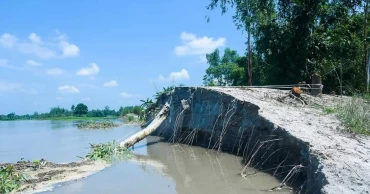
Thousands in agony as Teesta devours homes, farmland in north
In northern Bangladesh’s remote riverine belts, the once life-giving Teesta River now mercilessly swallows homes, farmland and hope, leaving entire communities on the brink.
Over the past few weeks, as the river’s water level rose and fell, erosion has grown more vicious, snatching away the last fragments of security from countless farming families in Rangpur, Kurigram, Lalmonirhat, Gaibandha and Nilphamari.
Arable land has vanished, homesteads have crumbled into the swirling current and with them, memories and sustenance of generations have been swept away.
According to the Rangpur divisional office of the Water Development Board (WDB), 59 houses in the five districts have been swallowed in just the last seven days.
More than 100 others stand at the edge, facing the same fate, their occupants warned to evacuate before the inevitable.
Teesta surges above danger mark, floods low-lying areas in Rangpur
Officials say erosion is now striking at 38 points along the Teesta. Emergency protection work is underway, but for many, it already feels too late.
On the cracked, collapsing riverbank in Kutirpara village, 65-year-old farmer Akbar Ali sat silently, his gaze fixed on the soil sliding into the current.
His voice broke as he told the UNB correspondent, “This land is all I have left from my father. The water is falling, but the erosion is rising.”
In Balapara village, elderly farmer Monsur Ali could barely utter the weight of his loss. “The Teesta has swallowed my homestead. I’ve lost everything -- my land, my home. I am left with nothing.”
Nearby, 45-year-old Alema Khatun wept openly, her words trembling with desperation. “Save us, our lives are finished. The river has taken everything. Where will we go? What will we eat? The river will take the rest soon.”
For Tasor Uddin, once a resident of land now buried beneath the river’s bed, the nightmare is unending. “The erosion has reached right beside my current house. It may fall into the river any moment. The government officials just come and give us words,” he said in a sad voice.
Another villager, Abul Hossain, voiced what many here feel. “We don’t want relief; we just want protection. If sandbags had been placed along the bank earlier, the river wouldn’t have taken our land,” he said.
The pain is just as raw for Mensur Ali, 56, from Tepamdhoopur in Kaunia upazila. Years ago, he bought 25 decimals of land to build his home.
Now, 20 decimals are gone, washed away. “Only five decimals remain and even that is at risk of being washed away tonight. If the river takes my homestead, I’ll have nothing left,” he said.
Flood fear looms over northern districts as Teesta swells
Tepamdhoopur Union Parishad Chairman Rashedul Islam painted a grim picture saying, “Villages like Rajib, Haricharan Sharma, Hoybatkha, and Bishwanath are being eaten alive by the river. We sought 4,000–5,000 geo-bags for protection but received only 250 --far short of the need.”
In Nilphamari’s Dimla upazila, six out of ten unions are flood-prone, with erosion striking even without major flooding. Villages like Purbo Duholpara and Purbo Baishpukur teeter on the brink. Residents say that if no measures are taken soon, they will be reduced to destitution.
Ahsan Habib, superintendent engineer of the WDB Rangpur zone, said 38 points across the five districts are experiencing severe erosion. “We are carrying out protection work in some areas and have sought more allocations. Once we get them, geo-bag dumping will begin.”
Rangpur Divisional Commissioner Shahidul Islam said the local administrations have been instructed to visit affected areas and take urgent measures, while the WDB has been ordered to intensify work to curb the destruction.
But for the thousands standing on collapsing embankments, watching their land crumble inch by inch, hope is fading fast, said Chairman Rashedul Islam.
For them, the Teesta’s slow, steady bite feels less like nature’s course and more like a death sentence.
1 year ago
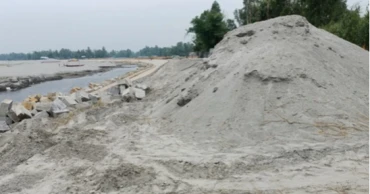
Illegal road construction using Teesta sand sparks outrage in Lalmonirhat
An illegal road project cutting through fertile farmland in Kaliganj upazila of Lalmonirhat district is drawing sharp criticism, as sand dredged unlawfully from the Teesta River is being used for its construction.
The construction, carried out with high-powered dredgers locally known as ‘bomb machines’, has triggered concerns over environmental degradation, infrastructure damage and the threat of large-scale erosion.
Despite repeated complaints from local residents, the activity continues unabated, allegedly backed by a politically connected syndicate.
The project not only violates environmental regulations but is also viewed as a direct threat to public resources and livelihoods.
A road built on sand literally
The road, currently under construction through cropland in the Munshir Bazar area of Tushbhandar Union, is being built entirely with sand illegally extracted from the Teesta River.
Locals report that the builders are presenting the project as a "voluntary community initiative" to avoid legal scrutiny. But, many believe the primary motive is to ease sand transportation for commercial purposes.
Witnesses confirm that several dredging machines operate around the clock, disrupting the river’s natural flow.
Locals warn that the river is already shifting course, putting hundreds of acres of farmland at immediate risk.
“Sand traders are building this road by destroying our farmland and threatening our future,” said Saiful Islam, a 70-year-old resident. “They’re using muscle power while the administration looks the other way.”
Bamboo breathes new life into Madaripur’s barren lands, rural livelihoods
Legacy infrastructure at risk
The illegal road runs parallel to a government-built road and bridge constructed over a decade ago as part of a Tk 30 lakh project by the Ministry of Disaster Management and Relief.
Originally intended to serve a cluster village (Guchhogram) for landless families, the road and bridge have remained crucial transport links between Kaliganj upazila and neighbouring Gangachara upazila in Rangpur district, even after the original settlement was swallowed by the river.
Over the years, the government has invested millions of taka in repairs to support local transport and agriculture. That legacy is now under threat.
Heavy sand trucks have already caused severe damage to the government road, leaving it riddled with potholes and virtually unusable during the monsoon.
In protest, locals recently imposed a ban on truck movement. In retaliation, the syndicate reportedly began building the new road across cultivable land. “If this continues, the government-built bridge will become useless, and our fields will flood due to blocked drainage,” warned a local resident.
Syndicate operating with impunity
Locals allege that the sand extraction and illegal construction are being carried out by a syndicate previously backed by former Social Welfare Minister Nuruzzaman Ahmed during the Awami League tenure.
Though he no longer holds office, his former associates are reportedly continuing operations without consequence. “The government road has been destroyed for their benefit, and now they’re taking our farmland too,” said KM Ar Shahin, a local community leader.
Frustrated by the lack of action, residents have organised several human chains and submitted written complaints to the local administration.
Authorities acknowledge the issue
Kaliganj Upazila Nirbahi Officer (UNO) Zakia Sultana told UNB that the administration is aware of the situation and maintains a zero-tolerance policy towards illegal sand extraction.
“Whenever we receive reports, we conduct mobile court drives. But the sand traders often flee before we arrive. There is absolutely no permission for building a new road over arable land,” she said.
The UNO confirmed the receipt of a written complaint and assured that there will be a formal investigation into the matter.
1 year ago

Teesta's water level crosses danger mark in Kurigram, short-term flood predicted
Teesta river's water level has surged 41 cm above the danger mark in Kurigram district, while water levels of Brahmaputra, Dudhkumar, and Dharla rivers are also on the rise.
The escalating water levels have instilled fears of potential flooding among the residents living along the riverbanks.
Kurigram Water Development Board has forecast short-term flooding.
Teesta's water level crosses danger mark, triggers flooding in Lalmonirhat
According to the district’s Water Development Board, Brahmaputra river's water level is currently 72 cm below the danger mark at the Nunkhawa point, 58 cm below the limit at the Chilmari point, and Dharla river's water level is 97 cm below the danger limit at the Kurigram Sadar point.
However, at Kaunia Point, Teesta river's water is surging 41 cm above the danger level.
Low-lying areas including Begumganj, Nayarhat, and Saheber Alga in the Ulipur upazila of the district have already been inundated due to the increased water levels.
Irrespective of whether the water level of Teesta river rises or decreases, erosion stays persistent and the residents of the riverside areas run from rising waters all year round.
Teesta erosion worsens in Kurigram; 50 homes swept away
Md. Noor Alam, a resident of the Goraipia area near Teesta river, expressed his concerns about the rising water levels over the past few days, particularly for the paddy fields.
“Whether the water of the Teesta river rises or recedes, river erosion persists, and the year-round struggles of the Teesta Par community go unnoticed,” he lamented.
Surman Ali from Khitab Khan village echoed the same and expressed distress over the continuous rain and rising water levels.
“The incessant rainfall coupled with the rising Teesta water has submerged our lives again, along with our cattles,” he said.
Abdullah Al Mamun, executive engineer of the Water Development Board, attributed the rising river water to heavy rainfall in India’s Assam and Arunachal.
Teesta flowing 20cm above danger level in Lalmonirhat, several hundred families stranded
He said that the onrush of hill water and heavy rainfall in the region have caused the Teesta river's water level to surpass the danger level. He also said that Brahmaputra river's water might reach the danger mark in the coming days.
While the forecast predicts short-term floods in certain areas of the district, including some unions of Ulipur and Chilmari upazilas, Mamun said that despite the water crossing danger levels, a major flood event is not likely to occur.
Kurigram’s Deputy Commissioner Mohammad Saidul Arif said that comprehensive preparations have been undertaken to manage potential flood situations. All necessary arrangements, including food aid, rescue boats, and shelters, have been organized to ensure residents’ safety, he added.
3 years ago

Rise in Teesta water may cause short-term flood in Lalmonirhat, Nilphamari in 24 hours: FFWC warns
Water in the Teesta river may cross the danger level at Dalia point over 24 hours, causing a short-term flood in the low-lying areas of Lalmonirhat and Nilphamari districts.
Flood Forecasting and Warning Centre (FFWC), in its regular bulletin, said the Brahmaputra-Jamuna and the Ganges-Padma rivers are in a rising trend, which may continue over 48 hours and water in the Dhalai river may cross danger level at Kamalganj point for a short period over 24 hours, starting from 9 am on today (July 05, 2023).
All gates of Teesta Barrage opened due to increase in water level
Besides, major rivers in the northeastern region of the country are in a falling trend except Khowai, Someswari and Dhalai, which may continue over 48 hours, the bulletin said.
Flood submerges 10 villages in Sunamganj, rain continues
The ongoing flood situation in Sunamganj and Netrokona districts may remain unchanged in 24 hours, it said.
Heavy rains may trigger short-term flood in Sylhet, Sunamganj
3 years ago