haor farmers
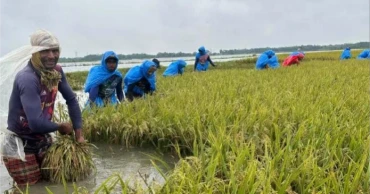
Farmers in tears as flash floods inundate Boro crop in Chhatak haors
An early wave of flash floods, triggered by upstream hill runoff and days of relentless rain, has inundated vast stretches of haor land in Chhatak upazila of Sunamganj, leaving thousands of farmers staring at devastating crop losses.
Within hours of heavy rainfall from Saturday morning, water levels rose sharply across the low-lying wetlands, submerging ripened boro paddy—the region’s primary and often only annual crop.
The sudden flood has turned once-golden fields into an endless expanse of water,said farmers.
Villages under Chormohalla union—including Buraigiri, Boroghatti, Bagachhara, Gojahati, Baruka and Ura beel—are now largely underwater.
The situation worsened dramatically after a key embankment at Khaner Badh in Boroghatti beel collapsed, sending torrents of water rushing into nearby fields and submerging nearly 400 acres of mature paddy in a short span.
“I watched my paddy go under water right before my eyes,” said Abdus Sobhan, a farmer from Buraigiri, holding a handful of soaked rice stalks.
“This boro crop was our only hope for the year. Now there won’t even be enough rice to feed my family.”
Abul Kalam, a farmer from Srinagar village, said his 17 bighas of land—along with nearly 200 bighas in his village—have been completely submerged. “It breaks my heart. I don’t know how we will survive this,” he said.
Similar scenes have been reported from multiple haors across unions such as Kalaruka, Uttar Khurma, and Dakshin Khurma.
Areas including Jhawar beel, Borobara, Puraidubi, Banderlama, Bhathgaon, Jauabazar, and Singchapair are all grappling with the same crisis.
Many farmers said the rapid rise in water left them with no time to harvest their crops.
Official estimates from the upazila agriculture office state that a total of 14,996 hectares were cultivated with boro this season—3,382 hectares in haor areas and 11,614 hectares in non-haor lands.
As of May 1, officials said 2,513 hectares in haor areas and 3,833 hectares in non-haor areas have already been harvested.
However, farmers on the ground contest these figures, alleging that the official data does not reflect the scale of devastation.
“Large parts of Chormohalla and surrounding areas are now under water. Thousands of hectares of ripe paddy have been lost,” said Advocate Abdul Ahad, a local resident and additional public prosecutor at the Sunamganj Judge Court. “The government estimates are far from the reality.”
Farmers also blamed poor water management for aggravating the disaster.
They alleged that inadequate drainage systems, silted canals, absence of functional sluice gates, and weak embankments have made the haor areas highly vulnerable.
“Even if the rain stops, the water has nowhere to go,” said a farmer in Boroghatti. “On one side there is hill runoff, and on the other, broken embankments—our crops are trapped in between.”
The crisis has been compounded by an acute shortage of agricultural labourers during the peak harvesting season, said farmers.
With fewer seasonal workers arriving this year, many farmers took to the fields themselves. But rising water levels and strong currents have made it nearly impossible to salvage the submerged crops.
As the waters continue to rise, uncertainty looms large over the livelihoods of thousands of farming families in Chhatak’s haor belt, where a single crop failure can push households into prolonged financial distress.
5 months ago

Govt to provide three months’ food assistance to flood-hit haor farmers: Minister
The government will provide food assistance for three months to farmers in haor regions affected by flashfloods and onrush of hilly water, Disaster Management and Relief Minister Asadul Habib Dulu said on Sunday.
As per the directives of the Prime Minister the food assistance will be provided to the affected farmers, he said.
The Agriculture Ministry has also been instructed to take rehabilitation measures, he said while speaking as the chief guest at the inauguration of ‘Bidyanondo Self-Employment Project 2026’ Shaheed Abul Kashem College ground in Lalmonirhat district.
Lists of affected farmers are being prepared in districts including Kishoreganj, Netrokona, Sunamganj, Habiganj, Sylhet and Brahmanbaria, said the minister.
Besides, special cards will be issued to enlisted farmers, enabling them to receive monthly assistance, he said.
The formal launch of the programme will take place on May 6 in Sunamganj, he added.
Bidyanondo Foundation distributed income-generating support materials among 101 underprivileged families.
The assistance included shop goods, vans, cattle and sewing machines aimed at improving livelihoods.
5 months ago

Govt to support rain-hit haor farmers for three months: PM Tarique
Prime Minister Tarique Rahman on Wednesday told Parliament that the government will provide assistance for the next three months to farmers affected by ongoing heavy rain in three haor districts and parts of Mymensingh.
“We will try to support them (affected farmers) for the next three months,” he said while replying to a question from treasury bench MP Kalim Uddin Ahmed.
The MP drew the Prime Minister’s attention to the worsening situation in his area, saying that continuous heavy rainfall has submerged haor areas, including Sunamganj. “Our farmers are struggling in the fields to harvest their paddy. I urge the government, especially the Honorable Prime Minister, to extend support.”
In response, the Prime Minister said earlier in the morning, before the session began, he discussed the matter with the Disaster Management Minister.
He said he instructed the minister to identify farmers in the three affected haor districts, as well as in some parts of Mymensingh who have suffered crop losses due to heavy rainfall so that assistance can be provided.
He also noted that three days earlier, based on weather forecasts, he directed the local administration in the haor districts to make the necessary preparations to handle any situation arising from heavy downpours.
The Prime Minister described the situation facing haor farmers and their losses as “painful”.
5 months ago
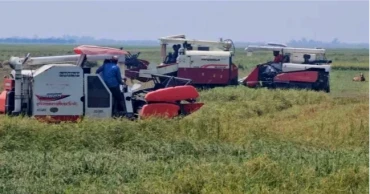
Diesel crisis, fuel price hike deepen harvesting woes for haor farmers
A diesel shortage coupled with the recent hike in fuel prices has sharply increased the cost of harvesting Boro paddy in the haor regions of northeastern Bangladesh, leaving farmers struggling to bring in their crops on time and facing mounting financial losses.
Although the harvesting season has already begun across Sylhet division, many farmers say they are unable to cut their paddy in time due to a lack of fuel and soaring machine rental costs, raising fears of crop damage from untimely rain or early flooding.
According to the Department of Agricultural Extension (DAE), a total of 2,23,511 hectares of land across 137 small and large haors in 12 upazilas of Sunamganj district were brought under Boro cultivation this year, with a production target of 14 lakh metric tons.
With farmers increasingly dependent on combine harvesters to quickly harvest crops in the flood-prone haor areas, rental charges for the machines have risen steeply.
Farmers said where harvesting one acre of land cost Tk 4,500 to Tk 5,000 last year, it has now increased to Tk 7,500-Tk 12,000, with some areas seeing even higher rates.
According to the DAE, a total of 1,473 combine harvesters are currently active across the four districts of Sylhet division, but authorities say the number remains insufficient compared to the demand.
Selim Reza Chowdhury, a farmer of Rajapur union in Dharmapasha upazila of the district, said though the yield is good this year, farmers are facing the greatest difficulty during harvesting.
“Even after offering up to Tk 12,000 per acre, we often cannot get a harvester. Costs are increasing every day and there is always the fear of rain or early flooding damaging the crops,” he said.
Besides, rice prices have not increased proportionately despite rising input costs, including fertiliser, seeds, irrigation and harvesting, pushing many farmers towards financial losses and debt.
Abdul Karim, another farmer said they are being forced to wait for available machines, with many farmers booking harvesters in groups due to the shortage.
Harvester owner Moinul Islam from Balijuri area of Tahirpur upazila said the situation is equally challenging for operators.
“Machines cannot run without diesel, but we are not getting sufficient fuel from dealers even after obtaining permits from agriculture offices. As a result, we are buying diesel from the open market at higher prices,” he said, adding that maintenance costs have also increased.
Jahangir Alam, a harvester operator, said it has become difficult to meet demand despite working day and night due to fuel shortages.
Deputy Director of the Sunamganj DAE Mohammad Omar Faruk said there is no actual fuel shortage in the district, but distribution complexities under a controlled system have created some disruptions.
Fuel is being supplied based on certification and administrative coordination is ongoing to stabilise the situation, he added.
5 months ago
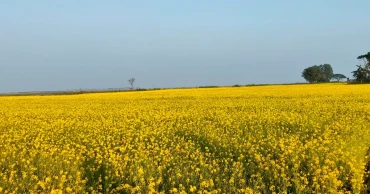
Haor farmers reap early gains as mustard cultivation flourishes in Sunamganj
A vast golden carpet has spread across the haor wetlands of Madhyanagar upazila in Sunamganj, as a bumper mustard harvest this season brings renewed hope and financial relief to local farmers.
The low-lying fields, riverbanks and wetlands of Banshikunda Uttar and Dakshin, Chamardani and Madhyanagar Sadar unions are now awash with bright yellow mustard flowers, transforming the landscape into a striking spectacle that is also drawing curious visitors.
Mustard, widely known as a low-cost and high-profit oilseed crop with a short growing cycle, has gained growing popularity among farmers in the haor region.
According to the Madhyanagar upazila agriculture office, mustard was cultivated on around 550 hectares of land this season, with officials optimistic about meeting, and possibly exceeding production targets.
Read more: Chuadanga farmers thrive as cauliflower yields hit new high
For many farmers, the shift towards mustard has been driven by rising production costs and price uncertainty surrounding paddy and other staple crops. “We often suffer losses from rice cultivation due to high input costs and unstable market prices,” said one farmer. “Mustard needs less investment, grows quickly and sells well. It is safer for us.”
As a result, mustard cultivation has expanded significantly in fallow lands and haor-adjacent areas this year, making productive use of land that often remains uncultivated after the monsoon.
The agriculture office said sowing typically begins at the end of Kartik, with harvesting completed by mid-Poush, allowing farmers to earn returns early in the season.
Even before harvesting the seeds, farmers generate additional income by selling mustard flowers and leaves, which are used locally to prepare dishes such as bora (fritters) and leafy vegetables.
After harvesting, the dried stalks are sold as fuel, further adding to household earnings.
Read more: Sirajganj’s mustard fields bloom into golden seas, promise bumper harvest
Upazila Deputy Assistant Agriculture Officer Akmal Hossain said the outlook remains positive. “Like previous years, the mustard production target has been achieved. If there is no major pest or disease outbreak, farmers can expect a bumper harvest,” he said.
He said timely distribution of fertilisers and seeds under government incentive programmes ensured smooth cultivation this season.
Across Bangladesh, mustard cultivation has emerged as a profitable rabi-season crop, particularly in districts such as Magura and Narail.
With the Bangladesh Agricultural Research Institute (BARI) keeps on developing high-yielding mustard varieties to support the farmers and keep up the encouraging growth trend, farmers have responded equally with the adoption of improved seeds and modern techniques.
Mustard farming is playing an increasingly vital role in Bangladesh’s agricultural economy with the country striving to reduce its dependence on imported edible oil, officials said.
Read more: Naogaon farmers make a fortune on mustard and honey
9 months ago
.jpg)
62pc haor paddy harvested: Agriculture Ministry
Farmers in haor areas of the country have already harvested 62 percent paddy from fields till April 27, said the Ministry of Agriculture.
6 years ago