Post-LDC era
NBR eyes bonded facilities for toy industry
The National Board of Revenue (NBR) has said it is working to simplify policies and expand bonded facilities for promising sectors like toy manufacturing, as the Dhaka Chamber of Commerce and Industry (DCCI) seeks a clear policy framework to boost exports in the post-LDC era.
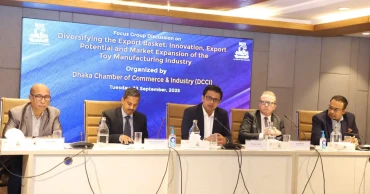
Speaking at a focus group discussion (FGD) on ‘Diversifying the Export Basket: Innovation, Export Potential and Market Expansion of the Toy Manufacturing Industry’ at the DCCI auditoriums on Tuesday, NBR Member (Customs: Policy & ICT) Muhammad Mubinul Kabir said the revenue authority imposes tariffs in line with the 2023 Tariff Policy and aligns its strategies with donor recommendations to strengthen efficiency and overall capacity.
He said the government may consider providing policy support for toy manufacturing in the upcoming budget although there is little scope for mid-year policy changes.
“The RMG sector has enjoyed policy support for the last 40 years, but now it is time to rethink its capacity. Toy entrepreneurs should also focus on enhancing their own skills, innovation, and product development rather than relying solely on government incentives,” he added.
British High Commission’s Deputy Development Director Martin Dawson said Bangladeshi toys have strong export potential and the UK government is keen to cooperate.
He expressed the hope that if policy barriers are removed, exports to the UK could multiply, particularly as the UK has recently simplified Rules of Origin requirements.
Presenting the keynote paper, Shamim Ahmed, President of Bangladesh Plastic Goods Manufacturers and Exporters Association (BPGMEA), said the domestic toy market is worth nearly Tk 400 billion, with around 250 of the country’s 5,000 plastic enterprises engaged in toy manufacturing, employing about 1.5 million people. Exports from this sector reached USD 276 million in FY 2023-24, up from just USD 15.23 million in FY 2016–17.
Adviser Salehuddin defends central bank’s $2 bln dollar market mop-up
Despite this growth, toy exports stood at only USD 77 million in FY 2022–23 against a global market of over USD 100 billion.
Shamim highlighted lack of product quality assurance, poor infrastructure, and lagging innovation as major challenges. He stressed cluster development, joint venture investment, infrastructural expansion, toy-specific policy formulation, and reduction of supplementary duties on machinery.
Industry representatives including Md Juhirul Islam Shimul (Redmin Industries Ltd), Musa Bin Tareque (Hashy Tiger Company Ltd), Dr Abdullah Al Mamun (Department of Environment), Md Anisur Rahman (Premiaflex Plastics Ltd), Yasir Obaid (Cupcake Exports Ltd), and Belal Ahmed (Golden Son Ltd) also shared recommendations ranging from tariff cuts and bank interest reduction to strengthening supply chains, ensuring IPR and involving academia in research.
Officials from the Ministry of Commerce, Ministry of Industries, and Bangladesh Trade and Tariff Commission (BTTC) echoed the need for better intellectual property protection and patent practices to sustain in the post-LDC era.
DCCI Senior Vice President Razeev H Chowdhury, Vice President Md. Salem Sulaiman, members of the Board of Directors and industry representatives were present at the event.
1 year ago

Post-LDC era: BGMEA seeks British lawmakers' support to retain market access
Bangladesh Garment Manufacturers and Exporters Association (BGMEA) President Faruque Hassan has sought the British lawmakers' support for the continuation of duty-benefit for the country after it graduates from the least developed countries (LDCs) category.
He met with UK lawmakers Rushanara Ali and Rupa Huq in London Saturday.
They discussed various issues, including cooperation between the UK and Bangladesh on LDC graduation, possible changes in the tariff regime and how Bangladesh can retain its access to the UK market in the post-LDC era.
Read: BGMEA chief urges UK buyers to raise prices
During the meeting, Faruque stressed the need for engagement of non-resident Bangladeshis (NRBs) in the development of the country.
He said NRBs have the immense potential to contribute more to Bangladesh's development with their skills, technical expertise, knowledge and investment.
Many UK-based NRBs are well-established businessmen, academicians, researchers, and several of them also hold influential positions in governments as politicians and members of parliaments.
They can play a significant role in shaping the financial, social and economic conditions of the country, the BGMEA chief said.
Read: BGMEA stresses ethical sourcing for sustainable supply chain
He sought the cooperation of the two British MPs in encouraging Bangladeshis living in the UK to invest in different potential sectors of Bangladesh, including high value-added and non-cotton textiles.
Faruque also informed the British MPs about the strides made by Bangladesh's apparel industry over the years in safety, sustainability and social compliance.
4 years ago
.jpg)
New industrial sectors need more focus for post-LDC era: BCI leaders
Industrial sector leaders on Saturday urged the authorities concerned to pay more attention to the development of new industrial sectors to face challenges in the post-LDC era.
5 years ago