spaceship
Spaceship carrying 3 Chinese astronauts docks with Tiangong space station in latest crew rotation
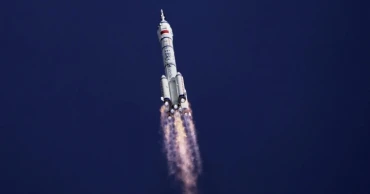
China achieved another milestone in its space exploration efforts on Thursday (April, 24) as the Shenzhou 20 spacecraft successfully docked with the Tiangong space station, delivering a fresh crew of three astronauts. The mission is part of the country's ongoing plans to establish a long-term human presence in space, with future goals including crewed missions to the Moon and Mars.
Launched at 5:17 p.m. local time (0917 GMT) aboard the reliable Long March 2F rocket, the spacecraft lifted off from the Jiuquan Satellite Launch Center, located on the edge of the Gobi Desert in northwestern China. It completed its journey to the Tiangong space station in approximately 6.5 hours, according to the China Manned Space Agency.
The newly arrived crew will take over responsibilities on the station, while the current team prepares for their return to Earth.
The Tiangong, or “Heavenly Palace,” space station has made China a major contender in space, especially since it was entirely Chinese-built after the country was excluded from the International Space Station over U.S. national security concerns. China’s space program is controlled by the People’s Liberation Army, the military branch of the ruling Communist Party.
The addition of mechanical arms to the three-module station has also raised concerns from some that China could use them to disable satellites or other space vehicles during a crisis.
Since first launching a man into space in 2003 — becoming only the third country to do so — China’s space program has advanced at a steady pace. The space agency has also landed an explorer on Mars and a rover on the less-explored far side of the moon, and aims to put a person on the moon before 2030.
NASA’s Lucy spacecraft sends back striking images of odd-shaped asteroid
The Shenzhou, or “Celestial Vessel,” 20 mission will be commanded by Chen Dong, who is making his third flight. He will be accompanied by fighter pilot Chen Zhongrui and engineer Wang Jie, both making their maiden voyages, according to the Manned Space Agency. Unlike previous crews, Shenzhou 20 is entirely male.
They will replace three astronauts currently on the Chinese space station. Like those before them, they will stay on board for roughly six months.
The space ship is due to be launched into space atop China’s workhorse Long March 2F rocket at 5:17 p.m. local time (0917 GMT) and reach the Tiangong about 6.5 hours later.
The three-person crew was sent in October last year and they have been in space for 175 days. They are due to return on April 29 after a brief overlap with their replacements. The Tiangong, fully assembled in October 2022, can accommodate up to six people at a time.
While in space, the astronauts will conduct experiments in medical science and new technologies and perform space walks to carry out maintenance and install new equipment, the Manned Space Agency said.
1 year ago
.jpg)
China launches first three-man crew to new space station
China launched the first three crew members on a mission to its new space station Thursday in its first crewed mission in five years.
The astronauts, already wearing their spacesuits, were seen off by the commander of China’s manned space program, other uniformed military personnel and a crowd of children waving flowers and flags and singing patriotic songs. The three gave final waves to a crowd of people waving flags as the entered the elevator to take them to the spaceship at the Jiuquan launch center in northwestern China.
The astronauts are traveling in the Shenzhou-12 spaceship launched by a Long March-2F Y12 rocket that blasted off shortly after the target time of 9:22 a.m. (0122 GMT) heading into the bright-blue skies with near-perfect visibility at the launch center on the edge of the Gobi Desert.
The two veteran astronauts and a newcomer making his first space flight are heading to the Tianhe, or Heavenly Harmony, station for a three-month stay in its main living compartment where they will carry out experiments, test equipment, conduct maintenance and prepare the station for receiving two additional modules next year.
Also read: Mars mission: China prepares to launch Long March-5 rocket
The rocket dropped its boosters about two minutes into the flight followed by the coiling surrounding Shenzhou-12 at the top of the rocket. After about 10 minutes it separated from the rocket’s upper section and extended its solar panels.
After the Tianhe was launched in April, the rocket that carried it into space made an uncontrolled reentry to Earth, though China dismissed criticism. Usually, discarded rocket stages reenter the atmosphere soon after liftoff, normally over water, and don’t go into orbit.
The rocket used Thursday is of a different type and the components that will reenter are expected to burn up long before they could be a danger, said Ji Qiming, assistant director of the China Manned Space Agency.
Also read: China’s Mars rover touches ground on red planet
The mission brings to 14 the number of Chinese astronauts traveling into space since China launched its first crewed mission in 2003, becoming only the third country after the former Soviet Union and the United States to do so on its own.
The mission is the third of 11 planned through next year to add the additional sections to the station and send up crews and supplies. A fresh three-member crew and a cargo ship with supplies will be sent in three months.
China is not a participant in the International Space Station, largely as a result of U.S. objections to the Chinese programs secrecy and close military ties. However, China has been stepping up cooperation with Russia and a host of other countries, and its station may remain in space beyond the International Space Station, which is reaching the end of its functional life.
Read:China receives photos from Mars: state-run media
The mission builds on experience China gained from earlier operating two experimental space stations. It also landed a probe on Mars last month that carried a rover, the Zhurong, and earlier landed a probe and rover on the moon and brought back the first lunar samples by any country’s space program since the 1970s.
5 years ago