BARC
PKSF, BARC join hands to boost agricultural research and growth
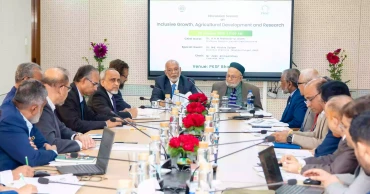
Palli Karma-Sahayak Foundation (PKSF) and the Bangladesh Agricultural Research Council (BARC) on Thursday agreed to work together to strengthen the linkage between agricultural research and extension to ensure inclusive growth.
The commitment was made at a discussion meeting held at PKSF Bhaban-1 in the capital.
The meeting was chaired by PKSF Chairman Zakir Ahmed Khan. Emeritus Professor at Kansas State University, USA, Dr ANM Mahbub-ul Alam, attended the event as the chief guest, while BARC Executive Chairman Md Abdus Salam was present as the special guest. PKSF Managing Director Md Fazlul Kader delivered the welcome address.
PKSF signs deal 5 commercial banks to fund partner organizations
Although agriculture remains a key pillar of the country’s food security and employment, its contribution to GDP is limited to around 12 percent, while nearly 47 percent of the total labour force is engaged in the sector.
Sluggish agricultural growth of 3.21 percent, shrinking arable land, declining soil fertility and rising production costs have emerged as major challenges.
Dr Alam said institutions often hesitate to engage others who possess greater expertise in specific areas, even when such collaboration is necessary.
“As a result, the country is deprived of the effective use of promising talent. We must break free from this mindset,” he said.
PKSF leading calls for transition to agroecological farming
Emphasising the need for balanced coordination between public and private initiatives for sustainable agricultural development, he added that ensuring food and nutrition security remains a shared national goal.
Md Abdus Salam said the objectives of advanced agricultural practices are fourfold — better production, better nutrition, a better environment and, ultimately, a better life.
He noted that BARC is continuously conducting research to achieve these goals and expressed hope that collaboration with PKSF would help expand research-based initiatives at the field level.
He also said PKSF could play a complementary role to the government in implementing the ‘Transforming Bangladesh Agriculture: Outlook 2050’ strategy.
PKSF Chairman Zakir Ahmed Khan said that while Bangladesh holds a strong position in the global agricultural landscape, sustainable and inclusive growth cannot be achieved without addressing structural challenges.
12,000 youth to receive skills training under PKSF program
“The main objective of today’s meeting is to enhance mutual cooperation between PKSF and BARC for the overall development of the agricultural sector,” he said, adding that coordinated efforts would also lead to innovative initiatives beyond conventional activities to benefit farmers and the sector.
He expressed optimism that a memorandum of understanding (MoU) between the two institutions would be signed soon.
Highlighting that nearly 50 percent of the total agricultural credit disbursed in the country is provided by PKSF and its partner organisations, PKSF Managing Director Md Fazlul Kader said the organisation is working to expand markets and promote agricultural micro-entrepreneurship as a dignified and attractive profession through diversification and value addition.
He added that PKSF is placing special emphasis on expanding ecological farming practices to reduce production costs, increase farmers’ income and restore soil fertility.
Former BARC Executive Chairman Dr Wais Kabir and WAVE Foundation Executive Director Mohsin Ali also spoke at the discussion.
A presentation on PKSF’s agricultural development interventions was delivered, and a special documentary was screened.
Senior officials of PKSF and BARC, along with chief executives of PKSF partner organisations, were present at the event.
8 months ago

Bangladesh, Bhutan sign three new MoUs
Bangladesh and Bhutan on Monday (March 25, 2024) signed three new memorandums of understanding (MoUs) to enhance mutual cooperation between the two neighbouring countries.
The MoUs are: Establishment of a Special Economic Zone in Kurigram, Setting up a Burn and Plastic Surgery Unit in Thimphu, and technical cooperation on consumer rights.
Another MoU on cultural exchange was renewed.
Japan extends Tk 33.5 million to 2 grassroots human security projects
Health Minister Smanta Lal Sen, Executive Chairman of Bangladesh Economic Zones Authority (BEZA) Shaikh Yusuf Harun, Directorate of National Consumers' Right Protection Director General (Additional Secretary) A.H.M. Shafiquzzaman and Cultural Affairs Secretary Khalil Ahmed signed the MoUs from Bangladesh side.
Bhutanese Health Minister Tandin Wangchuk, Bhutanese Commerce Secretary Tashi Wangmk and Bhutanese Foreign Secretary Pema Choden signed the MoUs on behalf of their country.
Bhutanese King Jigme Khesar Namgyel Wangchuck and Bangladesh Prime Minister Sheikh Hasina witnessed the MoU signing agreement held at the Prime Minister’s Office (PMO).
Besides, Bangladesh offered to increase the number of annual medical seats for Bhutanese students from 22 to 30 while the foreign service academy of Bangladesh offered two seats for the Bhutanese foreign service officers every year for capacity building. Bangladesh will also extend necessary assistance in setting up a Diplomatic Training Institute in Bhutan.
Apart from this, Bangladesh offered special training to Bhutanese officials in Bangladesh Agricultural Research Council (BARC) annually for three years.
Sweden will remain a steadfast partner to Bangladesh: Minister Johan Forssell
As a special gesture of goodwill and friendship, Bangladesh handed over computers and laptops for the capacity building and skills development of the government officials of Bhutan.
Earlier, on his arrival, the Bhutanese King was received by the Prime Minister at her office.
The Bhutanese King held a delegation-level meeting with Prime Minister Sheikh Hasina prior to the MoU signing ceremony.
They will also had a one-to-one meeting.
S Korea highlights importance of Economic Partnership Agreement with Bangladesh
2 years ago

Govt stares at potato glut; plans to boost export
Aiming to give a boost to potato exports, the government has decided to provide all sorts of support for its export and processing as the crop’s annual production surged past one crore metric tonnes in the country.
“Over one crore tonnes of potato are produced annually in Bangladesh. But we need to import potato chips and pringles at high prices. Local firms will have to produce quality chips, pringles and French fry processing potato with added values,” said Agriculture Minister Dr Muhammad Abdur Razzaque on Sunday.
The minister said this while addressing a views-exchange at the Bangladesh Agricultural Research Council (BARC) auditorium over the enhancement of potato-processing.
5 years ago