Local-Business

DSE index declines while CSE sees gains in first hour
The Dhaka Stock Exchange (DSE) witnessed a decline in all its indices during the first hour of trading, whereas the Chittagong Stock Exchange (CSE) recorded a slight gain.
But share prices of most companies fell across both markets.
DSE Performance
In the first hour of trading, the DSE’s benchmark index, DSEX, dropped by 11 points. Among the other indices, the Shariah-based DSES declined by 6 points, while the blue-chip DS30 fell by 3 points.
Read: Stock Market Slump: DSEX index falls by 40 points in three days
The DSE recorded a total turnover of Tk 76 crore during this period. Out of the traded stocks, 117 companies saw their share prices increase, while 151 declined, and 99 remained unchanged.
CSE Performance
Conversely, the CSE's overall index rose by 5 points in the first hour of trading.
At the CSE, the share prices of 19 companies increased, while 24 declined, and 6 remained unchanged. The total turnover stood at Tk 55 lakh.
Despite the mixed performance in indices, the broader market sentiment remained cautious as investors assessed market trends.
1 year ago

Some weak banks will merge, depositors will get back money: BB Governor
Bangladesh Bank (BB) Governor Ahsan H. Mansur has said some weak banks will merge and customers will get their deposits back in phases.
“The central bank will give back the depositors’ money or bonds against the deposited money in the S Alam related weak banks, but it required time,” he said while speaking as the chief guest at a workshop on ‘Microfinance in Bangladesh’ organised by the Microcredit Regulatory Authority (MRA).
Dr. Mansur said this in reply to a query from a top official of a Micro Finance Institution (MFI), who made FDR in S Alam Group-owned bank but did not return the money despite matured the tenure.
The Governor said, “I have been personally saying for the last 10 years that you should not keep money in S Alam's bank. But you have kept the money. They have given two percent more interest, and you have kept the money there; now you have been caught. You will get your deposited money back, but you will have to give some time for this. This money will be returned in stages.”
Read: Bangladesh Bank appoints Ernst & Young, KPMG to audit 6 troubled banks
Dr. Mansur said, "Now we will rescue you; but that is not possible right now. We will do it step by step; we will have to give time for this. We are moving towards the ‘Bank Resolution Act’, and some banks will have to be merged. Many things can be done and will be done. Maybe many things will be done this year. All I can say is, you get money, and you get bonds, you will get something."
The program was held at the CIRDAP auditorium in the capital on Tuesday. The event was presided over by MRA Executive Vice Chairman Mohammad Helal Uddin and was attended by Financial Institutions Division Secretary Nazma Mobarek and Palli Karma Sahayak Foundation (PKSF) Managing Director (MD) Md. Fazlul Kader.
1 year ago
Stock Market Slump: DSEX index falls by 40 points in three days
Dhaka's stock market has faced a continuous decline this week, with the DSEX index losing 40 points over three consecutive trading days.
Despite a slight rise during the first hour of trading, the main index, along with the Shariah-based index, ended the day in negative territory on Tuesday.
The DSEX index, which closed at 5,166 points last week, dropped to 5,126 points following three days of losses.
On Tuesday alone, the DSEX fell by 3 points, while the Shariah-based DSES index decreased by 4 points. But the blue-chip DS30 index managed to rise by 2 points.
Mixed Trading Performance
Despite the index decline, most companies saw a rise in their share prices. Of the 402 companies traded, prices increased for 173, declined for 152, and remained unchanged for 77.
Category A: Out of 222 companies, 91 witnessed price increases, 87 saw declines, and 44 remained unchanged.
Category B: Most companies in this category experienced losses. Prices rose for 33 of the 91 companies, fell for 40, and stayed static for 18.
Category Z: This underperforming category showed a relative improvement, with 48 of its 85 companies seeing price hikes, 22 experiencing declines, and 15 remaining stable.
In the mutual funds segment, prices for nine funds rose, nine fell, and 18 remained unchanged out of the 36 traded funds.
Sector-Wise Trends
Sector-wise, the ceramics sector recorded the highest price increase at 3.58%. Other sectors showing gains included food, textiles, telecommunications, paper, insurance, mutual funds, and corporate bonds. Conversely, sectors like leather, technology, and jute experienced the steepest declines. Banks and financial institutions also saw an overall negative trend.
Read: DSEX index gains over week, but banking sector remains weak
Top Gainers and Losers
Among the gainers, Omex Electrode Ltd, a B-category company, saw the highest price increase of 6.87%, with shares trading at Tk 28. On the other hand, ADN Telecom Ltd led the decliners with a 9.78% drop, closing at Tk 97.80 from a peak of Tk 108.10 during the day.
Dividend Announcements
On Tuesday, 10 companies distributed dividends. Notably, the Investment Corporation of Bangladesh (ICB) declared a 2% dividend, marking its lowest payout in a decade. ICB's dividend rates have been steadily declining, dropping from 35% in 2015 to 2.5% in 2023.
Meanwhile, Square Pharmaceuticals provided the highest dividend of 110%, its largest in a decade. Another Square Group company, Square Textiles, declared a 32% dividend, up from 30% in 2023. Kohinoor Chemicals distributed a 50% dividend, an increase from 40% in 2023. Despite this, Kohinoor's shares declined by 3.7%, closing at Tk 534.60.
Singer Bangladesh declared a 10% dividend for 2024 despite incurring losses. The company reported a per-share loss of Tk 4.91 for 2024, compared to a profit of Tk 5.24 per share in the previous year.
Singer attributed the loss to rising financing costs, which escalated from Tk 60.40 crore in 2023 to Tk 143.30 crore in 2024 due to higher bank interest rates.
Chittagong Stock Market Shows Resilience
Unlike Dhaka, the Chittagong Stock Exchange (CSE) saw its overall index rise by 21 points on Tuesday. Out of 186 companies traded, 86 experienced price increases, 70 saw declines, and 30 remained unchanged.
Read more: DSE sees sharp fall as most stocks suffer price drops
However, trading volume dropped significantly, with Tk 10.28 crore in turnover compared to Tk 21 crore in the previous session.
The ongoing volatility across the capital markets indicates investor caution, with mixed performance across sectors and trading categories.
1 year ago

BEPZA attracted 29 percent of total FDI last fiscal year, says its Chairman
Bangladesh Export Processing Zone Authority (BEPZA) has contributed 29 percent of total Foreign Direct Investment (FDI) of the country in the fiscal year 2023-24.
BEPZA Executive Chairman, Major General Abdul Kalam Mohammad Ziaur Rahman revealed this at a press conference at BEPZA Complex in the capital on Monday.
He said BEPZA exported US $ 7.07 billion which is 16 percent of total 44.47 billion export income in FY 2023-24.
Despite different challenges due to different global issues, BEPZA signed with 28 foreign companies to invest $568.49 million in Bangladesh, he added.
A total of 38 countries invested in Export Processing Zones under BEPZA.
Among these companies, 108 are Chinese, 61 South Korean, 29 Japanese, 19 Indian, 19 UK, US 17, 7 Sri Lankan.
BEPZA member investment Md. Ashraful Kabir in a presentation highlighted achievement and future plans.
Read: BEPZA signs deal with Chinese company to set up battery plates manufacturing industry
He showed that in these EPZs 48 percent diversified products are being produced.
Since the inception, BEPZA has deposited Tk 1215.94 crore in the treasury till December 2024.
BEPZA members Engineer Md. Imtiaz Hossain, ANM Foyzul Haque and BEPZA Director public relations ASM Anwar pervez also spoke at the event.
1 year ago
All indices fall in Dhaka Stock Market in the first hour
On the second trading day of the week, all indices on the Dhaka Stock Exchange (DSE) experienced a decline during the first hour of trading.
Despite the drop in indices, a majority of companies saw their share prices increase.
By 10:30 am on Monday, DSE's benchmark index, DSEX, had fallen by 5 points.
Among the other indices, the Shariah-based DSES dropped by 2 points, while the DS30, comprising blue-chip stocks, fell by 4 points.
In the first hour, the turnover on the DSE stood at Tk 70 crore. Out of the traded companies, the share prices of 154 advanced, 116 declined, and 93 remained unchanged.
Read: DSEX index gains over week, but banking sector remains weak
Meanwhile, the Chittagong Stock Exchange (CSE) saw a slight increase in its overall index, which rose by 1 point during the same period.
On the CSE, 20 companies recorded gains, 18 saw declines, and the share prices of 11 companies remained unchanged.
The total turnover at the CSE during the first hour was Tk 1.35 crore.
1 year ago
Asian markets are mixed after Wall Street edges back from its record
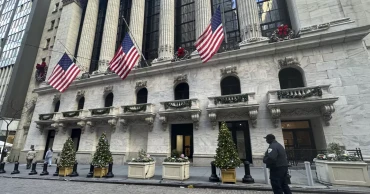
Shares were mixed in thin Asian trading on Monday after U.S. stocks edged back from their all-time high.
Oil prices fell and U.S. futures sank, while Chinese shares shed some of their early gains after a survey of manufacturers showed export orders dropping to a five-month low.
The official manufacturing purchasing managers index fell to 49.1 in January from 50.1 in December, slipping into contractionary territory on a scale where 50 and above indicates expansion.
Zichun Huang of Capital Economics said the slowdown might be temporary given increased government spending.
“But the disappointing PMI data underscores the difficulty policymakers face in achieving a sustained recovery in growth,” Huang wrote in a commentary.
The Hang Seng in Hong Kong was up 0.9% at 20,249.64, while the Shanghai Composite index was up 0.1%, at 3,256.91.
Tokyo's Nikkei 225 gave up 0.6% to 39,699.76, extending losses after the Bank of Japan raised its benchmark interest rate to 0.25%, its highest level since 2008.
The U.S. dollar was steady against the Japanese yen, at 155.73 yen, up from 155.72. The euro slipped to $1.0471 from $1.0483.
In Bangkok, the SET fell 0.2%.
Markets were closed in many other Asian markets due to lunar new year holidays.
On Friday, U.S. stocks pulled back from their all-time high to close out a second straight winning week.
The S&P 500 slipped 0.3% a day after setting a record, closing at 6,101.24. The Dow Jones Industrial Average dipped 0.3% to 44,424.25, and the Nasdaq composite sank 0.5% to 19,954.30.
Trading was quiet, aided by relative steadiness in the bond market, which has been driving much of the action on Wall Street lately. When worries about inflation and the U.S. government’s swelling debt have been on the rise, Treasury yields have climbed and helped knock down stock prices. When concerns ebb, such as after last week’s encouraging update on inflation, yields have eased and helped stocks rise.
A mostly encouraging start to the earnings reporting season for big U.S. companies has also helped prop up the stock market. Even if higher Treasury yields are pushing downward on their stock prices, companies can make up for it by delivering bigger profits.
Texas Instruments fell 7.5% despite reporting profit for the latest quarter that topped analysts’ expectations.
In a sign of how much pressure is on companies to keep growing, analysts focused on discouraging signals of how much profit the company is likely to make from each $1 of revenue during the first three months of 2025. That helped drag down stocks across the semiconductor industry.
CSX sank 2.9% even though the railroad delivered a profit for the latest quarter that matched analysts’ expectations. Its revenue for the last three months of 2024 just missed analysts’ forecasts as it dealt with the effects of hurricanes.
On the winning side of Wall Street were Novo Nordisk’s U.S.-listed shares, which jumped 8.5%. The Danish company reported results from a clinical trial of a treatment for people who are overweight or obese, which could mean bigger profits in the future.
The yield on the 10-year Treasury eased to 4.61% from 4.65% late Thursday. Other yields also pulled lower following a couple reports on the U.S. economy that came in worse than expected.
One said U.S. consumer sentiment is weaker than economists had forecast and fell in January for the first time in six months. A separate preliminary report suggested U.S. business activity is also weaker than expected. A third, potentially more encouraging report said sales of previously occupied homes were slightly stronger last month than expected, following the weakest year for such sales since 1995.
Traders don’t expect the weak data to push the Federal Reserve to cut its main interest rate at its meeting next week. They’re virtually certain the central bank will hold steady, according to data from CME Group.
In other dealings early Monday, U.S. benchmark crude oil shed 47 cents to $74.13 per barrel. Brent crude, the international standard, lost 47 cents to $77.08.
1 year ago
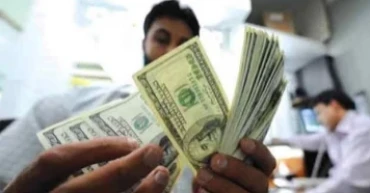
Bangladesh received $1.68 billion in remittance over 25 days of January
Bangladesh received $1.68 billion in remittance through legal channels during the first 25 days of January.
On average, expatriates sent $67.04 million per day during this period.
According to the latest data from Bangladesh Bank (BB), the total remittance flow for January is likely to surpass $2 billion if the current trend continues.
A breakdown of the central bank’s data shows that of the $1.68 billion received:
· $354.28 million came through state-owned banks,
· $74.4 million through a specialised bank,
· $1,242.53 million from private banks, and
· $479 million via foreign banks.
However, eight banks did not record any remittance inflow during this period. These include the state-owned Bangladesh Development Bank (BDBL) and the specialised Rajshahi Krishi Unnayan Bank.
Bangladesh receives over $1.20 billion remittance in 18 days of January
Private banks such as Community Bank, ICB Islami Bank, and Padma Bank also failed to report any remittance. Among foreign banks, Habib Bank, National Bank of Pakistan and State Bank of India did not receive any remittance.
During the first half of FY2024-25 (July–December), remittance inflows totalled $13.78 billion, compared to $10.8 billion during the same period last year—an increase of $2.98 billion.
US tops in remittance inflows to Bangladesh for 3 months: BB
1 year ago

Keya Cosmetics announces permanent closure of factory operations
Keya Cosmetics Limited has announced the permanent closure of its factories due to ‘ongoing challenges in the market’ from May next.
In a media release on Thursday, the company cited market instability, discrepancies in accounts with its bank, shortages of raw materials and declining production activities as the primary reasons behind the decision.
BRAC’s Youth Career Expo connects job seekers with employers in Chattogram
The factory is scheduled to cease all operations from May 1, 2025. Besides, the dyeing and utility division of the company will be permanently shut down from May 25, 2025.
This development marks a significant shift for Keya Cosmetics, which has been a key player in the cosmetics and personal care industry. The company has yet to release details about its future strategy following the closure.
CSE extends trading hours, faces opposition from brokers’ association
The decision comes amidst growing concerns over market conditions and the financial pressures faced by businesses in the sector.
Keya Cosmetics’ management has expressed regret for the situation but emphasised the necessity of the move to address the challenges at hand.
1 year ago

Indices rise in Dhaka Stock Exchange, significant fall in Chattogram
The Dhaka Stock Exchange (DSE) witnessed a rise in indices during the first hour of trading today, while the Chattogram Stock Exchange (CSE) faced a sharp decline.
On Thursday, the DSE's key index, DSEX, increased by 10 points within the first hour of trading.
Among the other indices, the Shariah-based DSES rose by 2 points, while the DS30, the blue-chip index, climbed by 1 point.
During this period, the DSE recorded a trading turnover of Tk 90 crore.
Read: DSE sees sharp fall as most stocks suffer price drops
Of the traded companies, share prices increased for 202, decreased for 72, and remained unchanged for 76.
In contrast, the CSE experienced a notable dip in its key index, the CSE All Share Price Index (CASPI), which fell by 32 points at the start of the day.
The CSE’s trading turnover in the first hour amounted to Tk 79 lakh.
Of the traded companies, share prices rose for 28, declined for 26, and remained unchanged for 7.
The contrasting trends in the two stock exchanges reflect a mixed start to the trading day across the country.
1 year ago

Dutch-Bangla Bank to issue Tk 1,200 crore bonds
The private-sector Dutch-Bangla Bank PLC has received approval from the Bangladesh Securities and Exchange Commission (BSEC) to issue subordinated bonds worth Tk 1,200 crore in the market.
The approval follows the bank's application on December 28, 2023, seeking to issue the bonds to strengthen its capital base under the Basel III international regulatory framework.
According to the Dhaka Stock Exchange (DSE), the bonds will be unsecured, non-convertible, and redeemable in nature.
Dutch-Bangla Bank plans to issue a total of 1,200 bonds, each priced at Tk 1 crore.
The bank's financial performance has shown a declining trend in recent quarters.
Read: MTB invests in treasury bills, bonds as private sector credit growth declines
In the third quarter of last year, the bank's earnings per share (EPS) stood at Tk 0.38, a significant drop from Tk 1.97 during the same period in 2023.
For the first three quarters of 2024, the bank reported an EPS of Tk 2.70, compared to Tk 4.71 during the same period the previous year.
1 year ago