Local-Business
NOVOAIR makes sky travel a reality for underprivileged children
NOVOAIR, the leading private airline in the country, has made sky travel a reality for underprivileged children.
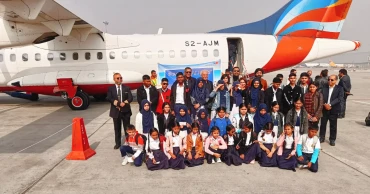
NOVOAIR took 30 children from Jaago Foundation schools on a special "dream flight" to Cox’s Bazar on Wednesday, according to a media statement.
In addition to the flight, the airline organised a beach cleaning program at Cox’s Bazar Sea Beach, with the students actively participating.
These events were part of NOVOAIR's celebration of its 12th anniversary.
The children flew from Dhaka to Cox’s Bazar on a flight that left at 10:20 am and returned to Dhaka at 6:30 pm. During their visit to Cox’s Bazar, they explored the sea beach, the Bangladesh Air Force base, and the Cox’s Bazar Railway Station, creating lasting memories.
Maymuna Rahman, a fifth-grade student, expressed her excitement, saying, "I never imagined I would visit the sea beach by plane and see the Bangladesh Air Force aircraft. I am truly grateful to NOVOAIR for making this dream come true."
Another student, Hanif Mia, shared, "Flying through the clouds was an amazing experience! We played on the beach and saw the beautiful Cox’s Bazar Railway Station. This trip felt like a dream come true."
1 year ago
Stock market starts week with decline in early trading
The Dhaka Stock Exchange (DSE) began the week with a downtrend as all three major indices registered losses in the first hour of trading.
The benchmark DSEX index dropped by 6 points, while the DS30, representing blue-chip stocks, declined by 2 points.
The Shariah-based DSES index also edged lower, losing 0.13 points.
During the initial hour, the market turnover stood at approximately Tk 80 crore. Out of the traded shares, prices of 154 stocks decreased, 122 advanced, and 80 remained unchanged.
Shares from the automobile, paper mills, fabrics, and engineering sectors performed well, maintaining a stronger position. But the banking sector showed limited activity, with only three banks making it to the top 20 performing stocks.
In the broader picture, the DSE's benchmark index has lost 38 points over the past two days, bringing the DSEX to 5,155 points.
Read: DSEx and DS30 indexes slide while DSES up by 4.16 points in 1st hour
The downward trend extended to the Chittagong Stock Exchange (CSE) as well. In the first hour of trading, the CSE's major index also showed a decline. Prices fell for 41 stocks, increased for 27, while the turnover amounted to Tk 47 crore in shares and bonds.
This lacklustre performance at the start of the week indicates cautious investor sentiment as both bourses continue to face headwinds.
1 year ago

DSEx and DS30 indexes slide while DSES up by 4.16 points in 1st hour
The Dhaka Stock Exchange (DSE), the country's main capital market, saw a decline in trading in the first hour on Sunday.
The 3 indexes of the Dhaka stock market DSEX and DS30 decreased while Shariah index DSES increased in the morning.
The main index DSEX decreased by 0.01 points to 5,194.42 points, the DSES Shariah index up by 4.16 points to 1166.10 points, and the DS30 special blue-chip index fell by 2.85 points to 1921.41 points during the first hour on Sunday.
Read: DSEX gains 9.42 points; 400 companies participate in trading
On the day, the trading record in the DSE shows that shares and units of 3.27 crore were exchanged through 31872 transactions. In the first hour, the market witnessed huge selling pressure, and shares and mutual funds worth Tk 101.9 crore were traded.
During this time, a total of 372 companies participated in trading. Among these, prices of 142 companies increased, 146 companies decreased and 84 companies remained unchanged at the DSE.
1 year ago
Govt's VAT, SD hike on 100+ products suicidal: DCCI
Dhaka Chamber of Commerce and Industries (DCCI) President Taskeen Ahmed has urged the government to reduce expenses by 20% to save Tk50,000 crore and avoid burdening businesses with increased value added tax (VAT), supplementary duty (SD), and gas prices.
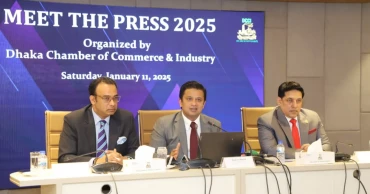
Speaking at a press event in Dhaka’s Motijheel, he criticised the government’s decision to raise VAT and SD on over 100 products and services through two ordinances issued Thursday night. The hikes, effective immediately, have increased costs on essentials such as mobile usage, clothing, restaurant dining, LP gas, and more. Ahmed called the move "suicidal," warning it would harm national and international trade, raise inflation, and deter investments.
He also expressed concern over the proposed gas price hike of 150%, noting industrial users would pay Tk 75.72 per cubic metre beyond their sanctioned load compared to the current flat Tk 30.75. Gas prices have already increased 200% in the last three years, and further hikes would severely impact businesses struggling with insufficient supply.
Ahmed stressed the need to separate politics and the economy, urging businessmen in politics to avoid politicising business affairs. He highlighted Bangladesh's economic challenges, including limited foreign exchange reserves, rising energy costs, inflation, and high interest rates, compounded by global geopolitical instability.
The DCCI plans to prioritise controlling inflation, stabilising foreign exchange rates, and reducing interest rates this year. Ahmed called for expedited low-cost financing for the CMSME sector, which is critical for employment generation.
On LDC graduation, Ahmed acknowledged setbacks from the COVID-19 pandemic, the Russia-Ukraine war, and local political unrest. He urged detailed stakeholder discussions to assess readiness and suggested deferring the timeline if necessary.
He also emphasised increasing the tax-GDP ratio and expanding the taxpayer base while urging the government to cut unnecessary projects, adopt austerity measures, and improve monitoring of ADP implementation.
DCCI Senior Vice President Razeev H Chowdhury, Vice President Md. Salem Sulaiman, and other board members attended the event.
1 year ago

Stock market was neglected for 15 years: DSE Chairman
The capital market was neglected, and even stakeholders failed to hold a single meeting for past 15 years to solve the problems and make policies for turning it sustainable as a source of investment, said Mominul Islam, chairman of Dhaka Stock Exchange (DSE).
He was speaking at a press conference on ‘Present Situation of Stock Market and Way Forward’ at Dhaka Club on Thursday.
DSEX index down by 5.77 points, prices of 214 stocks drop
He said, “The capital market has contracted drastically, failing to play the role it was supposed to play in the financial sector. The irregularities and inefficiency we have nurtured for a long time have kept the capital market from being positive.”
The DSE chairman said, “In the last 10 years, a weak IPO market worth Tk 650 crore has come. Good companies are coming in a very few. The number of investors in the market has come down by half in the last 10 years. There are even fewer active investors.”
He highlighted that one of the units to measure the quality of the capital market is the amount of foreign investment. Currently, the amount of foreign investment has come down to below 1.0 percent.
DSEX index gains 28.4 points as 294 stocks advance in early trading
Although the amount of corporate bonds is shown to be one percent, in reality, it is not more than 0.51 percent. New IPOs, corporate bonds, and mutual funds are the new priority in the market, he pointed out.
The capital market will hold the position of leading and coordinating skilled and trained manpower that will be needed to take the DSE forward.
“We are recruiting manpower with full leadership qualities. We hope that the confidence in the market will be better than before, and investors will come back again. IT security audit is very important. We are revitalizing the DSE website, especially working to digitize the IPO. The bond market is also a management problem, we are working in coordination with the BSEC,” added the DSE chief.
In response to a question, he said, "If the protection of DSE is legal, we will be able to work independently. We do not want CCBL to exist. BSEC, DSE, and CCBL will be respected and are working on this. We give importance to efficiency in recruiting manpower."
Chittagong Stock Exchange (CSE) Chairman AKM Habibur Rahman said, "The Bangladesh Securities and Exchange Commission (BSEC) is not trying to impose anything on us. We are working cooperatively."
DSE Brokers Association (DBA) Chairman Saiful Islam said that there was no good sign in a decade where professional people are involved in the development of the capital market.
However, “Various positive steps have been taken as a result of pressure from various electronic and print media. It is playing a positive role in the market,” he pointed out.
Regarding decentralisation, he said, instead of this everything is being made dependent on the finance ministry.
Many things are being taken from the hands of the primary regulator and taken under the control of the ministry or the financial institution division (FID). As a result, the stakeholders are facing various problems, he said.
1 year ago
DCCI raises alarms over VAT and gas price hikes
The Dhaka Chamber of Commerce & Industry (DCCI) has raised serious concerns over proposed hikes in industrial gas prices and VAT, warning they could disrupt business, deter investment and undermine export competitiveness.
Petrobangla recently submitted a proposal to the Bangladesh Energy Regulatory Commission (BERC) to more than double the per-unit price of gas for industrial and captive consumers—from Tk 30 and Tk 31.50 to Tk 75.72.
The move aims to alleviate the government’s subsidy burden on gas production costs. Simultaneously, the National Board of Revenue (NBR) has raised income tax for motorcycle, refrigerator, air-conditioner, and compressor manufacturers from 10% to 20%, reversing a prior commitment to maintain reduced rates until 2032.
In a statement, the DCCI highlighted that such measures, if implemented, would significantly increase production costs, placing inflationary pressure on both industries and consumers.
This, the DCCI cautioned, could deter local and foreign investment, jeopardise Bangladesh’s competitive standing in the global market, and hinder the establishment of new industries.
“The proposal to increase gas prices without ensuring uninterrupted supply presents a formidable challenge for businesses,” the DCCI said. “The cost of doing business will skyrocket, impacting both domestic and export-oriented industries. This would not only reduce profitability but also erode Bangladesh’s competitiveness in international markets.”
Read: Private sector facing various challenges: DCCI
The chamber said that the negative implications of inconsistent policies. The abrupt withdrawal of promised tax incentives, it argued, could tarnish Bangladesh’s reputation as an investment-friendly destination.
“Such a reversal sends a detrimental message to both local and foreign investors, undermining confidence and casting doubt on policy reliability,” the statement added.
A Call for Collaboration
The DCCI urged the government, BERC, and Petrobangla to reconsider the proposed gas price hike. It also called for a review of the VAT and tax rate increases, suggesting that these measures could exacerbate inflationary pressures and operational costs for businesses at a time of global economic uncertainty.
“To foster sustainable economic growth, it is imperative to maintain a stable, business-friendly environment,” the DCCI noted. “This requires long-term policy commitments, tax benefits, and active collaboration between the government, private sector, and other stakeholders.”
Broader Implications
The proposed tax hike on manufacturing industries such as motorcycles, refrigerators, and air-conditioners comes at a time when businesses are already grappling with an unstable economic climate.
The DCCI warned that these measures could dampen local industrial activity, reduce foreign investment, and ultimately curtail economic recovery.
Read more: Businesses agree with central bank's steps against bank robbers: DCCI
With Bangladesh striving to recover amid global economic challenges, the DCCI reiterated the need for “cost-effective policies that ensure continuity and stability.”
It argued that policy reversals and steep cost increases could undermine the country’s efforts to attract investors and sustain economic momentum.
1 year ago

Bajus suspends membership of Gold Kinen for irregularities
The Bangladesh Jewellers Association (Bajus) has suspended the membership of Gold Kinen Technologies following allegations of irregularities in the trading of gold.
In a press release issued on Thursday, Bajus said that Gold Kinen Technologies was granted provisional membership on December 26, 2022 after fulfilling all conditions required during the application process.
But the association decided to suspend the membership due to non-compliance with its regulations.
Read: BAJUS decides to lower gold price by Tk 1,773 per bhori
Bajus alleged that the company was involved in unauthorised practices, including selling gold bars and coins instead of jewellery, which is against the association's rules.
It mentioned that such activities violate Section 4(a) of the Bajus constitution.
1 year ago
DSEX index gains 4.7 points in early trading
The Dhaka Stock Exchange (DSE), the country’s main capital market, showed an uptrend in trading during the first 1 hour and 30 minutes on Thursday.
All three indices of the Dhaka stock market—DSEX, DSES, and DS30—recorded changes in the initial session of the fifth working day of the week.
The benchmark index DSEX rose by 4.70 points, reaching 5,189.7 points. The DSES Shariah index gained 2.5 points, climbing to 1,160.86 points, while the DS30 blue-chip index slightly dipped by 0.07 points to 1,920.92.
During this period, the DSE reported that 4.37 crore shares and units were exchanged through 35,192 transactions.
Read: DSEX index down by 5.77 points, prices of 214 stocks drop
Despite high selling pressure in the first hour, shares and mutual funds worth Tk 99.7 crore were traded.
In total, 383 companies participated in trading. Among them, the prices of 210 companies increased, 81 decreased and 92 remained unchanged.
1 year ago
DSEX index up by 5.98 points and 184 companies’ price advance in first hour
The Dhaka Stock Exchange (DSE), the country's main capital market, saw an upward trend of trading in the first hour on Wednesday.
The 3 indexes of the Dhaka stock market DSEX, DSES and DS30 increased in the first session of the 4th working day of the week.
The main index DSEX increased by 5.98 points to 5,196.75 points, the DSES Shariah index up by 1.13 points to 1160.03 points, and the DS30 special blue-chip index increased by 0.99 points to 1923.74 points during the first hour on Wednesday.
Read: DSEX index drops by 8.06 points, TK 427.5 crore traded on Tuesday
On the day, the trading record in the DSE shows that shares and units of 4.79 crore were exchanged through 33539 transactions. In the first hour, the market witnessed huge selling pressure, and shares and mutual funds worth Tk 95.5 crore were traded.
During this time, a total of 365 companies participated in trading. Among these, prices of 184 companies increased, 106 companies decreased and 75 companies remained unchanged at the DSE.
1 year ago
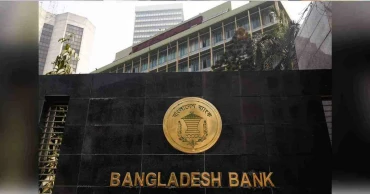
Former ED Ahsan Ullah joins central bank as advisor to the Governor
Ahsan Ullah, former executive director of the regulator has joined as an advisor to the governor of Bangladesh Bank.
He will assist Governor Dr. Ahsan H. Mansur with the central reform activities. Ahsan Ullah joined the advisory post after this appointment was issued on Monday.
In this regard, the internal order of the central bank said that Ahsan Ullah had been appointed as the advisor to the governor on the Bangladesh Bank (BB) reform activities on a contractual basis for one year.
The central bank has formed a task force to reform the financial sector in which banks play a leading role. Now Ahsan Ullah has been appointed as advisor to the governor for the reform and strengthening of Bangladesh Bank.
Read: Financial sector danger removed but full stability to take time: BB
After regular retirement, Ahsan worked as an advisor to the central bank and was associated with the central bank strengthening project. Later, he joined the teaching staff at the Bangladesh Institute of Bank Management (BIBM).
1 year ago