Asia

Bomb kills 1, wounds 5 at press award event in Afghanistan
A bomb exploded on Saturday during an award ceremony for journalists in Afghanistan’s Mazar-e- Sharif city, killing at least one person and wounded five others, a Taliban police spokesman said.
The blast occurred at the Tabian Farhang center in Mazar-e Sharif, the capital of Balkh province, as journalists gathered for the award event at 11 a.m., said Mohammad Asif Waziri, the Taliban-appointed spokesman for Balkh police.
It came two days after a bomb in Mazar-e-Sharif killed the provincial governor, Daud Muzmal, and two others. Four were wounded.
The identify of the fatality in Saturday's blast was not immediately known but journalists were among the five wounded. They included Najeeb Faryad, a reporter for Aryana News television station, who said he felt like something hit him in the back, followed by a deafening sound before he fell to the ground.
No one has immediately claimed responsibility for the attack, but the regional affiliate of the Islamic State group — known as the Islamic State in Khorasan Province — is a key rival of the Taliban.
The militant group has increased its attacks in Afghanistan since the Taliban takeover of the country in August 2021. Targets have included Taliban patrols and members of Afghanistan’s Shiite minority.
3 years ago

Xi awarded 3rd term as China's president, extending rule
Chinese leader Xi Jinping was awarded a third five-year term as the nation's president Friday, putting him on track to stay in power for life at a time of severe economic challenges and rising tensions with the U.S. and others.
The endorsement of Xi's appointment by the ceremonial National People's Congress was a foregone conclusion for a leader who has sidelined potential rivals and filled the top ranks of the ruling Communist Party with his supporters since taking power in 2012.
The vote for Xi was 2,952 to 0 by the NPC, members of which are appointed by the ruling party.
Xi, 69, had himself named to a third five-year term as party general secretary in October, breaking with a tradition under which Chinese leaders handed over power once a decade. A two-term limit on the figurehead presidency was deleted from the Chinese Constitution earlier, prompting suggestions he might stay in power for life.
There was no indication that members of the National People's Congress had any option other than to endorse Xi and other officials picked by the Communist Party for other posts. When Xi was named to his first term as president in 2013, NPC members received a ballot with only his name on it and dropped it unchanged into a box. On Friday, reporters were kept at a distance and couldn’t see the four ballots that each delegate deposited into boxes placed around the vast auditorium of the Great Hall of the People.
Xi was also unanimously named head of the Central Military Commission that commands the party's military wing, the 2 million-member People's Liberation Army, an appointment that has been automatic for the party leader for three decades.
In other voting, the party's third-ranking official, Zhao Leji, was named head of the National People's Congress. The vast majority of the body's legislative work is headed by its Standing Committee, which meets year-round.
Zhao, 67, a holdover from the previous party Politburo Standing Committee, the apex of political power in China headed by Xi, won Xi’s trust as head of the party’s anti-corruption watchdog, the Central Commission for Discipline Inspection, pursuing an anti-graft campaign that has frozen all potential opposition to Xi.
Former Shanghai party boss and member of the last Politburo Standing Committee Han Zheng was named to the largely ceremonial post of state vice president.
Xi, Zhao and Han then took the oath of office with one hand on a copy of the Chinese Constitution. The session also swore in 14 congress vice chairpersons.
Read more: Iran, Saudi Arabia agree to resume relations after tensions
Wang Huning, a holdover from the last Politburo Standing Committee, was later named head of the Chinese People’s Political Consultative Conference, the NPC’s advisory body that, in coordination with the party’s United Front Department, works to build Xi’s influence and image abroad. Wang has been a top adviser to three Chinese leaders and has authored books critiquing Western politics and society.
Xi's new term and the appointment of loyalists to top posts underscores his near-total monopoly on Chinese political power, eliminating any potential opposition to his hyper-nationalistic agenda of building China into the top political, military and economic rival to the U.S. and the chief authoritarian challenge to the Washington-led democratic world order.
While six others serve with him on the Politburo Standing Committee, all have longstanding ties to Xi and can be counted on to see to his will on issues from party discipline to economic management.
The standing committee has only men and the 24-member Politburo, which has had only four female members since the 1990s, also has no women after the departure of Vice Premier Sun Chunlan.
Second-ranked Li Qiang is widely expected to take over as premier, nominally in charge of the Cabinet and caretaker of the economy. Li is best known for ruthlessly enforcing a brutal “zero-COVID” lockdown on Shanghai last spring as party boss of the Chinese financial hub, proving his loyalty to Xi in the face of complaints from residents over their lack of access to food, medical care and basic services.
Former head of the manufacturing powerhouse of Guangdong province, seventh-ranked Li Xi has already been appointed to replace Zhao as head of the Central Commission for Discipline Inspection.
The congress is also expected to pass a measures intensifying party control over national level government organs as part of Xi’s campaign of centralizing power under the party.
At the opening of the annual congress session on Sunday, outgoing Premier Li Keqiang announced plans for a consumer-led revival of the struggling economy, setting this year’s growth target at “around 5%.” Last year’s growth in the world’s second-largest economy fell to 3%, the second-weakest level since at least the 1970s.
Separately, the Ministry of Finance announced a 7.2% budget increase in the defense budget to 1.55 trillion yuan ($224 billion), marking a slight increase over 2022. China’s military spending is the world’s second highest after the United States.
In the days then, Xi and his new Foreign Minister Qin Gang have set a highly combative tone for relations with the U.S., amid tensions over trade, technology, Taiwan, human rights and Beijing's refusal to criticize Russia's invasion of Ukraine.
On Tuesday, Qin warned in unusually stark terms about the possibility of U.S.-China frictions leading to something more dire.
“If the United States does not hit the brake, but continues to speed down the wrong path, no amount of guardrails can prevent derailing and there surely will be conflict and confrontation,” Qin said in his first news conference since taking up his post last year.
That echoed comments at a small group meeting of delegates from Xi on Monday, in which he said that “Western countries led by the United States have implemented all-round containment, encirclement and suppression of China, which has brought unprecedented grave challenges to our nation’s development.”
Xi followed up on Wednesday by calling for “more quickly elevating the armed forces to world-class standards.”
China must maximize its “national strategic capabilities” in a bid to “systematically upgrade the country’s overall strength to cope with strategic risks, safeguard strategic interests and realize strategic objectives,” Xi was quoted as saying to a meeting of delegates by the official Xinhua News Agency.
Asked about China's future foreign relations under Xi, Foreign Ministry spokesperson Mao Ning struck a relatively mild tone.
Beijing maintains an “independent foreign policy of peace” and will “continue to view and develop China-U.S. relations in accordance with the principles of peaceful coexistence, mutual respect and win-win cooperation,” Mao said at a daily briefing.
"We hope the U.S. side can also meet us halfway and push China-U.S. relations back on the track of sound and stable development," she said.
Russian President Vladimir Putin, with whom Xi has formed close ties, issued his congratulations, saying Xi's new term is an "acknowledgement of your achievements as the head of state, as well as wide support of your policy focused on China’s socioeconomic development and protection of its national interests on the global stage.”
Under Xi, China and Russia announced a “no limits” relationship and China has pointedly refused to criticize Russia's invasion of Ukraine while echoing Moscow’s claim that the U.S. and NATO were to blame for provoking the Kremlin. Beijing has also blasted sanctions imposed on Russia after it invaded Ukraine, while Russia has staunchly supported China amid tensions with the U.S. over Taiwan.
“We will continue to coordinate our joint work related to the most important issues on the regional and international agenda,” Putin said, according to the Kremlin.
North Korean leader Kim Jong Un, head of the ruling Worker's Party, also sent congratulations, saying “the two parties and the two countries are defending and advancing socialism, the common cause, while supporting and closely cooperating with each other.” China is the impoverished and isolated North's most important political ally and source of food and fuel aid.
3 years ago

China once again urges U.S. to immediately stop political manipulation on COVID origins-tracing: FM spokesperson
China once again urged the U.S. side to immediately stop political manipulation on COVID origins-tracing, voluntarily share the data of suspected early cases in the United States with the WHO, Chinese foreign ministry spokesperson Mao Ning said on Thursday.
Mao's remarks came after the U.S. Senate passed the COVID-19 Origin Act of 2023 a few days ago, which says that the COVID-19 pandemic may have originated in China. Director of the U.S. National Intelligence Avril Haines on Wednesday noted that there is not a consensus among the U.S. intelligence community on whether or not the outbreak is a result of a lab leak or natural exposure to an infected animal. Besides, Polish virologist Agnieszka Szuster-Ciesielska recently said in an interview that the COVID "lab leak" theory rehashed by the U.S. Department of Energy and FBI is sensation-seeking and has no factual or scientific basis.
For some time now, the United States has been politicizing, weaponizing and instrumentalizing COVID origins-tracing for many months, Mao said, adding it has let a matter of science be dominated by lawmakers and the intelligence community and spread myths such as the "lab leak" theory without any evidence to discredit and attack China.
"This has seriously poisoned the atmosphere for science-based global origins-tracing and been perceived by people in the rest of the world," she said.
Noting China's position on the origins-tracing is consistent, Mao said China has supported and participated in global science-based origins-tracing since day one.
"In the meantime, we have been firmly opposed to all forms of political manipulation on this issue," Mao said, adding the political manipulation by the United States is the main stumbling block to the science-based research on COVID origins.
Also Read: China's Xi awarded third term as president, extending rule
Mao said the United States has been pointing fingers at WHO's origins-tracing process, politically punishing scientists with conscience and attacking countries with lies that make no scientific sense.
Pointing out that the United States has done nothing responsible on origins-tracing, Mao said it has never invited WHO expert groups to the United States for joint research or shared any early data on COVID origins and it has turned a deaf ear to the world's concerns about U.S. bio-military bases at Fort Detrick and around the world.
Politicizing origins-tracing would only hamper science-based cooperation on the issue, disrupt solidarity against the virus, and undermine global health governance mechanisms, Mao said.
"We once again urge the U.S. side to immediately stop political manipulation on this issue, respond to the world's legitimate concerns, voluntarily share the data of suspected early cases in the United States with the WHO, disclose information about its bio-labs at Fort Detrick and around the world, and give the rest of the world the truth it deserves," she added.
3 years ago

IS claim attack on senior Taliban governor in Afghanistan
The Islamic State group has claimed responsibility for a suicide bombing that killed the governor of Afghanistan's northern Balkh province and two other people at his office.
The regional affiliate of IS — known as the Islamic State in Khorasan Province — is a key rival of the Taliban. The militant group has increased its attacks in Afghanistan since the Taliban takeover of the country in August 2021. Targets have included Taliban patrols and members of Afghanistan’s Shiite minority.
Thursday's attack in the city of Mazar-e-Sharif killed three people, including governor Daud Muzmal, and injured four others, said local police spokesman Mohammad Asif Waziri.
The Islamic State late Thursday claimed responsibility for the attack, naming the assailant as Abdul Haq al-Khorasani.
It said Khorasani passed through all security measures to enter the official building and carry out the attack.
Zabihullah Mujahid, the Taliban's chief spokesman, said Muzmal was killed “by the enemies of Islam.” He said an investigation is underway, but provided no further details.
Muzmal is one of the most senior Taliban officials to have been killed since they took power in mid-August 2021 as U.S. and NATO forces withdrew from Afghanistan after 20 years of war.
In recent months, the Taliban cracked down on IS. Their security forces killed several regional members, including leaders, in separate operations in February.
Also Read: UN: Afghanistan is world's most repressive country for women
Taliban forces have also detained IS members, including foreign nationals planning deadly attacks, during raids, according to Mujahid.
In January, eight IS militants were killed and nine others arrested in raids targeting key figures in Kabul and Nimroz provinces.
3 years ago

What’s happening at Fukushima plant 12 years after meltdown?
Twelve years after the triple reactor meltdowns at the Fukushima Daiichi nuclear power plant, Japan is preparing to release a massive amount of treated radioactive wastewater into the sea.
Japanese officials say the release is unavoidable and should start soon.
Dealing with the wastewater is less of a challenge than the daunting task of decommissioning the plant. That process has barely progressed, and the removal of melted nuclear fuel hasn’t even started.
The Associated Press recently visited the plant. Here’s an update on what’s happening.
___
HOW ARE WATER DISCHARGE PREPARATIONS PROCEEDING?
During their visit, AP journalists saw 30 giant tanks for sampling and analyzing the water for safety checks. A concrete facility for diluting the water after it is treated and tested is in the final stages of construction. From there, the water will be released via an undersea tunnel.
The plant's operator, Tokyo Electric Power Company Holdings, aims to have the facilities ready by spring. TEPCO needs a safety approval from the Nuclear Regulation Authority. The International Atomic Energy Agency, collaborating with Japan to ensure the project meets international standards, will send a mission to Japan and issue a report before the discharge begins.
___
Also Read: Japan lifts evacuation in parts of Fukushima plant hometown
WHAT IS TREATED WATER?
A magnitude 9.0 quake on March 11, 2011, triggered a massive tsunami that destroyed the plant’s power supply and cooling systems, causing reactors No. 1, 2 and 3 to melt and spew large amounts of radiation. Water used to cool the reactors' cores leaked into the basements of the reactor buildings and mixed with rainwater and groundwater.
The 130 tons of contaminated water created daily is collected, treated and then stored in tanks, which now number about 1,000 and cover much of the plant’s grounds. About 70% of the “ALPS-treated water,” named after the machines used to filter it, still contains Cesium and other radionuclides that exceed releasable limits.
TEPCO says the radioactivity can be reduced to safe levels and it will ensure that insufficiently filtered water is treated until it meets the legal limit.
Tritium cannot be removed from the water but is unharmful in small amounts and is routinely released by any nuclear plant, officials say. It will be also diluted, along with other radioactive isotopes, they say. The water release will be gradual and tritium concentrations will not exceed the plant's pre-accident levels, TEPCO says.
___
Also Read: How dangerous is the Fukushima nuke plant today?
WHY RELEASE THE WATER?
Fukushima Daiichi has struggled to handle the contaminated water since the 2011 disaster. The government and TEPCO say the tanks must make way for facilities to decommission the plant, such as storage space for melted fuel debris and other highly contaminated waste. The tanks are 96% full and expected to reach their capacity of 1.37 million tons in the fall.
They also want to release the water in a controlled, treated way to avoid the risk that contaminated water would leak in case of another major quake or tsunami. It will be sent through a pipe from the sampling tanks to a coastal pool to be diluted with seawater and released through an undersea tunnel to a point 1 kilometer (0.6 mile) offshore.
__
WHAT ARE THE SAFETY CONCERNS?
Local fishing communities say their businesses and livelihoods will suffer still more damage. Neighboring countries such as China and South Korea and Pacific Island nations have raised safety concerns.
“It would be best if the water isn't released, but it seems unavoidable,” said Katsumasa Okawa, owner of a seafood store in Iwaki, south of the plant, whose business is still recovering. Okawa said he hopes any further setbacks will be short-lived and that the releases might reassure people about eating fish from Fukushima.
“I find those massive tanks more disturbing," Okawa said. "The next time the water leaks out by accident, Fukushima’s fishing will be finished.”
The government has earmarked 80 billion yen ($580 million) to support Fukushima fisheries and to address “reputation damage” from the release.
TEPCO has sought to reassure people by keeping hundreds of flounder and abalone in two groups — one in regular seawater and another in the diluted treated water. The experiment is “for people to visually confirm the treated water we deem safe to release won't adversely affect creatures in reality," said Tomohiko Mayuzumi, TEPCO's risk communicator.
Radioactivity levels in the flounder and abalone rose while they were in the treated water but fell to normal levels within days after they were returned to regular seawater. That supports data showing a minimal effect on marine life from tritium, said Noboru Ishizawa, a TEPCO official overseeing the experiment.
Officials say the impact of the water on humans, the environment and marine life will be minimal and will be monitored before, during and after the releases which will continue through the 30-40 year decommissioning process. Simulations show no increase in radioactivity beyond 3 kilometers (1.8 mile) from the coast.
Scientists say health impacts from consuming tritium and other radioisotopes through the food chain may be worse than from drinking it in water and further studies are needed.
Cross-checks are another concern: TEPCO says water samples are shared with IAEA and the government-funded Japan Atomic Energy Agency, but experts would like to see independent cross-checks.
University of Tokyo radiologist Katsumi Shozugawa said his analysis of groundwater in multiple locations in no-go zones near the plant has shown that tritium and other radioactive elements have been leaking into groundwater.
If highly radioactive water escapes and is dispersed into the sea it becomes impossible to trace, a concern not only for Japan but also for countries in the Pacific, he said. “There should be a continuous, science-based effort to show other countries that it's thoroughly handled, which I think is lacking the most."
Environmental groups including Friends of the Earth oppose the release. They have proposed long-term storage of the water by solidification, as used at the Savannah River waste repository in the U.S.
___
ANY PROGRESS WITH THE MELTED REACTORS?
Massive amounts of fatally radioactive melted nuclear fuel remain inside the reactors. Robotic probes have provided some information but the status of the melted debris is largely unknown.
Akira Ono, who heads the cleanup as president of TEPCO’s decommissioning unit, says the work is “unconceivably difficult.”
Earlier this year, a remote-controlled underwater vehicle successfully collected a tiny sample from inside Unit 1's reactor — only a spoonful of about 880 tons of melted fuel debris in the three reactors. That's 10 times the amount of damaged fuel removed at the Three Mile Island cleanup following its 1979 partial core melt.
Trial removal of melted debris will begin in Unit 2 later this year after a nearly two-year delay. Spent fuel removal from Unit 1 reactor’s cooling pool is to start in 2027 after a 10-year delay. Once all the spent fuel is removed the focus will turn in 2031 to taking melted debris out of the reactors.
___
IS A 2051 COMPLETION TARGET REALISTIC?
Ono says the goal is a good “guidepost” but too little is known. The government has stuck to its initial 30-40 year target for completing the decommissioning, without defining what that means.
An overly ambitious schedule could result in unnecessary radiation exposures for plant workers and excess environmental damage, said Ryo Omatsu, an expert on legal aspects of nuclear plant decommissioning.
Some experts say it would be impossible to remove all the melted fuel debris by 2051.
3 years ago

Iraq’s crackdown on booze, social media posts raises alarm
Only a few months into its term, Iraq’s government is suddenly enforcing a long-dormant law banning alcohol imports and arresting people over social media content deemed morally offensive. The crackdown has raised alarm among religious minorities and rights activists.
Some see the measures as an attempt by Prime Minister Mohammed Shia al-Sudani to head off potential political challenges from religious conservatives and to distract from economic woes, such as rising prices and wild currency fluctuations.
The ban on the import, sale and production of alcohol was adopted in 2016, but was only published in the official gazette last month, making it enforceable. On Saturday, Iraq’s customs authority ordered all border crossings to impose the prohibition.
Although many liquor stores across Iraq continued business as usual — presumably using up their stocks — border crossings went dry overnight, with the exception of the northern, semi-autonomous Kurdish region which hasn't enforced the ban. The price of alcohol, meanwhile, spiked due to tightened supply.
Also Read: Iraqi president says country now peaceful, life is returning
Ghazwan Isso manufactures arak, a popular anise-flavored spirit, at his factory in Mosul, Iraq's second-largest city. He sells it, along with imported, foreign-made alcohol, at 15 stores in Baghdad.
“There are imported goods at the borders that are not allowed to enter, with a value of tens of millions of dollars,” he said.
Isso said he is also stuck with $3 million worth of goods in warehouses — liquor produced in his factory. It's not clear yet if and when the ban on the sale of alcohol will be enforced as well, but Isso said he won't send his trucks from his Mosul factory to Baghdad for fear they'll get stopped.
For Isso, the ban is a blow to Iraq’s multi-confessional social fabric. He believes it will prompt more non-Muslims to emigrate.
Alcohol is generally prohibited in Islam — the religion of the vast majority of Iraqis — but is permitted and used in religious rituals by Christians, who make up 1% of Iraq's population of about 40 million.
“The law is a narrowing of freedoms,” Isso said, adding the ban would encourage “bribes and blackmail, because alcohol will be sold the same way like illegal drugs.”
Joseph Sliwa, a former Christian lawmaker, blamed the decision to start enforcing the law on extremists within Iraq's Sunni and Shiite Muslim communities. He said alcohol shop owners and producers would become vulnerable, with those in power or armed groups likely trying to squeeze them for bribes.
Like Isso, Sliwa also worried the alcohol ban could increase the use of illegal drugs.
A judge and former lawmaker, Mahmoud al-Hassan, defended the ban as constitutional and argued that it's in line with the beliefs of most Iraqis and therefore would not impact personal freedoms.
“Quite the opposite, the majority of the people of Iraq are Muslim and their freedoms should be respected,” he said. “They make up 97% of the country.”
He downplayed fears that outlawing alcohol would increase trafficking of other drugs. “Drugs already exist, with or without this law,” he said. “Alcohol also causes addiction and social problems.”
The alcohol ban comes on the heels of the contentious campaign to police social media content.
In January, the Interior Ministry formed a committee to investigate reports of what it called indecent posts and set up a website for public complaints. The site received tens of thousands of reports.
A month later, judicial authorities announced the courts had charged 14 people for posting content labeled indecent or immoral; six were sentenced to prison time.
Among those targeted were people who posted videos of music, comedy skits and sarcastic social commentary. Some showed dance moves deemed provocative, used obscene language or raised sensitive social issues such as gender relations in Iraq's predominantly conservative society.
Amnesty International and Human Rights Watch, as well as local and regional rights groups, said the crackdown on expression violates fundamental rights.
“Iraqis should be free to express themselves ... whether it is to make jokes or engage in satire, criticize or hold authorities accountable, discuss politics or religious topics, share joyful dancing, or have public conversations on sensitive or controversial issues,” the groups said in a joint statement.
Amer Hassan, a Baghdad court judge dealing with publishing and media issues, defended the arrests in an interview with the state Iraqi News Agency.
“There is a confusion between freedom of expression, which is protected by the constitution” and what he called offensive content.
Hamzeh Hadad, an adjunct fellow at the Center for a New American Security, a Washington-based think tank, said the measures could be part of an attempt to distract from Iraq's unstable currency and to pander to the base of the conservative Shiite cleric and political leader Muqtada al-Sadr, a rival of al-Sudani’s bloc.
Hadad said the alcohol ban could disproportionately affect Christians and other non-Muslim religious minorities — a dwindling population in Iraq, particularly in the years since the formation of the extremist Islamic State group, which at one point controlled wide swaths of the country.
However, Hadad noted there were also “powerful actors with financial interests in alcohol” who might legally challenge or simply flout the ban.
Religious minorities are not the only ones pushing back against the measures.
“I personally am a Muslim and am not with the law,” said Mohammed Jassim, a 27-year-old from Baghdad who says he drinks alcohol regularly. Now he and others like him "will be forced to purchase alcohol under the table from those who dare sell it illegally,” he said.
Many Christians see the ban as an attempt to marginalize their community.
In the northern Christian town of Qaraqosh, a liquor shop owner who spoke on condition of anonymity for fear his business could be targeted, said the government's move stings, particularly in the wake of years of deadly attacks on Christians by IS militants.
“They are telling us to get out, we don’t want you in this country anymore,” he said.
3 years ago

Pakistan Foreign minister says country in `perfect storm' of crises
Pakistan's foreign minister said Thursday his country is facing "a perfect storm" of troules — an economic crisis, the consequences of catastrophic flooding, and terrorism "that is once again rearing its ugly head" as a result of the Taliban takeover of Afghanistan.
Bilawal Bhutto Zardari, the 34-year-old son of assassinated former Prime Minister Benazir Bhutto, said in a wide-ranging interview with The Associated Press that Pakistan, like other countries, is also beset by "hyper-partisan and hyper-polarized politics."
Discussing his cash-strapped country's crushing need for financial help, he sharply criticized the International Monetary Fund, which last month delayed a $6 billion bailout over Pakistan failing to meet terms of a 2019 deal. The government blames that failure on former Prime Minister Imran Khan, now the opposition leader.
The IMF gave new instructions to Pakistan to raise and collect taxes as well as slash subsidies without burdening poor people, government officials said.
Zardari said his party supports expanding revenue collection and believes those who are well off should pay more, but he said Pakistan has been unable to achieve structural tax reform "for the last 23 IMF programs that we have been a part of."
"Is it really the time to nitpick about our tax policy and tax collection while we're suffering from a climate catastrophe of this scale?" he said.
The IMF is not being fair to Pakistan, which is also dealing with 100,000 new refugees following the West's withdrawal from Afghanistan and "a steady uptick of terrorist activities within our country," Zardari said.
The IMF is stretching out talks on a bailout when the country needs money now to help "the poorest of the poor" whose homes and crops were washed away in the floods, he said. "And they're being told that until their tax reform is not complete, we will not conclude the IMF program."
Economically, he said, Pakistan had been able to keep its head above water despite the impact of the COVID-19 pandemic, the August 2021 Taliban seizure of power in Afghanistan, inflation and supply chain disruptions. But then last summer's floods killed 1,739 people, destroyed 2 million homes and caused $30 billion in damage — "the biggest, most devastating climate catastrophe that we've ever experienced," he said.
On the diplomatic front, Zardari said, Pakistan faces a number of challenges with its neighbors. He pointed to a host of bilateral issues with India, decades of "tragedy and conflict" in Afghanistan, and sanctions against Iran that hinder Pakistan's trade with the country.
Pakistan has "a very healthy economic relationship with our neighbor China that obviously is also in the spotlight as a result of geopolitical events," he said. The government is "very grateful" to Beijing for another $1.3 billion loan announced March 3, especially in light of the destruction of the floods, he said.
"The government of China have supported Pakistan whether by rolling over our debt or by providing economic assistance in one form or the other," Zardari said. "I am not concerned about this issue at the moment. We need help and support from wherever we can get it."
To meet its energy needs and provide relief to people paying for expensive imported fuel, he said, "we are looking to work with anyone, including Russia, to meet our energy needs." He added that he believes there is now space for imports from Russia within the U.S. price cap.
In an ideal world, Zardari said, a gas pipeline from Iran to Pakistan should be completed, but "unfortunately, I don't see that happening in the immediate future as a result of geopolitical complications."
Last May, Zardari had said that the United States and Pakistan needed to move beyond past tensions over Afghanistan and enter a new engagement after years of strained relations under Khan's administration.
"We are on a healthy trajectory," he said Thursday, pointing to talks on climate, health, technology and trade.
U.S. and Pakistani officials also just met to discuss counterterrorism, an issue Pakistan's government has also raised in Afghanistan, he added.
Zardari insisted Pakistan's "alleged influence over the Taliban has always been exaggerated" — before and after the fall of Kabul. He said Pakistan, however, has always maintained the importance of engagement with the Taliban on terrorism and other issues, especially women's rights to education and jobs. He was at the U.N. speaking at several meetings promoting women's rights.
Zardari said Pakistan would like to see the Taliban take action against all terrorist groups, including those linked to al-Qaida and the Islamic state. But he said there are questions about the Taliban's capacity to combat these groups because it doesn't have a standing army, a counter-terrosim force or an effective border management force.
Zardari said his advice to the West is to engage with the Taliban "regardless of what's going on on the ground."
The West should also not only maintain humanitarian aid to Afghanistan but provide economic assistance to get its economy and central bank running and help Afghans from falling into an even worse economic crisis, he said.
Zardari said he understands how difficult this will be with lawmakers in the United States, United Kingdom and European Union.
But without a functioning economy, he said, there won't be "space" for the Taliban to implement political decisions including trying to get them to keep prior commitments including on women's rights to education and jobs.
3 years ago

Kim supervises N. Korean troops simulating attack on South
North Korean leader Kim Jong Un supervised a live-fire artillery drill simulating an attack on a South Korean airfield and called for his troops to be ready to respond to the enemies' "frantic war preparation moves" — apparently referring to the recent series of military drills between the United States and South Korea.
The North Korean state media report Friday came a day after South Korea's military detected the North firing at least one short-range ballistic missile toward the sea from a site near the western coastal city of Nampo. The South's Joint Chiefs of Staff was assessing whether more missiles may have been launched simultaneously.
The United States has recently sent long-range B-1B and B-52 bombers for several rounds of joint aerial drills with South Korean warplanes. The allies are also preparing this month for their biggest combined field training exercise in years to counter the growing threat of Kim's growing nuclear arsenal. North Korea views regular U.S.-South Korean military exercises as invasion rehearsals.
Pyongyang's official Korean Central News Agency said Kim urged his troops to be prepared to "overwhelmingly respond to and contain" the military action of the North's enemies, which he said were proceeding with "all sorts of more frantic war preparation moves."
Read more: N. Korea wants more control over farming amid food shortage
He said frontline units should sharpen their capabilities to carry out their two main "strategic missions, that is, first to deter war and second to take the initiative in war."
South Korea's Unification Ministry later Friday urged North Korea to stop raising tensions with "reckless nuclear and missile programs and military provocations." Vice spokesperson Lee Hyo-jung told reporters that North Korea must focus instead on caring for people's livelihoods and take a path toward building peace on the Korean Peninsula.
The KCNA report did not specify what types of weapons were involved in Thursday's exercise or how many rockets were fired. Some of the North's newer short-range weapons targeting South Korea includes large-sized multiple rocket launchers that experts say blur the boundaries between artillery and ballistic missile systems.
North Korea describes some of its more advanced short-range systems as tactical weapons, which implies an intent to arm them with lower-yield battlefield nuclear weapons.
Experts say the North with the wording is communicating a threat to proactively use those weapons during conventional warfare to blunt the stronger conventional forces of South Korea and the United States, which keeps about 28,000 troops in South Korea to help deter potential aggression from North Korea.
Kim's comments were in line with an escalatory nuclear doctrine the North set into law last year, which authorizes preemptive nuclear strikes in situations where it may perceive its leadership as under threat, including conventional clashes.
Read more: North Korea says it test-fired long-range cruise missiles
Photos published by North Korea's official Rodong Sinmun newspaper showed at least six rockets being fired from launch vehicles lined up in an unspecified coastal forest area.
Kim watched the firings from an observation post along with military officials and his daughter, believed to be named Kim Ju Ae and around 10 years old.
She has appeared at several events tied to his military since first being showcased at an ICBM test launch in November, and analysts believe the events and elevated descriptions of her in state media are meant to show the world he has no intention to voluntarily surrender his nuclear weapons, which he apparently sees as the strongest guarantee of his survival and the extension of his family's dynastic rule.
Coming off a record year in missile testing, North Korea has conducted additional weapons demonstrations in 2023. Experts say North Korea with its heightened testing activity and threats is trying to claim a dual ability to conduct nuclear strikes against South Korea and the U.S. mainland.
Kim's campaign is aimed at forcing the United States into accepting the North as a nuclear power and negotiating badly needed economic concessions from a position of strength, analysts say. Diplomacy between the U.S. and North Korea has stalled since 2019.
The South Korean and U.S. militaries will conduct computer-simulated command post training March 13-23 and will resume their largest springtime field exercises, which were last held in 2018. The allies' regular drills were canceled or scaled back to support diplomacy or because of the COVID-19 pandemic but they renewed them after the diplomacy collapsed and North Korea's threats and weapons testing escalated.
On Tuesday, Kim Yo Jong, the North Korean leader's powerful sister and one of Pyongyang's top foreign policy officials, warned that her country is ready if necessary to take "quick, overwhelming action" in the face of the allies' expanded drills.
In previous statements, she threatened to turn the Pacific into North Korea's firing range and repeatedly implied that the North might test-fire an ICBM toward those waters on a standard ballistic trajectory, which would be seen as one of its most provocative weapons demonstrations yet.
All of North Korea's ICBM tests since 2017 have been conducted on a high angle to avoid the territories of neighbors.
3 years ago
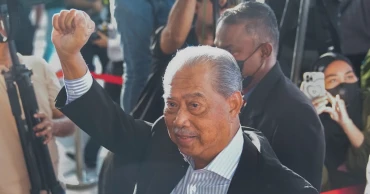
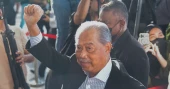
Malaysia ex-PM Muhyiddin charged with corruption, laundering
Former Prime Minister Muhyiddin Yassin was charged Friday with corruption and money laundering, making him Malaysia's second ex-leader to be indicted after leaving office.
Muhyiddin, 75, pleaded innocent to four charges of abusing his power to obtain 232.5 million ringgit ($51.4 million) bribes for his party and two charges of money laundering involving 195 million ringgit ($43 million). He has been released on bail.
Muhyiddin was arrested Thursday by the anti-graft agency, which questioned him over government stimulus projects to ethnic Malay contractors during the COVID-19 pandemic. He then slammed the charges against him as political persecution to crush his opposition alliance ahead of state elections. Outside the court building Friday, some supporters carried banners which read "malicious intent."
Read more: Malaysian ex-PM Muhyiddin arrested, faces graft charges
Prime Minister Anwar Ibrahim rejected accusations that the charges were politically motivated and noted the investigations were carried out independently by the anti-graft agency. After taking power in November, Anwar ordered a review of government projects approved by past administrations including Muhyiddin, who led Malaysia from March 2020 until August 2021.
Two senior members from Muhyiddin's Bersatu party were recently charged with graft. The anti-graft agency has also frozen Bersatu's party accounts.
Muhyiddin said Thursday that the charges were to embarrass him and cripple his Islamic-dominated alliance, which has strong support among ethnic Malays who account for about two-thirds of Malaysia's 33 million people.
Anwar and Muhyiddin has fought for the premiership after November general elections produced a hung parliament. The king later appointed Anwar as premier after he formed a unity government with several smaller parties, but his strength will be tested in six state elections due in the next few months.
Muhyiddin was the second former leader to be charged after ex-Prime Minister Najib Razak, who was hit with multiple charges after he lost in 2018 general elections. Najib began a 12-year jail term in August after losing his final appeal in the first of several graft trials related to the looting of the 1MDB state development fund.
If Muhyiddin is found guilty, he faces up to 20 years in prison for each of the corruption charges, 15 years each for money laundering and fines.
3 years ago
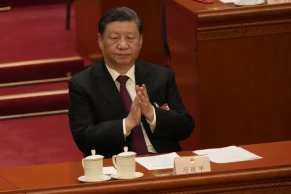
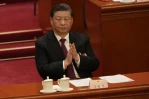
China's Xi awarded third term as president, extending rule
Chinese leader Xi Jinping was awarded a third five-year term as president Friday, putting him on track to stay in power for life.
The endorsement of Xi's appointment by the ceremonial National People's Congress was a foregone conclusion for a leader who has sidelined potential rivals and filled the top ranks of the ruling Communist Party with his supporters since taking power in 2012.
The vote for Xi was 2,952 to 0 by the NPC, members of which are appointed by the ruling party.
Xi, 69, had himself named to a third five-year term as party general secretary in October, breaking with a tradition under which Chinese leaders handed over power once a decade. A two-term limit on the figurehead presidency was deleted from the Chinese constitution earlier, prompting suggestions he might stay in power for life.
Read more: China's Xi calls for 'more quickly elevating' armed forces
No candidate lists were distributed, and Xi and those awarded other posts were believed to have run unopposed. The election process remains almost entirely shrouded in secrecy, apart from the process by which delegates to the congress placed four ballots into boxes placed around the vast auditorium of the Great Hall of the People.
Xi was also unanimously named commander of the 2 million-member People's Liberation Army, a force that explicitly takes its orders from the party rather than the country.
In other voting, the party's third-ranking official Zhao Leji was named head of the National People's Congress. The vast majority of the body's legislative work is headed by its Standing Committee, which meets year-round.
A holdover from the previous party Politburo Standing Committee, the apex of political power in China headed by Xi, Zhao, 67, won Xi's trust as head of the party's anti-corruption watchdog, the Central Commission for Discipline Inspection, pursuing an anti-graft campaign that has frozen all potential opposition to the leader.
Read more: Will China's next premier be a moderating influence on Xi?
Former Shanghai party boss and member of the last Politburo Standing Committee Han Zheng was named to the largely ceremonial post of state vice president.
Xi, Zhao and Han then took the oath of office with one hand on a copy of the Chinese constitution.
3 years ago