asia

Top UN woman urges Muslims: Move Taliban into 21st century
The highest-ranking woman at the United Nations said Wednesday she used everything in her “toolbox” during meetings with Taliban ministers to try to reverse their crackdown on Afghan women and girls, and she urged Muslim countries to help the Taliban move from the “13th century to the 21st.”
Deputy Secretary-General Amina Mohammed, a former Nigerian Cabinet minister and a Muslim, said at a news conference that four Taliban ministers, including the foreign minister and a deputy prime minister, spoke “off one script” during meetings with her delegation last week.
She said the officials sought to stress things that they say they have done and not gotten recognition for — and what they called their effort to create an environment that protects women.
“Their definition of protection would be, I would say, ours of oppression,” Mohammed said.
Those meetings in the Afghan capital, Kabul, and the Islamic group’s birthplace in Kandahar were followed by a visit this week by U.N. humanitarian chief Martin Griffiths and heads of major aid groups. They are pressing the Taliban to reverse their edict last month banning Afghan women from working for national and international non-governmental groups.
Speaking from Kabul on Wednesday, Griffiths said the focus of the visit was to get the Taliban to understand that getting aid operations up and running and allowing women to work in them was critical. The delegation’s message was simple — that the ban makes the groups' work more difficult, he said.
“What I heard from all those I met (was) that they understood the need as well as the right for Afghan women to work, and that they will be working on a set of guidelines which we will see issued in due course, which will respond to those requirements,” Griffiths said.
Mohammed said her delegation, including the head of UN Women, which promotes gender equality and women’s rights, pushed back against the Taliban, including when they started talking about humanitarian principles.
“We reminded them that in humanitarian principles, non-discrimination was a key part … and that they were wiping out women from the workplace,” she said.
As a Sunni Muslim, like the Taliban officials, Mohammed said she told the ministers that when it comes to preventing girls’ education beyond sixth grade and taking away women’s rights, they are not following Islam and are harming people.
In one setting, Mohammed said, she was told by a Taliban official she didn't name that “it was haram (forbidden by Islamic law) for me to be there talking to them.” These conservatives won’t look straight at a woman, she noted, so she said she played “that game” and didn’t look directly at them either.
“I gave as much as I think they gave, and we did push,” she said.
Mohammed said the Taliban have said that in due course the rights taken away from women and girls will come back so the U.N. delegation pressed for a timeline. “What they would say was ‘soon,’” she said.
The Taliban took power for a second time in August 2021, during the final weeks of the U.S. and NATO forces’ pullout from Afghanistan after 20 years of war.
Mohammed said the Taliban, who have not been recognized by a single country, want international recognition and Afghanistan’s seat at the United Nations, which is currently held by the former government led by Ashraf Ghani.
“Recognition is one leverage that we have and we should hold onto,” Mohammed said.
Before arriving in Kabul, Mohammed’s delegation traveled to Muslim majority countries, including Indonesia, Turkey, Gulf states and Saudi Arabia, where she said there was wide support against the Taliban bans.
She said there is a proposal for the U.N. and the 57-member Organization of Islamic Cooperation to host an international conference in mid-March on women in the Muslim world.
“It’s very important that the Muslim countries come together,” she said. “We have to take the fight to the region … and we need to be bold about it and courageous about it because women’s rights matter.”
Griffiths, the undersecretary-general for humanitarian affairs, and his delegation, including the heads of Care International and Save the Children U.S., did not travel to Kandahar, where the ban on Afghan women working for NGOs was issued on the orders of the reclusive Taliban supreme leader, Hibatullah Akhundzdaza.
Griffiths acknowledged Akhundzada’s top status but said there are many important voices among Taliban officials across the country.
“I don’t think it’s a simple matter of simply asking one man to take responsibility and to change an edict,” he said. “There is a collective responsibility for this edict, and I hope we’re building up a collective will to compensate for its ban.”
Save the Children’s Janti Soeripto said that there were meetings with eight ministries in two days and that some among the Taliban seemed to understand the need to reverse the ban.
“There’s resistance, they don’t want to be seen doing a U-turn,” she said. “If people don’t see the consequences as viscerally as we see them, people will feel less inclined.”
Mohammed said it is important for the U.N. and its partners to work more in some 20 Afghan provinces that are more forward leaning.
“A lot of what we have to deal with is how we travel the Taliban from the 13th century to the 21st," she said. “That's a journey. So it's not just overnight."
She said the Taliban told her delegation that it is putting forward a law against gender-based violence, which she called “a big plus” because rape and other attacks are increasing in Afghanistan.
“I want to hold the Taliban to champion implementing that law,” she said.
Mohammed said it is important to maximize whatever leverage there is to bring the Taliban back to the principles underpinning participation in the “international family.”
“No one objects to a Muslim country or Sharia (law),” she said. “But all of this cannot be re-engineered to extremism and taking views that harm women and girls. This is absolutely unacceptable, and we should hold the line.”
3 years ago

Sri Lanka says debt-restructuring talks making progress
Debt-stricken Sri Lanka’s Central Bank chief said Wednesday that the country is making good progress in talks with its creditors to obtain financial assurances for debt restructuring, an important step toward finalizing an International Monetary Fund rescue plan.
Sri Lanka is bankrupt and has suspended repayment of its $51 billion foreign debt, of which $28 billion must be repaid by 2027.
It has reached a preliminary agreement with the IMF for a $2.9 billion rescue package over four years. Its completion hinges on assurances on debt restructuring from creditors that include China, India and the Paris Club, a grouping of major creditor nations.
India announced last week that it has given its assurance to the IMF to facilitate the bailout plan. India has extended $4.4 billion in official credit to Sri Lanka, excluding other forms of lending.
Read more: Bangladesh not turning into Sri Lanka : FM
“Other bilateral creditors, Paris Club, China and small bilateral creditors are in the process of issuing financial assurances,” Sri Lankan Central Bank Governor Nandalal Weerasinghe said.
The “process is making very good progress,” Weerasinghe told reporters at his office, saying the country hopes to receive “the necessary financial assurances from all our creditors in a very short period.”
Sri Lanka borrowed heavily from China over the past decade for infrastructure projects that include a seaport, airport and a city being built on reclaimed land. The projects failed to earn enough revenue to pay for the loans, a factor in Sri Lanka’s economic woes.
China accounts for about 10% of Sri Lanka’s loans after Japan and the Asian Development Bank. However, its assent for restructuring its loans is crucial.
Sri Lanka's economic crisis and resultant shortages of food, medicine, fuel and cooking gas sparked riots last year, forcing the president to flee the country and later resign.
Read more: Sri Lanka's government cuts expenses as economy tanks
Sri Lanka has since shown some signs of progress, with shortages reduced and day-to-day functions restored. However, daily power cuts continue due to fuel shortages and the government is struggling to find money to pay government employees’ salaries and conduct other administrative functions.
It announced this month that it is cutting 6% from the budgets of each ministry this year and plans to downsize the military, which had swelled to more than 200,000 personnel due to a long civil war. The government plans to reduce the military’s size by nearly half by 2030.
3 years ago

BBC film on India's PM Modi, 2002 riots draws government ire
Days after India blocked a BBC documentary that examines Prime Minister Narendra Modi’s role during 2002 anti-Muslim riots and banned people from sharing it online, authorities on Wednesday were scrambling to halt screenings of the film in colleges and universities and restricting its clips on social media, a move that has been decried by critics as an assault on press freedom.
Jawaharlal Nehru University in the capital, New Delhi, cut off power and the internet on campus on Tuesday before the documentary was scheduled to be screened by a students’ union, saying it would disturb the peace on campus. The students nonetheless watched the documentary on their laptops and mobile phones after sharing it on messaging services like Telegram and WhatsApp.
The documentary has caused a storm at other Indian universities too.
Authorities at the University of Hyderabad, in India’s south, have begun a probe after a student group showed the banned documentary earlier this week. In the southern state of Kerala, workers from Modi’s Bharatiya Janata Party held demonstrations on Tuesday after some student groups affiliated with rival political parties defied the ban and screened the film.
The two-part documentary “India: The Modi Question” has not been broadcast in India by the BBC, but India’s federal government blocked it over the weekend and banned people from sharing clips on social media, citing emergency powers under its information technology laws. Twitter and YouTube complied with the request and removed many links to the documentary.
The first part of the documentary, released last week by the BBC for its U.K. audiences, revives the most controversial episode of Modi’s political career when he was the chief minister of western Gujarat state in 2002. It focuses on bloody anti-Muslim riots in which more than 1,000 people were killed.
The riots have long hounded Modi because of allegations that authorities under his watch allowed and even encouraged the bloodshed. Modi has denied the accusations, and the Supreme Court has said it found no evidence to prosecute him. Last year, the country's top court dismissed a petition filed by a Muslim victim questioning Modi's exoneration.
The first part of the BBC documentary relies on interviews with victims of the riots, journalists and rights activists, who say Modi looked the other way during the riots. It cites, for the first time, a secret British diplomatic investigation that concluded Modi was “directly responsible” for the “climate of impunity.”
The documentary includes the testimony of then-British Foreign Secretary Jack Straw, who says the British investigation found that the violence by Hindu nationalists aimed to “purge Muslims from Hindu areas” and that it had all the “hallmarks of an ethnic cleansing.”
Suspicions that Modi quietly supported the riots led the U.S., U.K. and E.U. to deny him a visa, a move that has since been reversed.
India’s Foreign Ministry last week called the documentary a “propaganda piece designed to push a particularly discredited narrative” that lacks objectivity and slammed it for “bias” and “a continuing colonial mindset.” Kanchan Gupta, a senior adviser in the government’s Ministry of Information and Broadcasting, denounced it as “anti-India garbage.”
The BBC in a statement said the documentary was “rigorously researched” and involved a wide range of voices and opinions.
“We offered the Indian Government a right to reply to the matters raised in the series — it declined to respond,” the statement said.
The second part of the documentary, released Tuesday in the U.K., “examines the track record of Narendra Modi’s government following his re-election in 2019,” according to the film’s description on the BBC website.
In recent years, India’s Muslim minority has been at the receiving end of violence from Hindu nationalists, emboldened by a prime minister who has mostly stayed mum on such attacks since he was first elected in 2014.
The ban has set off a wave of criticism from opposition parties and rights groups that slammed it as an attack against press freedom. It also drew more attention to the documentary, sparking scores of social media users to share clips on WhatsApp, Telegram and Twitter.
“You can ban, you can suppress the press, you can control the institutions … but the truth is the truth. It has a nasty habit of coming out,” Rahul Gandhi, a leader in the opposition Congress party, told reporters at a press conference Tuesday.
Mahua Moitra, a lawmaker from the Trinamool Congress political party, on Tuesday tweeted a new link after a previous one was taken down. “Good, bad, or ugly — we decide. Govt doesn’t tell us what to watch,” Moitra said in her tweet, which was still up Wednesday morning.
Human Rights Watch said the ban reflected a broader crackdown on minorities under the Modi government, which the rights group said has frequently invoked draconian laws to muzzle criticism.
Critics say press freedom in India has declined in recent years and the country fell eight places, to 150 out of 180 countries, in last year’s Press Freedom Index published by Reporters Without Borders. It accuses Modi’s government of silencing criticism on social media, particularly on Twitter, a charge senior leaders of the governing party have denied.
Modi’s government has regularly pressured Twitter to restrict or ban content it deems critical of the prime minister or his party. Last year, it threatened to arrest Twitter staff in the country over their refusal to ban accounts run by critics after implementing sweeping new regulations for technology and social media companies.
The ban on the BBC documentary comes after a proposal from the government to give its Press Information Bureau and other “fact-checking” agencies powers to take down news deemed “fake or false” from digital platforms.
The Editors Guild of India urged the government to withdraw the proposal, saying such a change would be akin to censorship.
3 years ago

Philippine plane crash kills 2, another carrying 6 missing
A Philippine air force plane crashed Wednesday on a farm northwest of Manila, killing the two people on board, while a search was continuing for a private aircraft carrying six people that went missing the previous day in the mountainous north.
The SF-260 plane was on a training flight from Sangley airport in Cavite province south of Manila when it plummeted into a rice field in Bataan province, air force spokesperson Col. Maria Consuelo Castillo said.
Police investigator Edgardo Delos Santos told The Associated Press by telephone from the crash site that the bodies of the two men were pulled from the wreckage and that witnesses saw the plane rapidly descending apparently out of control before crashing in the rice field.
Read more: Nepal begins national mourning after 68 killed in deadly plane crash
The air force grounded other SF-260s, which are used for training and in counter-insurgency operations, Castillo said. An investigation would be done to determine the cause of the crash, the air force said.
The Philippine military, one of the most underfunded in Asia, has struggled for years to modernize its air force and navy in particular despite funding problems while battling decades-old Muslim and communist insurgencies and defending Philippine territorial waters and claims in the disputed South China Sea.
Separately, a single-engine Cessna plane carrying six people lost contact with airport tower personnel about four minutes after takeoff on what was to be a 30-minute flight Tuesday in northern Isabela province, the Civil Aviation Authority of the Philippines said.
Read more: Passenger's video captures last moments before Nepal crash
A full-scale search and rescue was continuing Wednesday, the civil aviation agency said. It didn't identify those who were on the plane.
The Philippine air force said its helicopters could not take off to join the search in Isabela because of bad weather.
3 years ago

Ship sinks between S. Korea and Japan; 11 found unconscious
Ships searching in wind-whipped waters between South Korea and Japan have picked up at least 12 of the 22 crew members from a cargo ship that sank early Wednesday. Officials said only one of them remained conscious, but they did not immediately confirm any deaths.
South Korean and Japanese coast guard vessels and aircraft as well as two commercial cargo ships were continuing to search for the 10 missing crew members but the efforts were being slowed by strong winds and waves, South Korean officials said.
The 6,551-ton Jin Tian sank about three and a half hours after it sent a distress call at around 11:15 p.m. Tuesday in Japan's exclusive economic zone, Japanese coast guard spokesperson Shinya Kitahara said.
The vessel, which was Hong Kong registered and carrying lumber, sank about 160 kilometers (100 miles) southwest of Nagasaki, Japan, and about 150 kilometers (93 miles) south of South Korea’s Jeju island.
Read more: Vessel with 11 lakh litre fuel sinks in Meghna river
The captain last communicated with the coast guard through a satellite phone around 2:41 a.m., saying crew members would abandon the ship, minutes before it sank, Jeju island coast guard officials said.
Six crew members were picked up by South Korean coast guard vessels, while a cargo ship picked up five and a Japanese Maritime Self-Defense Force vessel picked up one, according to Jeju’s coast guard.
According to South Korean and Japanese officials, 14 crew members are Chinese and eight are from Myanmar.
South Korean officials didn’t immediately confirm where the rescued crew members would be taken for treatment or whether the 11 who were unconscious were likely to survive their injuries if they weren’t already dead.
Japan’s Chief Cabinet Secretary Hirokazu Matsuno confirmed the rescue of at least five crew members, who he said were all Chinese nationals, but didn’t provide details about their health conditions.
Kitahara said the cause of the ship’s sinking was not immediately known and there were no signs that it collided with another vessel. He said the arrivals of Japanese patrol boats and aircraft were delayed by rough weather following the sinking.
Read more: Lighter vessel sinks in Bay: 12 missing crew members rescued
Officials at Jeju’s coast guard say a strong wind warning was issued for the area earlier on Wednesday but was later lifted. Winds were blowing at around 16 meters (yards) per second in the area as of 7 a.m., creating waves that were 3 to 4 meters (yards) high. The area’s water temperature was then around 18.5 degrees Celsius, the South Korean officials said.
3 years ago

Pakistan's premier apologizes to nation for power outage
Pakistan’s prime minister on Tuesday apologized to the nation for a major, daylong power outage that disrupted normal life across the country and drew criticism from millions who were left without electricity amid the harsh winter weather.
Monday's blackout engulfed schools, factories and shops, and many among Pakistan's 220 million people were without drinking water as pumps powered by electricity also failed to work. In key businesses and institutions, including main hospitals, military and government facilities, backup generators kicked in.
Power was mostly restored, though some parts of the country still experienced blackouts on Tuesday.
“On behalf of my government, I would like to express my sincere regrets for the inconvenience our citizens suffered due to power outage yesterday," tweeted Prime Minister Shahbaz Sharif.
“On my orders an inquiry is underway to determine reasons of the power failure," he said adding that the probe will uncover who was responsible.
Read more: Lights out in Pakistan as energy-saving move backfires
At a press conference earlier Tuesday, Energy Minister Khurram Dastgir defended the government’s handling of the collapse of the grid and lauded engineers and technicians for their efforts to boot up the system. He made no reference to the fact that an energy-saving measure by the government had backfired.
Authorities had turned off electricity during low-usage hours on Sunday night to conserve fuel, according to an energy-saving plan. Efforts to turn power back on early on Monday morning led to the system-wide meltdown.
“Today, at 5:15 in the morning, power was fully restored,” Dastgir said Tuesday. He blamed the outage on a technical glitch but also floated a “remote chance" that it was caused by hackers targeting the country's grid systems.
The minister also expressed faith in Sharif's three-member committee, which is expected to complete a preliminary investigation within days. “We will fully cooperate" with it, he said.
Read more: Pakistan orders malls to close early amid economic crisis
He cautioned that some regions may still face “routine power outages" this week as Pakistan's two nuclear power plants and coal plants have yet to come fully online.
The outage was reminiscent of a massive blackout in January 2021, attributed at the time to a technical fault in Pakistan’s power generation and distribution system. Pakistan gets at least 60% of its electricity from fossil fuels, while nearly 27% of the electricity is generated by hydropower. The contribution of nuclear and solar power to the nation’s grid is about 10%.
Fawad Chaudhry, a senior leader at the opposition Pakistan Tehreek-e-Insaf party on Monday criticized the government for mismanaging the country's economy and said the outage was a reflection of the government's incompetence.
Grappling with one of its worst economic crisis in recent years amid dwindling foreign exchange reserves, Pakistan is currently in talks with the International Monetary Fund to soften some conditions on a $6 billion bailout. Sharif's government say the harsh conditions will trigger further inflation hikes.
The IMF released the last crucial tranche of $1.1 billion to Islamabad in August but since then, discussions between the two parties have oscillated due to Pakistan’s reluctance to impose new tax measures.
3 years ago

Lights out in Pakistan as energy-saving move backfires
Much of Pakistan was left without power for several hours on Monday morning as an energy-saving measure by the government backfired. The outage spread panic and raised questions about the cash-strapped government’s handling of the crisis.
Electricity was turned off across the country during low usage hours overnight to conserve fuel across the country, leaving technicians unable to boot up the system all at once after daybreak, officials said.
The outage was reminiscent of a massive blackout in January 2021, attributed at the time to a technical fault in the country's power generation and distribution system.
Energy Minister Khurram Dastgir told local media on Monday that engineers were working to restore the power supply across the country, including in the capital of Islamabad, and tried to reassure the nation that power would be fully restored within the next 12 hours.
According to the minister, during winter, electricity usage typically goes down overnight. “As an economic measure, we temporarily shut down our power generation systems" on Sunday night, he said.
When engineers tried to turn the systems back on, a “fluctuation in voltage" was observed, which “forced engineers to shut down the power grid" stations one by one, Dastgir said.
He insisted that this was not a major crisis, and that electricity was being restored in phases. In many places and key businesses and institutions, including hospitals, military and government facilities, backup generators kicked in.
Karachi, the country's largest city and economic hub, was also without power Monday, as were other key cities such as Quetta, Peshawar and Lahore.
Read more: Pakistan's politics of conspiracy will not stop
Imran Rana, a spokesman for Karachi's power supply company, said the government's priority was to “restore power to strategic facilities, including hospitals," airports and other places.
Pakistan gets at least 60% of its electricity from fossil fuels, while nearly 27% of the electricity is generated by hydropower. The contribution of nuclear and solar power to the nation's grid is about 10%.
Pakistan is grappling with one of the country's worst economic crisis in recent years amid dwindling foreign exchange reserves. This has compelled the government earlier this month to order shopping malls and markets closed by 8:30 p.m. for energy conservation purposes.
Talks are underway with the International Monetary Fund to soften some conditions on Pakistan’s $6 billion bailout, which the government thinks will trigger further inflation hikes. The IMF released the last crucial tranche of $1.1 billion to Islamabad in August.
Since then, talks between the two parties have oscillated due to Pakistan's reluctance to impose new tax measures.
3 years ago
More bodies found in Tibet avalanche; death toll rises to 28
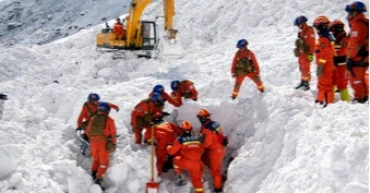
More bodies were found Friday following an avalanche that buried vehicles outside a highway tunnel in Tibet, raising the death toll to 28, Chinese state broadcaster CCTV reported.
Images from the scene at the exit of the tunnel connecting the city of Nyingchi in Tibet’s southwest with an outlying county showed about half a dozen backhoes digging through deep snow. Reports said around 1,000 rescuers had joined the effort.
Tons of snow and ice collapsed onto the mouth of the tunnel on Tuesday evening, trapping drivers in their vehicles.
Read more: More bodies found in Tibet avalanche, death toll rises to 20
Many of the people were headed home for China’s Lunar New Year holiday, which starts Sunday.
Nyingchi lies at an elevation of nearly 10,000 feet (3,048 meters), about a five-hour drive from the regional capital, Lhasa, along a highway that opened in 2018.
3 years ago

The AP Interview: Envoy says Taiwan learns from Ukraine war
Taiwan has learned important lessons from Ukraine’s war that would help it deter any attack by China or defend itself if invaded, the self-ruled island’s top envoy to the U.S. said in an interview Friday with The Associated Press.
Among the lessons: Do more to prepare military reservists and also civilians for the kind of all-of-society fight that Ukrainians are waging against Russia.
“Everything we’re doing now is to prevent the pain and suffering of the tragedy of Ukraine from being repeated in our scenario in Taiwan,” said Bi-khim Hsiao, Taiwan’s representative in Washington.
“So ultimately, we seek to deter the use of military force. But in a worst-case scenario, we understand that we have to be better prepared,” Hsiao said.
Hsiao spoke at the quiet, more than 130-year-old hilltop mansion that Taiwan uses for official functions in Washington. She talked on a range of Taiwan-US military, diplomatic and trade relations issues shaped by intensifying rivalries with China.
No Taiwanese flag flew over the building, reflecting Taiwan’s in-between status as a U.S. ally that nonetheless lacks full U.S. diplomatic recognition. The U.S. withdrew that in 1979, on the same day it recognized Beijing as the sole government of China.
The interview came after a year of higher tensions with China, including the Chinese launching ballistic missiles over Taiwan and temporarily suspending most dialogue with the U.S. after then-House Speaker Nancy Pelosi visited Taiwan in August.
Asked if new House Speaker Kevin McCarthy should make good on his earlier pledge to visit Taiwan as well, Hsaio said. “That will be his decision. But I think ultimately the people of Taiwan have welcomed visitors from around the world.”
Beijing’s leadership, she added, “has no right to decide or define how we engage with the world.”
Taiwan, which split from the mainland in 1949 during a civil war, is claimed by China. The decades-old threat of invasion by China of the self-governed island has sharpened since China cut off communications with the island’s government in 2016. That was after Taiwanese voters elected a government that Beijing suspected of wanting to take Taiwan from self-rule to full independence.
In Washington, Taiwan’s self-rule is one issue that has strong support from both parties.
U.S. administrations for decades have maintained a policy of leaving unsaid whether the U.S. military would come to Taiwan’s defense if China did invade. China’s military shows of force after Pelosi’s visit had some in Congress suggesting it was time for the U.S. to abandon that policy, known as “strategic ambiguity,” and to instead make clear Americans would fight alongside Taiwan.
Asked about those calls Friday, Hsiao only praised the existing policy.
“It has preserved the status quo for decades, or I should say it has preserved peace,” she said.
President Joe Biden has repeatedly volunteered in public comments that the U.S. would come to Taiwan’s defense, only to have aides walk that back with assurances that strategic ambiguity still prevails.
Read more: China renews threat against Taiwan as island holds drills
Meanwhile, after watching the Ukrainians’ successful hard-scrabble defense against invading Russian forces, Taiwan realizes it needs to load up on Javelins, Stingers, HIMARS and other small, mobile weapons systems, Hsiao said. The Taiwanese and Americans have reached agreement on some of those, she said.
Some security think tanks accuse the U.S. — and the defense industry — of focusing too much of the nation’s billions of dollars in arms deals with Taiwan on advanced, high-dollar aircraft and naval vessels. China’s mightier military could be expected to destroy those big targets at the outset of any attack on Taiwan, some security analysts say.
Taiwan is pushing to make sure that a shift to grittier, lower-tech weapon supplies for Taiwanese ground forces “happens as soon as possible,” Hsaio said. Even with the U.S. and other allies pouring billions of dollars worth of such weapons into Ukraine for the active fight there, straining global arms stocks, ”we are assured by our friends in the United States that Taiwan is a very important priority,” she said.
At home, Taiwan President Tsai Ing-wen announced last month the government was extending compulsory military service for men from four months to a year, and Taiwan is increasing spending on defense. Hsiao would not directly address a report by Nikkei Asia on Friday that U.S. National Guard members had begun work training in Taiwan, saying only that Taiwan was exploring ways to work with the U.S. Guard members to improve training.
Ukraine’s experience has had lessons for the U.S. and other allies as well, she said, including the importance of a united allied stand behind threatened democracies.
“It’s critical to send a consistent message to the authoritarian leaders that force is never an option ... force will be met by a strong international response, including consequences,” Hsiao said.
Hsiao also spoke on the United States’ push under the Biden administration to boost U.S. production of computer chips. Supply chain disruptions during the coronavirus pandemic have underscored semiconductors’ crucial importance to the U.S. economy and military — and the extent of U.S. reliance on chip imports.
Greater U.S. production will push the nation into more direct trade competition with Taiwan, which is a global leader, especially for advanced semiconductors. Concern that China could interfere with semiconductor shipping through the Taiwan Strait has helped drive the United States’ new production effort.
Hsiao pointed out that Taiwan’s computer chip industry took decades to develop and expressed confidence it “will continue to be an indispensable and irreplaceable contributor to global supply chains in the decades to come.”
She noted Taiwan’s investment of $40 billion in a new semiconductor plant in Arizona, a project big enough that Biden visited the site last month, and expressed frustration at what she called a continuing U.S. financial penalty for Taiwanese companies doing business in the United States.
Read more: China holds large-scale joint strike drills aimed at Taiwan
The United States’ diplomatic non-recognition of Taiwan as a country means that Taiwan – unlike China and other top U.S. trading partners – lacks a tax treaty with the U.S. and thus pays extra taxes.
Surmounting hurdles to fix that would make U.S.-Taiwan business investments “much more successful and sustainable in the long run,” she said.
3 years ago

Bombing derails passenger train in SW Pakistan, injures 15
A bomb planted by suspected militants derailed a passenger train in a remote area in southwestern Pakistan on Friday, injuring at least 15 people on board, officials said. A separatist group later claimed responsibility.
The train was passing through the district of Bolan in Baluchistan province when the bomb went off, according to a district administrator, Samiullah Agha.
The explosion was so powerful that it derailed eight train cars, Agha said. Rescuers transported the injured to a nearby hospital, and engineers were repairing the damaged rail tracks.
Some of the more seriously injured were moved to a military hospital in Quetta, the provincial capital in Baluchistan.
Read more: Suicide blast in southern Pakistan kills 3 Chinese, driver
Hours later, the separatist Baluchistan Liberation Army, which was designated a “terrorist” group by the United States in 2019, claimed responsibility for the attack.
Azad Baloch, a spokesman for the group, said their fighters targeted security forces traveling by train to the garrison city of Rawalpindi in eastern Punjab province.
Government and military officials did not immediately comment on the separatist group's claim.
For over a decade, Baluchistan has been the scene of a low-level insurgency by ethnic Baluch separatists seeking autonomy from the Islamabad government or outright independence
Pakistani militants also have a presence in the province, which borders both Afghanistan and Iran.
Read more: Suicide bombing kills 56 at Shiite mosque in Pakistan
3 years ago