asia

Fmr Bengal governor elected India's next Vice-President
Former governor of the eastern Indian state of West Bengal, Jagdeep Dhankhar, was elected as the country's next Vice-President on Saturday.
Dhankhar, who was fielded by India's ruling Bharatiya Janata Party, defeated his main challenger and opposition candidate Margaret Alva, also a former state governor and federal minister, by a huge margin.
Voting to elect India's 14th Vice-President was held earlier in the day. Dhankhar will replace incumbent Vice-President Venkaiah Naidu whose five-year term ends on August 10.
Also read: Indian oppn leader Rahul Gandhi released from detention
The Vice-President is elected by an electoral college consisting of members of both Houses of Parliament -- the Rajya Sabha (Upper House) and the Lok Sabha (Lower House).
The Vice-President is the second-highest constitutional office in India. The Vice-President serves as the chairperson of the Rajya Sabha and also acts as the chancellor of the central universities.
Who's Dhankhar?
Born on 18 May, 1951, in Kithana, a small village in the western state of Rajasthan, to a farmer family, Dhankhar completed his graduation in law and entered politics at a very young age.
Also read: India raises interest rate to 5.4%, in 3rd hike since May
He subsequently became a member of the Rajasthan state assembly and then India's Parliament. He also practiced as a senior advocate in India's Supreme Court.
3 years ago

Israel and Gaza militants exchange fire after deadly strikes
Israeli jets pounded militant targets in Gaza on Saturday and rocket barrages into southern Israel persisted, raising fears of an escalation after a wave of Israeli airstrikes on the coastal enclave killed at least 12 people, including a senior militant and a 5-year-old girl.
The fighting began with Israel’s killing of a senior commander of the Palestinian Islamic Jihad in a strike Friday. Gaza’s Hamas rulers so far appeared to stay on the sidelines of the conflict, keeping its intensity somewhat contained, for now. Israel and Hamas have fought four wars and several smaller battles over the last 15 years at a staggering cost to the territory’s 2 million Palestinian residents.
Shortly before noon Saturday, Israeli warplanes stepped up airstrikes. After warning residents in phone calls, fighter jets dropped two bombs on the house of an Islamic Jihad member in a residential area of Gaza City, flattening the two-story structure and badly damaging surrounding homes. Women and children rushed out of the area, and there were no casualties.
“Warned us? They warned us with rockets and we fled without taking anything,” said Huda Shamalakh, who lived next door. She said 15 people lived in the targeted home.
Another airstrike hit an Islamic Jihad site nearby. Gaza militants continued to launch rounds of rockets into southern Israel around every half hour, though there were no reports of casualties.
The lone power plant in Gaza ground to a halt at noon Saturday for lack of fuel as Israel has kept its crossing points into Gaza closed since Tuesday. The shutdown deepens the densely packed territory’s chronic power crisis amid peak summer heat. With the new disruption, Gazans can get only 4 hours of electricity a day, increasing their reliance on private generators.
The latest round of Israel-Gaza violence was sparked by the arrest this week of a senior Islamic Jihad leader in the West Bank, part of a monthlong Israeli military operation in the territory. Citing a security threat, Israel then sealed roads around the Gaza Strip and on Friday killed Islamic Jihad’s commander for northern Gaza, Taiseer al-Jabari, in a targeted strike.
An Israeli military spokesman said the strikes were in response to an “imminent threat” from two militant squads armed with anti-tank missiles.
Read: Israeli strikes on Gaza kill 10, including senior militant
“This government has a zero-tolerance policy for any attempted attacks — of any kind — from Gaza towards Israeli territory,” Israeli Prime Minister Yair Lapid said in a televised speech Friday. “Israel will not sit idly by when there are those who are trying to harm its civilians.”
“Israel isn’t interested in a broader conflict in Gaza but will not shy away from one either.” he added.
The violence poses an early test for Lapid, who assumed the role of caretaker prime minister ahead of elections in November, when he hopes to keep the position.
Lapid, a centrist former TV host and author, has experience in diplomacy having served as foreign minister in the outgoing government, but has thin security credentials. A conflict with Gaza could burnish his standing and give him a boost as he faces off against former Prime Minister Benjamin Netanyahu, a security hawk who led the country during three of its four wars with Hamas.
Hamas also faces a dilemma in deciding whether to join a new battle barely a year after the last war caused widespread devastation. There has been almost no reconstruction since then, and the isolated coastal territory is mired in poverty, with unemployment hovering around 50%.
Egypt intensified efforts to prevent escalation, communicating with Israel, the Palestinians and the U.S. to keep Hamas from joining the fighting, an Egyptian intelligence official said. The official spoke on condition of anonymity because he was not authorized to brief media.
The Palestinian Health Ministry said a 5-year-old girl and a 23-year-old woman were among 12 killed in Gaza, along with more than 80 wounded. It did not differentiate between civilians and militants. The Israeli military said early estimates were that around 15 fighters were killed.
Hundreds marched in a funeral procession for the Jihad commander al-Jabari and others who were killed, with many mourners waving Palestinian and Islamic Jihad flags and calling for revenge. Al-Jabari had succeeded another militant killed in an airstrike in 2019, which at the time also set off a round of heavy fighting.
3 years ago

ASEAN special envoy to Myanmar warns on further executions
Efforts by Myanmar’s neighbors to help restore peace and normalcy to the strife-torn Southeast Asian nation were hindered by the country’s recent executions of four political activists, Cambodia’s foreign minister said Saturday.
Prak Sokhonn, speaking in his capacity as special envoy to Myanmar of the 10-member Association of Southeast Asian Nations, warned that further executions would force the regional grouping to reconsider how it engages with fellow member Myanmar.
Cambodia is the current chair of the regional grouping, and Myanmar is not welcome to send members of its ruling military government to ASEAN meetings because of its failure to cooperate with a plan agreed upon last year to work toward restoring peace.
Myanmar’s military rulers initially agreed to the plan, a five-point consensus, but have since made little effort to implement it. The country has slipped into a situation that some U.N. experts have characterized as a civil war.
Prak Sokhonn was speaking at a news conference after a weeklong meeting in Cambodia of ASEAN foreign ministers. The meeting’s final communique, issued Friday, included a section criticizing Myanmar for its lack of progress in ending violence there, but with weaker language than several countries had hoped for.
On Saturday, he described the executions of Myanmar dissidents as a “setback” to his mediation efforts and said the nine ASEAN members aside from Myanmar had “agreed to see how things will evolve in the coming weeks and months.”
Read: Wang Yi’s visit to "elevate" ties with Dhaka to a new level: Beijing
He said “if more executions are conducted, then things will have to be reconsidered,” which suggested that ASEAN is prepared to downgrade its engagement with Myanmar’s military government. ASEAN has been criticized by some of its own members as well as other countries for doing too little to pressure Myanmar to implement the five-point consensus.
Myanmar’s army in February last year ousted the elected government of Aung San Suu Kyi and then violently cracked down on widespread protests against its actions. After security forces unleashed lethal force against peaceful demonstrators, some opponents of military rule took up arms.
Myanmar’s foreign ministry issued a statement Friday saying it objected to a reference in the ASEAN joint statement to a “lack of progress” in implementing the five-point consensus because “it neglects Myanmar’s efforts on its implementation.”
It also said that the four men recently executed were not punished because they were political activists but because they were “found guilty of masterminding, inciting, supporting, arming and committing terrorist activities which caused tremendous loss of innocent lives.”
Prak Sokhonn said progress has been made on providing humanitarian aid to Myanmar, but not on the other main points in ASEAN’s plan: stopping the violence and opening up a political dialogue among all the country’s contending parties.
“The only will I see now is to continue to fight,” he said. “Why? Because of the lack of trust and the execution of the activists, whether it is legal or illegal.”
3 years ago

Taliban: 2 civilians killed in a bomb blast in Afghanistan
A bomb hidden in a cart went off on Friday near a mosque in a minority Shiite neighborhood of the Afghan capital, killing two civilians and wounding another three, a Taliban official said.
According to Khalid Zadran, the Taliban-appointed spokesman for the Kabul police chief, the attack happened in western Kabul, in the Sar-e Karez area. There were fears the casualty numbers could rise after further reports come in.
Read: Taliban under scrutiny as US kills al-Qaida leader in Kabul
There was no immediate claim of responsibility, but blame is likely to fall on the Islamic State group, which has targeted Afghanistan’s minority Shiites in large-scale attacks in the past.
The regional affiliate of IS, known as the Islamic State in Khorasan Province, has increased attacks on mosques and minorities across the country since the Taliban seized power last August. It has been operating in Afghanistan since 2014.
IS is seen as the greatest security challenge facing the country’s Taliban rulers. Following their takeover of Afghanistan, the Taliban have launched a sweeping crackdown against the IS headquarters in the country's east.
On Wednesday, in a gunbattle between the Taliban and IS gunmen killed five, including two Taliban fighters. The fighting erupted near the Sakhi shrine in the Karti Sakhi neighborhood as people were busy preparing for Ashoura, which commemorates the 7th century death in battle of Imam Hussein, the grandson of the Prophet Muhammad.
3 years ago
.jpg)
Indian oppn leader Rahul Gandhi released from detention
Indian opposition leader Rahul Gandhi and his sister Priyanka were released by Delhi Police late on Friday evening, after over six hours of detention.
Rahul, Priyanka and other senior Congress leaders were detained by the cops during a protest by the country's principal opposition party against inflation and rising unemployment outside the grand old outfit's headquarters in Delhi this afternoon.
Around 1pm, Rahul, Priyanka and other senior leaders of the party were bundled into police jeeps and taken to Police Lines at Kingsway Camp as soon as they embarked on the protest. Around 7.15pm, all the leaders were released.
Read:Indian oppn leader Rahul Gandhi detained
"We're witnessing the death of democracy. What India has built brick by brick, starting almost a century ago, is being destroyed in front of your eyes. Anybody who stands against this idea of onset of dictatorship is viciously attacked, jailed, arrested and beaten up," Rahul said before his detention.
Earlier in the day, Rahul, his mother and Congress chief Sonia Gandhi, and several lawmakers of the party wore black clothes in Parliament to register their protest against rising prices, particularly of essential commodities, and unemployment.
A senior police officer told the local media that they were compelled to crack down on the protesters in the wake of the imposition of prohibitory orders by the authorities. "We have also not given them permission to hold any protest in Delhi," he said.
Rahul, son of Sonia and former Prime Minister Rajiv Gandhi, is seen by many as a future prime minister of India. Apart from his father, his grandmother Indira Gandhi and great grandfather Jawaharlal Nehru have all served as prime ministers of India.
3 years ago
.jpg)
Indian oppn leader Rahul Gandhi detained
Indian opposition leader Rahul Gandhi and his sister Priyanka were detained by police during the Congress party's protest against inflation and rising unemployment in Delhi on Friday.
Rahul, Priyanka and other senior leaders of the party were bundled into police jeeps and taken to Police Lines at Kingsway Camp as soon as they embarked on the protest near the Congress headquarters in the heart of the national capital.
"We're witnessing the death of democracy. What India has built brick by brick, starting almost a century ago, is being destroyed in front of your eyes. Anybody who stands against this idea of onset of dictatorship is viciously attacked, jailed, arrested and beaten up," Rahul told the media.
Also read: India raises interest rate to 5.4%, in 3rd hike since May
Earlier in the day, Rahul, his mother and Congress chief Sonia Gandhi, and several lawmakers of the party wore black clothes in Parliament to register their protest against rising prices, particularly of essential commodities, and unemployment.
A senior police officer told the local media that they were compelled to crack down on the protesters in the wake of the imposition of prohibitory orders by the authorities. "We have also not given them permission to hold any protest in Delhi," he said.
Rahul, son of Sonia and former Prime Minister Rajiv Gandhi, is seen by many as a future prime minister of India. Apart from his father, his grandmother Indira Gandhi and great grandfather Jawaharlal Nehru have all served as prime ministers of India.
Also read: Bollywood singer Babul Supriyo becomes Bengal minister
3 years ago

India raises interest rate to 5.4%, in 3rd hike since May
India’s central bank on Friday raised its key interest rate by 50 basis points to 5.4% in its third such hike since May as it focuses on containing inflation.
Reserve Bank of India Governor Shaktikanta Das projected inflation at 6.7% in this financial year. June was the sixth consecutive month with inflation above the central bank's tolerance level of 6%, he said in a statement after a meeting of the bank's monitoring committee.
The committee decided ``to remain focused on the withdrawal of accommodation to ensure that inflation remains within the target going forward while supporting growth," he said.
Das said the global economic and financial environment has deteriorated with the combined impact of monetary policy tightening across the world and the war in Ukraine raising risks of a recession.
The Indian rupee has plunged to an all-time low of 79.05 rupees to one U.S. dollar. Das attributed its weakness to a strengthening dollar as interest rates rise in the United States.
Multiple waves of COVID-19 outbreaks have badly hit India's large informal sector and contact-intensive services like restaurants, hotels, retailing and tourism.
Unemployment has risen to nearly 8%, according to data from the think tank Center for Monitoring Indian Economy.
Read:India & Oman to hold joint military exercise from Monday
The main opposition Congress party on Friday organized marches across the country protesting rising prices of petrol, gas, foodstuffs and goods and the services tax.
India’s Finance Minister Nirmala Sitharaman defended the government’s handling of the economy in Parliament earlier this week. She said there is zero probability of India slipping into recession, even though there are some other major economies are at greater risk of doing so.
On Friday, Das projected that the economy would expand at a 7.2% annual pace in the current fiscal year, which ends in March 2023, slowing to 6.7% in the next financial year.
``On the outlook for growth, rural consumption is expected to benefit from the brightening agricultural prospects," he said. Demand for services as the pandemic wanes and an improvement in business and consumer sentiment should boost discretionary spending and urban consumption, he said.
Given that inflation remains above the target, “It's clear that the tightening cycle still has legs," Shilan Shah of Capital Economics said in a report that forecast a full 1 percentage point of hikes by early next year.
The International Monetary Fund has projected 7.4% economic growth for India in 2022, down from 8.7% in 2021 and slipping to 6.1% in 2023.
The IMF on Thursday suggested that India withdraw fiscal and monetary policy stimulus gradually, develop better infrastructure for exports, such as ports and railways, and scale up shipments by forging free trade agreements with key trading partners to keep its economy balanced over the medium term.
Former RBI governor Raghuram Rajan said earlier this week that India should focus on services instead of blindly following China's model of manufacturing-led growth.
Even if India's economy is growing faster than many other nations, he said the country still needs more growth to sustain its huge population, now at 1.4 billion and due to overtake China's within a few years.
3 years ago

China sanctions Pelosi, sends 100 warplanes to Taiwan drills
China said Friday that more than 100 warplanes and 10 warships have taken part in live-fire military drills surrounding Taiwan over the past two days, while announcing sanctions on U.S. House Speaker Nancy Pelosi over her visit to the self-governing island earlier this week.
The official Xinhua News Agency said Friday that fighters, bombers, destroyers and frigates were all used in what it called “joint blockage operations” taking place in six zones off the coast of Taiwan, which China claims as its own territory.
The military’s Eastern Theater Command also fired new versions of missiles it said hit unidentified targets in the Taiwan Strait “with precision.”
Those included projectiles fired over Taiwan into the Pacific, military officers told state media, in a major ratcheting up of China’s threats to annex the island by force.
The drills, which Xinhua described as being held on an “unprecedented scale," are China's response to a visit this week by Pelosi to Taiwan. She is the highest ranking U.S. politician to visit Taiwan in 25 years.
China announced unspecified sanctions on Pelosi and her family. Such sanctions are generally mostly symbolic in nature.
A Chinese Foreign Ministry statement said that Pelosi had disregarded China’s serious concerns and resolute opposition to her visit. It called Pelosi’s visit provocative and said it undermines China’s sovereignty and territorial integrity.
China opposes Taiwan having its own engagements with foreign governments.
On the Chinese coast across from Taiwan, tourists gathered Friday to try to catch a glimpse of any military aircraft heading toward the exercise area.
Fighter jets could be heard flying overhead and tourists taking photos chanted, “Let’s take Taiwan back," looking out into the blue waters of the Taiwan Strait from Pingtan island, a popular scenic spot.
China's insistence that Taiwan is its territory and threat to use force to bring it under its control has featured highly in ruling Communist Party propaganda, the education system and the entirely state-controlled media for the more than seven decades since the sides divided amid civil war in 1949.
Island residents overwhelmingly favor maintaining the status quo of de facto independence and reject China's demands that Taiwan unify with the mainland under Communist control.
On Friday morning, China sent military ships and war planes across the mid-line of the Taiwan Strait, the Taiwanese Defense Ministry said, crossing what had for decades been an unofficial buffer zone between China and Taiwan.
Five of the missiles fired by China since the military exercises began Thursday landed in Japan’s Exclusive Economic Zone off Hateruma, an island far south of Japan’s main islands, Japanese Defense Minister Nobuo Kishi said. He said Japan protested the missile landings to China as “serious threats to Japan’s national security and the safety of the Japanese people.”
Japan's Defense Ministry later said they believe the other four missiles, fired from China’s southeastern coast of Fujian, flew over Taiwan.
Read: China cannot stop US officials from visiting Taiwan: Pelosi
Japanese Prime Minister Fumio Kishida said Friday that China’s military exercises aimed at Taiwan represent a “grave problem” that threatens regional peace and security.
In Tokyo, where Pelosi is winding up her Asia trip, she said China cannot stop U.S. officials from visiting Taiwan. Speaking after breakfast with Pelosi and her congressional delegation, Kishida said the missile launches need to be “stopped immediately.”
China said it summoned European diplomats in the country to protest statements issued by the Group of Seven nations and the European Union criticizing threatening Chinese military exercises surrounding Taiwan.
The Foreign Ministry on Friday said Vice Minister Deng Li made “solemn representations” over what he called “wanton interference in China’s internal affairs.”
Deng said China would “prevent the country from splitting with the strongest determination, using all means and at any cost.”
“Pelosi’s visit to Taiwan is a blatant political manipulation and a blatant and serious violation of China’s sovereignty and territorial integrity," Deng said. “In response to the U.S.-Taiwan collusion and provocation, China’s counterattack is only natural."
China's Foreign Ministry said the meeting was held Thursday night but gave no information on which countries participated. Earlier Thursday, China canceled a foreign ministers’ meeting with Japan to protest the G-7 statement that there was no justification for the exercises.
Both ministers were attending a meeting of the Association of Southeast Asian Nations in Cambodia.
China had earlier summoned U.S. Ambassador Nicholas Burns to protest Pelosi's visit. The speaker left Taiwan on Wednesday after meeting with President Tsai Ing-wen and holding other public events. She traveled on to South Korea and then Japan. Both countries host U.S. military bases and could be drawn into a conflict involving Taiwan.
The Chinese exercises involve troops from the navy, air force, rocket force, strategic support force and logistic support force, according to the official Xinhua News Agency.
They are believed to be the largest held near Taiwan in geographical terms, with Beijing announcing six exercise zones surrounding the island.
U.S. Secretary of State Antony Blinken addressed the drills Thursday saying, “I hope very much that Beijing will not manufacture a crisis or seek a pretext to increase its aggressive military activity. We countries around the world believe that escalation serves no one and could have unintended consequences that serve no one’s interests.”
U.S. law requires the government to treat threats to Taiwan, including blockades, as matters of “grave concern.”
The drills are due to run from Thursday to Sunday and include missile strikes on targets in the seas north and south of the island in an echo of the last major Chinese military drills aimed at intimidating Taiwan’s leaders and voters held in 1995 and 1996.
Taiwan has put its military on alert and staged civil defense drills, but the overall mood remained calm on Friday. Flights have been canceled or diverted and fishermen have remained in port to avoid the Chinese drills.
In the northern port of Keelung, Lu Chuan-hsiong, 63, was enjoying his morning swim Thursday, saying he wasn’t worried.
“Everyone should want money, not bullets,” Lu said.
3 years ago
China summons European diplomats over statement on Taiwan
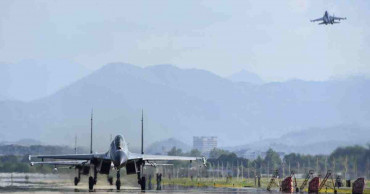
China says it summoned European diplomats in the country to protest statements issued by the Group of Seven nations and the European Union criticizing threatening Chinese military exercises surrounding Taiwan.
The Foreign Ministry on Friday said Vice Minister Deng Li made “solemn representations” over what he called “wanton interference in China’s internal affairs.”
China has dispatched navy ships and warplanes and launched missiles into the Taiwan Strait in response to a visit this week by U.S. Speaker of the House of Representatives Nancy Pelosi to Taiwan, which China regards as its own territory to be annexed by force if necessary.
On the Chinese coast across from Taiwan, tourists gathered Friday to try to catch a glimpse of any military aircraft heading toward the exercise area. Fighter jets could be heard flying overhead and tourists taking photos chanted, “Let’s take Taiwan back,” looking out into the blue waters of the Taiwan Strait from Pingtan island, a popular scenic spot.
Read: China cannot stop US officials from visiting Taiwan: Pelosi
On Friday morning, China sent military ships and war planes across the mid-line of the Taiwan Strait, the Taiwanese Defense Ministry said, crossing what had been an unofficial buffer zone between China and Taiwan for decades.
Five of the missiles fired by China since the military exercises began Thursday landed in Japan’s Exclusive Economic Zone off Hateruma, an island far south of Japan’s main islands, Japanese Defense Minister Nobuo Kishi said. He said Japan protested the missile landings to China as “serious threats to Japan’s national security and the safety of the Japanese people.”
Japan’s Defense Ministry later said they believe the other four missiles, fired from China’s southeastern coast of Fujian, flew over Taiwan.
Japanese Prime Minister Fumio Kishida said Friday that China’s military exercises aimed at Taiwan represent a “grave problem” that threatens regional peace and security.
In Tokyo, where Pelosi is winding up her Asia trip, she said China cannot stop U.S. officials from visiting Taiwan. Speaking after breakfast with Pelosi and her congressional delegation, Kishida said the missile launches need to be “stopped immediately.”
3 years ago

China conducts 'precision missile strikes' in Taiwan Strait
China conducted “precision missile strikes” Thursday in the Taiwan Strait and in the waters off the eastern coast of Taiwan as part of military exercises that have raised tensions in the region to their highest level in decades.
China earlier announced that military exercises by its navy, air force and other departments were underway in six zones surrounding Taiwan, which Beijing claims as its own territory to be annexed by force if necessary.
Five of the missiles fired by China landed inside Japan’s Exclusive Economic Zone off its coast, Japanese Defense Minister Nobuo Kishi said. He said Japan protested the missile landings to China as “serious threats to Japan’s national security and the safety of the Japanese people.” The missiles landed off Hateruma, an outer island quite far from the main islands of Japan, he said.
The drills were prompted by a visit to the island by U.S. House Speaker Nancy Pelosi this week and are intended to advertise China’s threat to attack the self-governing island republic. Along with its moves to isolate Taiwan diplomatically, China has long threatened military retaliation over moves by the island to solidify its de facto independence with the support of key allies including the U.S.
China fired long-range explosive projectiles, the Eastern Theater Command of the People's Liberation Army, the ruling Communist Party's military wing, said in a statement. It also said it carried out multiple conventional missile launches in three different areas in the eastern waters off Taiwan. An accompanying graphic on state broadcaster CCTV showed those occurred in the north, east, and south.
“All missiles hit the target accurately,” the Eastern Theater said in its announcement. No further details were given.
Taiwan's Defense Ministry said it tracked the firing of Chinese Dongfeng series missiles beginning around 1:56 p.m. Thursday. It said in a statement it used various early warning surveillance systems to track the missile launches. It later said it counted 11 Dongfeng missiles in the waters in the north, east and south.
The ministry also said it tracked long-distance rockets and ammunition firing in outlying islands in Matsu, Wuqiu and Dongyin.
Earlier during the day, Taiwan's Defense ministry said its forces were on alert and monitoring the situation, while seeking to avoid escalating tensions. Civil defense drills were held last week and notices were placed on designated air raid shelters months ago.
China's “irrational behavior" intends to alter the status quo and disrupt regional peace and stability, the ministry said.
“The three service branches will combine efforts with all the people to jointly safeguard national security and territorial integrity" while adapting to the situation as it develops, the statement said.
China’s official Xinhua News Agency reported the exercises were joint operations focused on “blockade, sea target assault, strike on ground targets, and airspace control.”
Ma Chen-kun, a professor at Taiwan’s National Defense University, said the drills were aimed at showing off the Chinese military’s ability to deploy precision weapons to cut off Taiwan’s links with the outside and facilitate the landing of troops.
The announced drills are “more complete" than previous exercises, he said.
Read:US-China ties on a precipice after Pelosi visit to Taiwan
"If the People’s Liberation Army actually invades Taiwan in an all-out invasion, the concrete actions it will take, it’s all in this particular exercise,” Ma said.
“The main thing is they will cut off Taiwan’s links to the outside world, from their sea, they would suppress the coastal defense firepower,” he said.
Meanwhile, the mood in Taiwan was calm.
In Keelung, a city on the northern coast of Taiwan and close to two of the announced drill areas, swimmers took their morning laps in a natural pool built in the ocean.
Lu Chuan-hsiong, 63, was enjoying his morning swim, saying he wasn't worried. “Because Taiwanese and Chinese, we’re all one family. There’s a lot of mainlanders here, too,” he said.
“Everyone should want money, not bullets,” he quipped, saying the economy wasn't doing so well.
Those who have to work on the ocean were more concerned. Fishermen are likely to be the most affected by the drills, which cover six different areas surrounding Taiwan, part of which come into the island's territorial waters.
Most fishermen will continue to try to fish, as it is the season for squid.
“It's very close. This will definitely impact us, but if they want to do this, what can we do? We can just avoid that area,” said Chou Ting-tai, who owns a fishing vessel.
While the U.S. has not said it would intervene, it has bases and forward-deployed assets in the area, including aircraft carrier battle groups.
On Thursday, the U.S. Navy said its USS Ronald Reagan aircraft carrier was operating in the Philippine Sea, east of Taiwan, as part of “normal scheduled operations."
Secretary of State Antony Blinken addressed the drills Thursday saying, “I hope very much that Beijing will not manufacture a crisis or seek a pretext to increase its aggressive military activity. We countries around the world believe that escalation serves no one and could have unintended consequences that serve no one’s interests.”
U.S. law requires the government to treat threats to Taiwan, including blockades, as matters of “grave concern."
The drills are due to run from Thursday to Sunday and include missile strikes on targets in the seas north and south of the island in an echo of the last major Chinese military drills aimed at intimidating Taiwan's leaders and voters held in 1995 and 1996.
On the diplomatic front, China canceled a foreign ministers’ meeting with Japan to protest a statement from the Group of Seven nations that there is no justification for the exercises. Both ministers are attending a meeting of the Association of Southeast Asian Nations in Cambodia.
“Japan, together with other members of the G-7 and the EU, made an irresponsible statement accusing China and confounding right and wrong,” Chinese Foreign Ministry spokesperson Hua Chunying said in Beijing.
While China has given no word on numbers of troops and military assets involved, the exercises could be the largest held near Taiwan in geographical terms, experts have said.
The exercises involved troops from the navy, air force, rocket force, strategic support force and logistic support force, Xinhua reported.
3 years ago