Africa

EXPLAINER: Why Kenya's presidential election is important
Kenyans are voting Tuesday to choose a successor to President Uhuru Kenyatta. The race is close and could go to a runoff for the first time.
One top candidate is Raila Odinga, an opposition leader in his fifth run for the presidency who is being supported by his former rival Kenyatta. The other is William Ruto, Kenyatta’s deputy who fell out with the president earlier in their decade in power.
Both tend to focus far more on domestic issues, raising the question of how either will follow up on Kenyatta's diplomatic efforts to quell the tensions in neighboring Ethiopia or disputes between Rwanda and Congo.
WHAT’S AT STAKE?
Kenya is East Africa’s economic hub and home to about 56 million people. The country has a recent history of turbulent elections. Even then, it stands out for its relative stability in a region where some elections are deeply challenged and longtime leaders such as Rwandan President Paul Kagame and Ugandan President Yoweri Museveni have been declared the winner with almost 99% of votes, or been widely accused of physically cracking down on contenders.
Kenya has no transparency in campaign donations or spending. Some candidates for Parliament and other posts are estimated to be spending hundreds of thousands of dollars to gain access to power and its benefits, both legal and illegal.
WHAT ARE THE MAIN CANDIDATES' PLATFORMS?
The 55-year-old Ruto promotes himself to the young and poor as a “hustler” who rose from humble beginnings as a chicken seller in contrast to the elite backgrounds of Kenyatta and Odinga. He seeks greater agricultural productivity and financial inclusion. Agriculture is a main driver of Kenya’s economy and about 70% of the rural workforce is in farming.
The 77-year-old Odinga, famous for being jailed while fighting for multi-party democracy decades ago, has promised cash handouts to Kenya’s poorest and more accessible health care for all. In his final campaign speech on Saturday, he said that if elected, his government in its first 100 days would begin paying 6,000 shillings ($50) to families living below the poverty line.
WHAT DO VOTERS CARE ABOUT?
Odinga and Ruto have long circled among contenders for the presidency, and there is a measure of apathy among Kenyans, especially younger ones in a country where the median age is about 20. The electoral commission signed up less than half of the new voters it had hoped for, just 2.5 million.
Key issues in every election include widespread corruption and the economy. Kenyans have been hurt by rising prices for food and fuel in the wake of Russia’s invasion of Ukraine, and that comes after the financial pain of the COVID-19 pandemic. More than a third of the country’s youth are unemployed.
WHEN WILL KENYA HAVE A WINNER?
Official results will be announced within a week of the vote. To win outright, a candidate needs more than half of all votes and at least 25% of the votes in more than half of Kenya’s 47 counties. No outright winner means a runoff election within 30 days.
The previous presidential election in 2017 made history when a top court overturned the results and ordered a new vote, a first in Africa. If the courts again call for a new vote, such an election would take place within 60 days of the ruling. Candidates or others have a week after the results are declared to file a petition to the court, which has two weeks to rule on it.
“I want you to know that we as a country are at an inflection point,” Odinga told the crowd listening to his campaign speech Saturday. “Either something very good will happen or something terrible will happen.”
He vowed to shake the hand of his “rivals” whether he wins or loses.
3 years ago

Sudan accuses Chad of cross-border attack it says killed 18
Sudan has accused neighboring Chad of a cross-border attack earlier this week that a top commander says killed at least 18 nomads in Sudan's western Darfur region.
According to Sudan’s ruling sovereign council, armed Chadian assailants crossed into West Darfur province and attacked a group of nomads staying in an open area near the border towns of Beir Saliba and Ardeiba last Thursday.
Apart from those killed, several nomads were also wounded in the attack and their livestock was looted and taken to Chad, the council said Friday.
There was no immediate comment from Chad on the accusations.
A Sudanese outlet, Darfur 24 news, reported a minor clash Friday between Chadian and Sudanese forces in the area, saying three Sudanese troops were wounded.
Senior Sudanese Gen. Mohammed Hamdan Dagalo, the deputy head of the sovereign council, had travelled to Chad before the attack for a previously scheduled meeting Thursday with Chad’s acting president and head of the country’s ruling transitional military council, Mahamat Idriss Deby.
Read: Sudan says 31 killed in tribal clashes in Blue Nile province
He then returned to Darfur where he has resided for weeks to help defuse tribal tensions and violence that has rocked the troubled region in recent months.
Dagalo attended the funerals of the slain nomads on Friday and urged tribal leaders and residents in West Darfur for restraint. On Saturday, he met with a Sudanese-Chadian joint committee and held talks with local officials and tribal leaders to prevent a further escalation.
Sudan has called on Chad to find the attackers and return the looted livestock.
3 years ago

WHO Africa sees 10-year growth in healthy life expectancy
Africa recorded a ten-year growth in its healthy life expectancy from 2000 to 2019, the World Health Organization Africa office said Thursday, exceeding the global average and progress seen in any other region over the same period.
The healthy life expectancy in the region “rose by almost ten years to stand at 56 years in 2019 compared with 46 years in the year 2000,” Dr. Lindiwe Makubalo, assistant regional Director for WHO Africa, said at an online briefing, citing the new WHO’s State of Health in Africa report.
The gain exceeds that of the average global healthy life expectancy that increased by five years over the same period, Dr. Makubalo said, attributing it to better essential health services, improvement in health service coverage, in productive and maternal health and in health services to tackle infectious diseases.
Despite the progress made, “we certainly have a lot to do and we seem to be ready to move together,” the WHO Africa official said, warning that life expectancy in the African region is still below the global average of 64 years.
Read: Taiwan cancels flights as China holds military drills
“Unless countries strengthen and make greater investments in the development of health systems as well as implementing effective catch-up plans, these life expectancy gains could easily be lost,” she said, warning also that the COVID-19 pandemic which had “greater disruptions” to essential health services in Africa compared to other regions may also affect the continent’s healthy life expectancy estimates.
Health systems across the continent have been overstretched mostly by the COVID-19 pandemic but also by other disease outbreaks such as monkeypox, cholera and Lassa fever. Countries such as Nigeria, the continent’s most populous nation, are battling as many as five of these outbreaks.
To improve the health systems beyond the pre-pandemic levels and achieve “quality, equitable and accessible services for all,” a major step would be in boosting public health financing, Dr. Makubalo said, noting that only seven countries in the region fund more than half of their annual national health expenditure.
“Over the past 20 years, out-of-pocket expenditure has increased in about 15 countries,” the official further said of the health situation in Africa, urging nations to do more to improve access to essential health services.
A case in point for countries recording massive gains is Botswana where universal health coverage is “the cornerstone of our development and our response or approach to health care delivery in the country,” according to Moses Kitele with Botswana’s Ministry of Health.
“We have made some strides in attaining UHC (universal health coverage) particularly with regards to minimizing the financial hardship,” Dr Kitele told the briefing, citing a recent WHO-funded study which shows that less than 1% of the households in Botswana face catastrophic health spending associated with health care.
A similar feat could be replicated in other parts of the continent, said Makubalo, the assistant regional Director for WHO Africa. The WHO’s State of Health in Africa report, she said, “provides us with an opportunity to reflect on where we are and the progress that has been made.”
“We cannot be complacent; there is so much that needs to be done especially the post-COVID-19 period,” Makubalo said. “We do need to sustain investments, to sustain efforts, to continue to build and to continue to work together.”
3 years ago

Africa lays out goals ahead of UN climate summit
African officials outlined their priorities for the upcoming U.N. climate summit, including a push to make heavily polluting rich nations compensate poor countries for the environmental damage done to them.
The continent will also focus on how countries can adapt to global warming and how the continent can best halt further climate-related disasters. Africa has seen debilitating droughts in the east and Horn of Africa and deadly cyclones in the south.
Other key areas for discussion include moving from high-carbon energy sources like oil and gas to renewables, and “carbon credit” schemes, where foreign governments and companies pay for tree planting in exchange for producing greenhouse gases.
The U.N. climate conference, known as COP27, will be held in Egypt in November.
How much funding Africa gets is the biggest factor for how prepared it will be for a hotter future, said Harsen Nyambe, the director of sustainable environment at the African Union Commission.
Read: Mideast nations wake up to damage from climate change
“We recall the $100 billion that was promised has never been fulfilled and current assessments show that even that amount is not enough,” Nyambe said, referring to a 12-year-old pledge by rich nations to provide climate funding for poorer nations.
“Africa must be given adequate time to transition and transform its energy infrastructure. We cannot transform abruptly. We need resources, capacity, technology transfer and finance to power our development,” he added.
A commitment made in the previous international summit in Glasgow to spend half of climate funds on helping developing nations adapt to the effects of a warming world by having infrastructure and agriculture that's resilient to more volatile weather systems, must be followed through, said Jean-Paul Adam, director of climate change for the U.N.'s Economic Commission for Africa.
He added the continent only received about 7.5% of its promised $70 billion in climate funding between 2014 and 2018.
Africa needs around $3 trillion to fulfill its self-determined emissions targets, known as nationally determined contributions, that each country is required to submit as part of the 2015 Paris agreement on climate, according to U.N. and Africa Development Bank estimates.
More meetings between the continent's climate leaders are set to follow ahead of COP27.
3 years ago

Power line kills 4 at anti-UN protest in eastern Congo
Four people participating in demonstrations against the United Nations peacekeeping mission in eastern Congo were killed Wednesday when a high-voltage power line fell on them, officials said.
Their deaths came on the third day of anti-U.N. protests. At least 15 people, including three U.N. personnel, died and more than 60 people were injured during the earlier demonstrations, Congolese government spokesman Patrick Muyaya said.
Andre Byadunia, a civil society coordinator in the city of Uvira in South Kivu province, said the four demonstrators were electrocuted when a power cable gave way in the Kilomoni district.
Uvira Deputy Mayor Kyky Kifara confirmed the incident and said he was at the demonstration site when the cable fell. He said he thinks the death toll could have been higher if police and security forces had not already dispersed the crowd.
“I was there, I’ve been there since morning. There was a bullet that cut a high-voltage wire. I almost died myself. Luckily, I barely escaped,” Kifara said.
Khassim Diagne, acting head of the U.N. peacekeeping mission, said later in the day that in the protests Monday and Tuesday, seven Congolese civilians were killed in Butembo in North Kivu province along with one U.N. peacekeeper from Morocco and two U.N. policemen from India. Five people were killed in eastern Congo’s main city, Goma, including an army officer hit by a stray bullet, he said.
Diagne said in a virtual news conference from the Congolese capital, Kinshasa, called the situation “fragile,” and said reinforcements from the United Nations and Congolese forces were securing U.N. bases and installations. He welcomed a strong statement by the governor of North Kivu on Tuesday night banning protests and calling on demonstrators to move out of the streets.
While some demonstrators were peaceful, there were also criminals and looters who were photographed walking out of a U.N. warehouse with bags of rice and dry goods, Diagne said.
Protesters accuse the peacekeepers of failing to protect civilians amid rising violence and are calling for the U.N. forces that have been in Congo for years to leave. The mission has more than 16,000 uniformed personnel in Congo, according to the U.N.
U.N. Secretary-General Antonio Guterres has condemned the violence, calling on the government to enforce justice on the perpetrators. He also underscored that any attack directed at U.N. peacekeepers might constitute a war crime.
The U.N. Security Council on Wednesday strongly condemned the attacks and peacekeeper deaths and called for “calm and dialogue to resolve current tensions and to ensure protection of civilians." It also underscored the Congolese government's primary responsibility for the safety and security of U.N. peacekeepers and U.N. assets.
Diagne said the United Nations will investigate the killings of the three members of the U.N. peacekeeping mission and seek to bring the perpetrators to justice.
Read:15 killed, 50 injured in anti-UN protests in Congo’s east
He said the U.N. has seen reports that U.N. troops were firing at civilians, but has no evidence of it. This is why the U.N. wants a joint investigation of the civilian deaths with the government, including an examination of the bullets, “to determine exactly where the shooting came from,” Diagne said.
Congo’s mineral-rich east is home to myriad rebel groups. Security has worsened there despite a year of emergency operations by a joint force of the armies of Congo and Uganda. Civilians in the east have faced violence from jihadi rebels linked to the Islamic State group.
In June 2021 and June 2022, the peacekeeping mission closed its office in Congo’s Kasai Central and Tanganyika regions.
U.N. deputy spokesman Farhan Haq said the U.N. made plans to draw down its peacekeeping force and even withdraw from Congo but the force remained because the situation on the ground was too dangerous to contemplate its departure. The U.N. has reduced the number of provinces it operates in from 10 in the early 2000s to three today, Daigne said.
Fighting has escalated between Congolese troops and the M23 rebels, forcing nearly 200,000 people to flee their homes. The M23 forces have demonstrated increased firepower and defense capabilities, according to a report by Human Rights Watch.
The protests are taking place after Senate President Modeste Bahati told his supporters that the U.N. mission should “pack its bags,” saying the peacekeepers have brought no solutions to deter the thousands of deaths at the hands of rebels in eastern Congo.
Augustin Kalume, a political analyst in Congo, said that while the demonstrations have a political element, there is also genuine anger as “every passing population continues to count deaths, and the looting of natural resources.”
“The population is fed up that despite the millions of dollars that the U.N. mission has cost, these peacekeepers are unable to restore peace and security in the eastern part of Congo,” Kalume said.
Diagne was asked whether he thought the Congolese people wanted the U.N. mission to remain and replied “absolutely.” He cited messages saying it would be a disaster if the U.N. left, but he said the peacekeeping mission needs to better communicate what it does.
The U.N. children’s agency said Wednesday that many children were manipulated into joining the demonstrations, where they were exposed to violence.
“UNICEF condemns the instrumentalization of children for political purposes and calls on authorities, members of civil society and parents to keep children safe from protests in order to protect them,” Grant Leaity, the UNICEF representative in Congo, said.
3 years ago

22 killed in Egypt traffic accident
At least 22 people were killed and 33 others injured Tuesday in a bus-truck accident on the desert road of Minya Province in southern Egypt.
"A passenger bus traveling to Cairo from the southern Province of Sohag crashed into the back of a truck parking on the side of the road for changing its tyres," Governor Osama Al Qady told Xinhua.
Ambulances have rushed the injured to local hospitals.
The crash took place 200 km away from Cairo, he added.
Read: 7 killed in traffic accident in NE Egypt
Road accidents are common in Egypt because of poorly maintained road infrastructure and loosely enforced traffic regulations.
Over the past few years, Egypt has been upgrading its road network, building new roads and bridges, and repairing old ones to reduce traffic accidents. ■
3 years ago
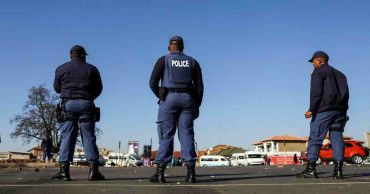
South Africa police say 15 killed in bar shooting in Soweto
A mass shooting at a tavern in Johannesburg’s Soweto township has killed 15 people and left others in critical condition, according to police.
Police say they are investigating reports that a group of men arrived in a minibus taxi and opened fire on some of the patrons at the bar shortly after midnight Sunday.
Those injured have been taken to Chris Hani Baragwanath Hospital.
The number of cartridges found on the scene indicates that a group of people opened fire in the bar, said Gauteng province police commissioner Lt. Gen. Elias Mawela.
Read: 16 dead in India cloudburst
“The primary investigation suggests that these people were enjoying themselves here, in a licensed tavern operating within the right hours,” Mawela told The Associated Press.
“All of a sudden they heard some gunshots, that is when people tried to run out of the tavern. We don’t have the full details at the moment of what is the motive, and why they were targeting these people,” he said.
“You can see that a high caliber firearm was used and it was shooting randomly. You can see that every one of those people were struggling to get out of the tavern,” Mawela told The Associated Press.
The area where the shooting took place was very dark, making it harder to find people who could identify the suspects, he said.
Rifles and a 9 mm pistol were used in the attack, said national police spokeswoman Col. Dimakatso Sello.
Read: Assassination of Japan’s Shinzo Abe stuns world leaders
In a separate incident, four people were shot dead by unknown gunmen at a tavern in Sweetwaters township in the coastal city of Pietermaritzburg on Saturday night.
According to the police, two men entered the tavern and randomly opened fire on the patrons, killing two people on the scene while two others were confirmed dead at the hospital. Police said 8 other people are receiving treatment in a hospital. The deceased were aged between 30 and 45 and police are investigating charges of murder and attempted murder, police said.
“The team will be working around the clock to track down and bring to book those responsible for this shooting”, said Kwazulu-Natal police commissioner Gen. Nhlanhla Mkhwanazi.
The bar shootings come two weeks after 21 teenagers were found dead in a tavern in the city of East London. The cause of those deaths has not yet been announced by authorities, but the teens were not shot nor crushed in a stampede, according to officials.
3 years ago

Infants, patients among 13 killed in Congo hospital attack
Rebels attacked a hospital in Congo and killed at least 13 people, including infants and patients, according to hospital and military officials. The Congolese army said three attackers were killed when the military intervened.
Also read:Suicide bomber attacks bar in eastern Congo, killing 6
Some hospital staff are missing and several houses were burned in the attack Thursday night on the medical center in Lume, North Kivu province. It's the largest health facility in the region.
Among those killed in the attack were three infants and four patients, hospital chief Kule Bwenge told reporters.
“Four blocks of the medical center were set on fire. Several sick guards, as well as a nurse, are missing,” he said.
The reason for targeting the hospital was unclear.
In the nearby village of Kidolo, four other people were killed with machetes and shot, apparently as part of the same attack.
North Kivu military spokesman Anthony Mualushayi said the attackers were Mai-Mai militia members from the Dido group. In addition to the attackers who were killed, one was captured in the ensuing clashes, he said.
But local civic groups accused rebels of the Uganda-based Allied Democratic Forces, or ADF, of carrying out the attack. ADF rebels have been active in eastern Congo for decades and have killed thousands in the region since they resurfaced in 2013.
Other attacks were reported last week in the nearby towns of Bulongo and Kilya, also in North Kivu.
North Kivu is in eastern Congo and borders Uganda and Rwanda. Eastern Congo sees daily threats from armed groups battling for the region’s rich mineral wealth, which the world mines for electric cars, laptops and mobile phones.
3 years ago
.jpg)
Former Angolan president Jose Eduardo dos Santos dies at 79
Former Angolan president José Eduardo dos Santos died Friday in a clinic in Barcelona, Spain, after an illness, the Angolan government said.
He was 79 years old and died following a long illness, the government said in an announcement on its Facebook page.
The announcement said dos Santos, who ruled Angola for almost 40 years from 1979, was “a statesman of great historical scale who governed ... the Angolan nation through very difficult times.”
Dos Santos had mostly lived in Barcelona since stepping down in 2017 and he reportedly had been undergoing treatment there for health problems.
Angola’s current head of state, Joao Lourenco, announced five days of national mourning starting Friday, when the country’s flag will fly at half-staff and public events are canceled.
Dos Santos came to power four years after Angola gained independence from Portugal and became enmeshed in the Cold War as a proxy battlefield.
Read: Angolan president pledges investments to modernize public television
His political journey spanned single-party Marxist rule in post-colonial years and a democratic system of government adopted in 2008. He voluntarily stepped down when his health began failing.
In public, dos Santos was unassuming and even appeared shy at times. But he was a shrewd operator behind the scenes.
He kept a tight grip on the 17th-century presidential palace in Luanda, the southern African country’s Atlantic capital, by distributing Angola’s wealth between his army generals and political rivals to ensure their loyalty. He demoted anyone he perceived to be gaining a level of popularity that could threaten his command.
Dos Santos’ greatest foe for more than two decades was Jonas Savimbi, leader of the UNITA rebels whose post-independence guerrilla insurgency fought in the bush aimed to oust dos Santos’ Popular Movement for the Liberation of Angola, or MPLA.
3 years ago

UN condemns protesters' storming of Libya's parliament
A senior U.N. official for Libya on Saturday condemned the storming of the parliament's headquarters in the east of the oil-rich country as part of protests in several cities the previous day against the political class and deteriorating economic conditions.
Hundreds of protesters marched in the streets of the capital, Tripoli, and other Libyan cities on Friday, with many attacking and setting fire to government buildings, including the House of Representatives in the eastern city of Tobruk.
“The people’s right to peacefully protest should be respected and protected but riots and acts of vandalism such as the storming of the House of Representatives headquarters late yesterday in Tobruk are totally unacceptable,” said Stephanie Williams, the U.N. special adviser on Libya, on Twitter.
The Secretary-General is following with concern the demonstrations that were held in several cities in Libya, including Tripoli, Tobruk and Benghazi, on 1 July.
Recognizing the right to demonstrate peacefully, he calls on all protestors to avoid acts of violence and on the security forces to exercise utmost restraint.
U.N. Secretary-General Antonio Guterres called on all protesters “to avoid acts of violence and on the security forces to exercise utmost restraint,” U.N. spokesman Stephane Dujarric said.
“The secretary-general urges Libyan actors to come together to overcome the continued political deadlock, which is deepening divisions and negatively impacting the country’s economy,” Dujarric said.
Friday’s protests came a day after the leaders of the parliament and another legislative chamber based in Tripoli failed to reach an agreement on elections during U.N.-mediated talks in Geneva. The dispute now centers on the eligibility requirements for candidates, according to the United Nations.
Libya failed to hold elections in December, following challenges such as legal disputes, controversial presidential hopefuls and the presence of rogue militias and foreign fighters in the country.
The failure to hold the December vote was a major blow to international efforts to bring peace to the Mediterranean nation. It has opened a new chapter in its long-running political impasse, with two rival governments now claiming power after tentative steps toward unity in the past year.
The protesters, frustrated from years of chaos and division, have called for the removal of the current political class and elections to be held. They also rallied against dire economic conditions in the oil-rich nation, where prices have risen for fuel and bread and power outages are a regular occurrence.
Protesters also rallied on Saturday in Tripoli and several towns in western Libya, blocking roads and setting tires ablaze, according to livestreaming on social media.
There were fears that militias across the country could quash the protests as they did in 2020 demonstrations when they opened fire on people protesting dire economic conditions.
Sabadell Jose, the European Union envoy in Libya, called on protesters to “avoid any type of violence.” He said Friday’s demonstrations demonstrated that people want “change through elections and their voices should be heard.”
The U.S. ambassador to Libya, Richard Norland, urged Libyan political leaders and their foreign backers to work for a compromise to hold elections.
“It is clear no single political entity enjoys legitimate control across the entire country and any effort to impose a unilateral solution will result in violence,” he warned on Twitter following a call with Mohammad Younes Menfi, head of the Libyan presidential council.
Libya has been wrecked by conflict since a NATO-backed uprising toppled and killed longtime dictator Moammar Gadhafi in 2011. The country was then for years split between rival administrations in the east and west, each supported by different militias and foreign governments.
3 years ago