Europe

Italy: Migrants paid 8,000 euros each for ‘voyage of death’
Rescue teams pulled more bodies from the sea on Tuesday, bringing the death toll from Italy’s latest migration tragedy to 65, as prosecutors identified suspected smugglers who allegedly charged 8,000 euros (nearly $8,500) for each person making the “voyage of death” from Turkey to Italy.
Authorities delayed a planned viewing of the coffins to allow more time for identification of the bodies, as desperate relatives and friends arrived in the Calabrian city of Crotone in hope of finding their loved ones, some of whom hailed from Afghanistan.
“I am looking for my aunt and her three children,” said Aladdin Mohibzada, adding that he drove 25 hours from Germany to reach the makeshift morgue set up at a sports stadium. He said he had ascertained that his aunt and two of the children died, but that a 5-year-old survived and was being sheltered in a center for minors.
Also Read: Deadly shipwreck in Italy must trigger action to save lives: UN
“We are looking into possibilities to send (the bodies) to Afghanistan, the bodies that are here,” he told The Associated Press outside the morgue. But he complained about a lack of information as authorities scrambled to cope with the disaster. “We are helpless here. We don’t know what we should do.”
At least 65 people, including 14 minors, died when their overcrowded wooden boat slammed into shoals 100 meters (yards) off the shore of Cutro and broke apart early Sunday in rough seas. Eighty people survived, but many more are feared dead since survivors indicated the boat had carried about 170 people when it set off last week from Izmir, Turkey.
Aid groups at the scene have said many of the passengers hailed from Afghanistan, including entire families, as well as from Pakistan, Syria and Iraq. Rescue teams pulled two bodies from the sea on Tuesday, bringing the toll to 65, police said.
Also Read: Rescuers find 60th body off Italy after migrant shipwreck
Premier Giorgia Meloni sent a letter to European leaders demanding quick action on the continent’s longstanding migration problem, insisting that migrants must be stopped from risking their lives on dangerous sea crossings.
“The point is, the more people who set off, the more people risk dying,” she told RAI state television late Monday.
Meloni’s right-wing government, which swept elections last year in part on promises to crack down on migration, has concentrated on complicating efforts by humanitarian boats to make multiple rescues in the central Mediterranean by assigning them ports of disembarkation along Italy’s northern coasts. That means the vessels need more time to return to sea after bringing migrants aboard and taking them safely to shore.
But aid groups’ rescue ships don’t normally operate in the area of Sunday’s shipwreck, which occurred off the Calabrian coast in the Ionian Sea. Rather, the aid groups generally operate in the central Mediterranean, rescuing migrants who set off from Libya or Tunisia — not from Turkey in the eastern Mediterranean.
Crotone prosecutor Giuseppe Capoccia confirmed investigators had identified three suspected smugglers, a Turk and two Pakistani nationals. A second Turk is believed to have escaped or died in the wreck.
Italy’s border police said in a statement that organizers of the crossing charged 8,000 euros (around $8,500) each for the “voyage of death.”
Interior Minister Matteo Piantedosi pushed back at suggestions that the rescue was delayed or affected by government policy discouraging aid groups from staying at sea to rescue migrants.
The EU border agency Frontex has said its aircraft spotted the boat off Crotone at 10:26 p.m. Saturday and alerted Italian authorities. Italy sent out two patrol vessels, but they had to turn back because of the poor weather.
Piantedosi told a parliamentary committee that the ship ran aground and broke apart at around 5 a.m. Sunday.
“There was no delay,” Piantedosi told Corriere della Sera. “Everything possible was done in absolutely prohibitive sea conditions.”
The Italian Coast Guard issued a statement on Tuesday saying Frontex had indicated that the migrants’ boat was “navigating normally” and that only one person could be seen above deck.
It added that an Italian border police vessel, “already operating in the sea” set out to intercept the migrant boat.
“At about 4:30 a.m., some indications by telephone from subjects on land, relative to a boat in danger a few meters from the coast, reached the Coast Guard,″ the statement said.
At that point, a Carabinieri police boat which had been alerted by border police “informed the Coast Guard about the shipwreck.”
In contrast to similar cases of migrant vessels in distress, “no phone indication ever came from migrants aboard” to the Coast Guard, the statement noted.
Not rarely, migrants aboard a vessel in distress contact Alarm Phone, a humanitarian support hotline which relays indications of boats in trouble in the Mediterranean to maritime authorities.
When briefing lawmakers, the interior minister cited figures supporting Italy’s long-held frustration that fellow European Union nations don’t honor pledges to accept a share of asylum-seeking migrants who reach Italy.
Piantedosi said that while these pledges covered some 8,000 migrant relocations from June last year through this month, only 387 people actually were transferred to other EU nations, with Germany taking in most of them.
3 years ago
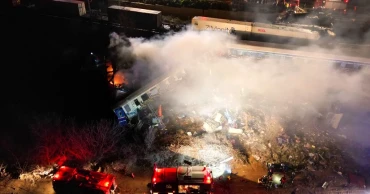
Fiery Greece train collision kills 32, injures at least 85
A passenger train in Greece carrying hundreds of people collided with an oncoming freight train in a fiery wreck in the country's north early Wednesday, killing 32 and injuring at least 85, officials said.
Multiple cars derailed and at least three burst into flames after the collision near Tempe, a small town next to a valley where major highway and rail tunnels are located, some 380 kilometers (235 miles) north of Athens.
Survivors said several passengers were thrown through the windows of the train cars due to the impact. They said others fought to free themselves after the passenger train buckled, slamming into a field next to the tracks.
Hospital officials in the nearby city of Larissa said at least 25 people had serious injuries.
“The evacuation process is ongoing and is being carried out under very difficult conditions due to the severity of the collision between the two trains,” said Vassilis Varthakoyiannis, a spokesperson for Greece’s firefighting service.
Rescuers wearing head lamps worked in thick smoke, pulling pieces of mangled metal from the cars to search for trapped people. Others scoured the field with flashlights and checked underneath the wreckage. Several of the dead are believed to have been found in the restaurant area near the front of the passenger train.
Also Read: Greece: 3 dead after boat with migrants hits rocks
The possible cause of the collision was not immediately clear. Two rail officials were being questioned by police but had not been detained.
Passengers who received minor injuries or were unharmed were transported by bus to Thessaloniki, 130 kilometers (80 miles) to the north. Police took their names as they arrived, in an effort to track anyone who may be missing.
A teenage survivor who did not give his name told reporters as he got off one of the buses that just before the crash, he felt a strong braking and saw sparks and then there was a sudden stop.
“Our carriage didn’t derail, but the ones in front did and were smashed,” he said, visibly shaken.
He added that the first car caught fire and that he used a bag to break the window of his car, the fourth, and escape.
Also Read: Cargo plane carrying munitions from Serbia to Bangladesh crashes in Greece
Rail operator Hellenic Train said the northbound passenger train from Athens to Thessaloniki, Greece's second-largest city, had about 350 passengers on board.
In comments to state television, Costas Agorastos, the regional governor of the Thessaly area, described the collision as “very powerful" and said it was “a terrible night.”
“The front section of the train was smashed. ... We’re getting cranes to come in and special lifting equipment clear the debris and lift the rail cars. There's debris flung all around the crash site."
Officials said the army had been contacted to assist.
Hellenic Train, which has added highspeed services in recent years, is operated by Italy's FS Group, which runs rail services in several European countries.
3 years ago

Rescuers find 60th body off Italy after migrant shipwreck
Rescue crews searched by sea and air Monday for the dozens of people believed still missing from a shipwreck off Italy’s southern coast that drove home once again the desperate and dangerous crossings of migrants seeking to reach Europe.
At least 80 people survived Sunday’s shipwreck off the Calabrian coast, but rescue crews recovered 60 bodies, including those of several children and the corpse of a young man Monday morning. Dozens more were feared dead given survivor reports that the ship, which set off from Turkey last week, had carried about 170 people.
The beach at Steccato di Cutro, on Calabria’s Ionian coast, was littered with the splintered remains of the ship that broke up in stormy seas on the reefs offshore, as well as the belongings the migrants had brought with them, including a toddler’s tiny pink sneaker and a yellow plastic pencil case decorated with pandas.
There were only a few life jackets scattered amid the debris.
On Monday, two coast guard vessels searched the seas north to south off Steccato di Cutro while a helicopter flew overhead and a four-wheel vehicle patrolled the beach. A strong wind whipped the seas that still churned up splinters of the ship, gas tanks, food containers and shoes. A pickup truck came to take away the body of the latest victim.
Firefighter Inspector Giuseppe Larosa said what gutted the first rescue crews who arrived on the scene was how many children were killed, and that the bodies of the dead had scratches all over them, as if they had tried to hang onto the ship to save themselves.
“It was a chilling scene. Bodies spread out on the beach, so many bodies, so many children," he said on the beach Monday morning. He said he had focused on the recovery efforts, but he was struck by what he found in the survivors.
“What struck me was their silence," he said. “Terror in their eyes, but mute. Silent."
Interior Minister Matteo Piantedosi, who has spearheaded Italy’s crackdown on migration, visited the scene Sunday and met with local officials in Crotone. At a news conference, he insisted the solution was to put an end to migrant crossings at their origin.
“I ask myself how it’s possible that these crossings are organized, pushing women and children to make the trips that end up tragically dangerous,” he said.
Italy's government under Premier Giorgia Meloni has focused on trying to block migrant ships from departing, while discouraging humanitarian rescue teams from operating in the Mediterranean. Meloni said Sunday that the government was committed to that policy “above all by insisting on the maximum collaboration with the countries of origin and departure.”
Italy has complained bitterly for years that fellow European Union countries have balked at taking in migrants, many of whom are aiming to find family or work in northern Europe. Italy is a prime destination, especially for smuggling operations launching boats from Libyan shores.
But Italy is also a destination for smugglers leaving from Turkey. According to U.N. figures, arrivals from the Turkish route accounted for 15% of the 105,000 migrants who arrived on Italian shores last year, with nearly half of those fleeing from Afghanistan.
European Commission President Ursula von der Leyen called for a redoubling of efforts to deal with the problem.
“The resulting loss of life of innocent migrants is a tragedy,” she said.
Meloni’s government has concentrated on complicating efforts by humanitarian boats to make multiple rescues in the central Mediterranean by assigning them ports of disembarkation along Italy’s northern coasts. That means the vessels need more time to return to the sea after bringing migrants aboard and taking them safely to shore.
Humanitarian organizations have lamented that the crackdown also includes an order to the charity boats not to remain at sea after the first rescue operation in hopes of performing other rescues, but to head immediately to their assigned port. Violators face stiff fines and confiscation of rescue vessels.
3 years ago

France to unveil new economic, military strategy in Africa
French President Emmanuel Macron will unveil on Monday his country’s changing economic and military strategy in Africa in the coming years, as France’s influence substantially declines on the continent.
Macron is expected to call for a more balanced partnership with African nations, in a speech at the Elysee presidential palace before he begins an ambitious Africa trip on Wednesday to Gabon, Angola, the Republic of Congo and Congo.
Monday’s speech comes at a time when France’s influence on the continent is facing more challenges than it has in decades.
In less than a year, French troops had to withdraw from Mali, which turned instead to Russian military contractors, and most recently from Burkina Faso, which also appears to increasingly look towards Moscow.
A growing anti-France sentiment has led to street protests in several West and North African countries against the former colonial power.
In addition, historical economic ties that France had with the region are being challenged by the growing commercial presence of Russia, China and Turkey.
“It’s not a trip that aims at getting into the race to regain a regretted influence,” a top official at the French presidency said. The trip isn’t aimed to “try to get back to the past. It’s more to respond to a demand for partnership, for relations, but with new methods and a new approach,” he said.
The official was speaking on condition of anonymity in line with the French presidency’s customary practices.
Macron is notably expected to detail changes that France will bring in its military deployment in the Sahel region.
Last year, he announced the formal end of the so-called Barkhane military force after France withdrew its troops from Mali. French operations to help fight Islamic extremists in the Sahel region are now focusing mostly on Niger and Chad, where the country still has about 3,000 troops.
Macron in recent years insisted any French presence in Africa should be based on “partnership” in efforts to move away from post-colonial interference.
“Faced with the strategic threats ahead, whether it’s war in Ukraine, economic shock, pandemic shock, it’s crucial that Europe and Africa are as aligned as possible and get, let’s say, as intimate as possible in their dialogue,” the French official said.
Macron, 45, is the first French president born after the colonial era. He has previously sought to extend France’s cooperation with English-speaking countries, like Ghana and Kenya, and increase French investments in Africa’s private sector.
During this week’s tour, he will notably visit Portuguese-speaking Angola, with the aim to develop links especially in the fields of agriculture and food industry as well as energy, including oil and gas.
Yet Macron’s tour this week in central Africa already faces questions.
Some opposition activists in Gabon have denounced his visit, which they perceive as bringing support to President Ali Bongo Ondimba, whose family has ruled since the 1960s, before the presidential election scheduled later this year.
Similar questions have been raised in Congo before a December presidential election.
“Before, during and after this trip, the president of the republic, like all French authorities, will show strict neutrality regarding these elections,” the French top official said.
The Elysee stressed that Macron is coming to Gabon mostly to attend a major climate-related summit focusing on the preservation of forests.
He will also seek to show France’s attachment to improving economic and cultural relations with two French-speaking countries, neighbouring Republic of Congo and Congo, not only via talks with authorities, but also by establishing links with local populations, entrepreneurs, artists and activists, according to the Elysee.
3 years ago

‘Love doesn’t exist’: Immigrants defy forced marriage abroad
From the day of her birth in Pakistan, Iram Aslam was betrothed to a cousin 17 days older. But to the young woman, who emigrated as a teenager to this Italian farm town on the Po River plain, the cousin felt like a brother. So on a visit to her homeland, she played for time, telling her aunts she wasn’t ready for marriage.
“They did everything possible to make me marry him,″ said Aslam, now 29. She said she told them: ”‘I don’t want to marry him and please don’t ask me anymore.’”
Her family, in both Italy and Pakistan, kept scheming to have her wed a man of their choice — and their caste. Aslam dismissed around 30 potential husbands.
“In the end, I made everyone angry, and no one talks to me anymore,” she said of her relatives in Pakistan.
In two murder trials this month, Italian prosecutors are seeking justice for Pakistani immigrant women allegedly killed because they refused marriages imposed by their parents. The cases highlight differences, often misconstrued as religion-based, between centuries-old immigrants’ cultural traditions and Western values prizing individualism.
Also Read: Nearly 1 million asylum requests in the EU in 2022
“I liked another person, wanted another one,″ Aslam said of her own situation. “But they didn’t want it, because among us, love doesn’t exist.” Love is viewed “as a sin,” she added, her thick, wavy brown hair covered by a multicolored headscarf. She asked that her face not be fully shown for fear of further antagonizing Pakistani neighbors in Guastalla, a town of 15,000 where they are the dominant immigrant community.
To escape marriage-obsessed relatives, Aslam went for a time to live in Germany.
But there was no escape for 18-year-old Saman Abbas.
Like Aslam, she emigrated as a teenager from Pakistan to an Italian farm town, Novellara, 11 kilometers (seven miles) from Guastalla.
In what appears to be an identity card photo taken shortly after her arrival, Abbas’ face is framed by a black hijab, or headscarf. But the young woman quickly embraced Western ways, appearing in social media posts with her hair tumbling out from under a bright red headband. In one, she and her Pakistani boyfriend were shown kissing on a street in the regional capital, Bologna.
According to Italian investigators, that kiss enraged Abbas’ parents, who wanted their daughter to marry a cousin in Pakistan.
Also Read: Italy contributes €3mn to UNHCR for Rohingya refugees in Bangladesh
In November, her body was dug up in the ruins of a Novellara farmhouse. She had last been seen alive a few hundred yards away on April 30, 2021, in surveillance camera video as she walked with her parents on the watermelon farm where her father worked. A few days later, her parents caught a flight from Milan to Pakistan.
Abbas had reportedly told her boyfriend she feared for her life, because she refused to be married to an older man in her homeland.
An autopsy revealed a broken neck bone, possibly caused by strangulation.
An uncle and a cousin were extradited from France, and another cousin from Spain. They are now on trial in Reggio Emilia, the provincial capital with jurisdiction over Novellara, accused of Abbas’ murder.
Also indicted is her father, Shabbir Abbas, arrested in his village in eastern Punjab. The whereabouts of her mother, who is also charged, are unknown.
A lawyer for her father, Akhtar Mahmood, told Italian state television that the young woman’s family is innocent. He disputed prosecutors’ allegations, contending that she had wanted to return with her family to Pakistan to flee Western ways.
Asked about Italy’s request for Shabbir Abbas’ extradition, Pakistan’s ambassador to Italy, Ali Javed, told The Associated Press that the Pakistani government would “not hesitate” to do so. However, Italy has no extradition treaty with Pakistan.
Javed blamed “individual ignorance″ for forced marriage, which is illegal in Pakistan.
In 2019, Italy made coercing an Italian citizen or resident into marriage, even abroad, a crime covered under domestic violence laws.
Late this month, police in Spain detained the father of two sisters who were allegedly murdered while visiting family in Pakistan. The women had reportedly refused to have their husbands come to Spain after being forced to marry their cousins.
In the United Kingdom, home to Europe’s largest Pakistani community, the government’s Forced Marriage Unit cautioned that the problem of forced marriage isn’t “specific to one country, religion or culture” and said statistics don’t reflect “the full scale of the abuse” since forced marriage is a “hidden crime.”
Under the Italian justice system, civil plaintiffs can attach lawsuits for damages to criminal trials, and two organizations representing Islamic communities in Italy are among those suing in the Abbas trial.
Other plaintiffs include women’s advocacy organizations.
Tiziana Dal Pra, whose group, Trama delle Terre, promotes intercultural relations, said that while violence surrounding forced marriage “gets interpreted as religious,” what’s really at play is “patriarchal control” of women’s bodies.
In December, a court in the northern city of Brescia convicted and gave five-year prison sentences to three Pakistani immigrants — the parents and older brother of four girls — for beating them and keeping them out of school.
According to court documents, the parents threatened their daughters that if they refused arranged marriages, they would end up like that “girl in Pakistan.”
The court said that threat referred to 25-year-old Sana Cheema, who was slain when she returned from Italy to Pakistan in 2018, allegedly at her parents’ insistence.
By her friends’ accounts, Cheema, who had taken Italian citizenship, loved her life in Brescia, where she worked out at a gym, went out for coffee with girlfriends and danced with them at a disco. She was proud of her job teaching at a driving school in the northern city.
Brescia prosecutors are now trying Cheema’s father and brother in absentia on a novel charge: murder in violation of the political right to marry one’s own choice.
In 2019, a court in Pakistan acquitted the two on murder charges, citing insufficient evidence. But Italy’s justice ministry ruled the Brescia trial could go forward since Pakistan and Italy have no agreement governing cases involving so-called judicial double jeopardy.
Cheema’s family initially told Pakistani authorities that she died of a heart attack the day before she was supposed to fly back to Italy. Two friends testified in Brescia this month that Cheema told them her parents wanted her to marry a cousin in Pakistan.
They also quoted from Facebook messages in which Cheema said her parents had confiscated her passport and phone in Pakistan.
With the Italian Embassy closely following the case, Cheema’s body was exhumed. An autopsy indicated she was likely strangled.
Prosecuting the case in Italy sends the message that “exercising the right of who you want to live with, above all, who you want to marry, is a political right” to be guaranteed “with utmost firmness,” Brescia Prosecutor General Guido Rispoli told the AP.
At the edge of a field near the farmhouse where Saman Abbas’ body was found, mourners have left a stuffed toy squirrel and bunches of flowers at an improvised shrine.
“It will continue to happen, I tell you, that’s how it is,″ Aslam said of violence linked to forced marriage.
What progress has been made with trials like the ones in Reggio Emilia and Brescia isn’t enough, she added: “It’s like salt in flour.”
3 years ago

Serbia, Kosovo leaders weigh EU proposals to improve ties
The leaders of Serbia and Kosovo are holding talks on Monday on European Union proposals aimed at ending a long series of political crises and setting the two on the path to better relations and ultimately mutual recognition.
Tensions have simmered between Serbia and its former territory since Kosovo unilaterally broke away in 2008; a move recognized by many Western countries but opposed by Serbia, with the backing of Russia and China.
Recently, those tensions flared over seemingly trivial matters like vehicle license plate formats, or the arrest of an ethnic Serb police officer, triggering renewed concern among Western leaders that a new Balkan conflict might break out just as Russia’s war in Ukraine enters its second year.
At meetings in Brussels, Serbian President Aleksandar Vucic and Kosovo Prime Minister Albin Kurti are expected to discuss ways to put the European proposals into action. Both leaders have already discussed the plan, which hasn't been made public, and EU officials are confident of progress.
A senior EU official said before the talks that “we need to break the vicious circle of crisis.” He said the proposals are “not the end of the road” when it comes to normalizing ties between Belgrade and Pristina, but that given recent tensions, the EU plan is the “maximum achievable at this point.”
The official briefed reporters on the condition that he not be named because of the highly sensitive nature of the meetings. Previous talks between Vucic and Kurti have degenerated into arguments and mutual recrimination, but this time both leaders have already endorsed the proposals “in principle,” he said.
Vucic said Sunday, before the meetings supervised by EU foreign policy chief Josep Borrell, that he’s “ready to work on the concept and implementation of the proposed plan with clearly defined limitations.”
Also Read: Greece plane crash: Cargo aircraft was carrying weapons to Bangladesh : Serbian minister
He didn't specify the “limitations,” but he has repeatedly said that they include the refusal to recognize Kosovo as an independent state as well as agree to it becoming a U.N. member.
The EU has mediated negotiations between Serbia and Kosovo since 2011, but few of the 33 agreements that have been signed were put into action. The EU and the U.S. have pressed for faster progress since Russia launched a full-scale invasion of Ukraine last year.
Earlier this month, hundreds of Serbian nationalists gathered in Belgrade to demand that Vucic reject the EU plan and pull out of the talks.
Shouting “Treason” and carrying banners reading “No surrender,” the right-wing protesters blocked traffic as they gathered near the Serbian presidency building. The protesters are also strongly pro-Russia, and one banner read: “Betrayal of Kosovo is betrayal of Russia!”
In recent months, U.S. and EU envoys have visited Pristina and Belgrade regularly to encourage them to accept the new proposals, and the two leaders met with senior EU representatives on the sidelines of a major security conference in the German city of Munich earlier this month.
3 years ago

Migrant boat breaks up off Italian coast, killing nearly 60
A wooden boat crowded with migrants smashed into rocky reefs and broke apart before dawn Sunday off the Italian coast, authorities said. Rescuers recovered nearly 60 bodies, and dozens more people were missing in the rough waters.
Officials feared the death toll could top 100 since some survivors indicated the boat had as many as 200 passengers when it set out from Turkey, United Nations refugee and migration agencies said.
At least 80 people were found alive, including some who reached the shore after the shipwreck just off Calabria’s coastline along the Ionian Sea, the Italian Coast Guard said. One of the agency’s motorboats rescued two men suffering from hypothermia and recovered the body of a boy.
As sundown approached, firefighters said 59 bodies had been found.
One man was taken into custody for questioning after fellow survivors indicated he was a trafficker, state TV said.The boat collided with the reefs in rough, wind-whipped seas. Three big chunks of the vessel ended up on the beach near the town of Steccato di Cutro, where splintered pieces of bright blue wood littered the sand like matchsticks.
“All of the survivors are adults,″ Red Cross volunteer Ignazio Mangione said. ”Unfortunately, all the children are among the missing or were found dead on the beach.” A baby was reported among the dead.
3 years ago

EU slaps sanctions on top Russia officials, banks, trade
The European Union agreed Saturday to impose new sanctions on Russia over its invasion of Ukraine targeting more officials and organizations accused of supporting the war, spreading propaganda or supplying drones, as well as restricting trade on products that could be used by the armed forces.
The EU’s Swedish presidency said the sanctions "are directed at military and political decision-makers, companies supporting or working within the Russian military industry, and commanders in the Wagner Group. Transactions with some of Russia’s largest banks are also prohibited.”
Asset freezes were slapped on three more Russian banks and seven Iranian “entities” — companies, agencies, political parties or other organizations — that manufacture military drones, which the EU suspects have been used by Russia during the war.
The new measures, proposed by the EU’s executive branch three weeks ago, were only adopted after much internal wrangling over their exact make-up, and made public one day after the first anniversary of Russia’s invasion of Ukraine — the intended target date.
The delay, which was minor but symbolically important, is yet more evidence of how difficult it has become for the 27-nation bloc to identify new targets for restrictive measures that are acceptable to all member nations.
Read More: Nearly 1 million asylum requests in the EU in 2022
The sanctions are meant to undermine Russia’s economy and drain funds for its war effort, but they are also increasingly inflicting pain on European economies already hit by high inflation and energy prices and still suffering from the effects of the COVID-19 pandemic.
Before this latest round of measures, the EU had already targeted almost 1,400 Russian officials, including President Vladimir Putin, government ministers, lawmakers and oligarchs believed loyal to the Kremlin, but also officers believed responsible for war crimes or targeting civilian infrastructure.
The bloc had also frozen the assets of more than 170 organizations, ranging from political parties and paramilitary groups to banks, private companies and media outlets accused of spreading pro-Kremlin propaganda.
Russia’s energy sector was hit, too — notably oil and coal — and the bloc, through its own measures and political decisions combined with retaliation from Moscow, was rapidly weaned off its dependence on Russian natural gas.
Ukrainian President Volodymyr Zelenskyy welcomed the new package in his nightly address on Saturday.
“Sanctions will continue to be introduced so that nothing remains of the potential of Russian aggression,” he said.
“There are new sanctions steps in the 10th package, powerful ones, against the defense industry and the financial sector of the terrorist state and against the propagandists who drowned Russian society in lies and are trying to spread their lies onto the whole world,” Zelenskyy said.
3 years ago

Ukraine: Zelenskyy seeks more sanctions, fighting grinds on
Fighting is grinding on in Ukraine after the country marked the anniversary of Russia’s invasion, with Ukrainian authorities on Saturday reporting dozens of new Russian strikes and attacks on cities in the east and south.
After a somber and defiant day of commemorations on Friday and a marathon news conference, Ukraine’s seemingly indefatigable president followed up with new video posts a day later in which he declared that “Russia must lose in Ukraine” and argued that its forces can be defeated this year.
In a separate tweet, President Volodymyr Zelenskyy also pushed for more sanctions pressure on Russia after the U.K., U.S. and the European Union all announced new measures aimed at further choking off funding and support for Moscow.
“The pressure on Russian aggressor must increase,” Zelenskyy tweeted in English.
He said that Ukraine wants to see “decisive steps” against Russian state nuclear corporation Rosatom, and the Russian nuclear industry as well as “more pressure on military and banking.”
Also Read: China issues peace plan; Zelenskyy says he'll await details
Russian President Vladimir Putin said this week that Rosatom and his Defense Ministry need to work on ensuring that Russia is ready to resume nuclear weapons tests if needs be. He alleged that the U.S. is working on nuclear weapons and that some in the U.S. are pondering plans to carry out nuclear tests banned under the global test ban that took effect after the end of the Cold War.
“If the U.S. conducts tests, we will also do it,” Putin said.
Russia has already become the most sanctioned nation in the world over the past year, targeted with sanctions by more than 30 countries representing more than half of the world’s economy. But the squeeze on its economy, trade and firms has yet to deliver a knockout blow.
Russia’s ambassador to Washington, Anatoly Antonov, called the latest U.S. sanctions “thoughtless.”
Also Read: Ukraine’s Zelenskyy makes emotional appeal for EU membership
“We have learned to live under economic and political pressure,” Antonov said. “The experience of previous sanctions has shown that they harm the world market to a greater extent, worsen the situation of ordinary citizens in states that initiate or support reckless sanctions.”
The Feb. 24 anniversary of last year’s invasion brought no respite in Russian attacks.
Still, in one of his video posts on Saturday, Zelenskyy asked: “Is it possible for us to win?”
“Yes,” he said. “We are capable of this in unity, resolutely and unyieldingly, to put an end to Russian aggression this year.”
Ukraine’s military on Saturday reported 27 Russian airstrikes and 75 attacks from multiple rocket launchers in the most recent 24-hour spell. It said Russian offensive efforts continue to be concentrated in Ukraine’s industrial east and northeast. Five wounded civilians were reported in Ukraine’s eastern Donetsk province, where territory is roughly split between Russian and Ukrainian control.
In the southern Kherson region, Gov. Oleksandr Prokudin also reported 83 Russian shelling attacks, with the regional capital, also called Kherson, hit nine times, and residential buildings, a preschool and a medical institution struck. The head of Ukraine’s presidential office reported three civilian wounded in the region.
3 years ago
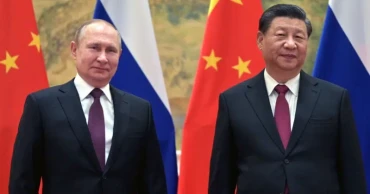
China issues peace plan; Zelenskyy says he'll await details
China called for a cease-fire and peace talks between Ukraine and Russia on Friday, and Ukrainian President Volodymyr Zelenskyy cautiously welcomed Beijing’s involvement -- but said the plan’s success would depend on actions not words.
Beijing claims to have a neutral stance in the war that began one year ago, but has also said it has a “no limits friendship” with Russia and has refused to criticize Moscow’s invasion of Ukraine, or even refer to it as an invasion. It has accused the West of provoking the conflict and “fanning the flames” by providing Ukraine with defensive arms.
“China has shown its thoughts. I believe that the fact that China started talking about Ukraine is not bad,” Zelenskyy told a news conference on the first anniversary of the Russian invasion.
“But the question is what follows the words. The question is in the steps and where they will lead to.”
He said there are points in the Chinese proposals that he agrees with, and some he doesn't. But China's involvement could be useful in isolating Russia, he said.: “Our task is to gather everyone to isolate the one.”
Zelenskky said his main goal was making sure China doesn't supply weapons to Russia, he said.
"It is Point No. 1,” he said.
He also said he’d like to meet Chinese President Xi Jinping: “I believe that it will benefit our countries and the security of the world."
The plan released by China’s Foreign Ministry mainly reiterated long-held positions, and analysts said Beijing would be an unlikely broker.
It calls for the “sovereignty, independence and territorial integrity of all countries” to be respected, but does not say what will happen to the territory Russia has occupied since the invasion. It also calls for an end to “unilateral” sanctions on Russia, indirectly criticizes the expansion of the NATO alliance, and condemns threats of nuclear force.
Russia’s Foreign Ministry welcomed China’s proposal, and said it remains open to political and diplomatic efforts. Ministry spokeswoman Maria Zakharova praised the plan for, among other things, “implying halting the flow of Western weapons” and “acknowledging the territorial realities that have emerged.” That would include Russia’s illegal annexation of parts of Ukraine.
Ukraine has said it will not agree to any peace without the return of all its territory.
The proposal is “an attempt for public relations on the part of China,” said Li Mingjiang, a professor and international security expert at Singapore’s Nanyang Technological University. “I’m not convinced that this policy is going to improve their credibility in being an honest broker.”
Read more: What is China’s peace proposal for Ukraine War?
Speaking after China issued the paper, but without referring to it, Zhanna Leshchynska, charge d’affaires at the Ukrainian embassy in Beijing, said her country doesn't want peace at any price.
“We will not agree to anything that keeps Ukrainian territories occupied and puts our people at the aggressor’s mercy,” Leshchynska told a gathering at the EU mission to China marking the anniversary of the invasion.
Leonid Slutsky, a senior Russian lawmaker, said the plan contains moves that would mark “an end of the hegemony of the collective West."
Ukraine's allies expressed skepticism. U.S. National Security Adviser Jake Sullivan said on CNN that his first reaction to the proposal was that “it could stop at point one, which is: Respect the sovereignty of all nations.”
He added: “This war could end tomorrow if Russia stopped attacking Ukraine and withdrew its forces.... This was a war of choice.”
German government spokesman Wolfgang Buchner said the Chinese proposal contained several important points, but was missing a key one: “first and foremost the withdrawal of Russian troops from Ukraine.”
China abstained Thursday when the U.N. General Assembly approved a nonbinding resolution that calls for Russia to end hostilities in Ukraine and withdraw its forces.
The 12-point paper also urges measures to prevent attacks on civilians and civilian facilities, keep nuclear facilities safe, establish humanitarian corridors for civilians and ensure the export of grain. It called for an end to the “Cold War mentality” — China’s standard term for what it regards as U.S. hegemony, and maintenance of alliances such as NATO.
“Dialogue and negotiation are the only viable solution to the Ukraine crisis.” the proposal said. It offered no details on what form talks should take but said “China will continue to play a constructive role in this regard.”
While neither Kyiv nor Moscow might pay much heed to the Chinese proposal, Beijing needed to clarify its stance, said Shi Yinhong, a professor of international relations at Beijing’s Renmin University.
“China feels it necessary to repeat its self-perceived neutrality at this juncture, to save some international inference by not only criticizing NATO but also distinguishing itself from Russia’s behavior,” Shi said.
The proposal comes as U.S.-China relations have hit a historic low over Taiwan, disputes over trade and technology, human rights, and China’s aggressive actions in the South China Sea.
The U.S. recently said China may be preparing to provide Russia with military aid, an allegation that Chinese Foreign Ministry spokesperson Wang Wenbin called “nothing more than slander and smears.”
On Friday he referred to a “massive disinformation in this respect against China.”
Wang was responding to a report in the German magazine Der Spiegel that Russia’s military was negotiating with a small Chinese drone manufacturer for the “components and know-how” to allow the country to manufacture about 100 suicide drones a month.
3 years ago