Europe
People across the world gather to mark war anniversary
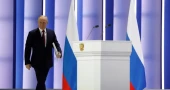
A wrecked Russian tank put on display in Berlin, a bloody cake with a skull on top of it left in a Belgrade street and Ukraine’s yellow-and-blue flag held aloft in the sizzling Bangkok sun were among the memorials, stunts and ceremonies held across the world Friday to mark the anniversary of Moscow’s full-scale invasion of its neighbor.
Commemorations of a grim year for Ukraine spread across the globe, drawing people to peace rallies and other events in the Middle East, Asia, Australia and Latin America.
A rusting T-72 tank was placed outside the prominent Russian Embassy building on the German capital’s Unter den Linden boulevard.
The tank was struck in the Kyiv region in the early stages of the war, which began on Feb. 24, 2022. It was taken to Berlin by a private group, which said that the Ukrainian defense ministry’s Military History Museum loaned it. Destroyed Russian armor litters parts of Ukraine after months of battlefield setbacks for the Kremlin’s forces.
“The whole world should see that there are many people in Germany who stand behind Ukraine, so that’s why we’re putting the Russians’ scrap tank in front of their door,” said Wieland Giebel of the Berlin Story group, who was one of the exhibit’s organizers.
In Serbia, whose government has maintained friendly relations with Russia and has refused to join Western sanctions designed to punish Moscow for its invasion, police moved in to stop a group of anti-war activists from reaching the Russian Embassy in the capital, Belgrade.
The activists wanted to hand over a demand for Russian President Vladimir Putin to be put on trial for genocide in Ukraine. They left a cake, covered with red icing representing blood and with a skull on top of it, on the pavement near the embassy.
Read more: What is China’s peace proposal for Ukraine War?
U.K. Prime Minister Rishi Sunak stepped outside his office at No. 10 Downing Street, joining Ukraine’s ambassador and some Ukrainian soldiers being trained in the United Kingdom for a minute’s silence in commemoration of those killed in the fighting.
King Charles III published a message lauding the “remarkable courage and resilience” of the Ukrainian people.
A teenage Ukrainian pianist forced to flee her country with her mother when the war broke out gave a solo performance at a shopping mall in the city of Liverpool in northwest England.
Alisa Bushuieva, age 13, wore a traditional Ukrainian floral headband and dress as she played her country’s national anthem.
At a convention center in Utrecht, Netherlands, about 2,000 Ukrainian refugees gathered to hear by video link a speech by Ukrainian President Volodymyr Zelensky, and in Brussels hundreds gathered to wave the Ukrainian flag and chant “Slava Ukraini!” (Glory to Ukraine).
In northern Europe, people placed candles on the steps of Helsinki Cathedral at a memorial event for Ukraine war victims, and in southern Europe peace quotations printed on jute bags were displayed in Rome as part of an installation by Italian artist Gianfranco Meggiato entitled “The Meeting: The Symbol of Peace.”
Moscow planned no special events for Friday, as most Russians took a nationwide day off amid an extended public holiday. As part of authorities’ relentless effort to prevent any sign of dissent, police in some areas visited activists’ homes to warn them against trying to stage any demonstrations.
Ukrainians living in Brazil protested outside the Russian Consulate in Sao Paulo, with one sign comparing Putin to Adolf Hitler.
Ukrainians in Lebanon chanted slogans during a Beirut rally and held up signs saying, “Stand strong with Ukraine” and “No terrorism.” Ukrainians and their supporters also marked the anniversary in Tel Aviv.
Dozens of South Koreans and Ukrainian expatriates gathered outside the Russian Embassy in Seoul. They held candles and banners demanding the immediate withdrawal of Russian troops from Ukrainian territory.
A peace rally was also held in Tokyo, and people placed flowers outside the Ukrainian consulate in Bali, Indonesia in tribute to those killed in the war.
Ukrainians living in Thailand gathered outside their embassy in Bangkok. About 50 people, many wearing their national colors, sang the national anthem as an embassy official raised the flag. Several wept during a speech by the embassy’s charge d’affaires, in which he urged them to stay strong.
Iliana Martsenyak, originally from the eastern Ukrainian city of Kharkiv, which has been pummeled by Russian barrages, wiped tears from her eyes as she spoke of how the anniversary made her feel.
“Honestly, I cannot find any words to describe how me and every single Ukrainian feels today because of this absolutely irrational, cruel and awful war that has been brought to our land,” she said.
The group marched to a nearby city park, holding Ukrainian flags and protest signs aloft. They stopped at the library of Lumpini park, largely in silence as a mother embraced her young daughter and others stared resolutely into the distance.
Some of the anniversary commemorations began Thursday evening, when the Eiffel Tower in Paris and the Portuguese parliament building in Lisbon were lit up in the colors of the Ukrainian flag. The Sydney Opera House followed suit on Friday.
A vigil took place in London’s Trafalgar Square, organized by the Ukrainian and U.S. embassies, and 461 paper angels were hung from the roof of the Ukrainian Catholic Cathedral in London to commemorate each Ukrainian child that has died in the past year.
3 years ago
Germany expels 2 Iranian diplomats over death sentence
Germany said Wednesday that it is expelling two Iranian diplomats over the death sentence imposed in Iran against one of its citizens.
Authorities in Iran announced Tuesday that Jamshid Sharmahd, a 67-year-old Iranian-German national and U.S. resident, was sentenced to death after being convicted of terrorist activities.
Iran claims Sharmahd is the leader of the armed wing of a group advocating the restoration of the monarchy that was overthrown in the 1979 Islamic Revolution, but his family say he was merely the spokesman for the opposition group and deny he was involved in any attacks.
German Foreign Minister Annalena Baerbock said she summoned Iran’s charge d’affaires in Berlin and informed him that “we will not accept this massive breach of a German citizen’s rights.”
Also Read: Ausbildung in Germany for Non-EU Students including Bangladesh
“As a consequence the German government has declared two members of the Iranian embassy unwanted persons and asked them to leave Germany at short notice,” she said. “We demand that Iran revokes the death sentence against Jamshid Sharmahd and allows him to have an appeal that is fair and in line with the rule of law.”
Baerbock has said that Sharmahd, who lives in Glendora, California, did not have “even the beginning of a fair trial” and that consular access and access to the trial had been repeatedly denied. She has also alleged that he had been arrested “under highly questionable circumstances,” without elaborating.
Sharmahd's family accuse Iranian intelligence of abducting him from Dubai in 2020.
Also Read: Iran International moves shows to Washington, citing threats
The official website of Iran’s judiciary said Sharmahd was convicted of plotting terrorist activities. He was tried in a Revolutionary Court, where proceedings are held behind closed doors and where rights groups say defendants are unable to choose their lawyers or see the evidence against them.
The death sentence — which can be appealed — comes against the backdrop of months of anti-government protests in Iran sparked by the death of a 22-year-old woman who was detained by the morality police for allegedly violating the country's strict Islamic dress code.
The protesters have called for the overthrow of the country’s ruling clerics. Monarchists based outside Iran support the protests, as do other groups and individuals with different ideologies.
Security forces have attacked the demonstrators with live ammunition, bird shot and batons, rights groups say. At least 530 protesters have been killed and nearly 20,000 people have been arrested, according to Human Rights Activists in Iran, a group monitoring the unrest.
Iranian authorities have blamed the protests on hostile foreign powers, without providing evidence, and have not released official figures for those killed or arrested.
Iran has executed four men accused of violence linked to the protests, and activists say at least 16 others have been sentenced to death.
3 years ago
No economic ‘knockout’ yet from West’s sanctions on Russia
One month into the invasion of Ukraine, President Joe Biden stood in the courtyard of a grand Polish castle and laid out the punishing economic costs that the U.S. and its allies were inflicting on Vladimir Putin’s Russia, declaring that the ruble is almost immediately “reduced to rubble.”
Russia is now the world’s most heavily sanctioned country, according to U.S. officials. The ruble did in fact take a temporary dive and has been slipping again in recent months. But as the war nears its one-year mark, it’s clear the sanctions didn’t pack the instantaneous punch that many had hoped.
The ruble trades around the same 75-per-dollar rate seen in the weeks before the war, though Russia is using capital controls to prop up the currency. And while Russia’s economy did shrink 2.2% in 2022, that was far short of predictions of 15% or more that Biden administration officials had showcased. This year, its economy is projected to outperform the U.K.’s, growing 0.3% while the U.K. faces a 0.6% contraction, according to the International Monetary Fund.
The West’s export controls and financial sanctions appear, instead, to be gradually eroding Russia’s industrial capacity, even as its oil and other energy exports last year enabled it to keep funding a catastrophic war.
Also Read: EU prepares more Russia sanctions; Kremlin readies offensive
Large American multinationals like McDonald’s, Citibank and General Electric fled the country, and some of the country’s richest citizens are forbidden from traveling to the U.S. But if Muscovites can’t get a latte at Starbucks, there’s an imitation waiting for them at the knockoff Stars Coffee as Russia has adapted.
U.S. Treasury Deputy Secretary Wally Adeyemo stressed in an interview that the Western sanctions are only one “tool as part of a larger strategy” and that the U.S. continues to adjust its sanctions to outmaneuver Russia’s own shifts in strategy.
“You look at the exodus, the brain drain from Russia,” Adeyemo said. “The Russian economy is far smaller, far more closed and will look more like Venezuela, North Korea and Iran than like a major G-7 economy.”
Still, a December Congressional Research Service report drew an underwhelming conclusion from all the economic parrying, stating that “the sanctions have created challenges for Russia but to date, have not delivered the economic ‘knockout’ that many predicted.”
A closer look at what’s been done so far and what lies ahead:
WHAT’S BEEN SANCTIONED, BY WHOM AND WHY?
Biden last year called the West’s sanctions “a new kind of economic statecraft with the power to inflict damage that rivals military might.”
The sanctions, imposed largely through executive orders, are meant to punish Russia and block its access to the international financial systems and bank accounts that it needs to finance its war effort. Export controls also limit its access to computer chips and other products needed to equip a modern military.
Simultaneously, the U.S. and its allies devoted billions to provide Ukraine with weapons, munitions and other military aid and direct financial assistance.
More than 30 countries, including the U.S., EU nations, the United Kingdom, Canada, Australia, Japan and others — representing more than half the world’s economy — are part of the unprecedented effort. They’ve imposed price caps on Russian oil and diesel, frozen Russian Central Bank funds and restricted access to SWIFT, the dominant system for global financial transactions.
Beyond targeting key institutions and economic sectors, the West has directly sanctioned roughly 2,000 Russian firms, government officials, oligarchs and their families. The sanctions are depriving them of access to their American bank accounts and financial markets, preventing them from doing business with Americans and traveling to the U.S, and more.
Unlike the countrywide sanctions on Iran and North Korea, the restrictions placed on Russia target specific industry sectors, firms and individuals. This approach was designed to keep Russian oil and natural gas flowing, in order to limit disruptions to the wider global economy. But energy exports also enabled Russia to replenish its finances and stave off a sharp decline.
An industrialized country of its size — the 11th largest economy in the world in 2021 — has never faced such financial pressure. Daniel Fried, a former assistant secretary of state for European and Eurasian affairs, said that “policy making of this kind is always a shot in dark.”
“You’re looking for hits on the Russian economy, it doesn’t happen overnight,” Fried said, noting that military aid was far more important as Ukrainian troops have performed better in repelling Russian attacks than U.S. and European officials expected.
DIFFERENCES EMERGE
While there has largely been unity among Western governments on the necessity to punish Russia, there have been differences in the lengths to which countries are willing to go.
European and Asian countries are more dependent on Russian oil and natural gas than was the U.S. That made a ban on Russian exports hard for the alliance and forced compromises that took months to forge.
Ultimately, the countries in December settled on a $60 price cap, which some critics said came too late and was too high to significantly hurt Russia.
Experts and administration officials have said putting greater downward pressure on the sale of oil and other energy products from Russia would make sanctions more effective.
To Marshall Billingslea, assistant Treasury secretary for terrorist financing in the Trump administration, the sanctions were far from bulletproof and easy for the Kremlin to elude.
“Russia has shot holes through the administration’s sanctions,” Billingslea said.
Tom Firestone, a sanctions attorney, said more time is needed for the sanctions to take their course.
“Anyone who expects massive sanctions on Monday, and on Tuesday the Russian regime would fall is not reasonable,” Firestone said. “It’s a large economy that has large reserves. It has a large variety of trading partners. What we’re seeing and what the government is saying is they’re on track and it’s seriously curtailed Russia’s ability to operate.”
Russia is also seeking deeper ties with countries that have refused to join the sanctions effort. Its exports to Brazil, China, India and Turkey have increased by at least 50% since the war started compared with the previous year, according to the Congressional Research Service.
HOW RUSSIA HAS BEEN IMPACTED
“Russia is a different country today than it was just a year ago,” says Adeyemo, “and they’ve given up almost 30 years of progress in terms of their economic policy in the course of one year.”
But on a day-to-day consumer level, it’s a mixed picture.
Shopping centers have a lot of shuttered shops, but Russian entrepreneurs are helping fill the gaps. One Russian startup has created a reasonably convincing analogue of McDonald’s.
Some sectors have suffered greatly from sanctions and the departure of foreign companies.
Russia’s automobile sector, for example, has taken a particular hit. A market analysis from the Association of European Businesses, representing European companies in Russia, said sales of new cars in January were 63% lower than a year earlier.
Still, Russia continues to export some lumber, aluminum and other goods to the U.S., based on the need for the products in America.
Russian goods imported to the U.S. totaled $14.5 billion in 2022. That’s less than 1% of all U.S. imports and about half the $30 billion imported from Russia in 2021.
The Justice Department last year formed a task force to target the ill-gotten proceeds of Russian oligarchs, whom the U.S. sees as enabling Moscow’s war against Ukraine.
As part of that effort, the department has seized two luxury yachts — in Fiji and Spain — alleged to belong to oligarchs. Prosecutors have also brought criminal charges against oligarchs accused of sanctions violations, including Oleg Deripaska, an aluminum magnate and close Putin associate. Deripaska remains at large.
WHAT COMES NEXT
The U.S. government is not finished by any means.
Expect the Treasury Department to impose another large round of sanctions on Russia around the invasion’s anniversary on Friday, with a likely focus in 2023 on logistics and manufacturing firms.
Daniel Pickard, a sanctions attorney, said it’s a safe bet that sanctions “will continue to be used with greater frequency with this administration and other administrations. It allows the president to take action without having to consult Congress and can be adjusted with regard to changing events on the ground.”
3 years ago
Nearly 1 million asylum requests in the EU in 2022
Nearly 1 million people applied for international protection in the European Union in 2022, according to data published Wednesday, bringing the number of asylum requests to a level not seen since the refugee crisis of 2015-2016.
The EU agency for asylum said 966,000 asylum applications were made in the 27 EU countries as well as in Norway and Switzerland last year, up 50% from 2021. That doesn't include more than 4 million Ukrainian refugees who were granted temporary protection in the EU, a special mechanism activated to avoid collapsing already backlogged asylum systems.
The European agency linked the increase to continuing easing of COVID-19 travel restrictions, increasing food insecurity and conflicts in many parts of the world. Though most asylum-seekers enter the EU legally, mainly by plane with travel visas, some also crossed the EU's land and sea borders without permission, mainly through the Western Balkans and the Mediterranean.
After more than a decade of war and economic collapse in their country, Syrians continued to be the top nationality of asylum-seekers in Europe with more than 130,000 applications. They were followed closely by Afghans fleeing the spiraling security, humanitarian and financial troubles that followed the Taliban takeover in August 2021, with 129,000 requests.
Also Read: Migrants seeking US sponsors find questionable offers online
Coming in third were applicants from Turkey who doubled in numbers with 55,000 requests. Soaring inflation and “democratic backsliding” were among the factors believed to have caused the increase, the agency said.
In many places, reception centers are overwhelmed, leaving asylum-seekers in the streets.
The recent earthquake that killed nearly 46,000 people and left hundreds of thousands homeless in Turkey and Syria has raised fears of a potential surge in irregular border crossings into Greece. Germany offered earlier this month to temporarily ease visa restrictions to some quake survivors while Spain promised to resettle a small group of 100 vulnerable Syrian refugees from Turkey, which is home to 4 million refugees.
Venezuelans, Colombians, Bangladeshis and Georgians applied for asylum in record numbers last year, as did Moroccans, Tunisians and Egyptians. Some 4% of asylum-seekers in 2022 claimed to be unaccompanied minors.
The European agency didn't say which EU countries received the most applications last year. But an internal EU migration report seen by the Associated Press lists Germany, France, Spain, Austria and Italy as the top five.
Asylum authorities issued decisions on more than 600,000 applications last year but they received even more new cases, adding to the existing backlog. Of the applications analyzed, 40% were granted refugee status or subsidiary protection, mostly for Syrian, Belarusian, Eritrean, Yemeni, and Malian applicants, as well as for most of the Ukrainians who chose to apply for asylum instead of temporary protection.
3 years ago
Global impact: 5 ways war in Ukraine has changed the world
War has been a catastrophe for Ukraine and a crisis for the globe. The world is a more unstable and fearful place since Russia invaded its neighbor on Feb. 24, 2022.
One year on, thousands of Ukrainian civilians are dead, and countless buildings have been destroyed. Tens of thousands of troops have been killed or seriously wounded on each side. Beyond Ukraine’s borders, the invasion shattered European security, redrew nations’ relations with one another and frayed a tightly woven global economy.
Here are five ways the war has changed the world:
THE RETURN OF EUROPEAN WAR
Three months before the invasion, then-British Prime Minister Boris Johnson scoffed at suggestions that the British army needed more heavy weapons. “The old concepts of fighting big tank battles on European landmass,” he said, “are over.”
Johnson is now urging the U.K. to send more battle tanks to help Ukraine repel Russian forces.
Despite the role played by new technology such as satellites and drones, this 21st-century conflict in many ways resembles one from the 20th. Fighting in eastern Ukraine’s Donbas region is a brutal slog, with mud, trenches and bloody infantry assaults reminiscent of World War I.
Read more: Biden to meet eastern flank NATO leaders amid Russia worries
The conflict has sparked a new arms race that reminds some analysts of the 1930s buildup to World War II. Russia has mobilized hundreds of thousands of conscripts and aims to expand its military from 1 million to 1.5 million troops. The U.S. has ramped up weapons production to replace the stockpiles shipped to Ukraine. France plans to boost military spending by a third by 2030, while Germany has abandoned its longstanding ban on sending weapons to conflict zones and shipped missiles and tanks to Ukraine.
Before the war, many observers assumed that military forces would move toward more advanced technology and cyber warfare and become less reliant on tanks or artillery, said Patrick Bury, senior lecturer in security at the University of Bath.
But in Ukraine, guns and ammunition are the most important weapons.
“It is, for the moment at least, being shown that in Ukraine, conventional warfare — state-on-state — is back,” Bury said.
ALLIANCES TESTED AND TOUGHENED
Russian President Vladimir Putin hoped the invasion would split the West and weaken NATO. Instead, the military alliance has been reinvigorated. A group set up to counter the Soviet Union has a renewed sense of purpose and two new aspiring members in Finland and Sweden, which ditched decades of nonalignment and asked to join NATO as protection against Russia.
The 27-nation European Union has hit Russia with tough sanctions and sent Ukraine billions in support. The war put Brexit squabbles into perspective, thawing diplomatic relations between the bloc and awkward former member Britain.
“The EU is taking sanctions, quite serious sanctions, in the way that it should. The U.S. is back in Europe with a vengeance in a way we never thought it would be again,” said defense analyst Michael Clarke, former head of the Royal United Services Institute think tank.
NATO member states have poured weapons and equipment worth billions of dollars into Ukraine. The alliance has buttressed its eastern flank, and the countries nearest to Ukraine and Russia, including Poland and the Baltic states, have persuaded more hesitant NATO and European Union allies, potentially shifting Europe’s center of power eastwards.
There are some cracks in the unity. Hungarian Prime Minister Viktor Orban, Putin’s closest ally in the EU, has lobbied against sanctions on Moscow, refused to send weapons to Ukraine and held up an aid package from the bloc for Kyiv.
Western unity will come under more and more pressure the longer the conflict grinds on.
“Russia is planning for a long war,” NATO Secretary-General Jens Stoltenberg said at the end of 2022, but the alliance was also ready for the “long haul.”
A NEW IRON CURTAIN
The war has made Russia a pariah in the West. Its oligarchs have been sanctioned and its businesses blacklisted, and international brands including McDonald’s and Ikea have disappeared from the country’s streets.
Yet Moscow is not entirely friendless. Russia has strengthened economic ties with China, though Beijing is keeping its distance from the fighting and so far has not sent weapons. The U.S. has recently expressed concern that may change.
China is closely watching a conflict that may serve as either encouragement or warning to Beijing about any attempt to reclaim self-governing Taiwan by force.
Putin has reinforced military links with international outcasts North Korea and Iran, which supplies armed drones that Russia unleashes on Ukrainian infrastructure. Moscow continues to build influence in Africa and the Middle East with its economic and military clout. Russia’s Wagner mercenary group has grown more powerful in conflicts from the Donbas to the Sahel.
In an echo of the Cold War, the world is divided into two camps, with many countries, including densely populated India, hedging their bets to see who emerges on top.
Tracey German, professor of conflict and security at King’s College London, said the conflict has widened a rift between the “U.S.-led liberal international order” on one side, and angry Russia and emboldened rising superpower China on the other.
A BATTERED AND RESHAPED ECONOMY
The war’s economic impact has been felt from chilly homes in Europe to food markets in Africa.
Before the war, European Union nations imported almost half their natural gas and third of their oil from Russia. The invasion, and sanctions slapped on Russia in response, delivered an energy price shock on a scale not seen since the 1970s.
The war disrupted global trade that was still recovering from the pandemic. Food prices have soared, since Russia and Ukraine are major suppliers of wheat and sunflower oil, and Russia is the world’s top fertilizer producer.
Grain-carrying ships have continued to sail from Ukraine under a fragile U.N.-brokered deal, and prices have come down from record levels. But food remains a geopolitical football. Russia has sought to blame the West for high prices, while Ukraine and its allies accuse Russia of cynically using hunger as a weapon.
The war “has really highlighted the fragility” of an interconnected world, just as the pandemic did, German said, and the full economic impact has yet to be felt.
The war also roiled attempts to fight climate change, driving an upsurge in Europe’s use of heavily polluting coal. Yet Europe’s rush away from Russian oil and gas may speed the transition to renewable energy sources faster than countless warnings about the dangers of global warming. The International Energy Agency says the world will add as much renewable power in the next five years as it did in the last 20.
A NEW AGE OF UNCERTAINTY
The conflict is a stark reminder that individuals have little control over the course of history. No one knows that better than the 8 million Ukrainians who have been forced to flee homes and country for new lives in communities across Europe and beyond.
For millions of people less directly affected, the sudden shattering of Europe’s peace has brought uncertainty and anxiety.
Putin’s veiled threats to use atomic weapons if the conflict escalates revived fears of nuclear war that had lain dormant since the Cold War. Fighting has raged around the Zaporizhzhia nuclear power plant, raising the specter of a new Chernobyl.
But the conflict has also brought reminders that, sometimes, individual human actions make all the difference. Defense analyst Clarke said one such moment occurred a day after the invasion, when Zelenskyy filmed himself outside in Kyiv and vowed not to leave the city.
“That was critical in showing that Kyiv would fight,” Clarke said. “And with that, of course, the United States, Joe Biden fell in behind it. If those two things hadn’t happened — Zelenskyy and then Biden’s decision — the Russians would have won.
“That Zelenskyy moment will go down in history as very, very important.”
3 years ago
Biden to meet eastern flank NATO leaders amid Russia worries
President Joe Biden is wrapping up his whirlwind, four-day visit to Poland and Ukraine by reassuring eastern flank NATO allies that his administration is highly attuned to the looming threats and other impacts spurred by the grinding Russian invasion of Ukraine.
Before departing Warsaw on Wednesday, Biden will hold talks with leaders from the Bucharest Nine, a collection of nations on the most eastern parts of the NATO alliance that came together in response to Russian President Vladimir Putin's 2014 annexation of Crimea from Ukraine.
As the war in Ukraine drags on, the Bucharest Nine countries’ anxieties have remained heightened. Many worry Putin could move to take military action against them next if he’s successful in Ukraine. The alliance includes Bulgaria, the Czech Republic, Estonia, Hungary, Latvia, Lithuania, Poland, Romania and Slovakia.
“When Russia invaded, it wasn’t just Ukraine being tested. The whole world faced a test for the ages,” Biden said in an address from the foot of Warsaw's Royal Castle on Tuesday to mark the somber milestone of the year-old Russian invasion. “Europe was being tested. America was being tested. NATO was being tested. All democracies were being tested.”
Biden met Tuesday in Warsaw with Moldovan President Maia Sandu, who last week claimed Moscow was behind a plot to overthrow her country’s government using external saboteurs.
Sandwiched between Ukraine and Romania and one of Europe’s poorest countries, the Eastern European nation has had historic ties to Russia but wants to join the 27-nation European Union. Biden in his remarks endorsed Moldova's bid to join the EU
“I’m proud to stand with you and the freedom-loving people of Moldova,” Biden said of Sandu and her country in his Tuesday address.
Read more: Putin raises tension on Ukraine, suspends START nuclear pact
Since Russia invaded Ukraine nearly a year ago, Moldova, a former Soviet republic of about 2.6 million people, has sought to forge closer ties with its Western partners. Last June, it was granted EU candidate status, the same day as Ukraine.
Sandu spoke out last week about a Russian plot “to overthrow the constitutional order.” She spoke out after Ukrainian President Volodymyr Zelenskyy said his country had intercepted plans by Russian secret services to destroy Moldova. Those claims were later confirmed by Moldovan intelligence officials.
Biden's speech on the Ukraine war came one day after he made a surprise visit to Kyiv, a grand gesture of solidarity with the Ukraine. The address was part affirmation of Europe's role in helping Ukraine repel Russia's ongoing invasion of Ukraine and part sharply worded warning to Putin that the U.S. won't abide Moscow defeating Ukraine.
The White House has praised several eastern flank countries, including Lithuania, Poland and Romania, over the last year for stepping up efforts to back Ukraine with weapons and economic aid and taking in refugees.
Biden has given particular attention to Poland's efforts. The country is hosting about 1.5 million Ukrainian refugees and has committed $3.8 billion in military and economic assistance to Kyiv.
"The truth of the matter is: The United States needs Poland and NATO as much as NATO needs the United States," Biden said during talks with Duda on Wednesday.
3 years ago
Putin raises tension on Ukraine, suspends START nuclear pact
Russian President Vladimir Putin suspended Moscow’s participation in the last remaining nuclear arms control pact with the United States, announcing the move Tuesday in a bitter speech in which he made clear he would not change his strategy in the war in Ukraine.
Putin emphasized, however, that Russia isn’t withdrawing from the pact yet, and hours after his address the Foreign Ministry said Moscow would respect the treaty's caps on nuclear weapons. It also said Russia would continue to exchange information about test launches of ballistic missiles per earlier agreements with the United States.
In his long-delayed state-of-the-nation address, Putin cast his country — and Ukraine — as victims of Western double-dealing and said it was Russia, not Ukraine, fighting for its very existence.
“We aren’t fighting the Ukrainian people,” Putin said ahead of the war’s first anniversary Friday. “The Ukrainian people have become hostages of the Kyiv regime and its Western masters, which have effectively occupied the country.”
The speech reiterated a litany of grievances he has frequently offered as justification for the widely condemned military campaign, while vowing no military letup.
Along with limits on the number of nuclear weapons, the 2010 New START envisages broad inspections of nuclear sites. Putin said Russia should stand ready to resume nuclear weapons tests if the U.S. does so, a move that would end a global ban on such tests in place since the Cold War era.
U.N. Secretary-General Antonio Guterres responded by calling for Russia and the United States to return to dialogue immediately because “a world without nuclear arms control is a far more dangerous and unstable one.”
U.S. Secretary of State Antony Blinken described Moscow’s decision to suspend participation in the treaty as “really unfortunate and very irresponsible."
Read more: Biden in Poland: US, allies 'will never waver' in Ukraine
“We’ll be watching carefully to see what Russia actually does,” he said while visiting Greece.
China’s U.N. Ambassador Zhang Jun called on the U.S. and Russia to “continue to negotiate with each other in finding a good solution.”
U.S. President Joe Biden, speaking in Poland a day after his surprise visit to Ukraine, did not mention the START suspension but blasted Putin for the invasion. He pledged continued support for Ukraine despite “hard and bitter days ahead.”
“Democracies of the world will stand guard over freedom today, tomorrow and forever,” Biden said at Warsaw's landmark Royal Castle before a cheering crowd of Poles and Ukrainian refugees.
Putin's announcement was the second time in recent days the Ukraine war showed it could spread into perilous new terrain, after Blinken told China over the weekend that it would be a “serious problem” if Beijing provided arms and ammunition to Russia.
China and Russia have aligned their foreign policies to oppose Washington. Beijing has refused to condemn Russia’s invasion or atrocities against civilians in Ukraine, while strongly criticizing Western economic sanctions on Moscow. Late last year, Russia and China held joint naval drills.
The deputy head of Ukraine’s intelligence service, Vadym Skibitskyi, told The Associated Press his agency hasn’t seen any signs so far that China is providing weapons to Moscow.
Russia invaded Ukraine on Feb. 24, 2022, and made a dash toward Kyiv, apparently expecting to overrun the capital quickly. But stiff resistance from Ukrainian forces — supported by Western weapons — turned back Moscow's troops. While Ukraine has reclaimed many areas initially seized by Russia, the sides have become bogged down elsewhere.
The war has revived the divide between Russia and the West, reinvigorated the NATO alliance, and created the biggest threat to Putin's rule of more than two decades.
In Tuesday's speech, Putin again offered his own version of recent history, discounting Ukraine's arguments that it needed Western help to thwart a Russian military takeover. He has repeatedly depicted NATO’s expansion to include countries close to Russia as an existential threat to his country.
“It’s they who have started the war. And we are using force to end it,” he said before an audience of lawmakers, officials and soldiers, and broadcast on all state TV channels.
Italian Premier Giorgia Meloni, who was in Ukraine on Tuesday, said she wished Putin had taken a different approach.
“What we heard this morning was propaganda that we already know,” Meloni said in English. “He says (Russia) worked on diplomacy to avoid the conflict, but the truth is that there is somebody who is the invader and somebody who is defending itself.”
Also meeting with Zelenskyy was the newly appointed chairman of the U.S. House Foreign Affairs Committee, who led a delegation for the first time since the start of the war and since Republicans won control of the House of Representatives.
Chairman Mike McCaul and a handful of other GOP lawmakers said they had a productive meeting about what Zelenskyy needs for winning the war. He provided them with a list of weapons, including longer-range artillery and air-to-surface systems.
The meeting comes as some hard-right Republicans are vowing to block future U.S. aid to Ukraine. “We have seen time and again the majority of Republicans and Democrats support our assistance to Ukraine,” McCaul said in a statement. “But the Biden administration needs to lay out their long-term strategy.”
Putin denied any wrongdoing in Ukraine, even after Kremlin forces struck civilian targets, including hospitals, and are widely accused of war crimes.
Zelenskyy cited fresh attacks on Ukrainian civilians Tuesday, and downplayed Putin’s speech.
“I have not watched it, because during this time there were missile strikes on Kherson. Twenty-one people were wounded and six were killed,” he said.
Putin also accused the West of taking aim at Russian culture, religion and values. He fired another broadside at Western gender policies that he described as efforts to destroy “traditional” values.
And he said Western sanctions hadn’t “achieved anything and will not achieve anything.” He blasted Russian tycoons who kept their assets in the West and saw them confiscated or frozen as part of the sanctions.
“Believe me, ordinary people had no sympathy for those who lost their yachts, palaces and other assets abroad,” Putin said.
While Russia’s Constitution mandates that the president deliver the state-of-the-nation speech annually, Putin never gave one in 2022. Last year, the Kremlin also canceled two other big annual events — Putin’s news conference and a highly scripted phone-in marathon taking questions from the public.
Reflecting the Kremlin's clampdown on free speech and press, it barred in-person coverage of the address by media from “unfriendly” countries, including the U.S., the U.K. and those in the European Union.
3 years ago
Biden in Poland: US, allies 'will never waver' in Ukraine
President Joe Biden on Tuesday warned of “hard and bitter days ahead" as Russia's invasion of Ukraine nears the one-year mark, but vowed that no matter what, the United States and allies “will not waver” in supporting the Ukrainians.
A day after his surprise visit to Kyiv, Biden used a strongly worded address in neighboring Poland to praise allies in Europe for stepping up over the past year and to send a clear message to Russian President Vladimir Putin that "NATO will not be divided, and we will not tire.”
“One year ago, the world was bracing for the fall of Kyiv,” Biden said before a crowd of thousands outside Warsaw’s Royal Castle. “I can report: Kyiv stands strong. Kyiv stands proud. It stands tall and, most important, it stands free."
With Russia and Ukraine each preparing spring offensives, Biden insisted there will be no backing down from what he’s portrayed as a global struggle between democracy and autocracy — though polling suggests American support for ongoing military assistance appears to be softening.
“Democracies of the world will stand guard over freedom today, tomorrow and forever," Biden declared. The U.S. and allies will “have Ukraine's back.”
Biden's speech came a day after his unannounced trip to Kyiv, where he met with Ukrainian President Volodymyr Zelenskyy and walked the city streets as an air raid siren blared.
Last year, weeks after Russian forces began their attacks on Ukraine, Biden delivered a harsh condemnation of Putin from the gardens of the castle. Speaking Tuesday to a crowd that included Polish citizens and Ukrainian refugees — and millions more following in Ukraine, Russia and around the world — he made his case that Putin's war has been a failure.
“When President Putin ordered his tanks to roll into Ukraine, he thought we would roll over. He was wrong,” Biden said.
The president also declared “the democracies of the world have grown stronger" while the world's autocrats — including Putin — have become weaker.
“Autocrats only understand one word — no, no, no,” Biden said. “No, you will not take my country. No, you will not take my freedom. No, you will not take my future.”
Read more: Putin ups tensions over Ukraine, suspending START nuke pact
Biden was using the trip to prepare allies for an ever-more-complicated stage of the war and to reassure allies in the region that the U.S. was committed for the long haul. He met Tuesday with Moldovan President Maia Sandu — who last week claimed Moscow was behind a plot to overthrow her country’s government using external saboteurs — and with his host Polish President Andrzej Duda.
“We have to have security in Europe,” Biden said at the presidential palace. “It's that basic, that simple, that consequential.”
He described NATO as “maybe the most consequential alliance in history," and he said it's “stronger than it's ever been” despite the Russian leader's hopes that it would fracture over the war in Ukraine.
Duda praised the American president’s visit to Kyiv as “spectacular,” saying it “boosted morale of Ukraine’s defenders.”
He said the trip was “a sign that the free world, and its biggest leader, the president of the United States, stands by them.”
On Wednesday, Biden will meet again with Duda along with other leaders of the Bucharest Nine, the easternmost members of the NATO military alliance. Ukraine is not a member.
While Biden was in Poland, Putin announced that Moscow would suspend its participation in the last remaining nuclear arms control pact with the United States.
The New START Treaty caps the number of long-range nuclear warheads countries may deploy and limits the use of missiles that can carry atomic weapons.
Despite his criticisms of Putin, Biden did not mention the START suspension during his speech. And the Russian Foreign Ministry later said that, despite Putin's announcement, it would continue abiding by the treaty's caps.
The conflict in Ukraine — the most significant war in Europe since World War II — has already left tens of thousands of people dead, devastated Ukraine’s infrastructure system and damaged the global economy.
While Biden is looking to use his whirlwind trip to Europe as a moment of affirmation for Ukraine and allies, the White House has also acknowledged that there is no clear endgame to the war in the near term, and the situation on the ground has become increasingly complex.
The administration on Sunday said it has new intelligence suggesting that China, which has generally remained on the sidelines of the conflict, is now considering sending Moscow lethal aid. Secretary of State Antony Blinken said it could become a “serious problem” if Beijing follows through.
Biden and Zelenskyy discussed capabilities that Ukraine needs “to be able to succeed on the battlefield” in the months ahead, said U.S. National Security Adviser Jake Sullivan. Zelenskyy has been pushing the U.S. and European allies to provide fighter jets and long-range missile systems known as ATACMS — which Biden has declined to provide so far. Sullivan declined to comment on whether there was any movement on that during the leaders' talk.
With no quick end in sight for the war, the anniversary is a critical moment for Biden to try to bolster European unity and reiterate the West's position that Putin's invasion was a frontal attack on the post-World War II international order. The White House hopes the president's visit to Kyiv and Warsaw will help bolster American and global resolve.
In the U.S., a poll published last week by The Associated Press-NORC Center for Public Affairs Research showed that support for providing Ukraine with weapons and direct economic assistance is softening. And earlier this month, 11 House Republicans introduced what they called the “Ukraine fatigue” resolution urging Biden to end military and financial aid to Ukraine, while pushing Ukraine and Russia to come to a peace agreement.
Biden dismissed the notion of waning American support during his visit to Kyiv.
“For all the disagreement we have in our Congress on some issues, there is significant agreement on support for Ukraine,” he said. He described the conflict as "about freedom of democracy at large.”
Biden had high praise for Poland's efforts to assist Ukraine. More than 1.5 million Ukrainian refugees have settled in Poland since the start of the war, and millions more have crossed through Poland on their way to other countries. Poland has also provided Ukraine with $3.8 billion in military and humanitarian aid, according to the White House.
The Biden administration announced last summer that it was establishing a permanent U.S. garrison in Poland, creating an enduring American foothold on NATO's eastern flank.
“The truth of the matter is the United States needs Poland and NATO as much as NATO needs the United States,” Biden told Duda on Tuesday.
3 years ago
Putin ups tensions over Ukraine, suspending START nuke pact
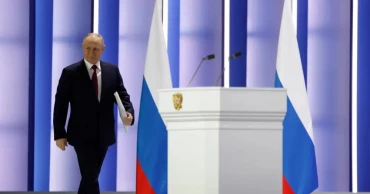
Russian President Vladimir Putin suspended Moscow’s participation in the last remaining nuclear arms control pact with the U.S., announcing the move Tuesday in a bitter speech where he made clear he would not change his strategy in the war in Ukraine.
In his long-delayed state-of-the-nation address, Putin cast his country — and Ukraine — as victims of Western double-dealing and said it was Russia, not Ukraine, fighting for its very existence.
“We aren’t fighting the Ukrainian people,” Putin said in a speech days before the war’s first anniversary on Friday. “The Ukrainian people have become hostages of the Kyiv regime and its Western masters, which have effectively occupied the country.”
The speech reiterated a litany of grievances that the Russian leader has frequently offered as justification for the widely condemned military campaign while vowing no military let-up in a conflict that has reawakened fears of a new Cold War.
On top of that, Putin sharply upped the ante by declaring that Moscow would suspend its participation in the so-called New START Treaty. The pact, signed in 2010 by the U.S. and Russia, caps the number of long-range nuclear warheads the two sides can deploy and limits the use of missiles that can carry atomic weapons.
Putin also said that Russia should stand ready to resume nuclear weapons tests if the U.S. does so, a move that would end a global ban on such tests in place since the Cold War era.
U.S. Secretary of State Antony Blinken described Moscow’s decision as “really unfortunate and very irresponsible.”
“We’ll be watching carefully to see what Russia actually does,” he said during a visit to Greece.
Russia invaded Ukraine on Feb. 24, 2022, and made a dash toward Kyiv, apparently expecting to quickly overrun the capital. But stiff resistance from Ukrainian forces — backed by Western weapons — turned back Moscow’s troops. While Ukraine has reclaimed many areas initially seized by Russia, the two sides have become bogged down in tit-for-tat battles in others.
The war has revived the old Russia-West divide, reinvigorated the NATO alliance, and created the biggest threat to Putin’s more than two-decade rule. U.S. President Joe Biden, fresh off a surprise visit to Kyiv, was in Poland on Tuesday on a mission to solidify that Western unity — and planned his own speech.Observers were expected to scour Putin’s address for any signs of how the Russian leader sees the conflict, where he might take it and how it might end. While the Constitution mandates that the president deliver the speech annually, Putin never gave one in 2022, as his troops rolled into Ukraine and suffered repeated setbacks.
Much of the speech covered old ground, as Putin offered his own version of recent history, discounting arguments by the Ukrainian government that it needed Western help to thwart a Russian military takeover.
“Western elites aren’t trying to conceal their goals, to inflict a ‘strategic defeat’ to Russia,” Putin said in the speech broadcast by all state TV channels. “They intend to transform the local conflict into a global confrontation.”
He added that Russia was prepared to respond since “it will be a matter of our country’s existence.” He has repeatedly depicted NATO’s expansion to include countries close to Russia as an existential threat to his country.
Italian Premier Giorgia Meloni, who was in Ukraine on Tuesday, said she had hoped that Putin might have taken a different approach.
“What we heard this morning was propaganda that we already know,” Meloni said in English. “He says (Russia) worked on diplomacy to avoid the conflict, but the truth is that there is somebody who is the invader and somebody who is defending itself.”
Putin denied any wrongdoing, even as the Kremlin’s forces in Ukraine strike civilian targets, including hospitals, and are widely accused of war crimes. On the ground Tuesday, the Ukrainian military reported that Russian forces shelled southern cities of Kherson and Ochakiv while Putin spoke, killing six people.
President Volodymyr Zelenskyy lamented that Russian forces were “again mercilessly killing the civilian population.”
Many observers predicted Putin’s speech would address Moscow’s fallout with the West — and Putin began with strong words for those countries that have provided Kyiv with crucial military support and warned them against supplying any longer-range weapons.
“It’s they who have started the war. And we are using force to end it,” Putin said before an audience of lawmakers, state officials and soldiers who have fought in Ukraine.
Putin also accused the West of taking aim at Russian culture, religion and values because it is aware that “it is impossible to defeat Russia on the battlefield.”
Likewise, he said Western sanctions would have no effect, saying they hadn’t “achieved anything and will not achieve anything.”
Underscoring the anticipation ahead of the speech, some state TV channels put out a countdown for the event starting on Monday. Reflecting the Kremlin’s clampdown on free speech and press, this year it barred media from “unfriendly” countries, the list of which includes the U.S., the U.K. and those in the EU. Peskov said journalists from those nations will be able to cover the speech by watching the broadcast.
He previously told reporters that the speech’s delay had to do with Putin’s “work schedule,” but Russian media reports linked it to the setbacks of Russian forces. The Russian president postponed the state-of-the-nation address before, in 2017.
Last year, the Kremlin also canceled two other big annual events — Putin’s press conference and a highly scripted phone-in marathon where people ask the president questions.
Analysts expected Putin’s speech would be tough in the wake of Biden’s visit to Kyiv on Monday. In his his own speech later Tuesday, Biden is expected to highlight the commitment of the central European country and other allies to Ukraine over the past year.
White House national security adviser Jake Sullivan said that Biden’s address would not be “some kind of head to head” with Putin’s.
“This is not a rhetorical contest with anyone else,” said.
3 years ago
Ukrainian grain shipments drop as ship backups grow
The amount of grain leaving Ukraine has dropped even as a U.N.-brokered deal works to keep food flowing to developing nations, with inspections of ships falling to half what they were four months ago and a backlog of vessels growing as Russia's invasion nears the one-year mark.
Ukrainian and some U.S. officials are blaming Russia for slowing down inspections, which Moscow has denied. Less wheat, barley and other grain getting out of Ukraine, dubbed the “breadbasket of the world, ” raises concerns about the impact to those going hungry in Africa, the Middle East and parts of Asia — places that rely on affordable food supplies from the Black Sea region.
The hurdles come as separate agreements brokered last summer by Turkey and the U.N. to keep supplies moving from the warring nations and reduce soaring food prices are up for renewal next month. Russia is also a top global supplier of wheat, other grain, sunflower oil and fertilizer, and officials have complained about the holdup in shipping the nutrients critical to crops.
Under the deal, food exports from three Ukrainian ports have dropped from 3.7 million metric tons in December to 3 million in January, according to the Joint Coordination Center in Istanbul. That's where inspection teams from Russia, Ukraine, the U.N. and Turkey ensure ships carry only agricultural products and no weapons.
The drop in supply equates to about a month of food consumption for Kenya and Somalia combined. It follows average inspections per day slowing to 5.7 last month and 6 so far this month, down from the peak of 10.6 in October.
Also Read: Russia’s year of war: Purge of critics, surge of nationalism
That has helped lead to backups in the number of vessels waiting in the waters off Turkey to either be checked or join the Black Sea Grain Initiative. There are 152 ships in line, the JCC said, a 50% increase from January.
This month, vessels are waiting an average of 28 days between applying to participate and being inspected, said Ruslan Sakhautdinov, head of Ukraine's delegation to the JCC. That's a week longer than in January.
Factors like poor weather hindering inspectors’ work, demand from shippers to join the initiative, port activity and capacity of vessels also affect shipments.
“I think it will grow to be a problem if the inspections continue to be this slow,” said William Osnato, a senior research analyst at agriculture data and analytics firm Gro Intelligence. “In a month or two, you’ll realize that’s a couple a million tons that didn’t come out because it’s just going too slowly.”
“By creating the bottleneck, you’re creating sort of this gap of the flow, but as long as they’re getting some out, it’s not a total disaster,” he added.
U.S. officials such as USAID Administrator Samantha Power and U.S. Ambassador to the U.N. Linda Thomas-Greenfield have blamed Russia for the slowdown, saying food supplies to vulnerable nations are being delayed.
Ukrainian Foreign Minister Dmytro Kuleba and Infrastructure Minister Oleksandr Kubrakov said in statement Wednesday on Facebook that Russian inspectors have been “systematically delaying the inspection of vessels” for months.
They accused Moscow of obstructing work under the deal and then “taking advantage of the opportunity of uninterrupted trade shipping from Russian Black Sea ports.”
Osnato also raised the possibility that Russia might be slowing inspections “in order to pick up more business” after harvesting a large wheat crop. Figures from financial data provider Refinitiv show that Russian wheat exports more than doubled to 3.8 million tons last month from January 2022, before the invasion.
Russian wheat shipments were at or near record highs in November, December and January, increasing 24% over the same three months a year earlier, according to Refinitiv. It estimated Russia would export 44 million tons of wheat in 2022-2023.
Alexander Pchelyakov, a spokesman for the Russian diplomatic mission to U.N. institutions in Geneva, said last month that the allegations of deliberate slowdowns are “simply not true.”
Russian officials also have complained that the country's fertilizer is not being exported under the agreement, leaving renewal of the four-month deal that expires March 18 in question.
Without tangible results, extending the deal is “unreasonable,” Deputy Foreign Minister Sergey Vershinin on Monday told RTVI, a privately owned Russian-language TV channel.
U.N. officials say they have been working to unstick Russian fertilizer and expressed hope that the deal will be extended.
“I think we are in slightly more difficult territory at the moment, but the fact is, I think this will be conclusive and persuasive,” Martin Griffiths, U.N. undersecretary-general for humanitarian affairs, told reporters Wednesday. “The global south and international food security needs that operation to continue.”
Tolulope Phillips, a bakery manager in Lagos, Nigeria, has seen the impact firsthand. He says the cost of flour has exploded 136% since the war in Ukraine began. Nigeria, a top importer of Russian wheat, has seen costs for bread and other food surge.
“This is usually unstable for any business to survive,” Phillips said. “You have to fix your prices to accommodate this increase, and this doesn’t only affect flour — it affects sugar, it affects flavors, it affects the price of diesel, it affects the price of electricity. So, the cost of production has generally gone up.”
Global food prices, including for wheat, have dropped back to levels seen before the war in Ukraine after reaching record highs in 2022. In emerging economies that rely on imported food, like Nigeria, weakening currencies are keeping prices high because they are paying in dollars, Osnato said.
Plus, droughts that have affected crops from the Americas to the Middle East meant food was already expensive before Russia invaded Ukraine and exacerbated the food crisis, Osnato said.
Prices will likely stay high for more than a year, he said. What's needed now is “good weather and a couple of crop seasons to become more comfortable with global supplies across a number of different grains” and “see a significant decline in food prices globally.”
3 years ago