Europe
Putin launches drills of Russia's nuclear forces simulating retaliatory strikes
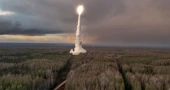
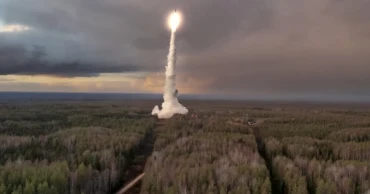
Russian President Vladimir Putin on Tuesday launched a massive exercise of the country's nuclear forces featuring missile launches in a simulation of a retaliatory strike, as he continued to flex the country's nuclear muscle amid spiraling tensions with the West over Ukraine.
Speaking in a video call with military leaders, Putin said that the drills will simulate top officials' action in using nuclear weapons and include launches of nuclear-capable ballistic and cruise missiles.
Defense Minister Andrei Belousov reported that the exercise is intended to practice “strategic offensive forces launching a massive nuclear strike in response to a nuclear strike by the enemy.”
Putin, who has repeatedly brandished the nuclear sword as he seeks to deter the West from ramping up support for Ukraine, emphasized on Tuesday that Russia's nuclear arsenal remains a "reliable guarantor of the country's sovereignty and security."
“Taking into account growing geopolitical tensions and emerging new threats and risks, it's important for us to have modern strategic forces that are always ready for combat,” he said, reaffirming that Russia sees nuclear weapons use as “the ultimate, extreme measure of ensuring its security.”
Putin noted that Moscow will continue to modernize its nuclear forces, deploying new missiles that have a higher precision, quicker launch times and increased capabilities to overcome missile defenses.
As part of Tuesday's drills, the military test-fired a Yars intercontinental ballistic missile from the Plesetsk launch pad at the Kura testing range on the Kamchatka Peninsula, the Defense Ministry said. The Novomoskovsk and Knyaz Oleg nuclear submarines test-fired ICBMs from the Barents Sea and the Sea of Okhotsk, while nuclear-capable Tu-95 strategic bombers carried out practice launches of long-range cruise missiles.
The ministry said that all the missiles reached their designated targets.
Last month, the Russian leader warned the U.S. and NATO allies that allowing Ukraine to use Western-supplied longer-range weapons for strikes deep inside Russia would put NATO at war with his country.
He reinforced the message by announcing a new version of the nuclear doctrine that considers a conventional attack on Russia by a nonnuclear nation that is supported by a nuclear power to be a joint attack on his country — a clear warning to the U.S. and other allies of Kyiv.
Putin also declared that the revised document envisages possible nuclear weapons use in case of a massive air attack, holding the door open to a potential nuclear response to any aerial assault — an ambiguity intended to deter the West.
Tuesday's maneuvers follow a series of other drills of Russia's nuclear forces.
Earlier this year, the Russian military held a joint nuclear exercise with Moscow's ally Belarus, which has hosted some of Russia’s tactical nuclear weapons
1 year ago
Turkey and Germany leaders meet in Istanbul and find many avenues of agreement. But not on Israel
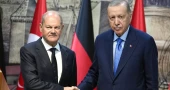
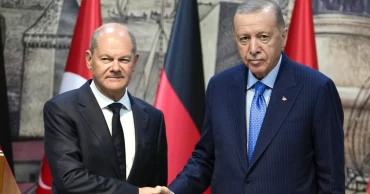
Turkish President Recep Tayyip Erdogan met with German Chancellor Olaf Scholz on Saturday in Istanbul, where both leaders discussed bilateral concerns and opportunities for cooperation. But they couldn't agree on their respective stances toward Israel.
During an otherwise cordial news conference following their meeting, Erdogan had very harsh words for Israel and its Western supporters.
“It’s clear that in Netanyahu’s mind, he doesn’t want to limit the war to just some definite, fascist circle, but to expand it,” he said, referring to Israeli Prime Minister Benjamin Netanyahu. “The deaths of so many leaders is practically a point of delight for them. And the West is jumping for joy.”
Scholz, on the other hand, defended Israel’s “right to self defense” and expressly disagreed with Erdogan’s labeling of the war in Gaza as “genocide.”
The German leader pointed out Berlin’s support for humanitarian aid to Gaza, a two-state solution and a cease-fire.
“But I also want to say this: Germany does not believe ... that the accusation of genocide is justified,” Scholz said.
He noted the importance of feeling compassion when children and other innocent civilians die, but stressed that genocide is a “legal question.”
Despite the difference of views on Israel, Scholz and Erdogan struck a friendly tone in their appearance before reporters.
The meeting came as each side needs help from the other side.
One of Turkey’s primary focuses is the procurement of arms from Europe, particularly Eurofighter Typhoon jets.
Scholz hinted that there will be some developments in this regard.
“Turkey is a member of NATO and therefore we always make decisions that involve concrete deliveries," he said. "That is a matter of course and we have also made such decisions recently and they will be passed on.” Shortly before Scholz’s visit to Turkey, his second during his nearly three years in office, the government announced that it was again allowing arms exports to Turkey on a larger scale, the German news agency dpa reported. This year, 69 permits worth 103 million euros ($111.7 million) had already been issued by Oct. 13. This included military weapons worth 840,000 euros ($911,000). Until the failed military coup in Turkey in 2016 and the invasion of northern Syria, the German government had approved arms exports to the country on a large scale, but then significantly reduced them.
While Turkey is focused on a defense deal, Scholz is seeking Turkey’s help to deport more rejected asylum-seekers and migrants to Turkey.
Almost 16,000 Turkish citizens in Germany were required to leave the country at the end of September. The government in Berlin is also seeking to deport those who have committed crimes back to Afghanistan and Syria, and is seeking the help of Turkey and other partners for this.
1 year ago

Ukraine’s ‘victory plan’ receives mixed reactions from Western allies
President Volodymyr Zelenskyy’s plan to end Ukraine’s nearly three-year war with Russia has received mixed reactions from Western allies so far.
The “victory plan” that Zelenskyy outlined at home and abroad includes a formal invitation for Ukraine to join NATO and permission to use Western long-range missiles to strike military targets in Russia — two steps Kyiv's allies have been reluctant to support before.
U.S. backing is crucial if Zelenskyy is to get support from other allies for proposals he believes are necessary to strengthen Ukraine’s position on the battlefield and ahead of any peace negotiations. But analysts say the Biden administration is unlikely to make a decision before the U.S. presidential election on Nov. 5, as it may not appeal to voters.
“They seem to be just doing very little now and waiting for the election,” said Phillips O'Brien, professor of strategic studies at the University of St. Andrews, Scotland. “So much of the strategy will live or die in Washington.”
Analysts said the plan is a step in the right direction for Ukraine's military efforts. They also described it as ambitious, given allies’ fears of escalation with nuclear-armed Russia. Ukraine has previously secured Western support for requests once deemed unrealistic, such as Patriot air defense systems and F-16 jets.
Presenting the plan now puts on the radar for the next U.S. administration, analysts said, though it's unknown how the next president will receive it.
After returning from making his case to the European Council, Zelenskyy said he expects the White House to provide feedback. “They will be here soon with some form of response,” he said.
Will the plan bring victory to Ukraine?
Zelenskyy laid out the five-point plan as Ukraine’s troops struggle to hold back Russian slow but steady advances in eastern Ukraine. The plan includes three “secret annexes” that were presented only to some leaders. It also addresses partners’ concerns about Ukraine’s strategy after the failed summer 2023 counteroffensive.
Zelenskyy described the main goal as “to strengthen us and force Russia to come to the negotiating table with all partners.”
The plan won’t immediately alter the battlefield situation, but it will help Ukraine wear down Russia and give more means to keep going in the attrition war.
“I think people were potentially expecting some sort of more operational plan on winning the war,” said Justin Crump, a former British tank commander who heads Sibylline, a strategic advisory firm. “That’s a naive opinion to have expected a plan to have provided operational details that would obviously be of use to the enemy.”
Some Ukrainian analysts blame the name of the plan, adding that it was likely chosen for marketing purposes. Ukrainian analyst Yurii Bohdan said the goal is get resources.
“To win such war (of attrition), Ukraine needs to increase its resilience and exhaust its opponent,” said Hlib Voloskyi, an analyst from a Ukrainian think tank, Come Back Alive Centre of Initiatives. “The side that falls last wins.”
What was the allies’ response?
U.S. reaction was muted and noncommittal, though it did issue a new $425 million package of security assistance for Ukraine the day that Zelenskyy presented the plan to lawmakers.
“It’s not my position to publicly evaluate his plan," Defense Secretary Lloyd Austin said. "We have been supporting him by providing security assistance in a major way for 2 1/2 years. We are going to continue to do that.”
In Europe, reactions ranged from categorical opposition to strong support.
French Foreign Minister Jean-Noël Barrot stated in Kyiv on Saturday that he will work with Ukrainian officials to rally other nations to get behind the proposal.
German Chancellor Olaf Scholz stood by his refusal to supply Taurus long-range cruise missiles to Kyiv.
“Our position is clear: We are supporting Ukraine as strongly as possible,” he said. “At the same time, we are taking care that NATO does not become a party to the war so that this war doesn’t culminate in an even bigger catastrophe.”
Hungarian Prime Minister Viktor Orbán, widely seen as having the warmest relations of any EU leader with Russian President Vladimir Putin, called Zelenskyy’s plan “more than frightening” in a Facebook post.
Kremlin spokesman Dmitry Peskov mocked Zelenskyy’s plan as “ephemeral,” and Russian Foreign Ministry spokeswoman Maria Zakharova called it “a set of incoherent slogans.”
What's at stake for Ukraine?
Without an invitation to join NATO, Ukraine won’t have an “assurance that its geopolitical future will not be a bargaining chip with Russia,” said Ukrainian analyst Hlib Voloskyi.
Ukrainian officials say there are no other guarantees for Ukraine besides NATO to protect against Russia's aggression after the war.
Zelensky made ambiguous comments suggesting that nuclear weapons are the only other security alternative. Some thought he was talking about self-made nuclear weapons, sparking strong reaction among Ukrainians, many of whom were pessimistic about the prospects for an invitation to NATO.
Zelensky later clarified that he was highlighting the dire situation for Ukraine by referencing the 1994 Budapest Memorandum, in which Ukraine relinquished its nuclear arsenal in exchange for security guarantees from major nuclear powers, including the U.K., the U.S., and Russia.
Without Western support, Ukraine will struggle to endure a protracted war with Russia, backed by North Korea, Iran, and China. If Ukraine falls, it will be forced to negotiate on Russia’s terms.
“Getting help from outside is a key part of winning the war,” O’Brien said.
1 year ago

10,000 North Koreans could join Russian forces in Ukraine: Zelenskyy
Ukrainian President Volodymyr Zelenskyy said Thursday his government has intelligence information that 10,000 troops from North Korea are being prepared to join Russian forces fighting against his country, warning that a third nation wading into the hostilities would turn the conflict into a “world war.”
Zelenskyy did not go into detail about the claim that came a day after U.S. Deputy Secretary of State Kurt Campbell said that Washington and its allies are alarmed by North Korea's military support for Russia’s war in Ukraine but couldn’t confirm Ukrainian claims that soldiers were sent to fight for Moscow.
“From our intelligence we’ve got information that North Korea sent tactical personnel and officers to Ukraine,” Zelenskyy told reporters at NATO headquarters. “They are preparing on their land 10,000 soldiers, but they didn’t move them already to Ukraine or to Russia.”
Earlier, he warned that any North Korean involvement would be "the first step to a world war.”
NATO Secretary-General Mark Rutte said the allies "have no evidence that North Korean soldiers are involved in the fight. But we do know that North Korea is supporting Russia in many ways, weapons supplies, technological supplies, innovation, to support them in the war effort. And that is highly worrying.”
The Ukrainian leader’s comments raised the stakes for his Western allies as he met in Brussels with European Union leaders and then NATO defense ministers to discuss his “ victory plan ” to end the country’s devastating war with Russia.
Major points of the plan include an invitation for Ukraine to join NATO and permission to use Western-supplied longer-range missiles to strike military targets deep inside Russia, steps that have been met with reluctance by Kyiv’s allies so far.
“Ukraine truly deserves to become the 33rd NATO member one day, and we must do everything to ensure this happens," Zelenskyy said in an appeal at the alliance's headquarters. "Ukrainians have shown that we can defend shared values, and we are standing against Russia, the biggest threat to Europe and global peace.”
He told EU leaders that “we can end this war no later than next year” if his plan is followed. Zelenskyy told reporters that the plan aims “to strengthen Ukraine" and pave the way for a diplomatic solution to end the conflict on Europe's eastern flank.
“This plan doesn’t depend on Russian will, only on the will of our partners,” he said.
In a statement after their talks with Zelenskyy, the EU leaders called for a “rapid stepping up of military support and acceleration in its delivery, in particular air defense systems, ammunition and missiles” to protect Ukraine’s population and energy infrastructure.
Read: Kim again threatens to use nuclear weapons against South Korea and US
“Russia must not prevail,” the statement said.
The EU is a key supporter of Ukraine, a candidate member of the 27-nation bloc, as it fights Russia's invasion that began more than 2 1/2 years ago.
Zelenskyy had outlined the five-point plan to Ukraine’s parliament on Wednesday without disclosing confidential elements that have been presented in private to key allies, including the United States.
Hungarian Prime Minister Viktor Orbán, widely seen as having the warmest relations of any EU leader with Russian President Vladimir Putin, called Zelenskyy's plan “more than frightening” in a Facebook post. He said he would urge major EU powers France and Germany to “begin negotiations with the Russians as soon as possible, in order to find a way out of this situation.”
Rutte said Kyiv can rest “absolutely assured that 32 allies are united in making sure that collectively, we will do whatever is needed to make sure that Ukraine can prevail, that Putin will not get his way.” He reiterated that Ukraine’s place is among NATO’s ranks, but would not say when it might join.
Zelenskyy told EU leaders that his troops must keep battling Russian forces in Ukraine "while also bringing the war back into Russia so that Russians can feel what war is like and begin to hate Putin for it.”
Zelenskyy said he needs to "move some partners forward” on the issue. “And I think only with the unity in EU we can move and can move not only EU leaders, we can move other leaders.”
Thursday's talks in Brussels come as Ukrainian troops are struggling to hold off better-equipped Russian forces, especially in the eastern Donetsk region where they are gradually being pushed back. Kyiv is surviving with Western help, but Ukraine says it is coming too slowly.
Lithuanian President Gitanas Nauseda criticized slow Western decision-making over Ukraine and said it “would be a great mistake to think that our hesitance is the best way to de-escalation.”
At their summit in Washington in July, the 32 NATO members declared Ukraine on an “irreversible” path to membership.
But for now, NATO is in a holding pattern. Its biggest and most powerful member, the United States, is facing a presidential election. European allies expect little movement on Ukraine until a new president takes office in January.
Read more: North Korea discloses a uranium enrichment facility as Kim calls for more nuclear weapons
Beyond that, the United States and European heavyweight Germany remain deeply concerned about being dragged into a wider war with nuclear-armed Russia, and they lead a group of countries that oppose allowing Ukraine to join NATO until the conflict ends.
1 year ago

Australia gives 49 aging Abrams tanks to Ukraine
Australia will give 49 of its aging M1A1 Abrams tanks to Ukraine months after Kyiv requested the redundant fleet, Defense Minister Richard Marles said Thursday.
The Australian government was giving Ukraine most of its American-made M1A1 tanks, which are valued at 245 million Australian dollars ($163 million), Marles said. They will be replaced in Australia by a fleet of 75 next-generation M1A2 tanks.
In February, Marles said that giving Ukraine the tanks as they were phased out was not on his government’s agenda. But on Thursday he said he did not regard the donation as a backflip on his government's previous position.
“We talk with the Ukrainian government consistently around how best we can support them,” Marles told Australian Broadcasting Corp.
“We look at the material that we have; its effectiveness, ... the shape that it’s in, to be frank, whether it would be able to make a difference, whether it can be sustained and maintained so that it can be kept in the fight. And the Abrams tanks fit all of those criteria,” he added.
The United States provided the necessary permission for Australia to transfer the tanks to Ukraine as required under U.S. International Traffic in Arms Regulations, Defense Industry and Capability Delivery Minister Pat Conroy said.
“We are working very closely with our U.S. allies on the donation of these tanks,” Conroy said.
The United States agreed to send 31 Abrams tanks to Ukraine in January 2023 after an aggressive monthslong campaign by Kyiv arguing that the tanks were vital to its ability to breach Russian lines.
Conroy said Australia placed no specific conditions on how Ukraine used the tanks or on whether they crossed the Russian border.
“Our long-standing principle is as long as they are used according to the international rules of law, there are no other conditions,” Conroy said.
Ukraine's Ambassador to Australia, Vasyl Myroshnychenko, would not be drawn on opposition lawmakers’ criticisms that the tanks should have been donated earlier.
“This is a very timely, a very substantial and very fit-for-purpose announcement,” Myroshnychenko said. “We respect the decision of the government. It was not an easy one and I’m very happy that it was a positive one."
The tanks bring the total value of Australia’s military assistance to Ukraine since Russia's 2022 invasion to over AU$1.3 billion ($866 million).
1 year ago
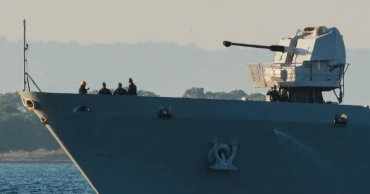
Italian ship docks at Albanian port to process asylum request
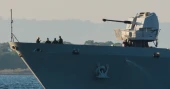
An Italian navy ship on Wednesday docked at the Albanian port of Shengjin to bring the first group of 16 migrants intercepted in international waters to be processed there.
The naval ship Libra left the port of Lampedusa on Monday with 16 men — 10 from Bangladesh and six from Egypt — who were rescued at sea after departing from Libya, a ministry spokesperson said.
Last week, Italy formally opened two centers in Albania where it plans to process thousands of asylum-seekers outside its borders.
The centers will only house adult men, while vulnerable people such as women, children, the elderly and those who are ill or victims of torture will be accommodated in Italy. Families will not be separated.
Italian Ambassador to Albania Fabrizio Bucci said Friday the two centers were ready to process migrants after the opening was delayed for months to consolidate the crumbling soil at one center, in Gjader where they will be accommodated.
A small group of activists gathered at the entrance of the port to protest the arrival of the migrants, holding a banner saying, “The European dream ends here.”
“This deal is against human rights, more concretely the migrants’ rights,” said Edison Lika, a protester.
Though the center in Gjader has capacity for 3,000 migrants, it will start with 400 and increase to 880 in a few weeks.
The number of people reaching Italy along the central Mediterranean migration route from North Africa has fallen by 61% in 2024 from 2023. According to the Italian Interior Ministry, as of Oct. 15, 54,129 migrants have arrived in Italy by sea this year, compared to 138,947 by the same date last year.
Under a five-year deal signed last November by Italian Premier Giorgia Meloni and her Albanian counterpart, Edi Rama, up to 3,000 migrants picked up by the Italian coast guard in international waters each month will be sheltered in Albania. They will be screened initially on board the ships that rescue them before being sent to Albania for further screening.
The two centers will cost Italy 670 million euros ($730 million) over five years. The facilities are run by Italy and are under Italian jurisdiction, while Albanian guards provide external security.
The first center, an area in Shengjin, 66 kilometers (40 miles) northwest of the capital, Tirana, is used for screening newcomers. While the other center, about 22 kilometers (14 miles) to its east near the former military airport in Gjader, accommodates migrants during the processing of their asylum requests.
Italian officials expect the Gjader center will never be at full occupancy but that depends on the flow of migrants brought to Albania.
In Albania, the migrants retain their right under international and European Union law to apply for asylum in Italy and have their claims processed there, a move expected to take a maximum of 28 days, including any appeal case, to process.
Italy has agreed to welcome those who are granted asylum. Those whose applications are rejected face deportation directly from Albania.
The controversial agreement to outsource the housing of asylum-seekers to a non-EU member country has been hailed by some countries that, like Italy, are experiencing a high level of migrant arrivals.
The agreement was endorsed by European Commission President Ursula von der Leyen as an example of “out-of-box thinking” in tackling the issue of migration into the European Union.
But it has been slammed by human rights groups as setting a dangerous precedent.
Rama has made it clear that no other country will be able to have such centers in Albania. He said Albania felt an expression of gratitude for the tens of thousands of Albanians who were welcomed by Italy when communism fell in 1991, or support extended by Rome during the economic turmoil in 1997 and in the aftermath of the 2019 earthquake.
Meloni and her right-wing allies have long demanded that European countries share more of the migration burden. She has held up the Albania agreement as an innovative solution to a problem that has vexed the EU for years.
1 year ago

Moderate earthquake strikes Eastern Turkey
A 5.9 magnitude earthquake hit eastern Turkey on Wednesday, causing widespread panic among residents, though there were no immediate reports of serious injuries or damage.
The earthquake occurred at 10:46 a.m. (07:46 GMT) near the town of Kale in Malatya province, as reported by the Disaster and Emergency Management Presidency (AFAD). It was felt in surrounding cities including Diyarbakir, Elazig, Erzincan, and Tunceli.
Read: Unusual earthquake raises alarms: Is Iran testing its first nuclear bomb?
Malatya Mayor Sami Er stated that there had been no reports of significant issues so far, but officials were assessing potential damage in more remote areas. Many people fled their homes and offices in fear and waited outside in streets and parks, hesitant to return indoors. As a precaution, schools in Elazig were ordered to close.
Malatya was previously impacted by a devastating earthquake last year that resulted in over 53,000 fatalities in Turkey, along with significant destruction in parts of Turkey and northern Syria.
1 year ago
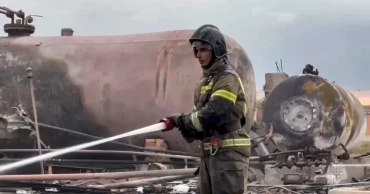
An explosion and fire at a service station in Russia's Chechnya kills 4
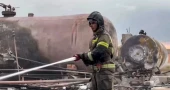
An explosion at a gas station in Russia’s southern region of Chechnya killed at least four people, officials said Saturday.
The explosion of a gas tank triggered a fire at the service station in the regional capital, Grozny, said Russia’s Emergencies Ministry, adding that two children were among the dead. The fire was extinguished.
Grozny is about 1,500 kilometers (930 miles) south of Moscow.
Read: Ukrainian drone strikes another arms depot inside Russia, officials say
Regional authorities said a criminal investigation was opened.
Last month an explosion at a gas station in the neighboring region of Dagestan killed at least 13 people and injured 23 others.
1 year ago
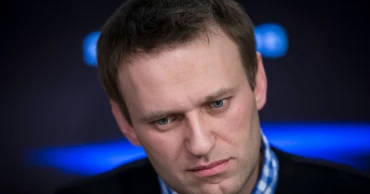
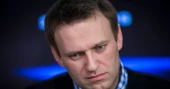
Excerpts from Navalny's memoir show he knew he would die in prison
Excerpts of a memoir written by late Russian opposition leader Alexei Navalny revealed he believed he would die in prison.
The New Yorker magazine published the excerpts Friday in anticipation of the release of “Patriot” on Oct. 22.
Navalny was President Vladimir Putin’s fiercest and most prominent foe and relentlessly campaigned against official corruption in Russia. He died in a remote Arctic prison in February while serving a 19-year sentence on several charges, including running an extremist group, which he said were politically motivated.
He was jailed after returning in 2021 from Germany where he was recuperating from a nerve agent poisoning he blamed on the Kremlin, and was given three prison terms since. Russian officials have vehemently denied involvement both in the poisoning and in his death.
“Patriot" was announced in April by publisher Alfred A. Knopf who called it the late politician’s “final letter to the world."
According to Knopf, Navalny began working on the book while recovering from the poisoning and continued writing it in Russia, both in and out of prison.
In detailing his coping strategies while imprisoned, Navalny said he would “imagine, as realistically as possible, the worst thing that could happen. And then (...) accept it.”
For him, this was dying in prison.
“I will spend the rest of my life in prison and die here,” he wrote on March 22, 2022.
“There will not be anybody to say goodbye to ... All anniversaries will be celebrated without me. I’ll never see my grandchildren.”
Although he had accepted this fate, Navalny’s memoir conveys a resolute stance against official corruption in Russia.
“My approach to the situation is certainly not one of contemplative passivity. I am trying to do everything I can from here to put an end to authoritarianism (or, more modestly, to contribute to ending it),” he wrote, also on March 22, 2022.
In a published excerpt, dated January 17, 2024, a month before his death, Navalny answers the question posed by his fellow inmates and prison guards: “Why did you come back?”
“I don’t want to give up my country or betray it. If your convictions mean something, you must be prepared to stand up for them and make sacrifices if necessary,” he wrote.
As well as capturing the isolation and challenges of his imprisonment, Navalny’s writing is notable also for its humor. The late dissident recounts a bet with his lawyers over the length of a new prison sentence: "Olga reckoned eleven to fifteen years. Vadim surprised everyone with his prediction of precisely twelve years and six months. I guessed seven to eight years and was the winner.”
He also marveled at the absurdity of being made to sit for “hours on a wooden bench under a portrait of Putin” as a “disciplinary activity.”
Navalny’s widow, Yulia Navalnaya, said in a statement released in April by the publisher the book was not only a testament “to Alexei’s life, but to his unwavering commitment to the fight against dictatorship,” adding that sharing his story would" inspire others to stand up for what is right and to never lose sight of the values that truly matter.”
She also said the memoir was already translated into 11 languages and would “definitely” be published in Russian.
1 year ago
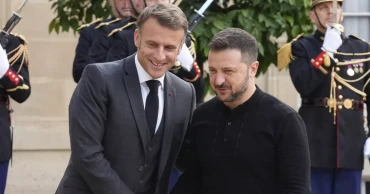
Ukraine's Zelenskyy city-hops across Europe, promoting 'victory plan' to allies
Ukrainian President Volodymyr Zelenskyy was city-hopping across Europe on Thursday to promote a “victory plan” that he said “aims to create the right conditions for a just end to the war" against Russia, detailing the proposals to European allies after a summit with President Joe Biden was derailed by Hurricane Milton.
Zelenskyy's talks in London with British Prime Minister Keir Starmer and NATO Secretary-General Mark Rutte were quickly followed by another meeting in Paris with French President Emmanuel Macron, who just the previous day sent a strong signal of support for Ukraine by visiting Ukrainian troops being trained in France.
Zelenskyy posted on X that he “outlined the details” of the Ukrainian victory plan to Starmer and added: “We have agreed to work on it together with our allies.”
Starmer's Downing Street office said the leaders discussed the blueprint, the challenges for Ukraine of the approaching winter and “how investment in the country’s security today would support Europe’s broader security for generations to come.”
The Ukrainian leader also met Rutte with Starmer. Zelenskyy posted afterward that they discussed trans-Atlantic cooperation and further reinforcing Ukraine militarily. He gave no details but posted that “these are the steps that will create the best conditions for restoring a just peace.”
Zelenskyy has yet to publicly present his proposals for victory. But the timing of his efforts to lock in European support appeared to have the looming U.S. election in mind. Former President Donald Trump has long been critical of U.S. aid to Ukraine.
Zelenskyy had planned to present his blueprint at a weekend meeting of Western leaders in Germany, but it was postponed after Biden stayed home because of the hurricane that struck Florida.
Zelenskyy then embarked on his whistle-stop tour of European capitals that have been among Ukraine's staunchest allies outside of the United States.
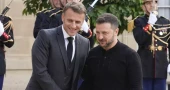
In Paris, Macron and Zelenskyy hugged before talks on the plan at the French presidential Elysee Palace. Afterward, Zelenskyy said “all the details” would come in November and that he's talking with allies about securing more military aid and permission for Ukrainian forces to carry out long-range strikes.
Kyiv wants Western partners to allow strikes deep inside Russia, using long-range weapons they provide. Some, including the U.K. and France, appear willing, but Biden is reticent about escalating the conflict.
Read: New NATO chief Mark Rutte visits Ukraine in his first trip since taking office
“The situation looks bleak for all sides,” Tatiana Stanovaya, a senior fellow at the Carnegie Russia Eurasia Center, said Thursday on X. "The West hesitates amid internal divisions, Ukraine struggles while bracing for a harsh winter, and Russia presses forward without any strategic shifts in its favor, yet grows increasingly impatient.”
Later Thursday, Zelenskyy met in Rome with Italian Premier Giorgia Meloni, who ensured Italy's full and continued support “at both bilateral and multilateral level in order to put Kyiv in the best position possible to build a just and lasting peace.”
Meloni said the meeting provided an opportunity to discuss the situation on the ground and Ukraine’s “most immediate military, financial and humanitarian needs, as well as the forthcoming diplomatic initiatives and the pathway to bring an end to the conflict.”
She added that Rome will continue to do its part also in the future reconstruction of Ukraine and announced the dates for the next Ukraine recovery conference, which will be held in Rome in July 2025.
Zelenskyy stressed that his priority is to strengthen Ukraine’s position, with the help of its international partners, to create the necessary conditions for diplomacy.
"Russia is not really looking for a diplomatic path,” he said. “If we are able to implement the victory plan, Russia won't be able to continue the war.”
Zelenskyy is scheduled to meet Pope Francis Friday morning for a half-hour audience, the Vatican said. Later in the day, he'll meet German Chancellor Olaf Scholz in Berlin.
Ukraine relies heavily on Western support, including tens of billions of dollars’ worth of military and financial aid, to keep up the fight against its bigger enemy after almost 1,000 days of fighting since the full-scale Russian invasion began in 2022.
Fearing that crucial help could be in jeopardy due to political changes in donor countries, Ukraine has been building up its domestic arms industry. It also wants to raise more money from taxpayers to pay for the war effort. The Ukrainian parliament passed a bill on second reading Thursday that raises the so-called military tax from 1.5% to 5%. Some amendments are expected before it becomes law.
Read more: China, at UN, warns against 'expansion of the battlefield' in Ukraine war
Zelenskyy’s tour comes as Russia continues a slow but relentless drive deeper into Ukraine’s eastern Donetsk region and targets key infrastructure with airstrikes.
Zelenskyy said Wednesday that the victory plan seeks to strengthen Ukraine “both geopolitically and on the battlefield” before any kind of dialogue with Russia.
“Weakness of any of our allies will inspire (Russian President Vladimir) Putin,” he said. “That’s why we’re asking them to strengthen us, in terms of security guarantees, in terms of weapons, in terms of our future after this war. In my view, he (Putin) only understands force.”
The death toll from a Russian ballistic missile strike on Ukraine’s southern city of Odesa rose Thursday to eight, regional Gov. Oleh Kiper said. It was the latest in a string of assaults on the Black Sea port.
Authorities in Kyiv also announced Thursday that Ukrainian journalist Viktoria Roshchyna died while being in Russian captivity, although the circumstances of her death remained unknown. Moscow admitted detaining Roshchyna, who went missing in 2023 while on a reporting trip to Russia-occupied areas.
1 year ago