Europe

Davos 2024: Zelenskyy trying to rally support for Ukraine’s fight
Ukrainian President Volodymyr Zelenskyy is headlining a frenzied first full day of the World Economic Forum's annual meeting in the Swiss ski resort of Davos, where top officials from the United States, the European Union, China, the Middle East and beyond will also take center stage Tuesday.
Zelenskyy will endeavor to keep his country's long and largely stalemated defense against Russia on the minds of political leaders, just as Israel's war with Hamas, which passed the 100-day mark, has siphoned off much of the world's attention and sparked concerns about a wider conflict in the Middle East.
Conversations with prime ministers of Qatar and Jordan will bookend the day's most visible events, with speeches by Chinese Premier Li Qiang, European Commission President Ursula von der Leyen and the United States national security adviser Jake Sullivan in between.
Read: Davos 2024: Zelenskyy trying to rally support for Ukraine’s fight
Zelenskyy, once reticent about leaving his war-torn country, has recently gone on a whirlwind tour to try to rally support for Ukraine's cause against Russia amid donor fatigue in the West and concerns that former U.S. President Donald Trump — who touted having good relations with Putin — might return to the White House next year.
On Monday, Zelenskyy made a stop in Switzerland's capital of Bern, where President Viola Amherd pledged her country would start working with Ukraine to help organize a “peace summit” for Ukraine.
Zelenskyy is following that up with his first trip to Davos as president after speaking by video in previous years. He hopes to parlay the high visibility of the event into a bully pulpit to showcase Ukraine's pressing needs, and allies will be lining up: A morning, invitation-only “CEOs for Ukraine” session will precede his afternoon speech.
The corporate chiefs will hear “what kind of immediate assistance is needed” and lay out how private and public sectors can help Ukraine rebuild one day, forum organizers say. The session will draw NATO leader Jens Stoltenberg, German Vice Chancellor Robert Habeck and U.S. envoy for Ukraine's economic recovery, Penny Pritzker, among others.
Later Tuesday, leaders of some of Ukraine’s key European allies — Lithuanian President Gitanas Nauseda, Dutch Foreign Minister Hanke Bruins Slot and Spanish Foreign Minister José Manuel Albares Bueno — will participate in a session on the “horizons” for Ukraine.
Read: Russian missiles hit Ukrainian cities, killing 5 and injuring more than 100, Kyiv officials say
The theme of the meeting in Davos is “rebuilding trust,” and it comes as that sentiment has been fraying globally: Wars in the Middle East and Europe have increasingly split the world into different camps.
While the geopolitical situation has oozed gloom, businesses appear more hopeful — in part from prospects that artificial intelligence can help boost productivity. Leading Western stock indexes shot up in 2023, and falling inflation raised hopes of a decline in interest rates.
The consulting firm PwC, in its 27th annual CEO survey, said economic optimism has doubled among executives over the past year — even if the prospects over the next decade appear less certain. With the pressure from climate change and technology like artificial intelligence, a growing number of executives say they are worried their businesses would not be viable in 10 years without reinvention.
AI is a major topic over the week in Davos, with a key talk by Microsoft CEO Satya Nadella — whose company has invested billions in ChatGPT maker OpenAI — among the sessions planned Tuesday.
2 years ago

France gets its youngest-ever prime minister, Gabriel Attal, as Macron shakes up government
Gabriel Attal was named Tuesday as France’s youngest-ever prime minister, as President Emmanuel Macron seeks a fresh start for the rest of his term amid growing political pressure from the far right.
Macron’s office announced the appointment in a statement. Attal, 34, rose to prominence as the government spokesman and education minister. He is France’s first openly gay prime minister.
His predecessor Elisabeth Borne resigned Monday following recent political turmoil over an immigration law that strengthens the government’s ability to deport foreigners.
Read: Russian missiles hit Ukrainian cities, killing 5 and injuring more than 100, Kyiv officials say
Macron – who was France’s youngest-ever president when he came to power in 2017 -- is to work with Attal to name a new government in the coming days, though some key ministers are expected to continue in their posts.
The 46-year-old president has shifted rightward on security and migration issues since rising to power on a pro-business centrist platform in 2017, notably as far-right rival Marine Le Pen and her anti-immigration, anti-Islam National Rally have gained political influence.
Attal, a former member of the Socialist Party, joined Macron’s newly created political movement in 2016 and was government spokesperson from 2020 to 2022, a job that made him well-known to the French public. He was then named budget minister before being appointed in July as education minister, one of the most prestigious positions in the French government.
Attal quickly announced a ban on long robes in classrooms which took effect with the new school year in September, saying the garments worn mainly by Muslims were testing secularism in the schools.
Read: Ukraine celebrates Christmas on Dec. 25 for the first time, distancing itself from Russia
He also launched a plan to experiment with uniforms in some public schools, as part of efforts to move the focus away from clothes and reduce school bullying.
Attal recently detailed on national television TF1 how he suffered bullying at middle school, including homophobic harassment.
French opinion polls show he was the most popular minister in Borne’s government.
2 years ago

Dutch anti-Islam lawmaker Geert Wilders has withdrawn a 2018 proposal to ban mosques and the Quran
Far-right Dutch election winner Geert Wilders made a key concession to potential coalition partners on Monday, announcing that he's withdrawing legislation that he proposed in 2018 that calls for a ban on mosques and the Quran.
The move came a day before talks to form the next government were set to resume following the November election. The abandonment of the bill could be critical in gaining the trust and support of three more mainstream parties that Wilders wants to co-opt into a coalition along with his Party for Freedom, known by its Dutch acronym PVV.
One of those parties' leaders, Pieter Omtzigt of the reformist New Social Contract, has expressed fears that some of Wilders' policies breach the Dutch Constitution that enshrines liberties, including the freedom of religion.
During a parliamentary debate last year after the PVV won 37 seats in the 150-seat lower house of the Dutch parliament in the Nov. 22 general election, Wilders flagged a softening of his party's strident anti-Islam stance.
"Sometimes I will have to withdraw proposals and I will do that," Wilders said in the debate. "I will show the Netherlands, the legislature, Mr. Omtzigt's party — anybody who wants to hear it — that we will adapt our rules to the constitution and bring our proposals in line with it."
Wilders is due to resume coalition talks on Tuesday with Omtzigt, and the leaders of two other parties — the center-right People's Party for Freedom and Democracy of outgoing Prime Minister Mark Rutte and the Farmer Citizen Movement led by Caroline van der Plas.
Among three pieces of legislation axed by by Wilders Party for Freedom was one dating back to 2018 that proposes banning "Islamic expressions." The text of the bill labels Islam a "violent, totalitarian ideology" and proposes bans on mosques, the Quran, Islamic schools and the wearing of burqas and niqabs.
Wilders didn't immediately comment further on the decision to withdraw the legislation, which his party announced in a brief statement.
The three laws were proposed to parliament by Wilders in 2017, 2018 and 2019, but never garnered a majority in the lower house.
In an assessment of the proposed ban on Islamic expressions, the Council of State, an independent watchdog that evaluates legislation, called on Wilders to scrap it.
"The Advisory Division advises the initiators to abandon the bill," the council said in advice published in 2019. "It is not compatible with the core elements of the democratic constitutional state; elements that the initiators intend to protect."
2 years ago

Russian missiles hit Ukrainian cities, killing 5 and injuring more than 100, Kyiv officials say
Ukraine's two largest cities came under attack Tuesday from Russian missiles that killed five people and injured more than 100, officials said, as the war approached its two-year mark and the Kremlin stepped up its winter bombardment of urban areas.
The Ukrainian Interior Ministry said Tuesday evening that the attack killed five civilians and injured 127 as air defenses downed Russian Kinzhal missiles that can fly at 10 times the speed of sound. The Kremlin's forces targeted Kyiv, the capital, and the northeastern Kharkiv region whose provincial capital is also called Kharkiv, authorities said.
There was some confusion over the death toll as Kharkiv Gov. Oleh Syniehubov initially reported one death there but later said the injured woman thought to have been killed was in a coma. He said 52 people were wounded in Kharkhiv.
Also read: Russia launches fresh drone strikes on Ukraine after promising retaliation for Belgorod attack
Air defenses shot down all 10 of the hypersonic missiles, out of about 100 of various types that were launched, Ukrainian Commander-in-Chief Gen. Valerii Zaluzhnyi claimed. It was the most Kinzhals used by Russia in one attack since the start of the war, air force spokesperson Yurii Ihnat said.
The barrage extended Russian attacks that began Friday with its largest single assault on Ukraine since the war started, as fighting along the 1,000-kilometer (620-mile) front line has subsided into grinding attrition amid winter. At least 41 civilians were killed since the weekend.
At a nine-story Kyiv apartment building where two people were killed, 48-year-old Inna Luhina was getting ready for work when a blast shattered her windows and she and other family members, including her 80-year-old mother, were struck by flying glass.
Also read: Russia launches the biggest aerial barrage of the war and kills 30 civilians, Ukraine says
More than 100 survivors gathered at a school set up as a temporary shelter.
Iryna Dzyhil, a 55-year-old resident of the same building, said the explosion threw her and her husband from their chairs, and a subsequent fire trapped them on the top floor until emergency crews rescued them via the roof.
"They say they're hitting military targets, but they're hitting people, killing our children and our loved ones," Dzyhil said of the Russians.
Russia fired almost 100 missiles of various types in the attacks, Zelenskyy said on X, formerly Twitter. He claimed at least 70 were shot down, almost all of them in the Kyiv area, noting that Western-supplied air defense systems such as Patriots and NASAMS had saved hundreds of lives.
Russia's Defense Ministry said it had launched missile and drone strikes on military industrial facilities in and around Kyiv. Depots storing missiles and munitions supplied by the West also were targeted, it said.
Also read: Putin ratchets up military pressure on Ukraine as he expects Western support for Kyiv to dwindle
"The goal of the strike has been achieved, all the targets have been hit," it said without elaborating.
It was not possible to independently verify either side's claims.
Zelenskyy said that since Sunday, Russian forces have launched about 170 Shahed drones and dozens of missiles, with most aimed at civilian areas.
The Kh-47M2 Kinzhal is an air-launched hypersonic ballistic missile. Russian forces rarely use such expensive missiles against Ukraine, due to their limited stocks.
The attacks created a desolate morning scene in Kyiv, with most cafes and restaurants remaining closed. Many people opted to stay indoors or seek refuge in shelters as powerful blasts shook the city from early morning. Air raid sirens blared for nearly four hours, and the city's subway stations — which function as shelters — were crowded.
After the air force issued warnings about incoming missiles, people wearing pajamas underneath their coats took sleeping bags, mats and their pets to subway stations while loud explosions echoed above. At one of the central stations, called Golden Gates, hundreds of people filled the spacious underground areas while trains continued to run.
"Perhaps today was the most frightening because there were so many explosions," said resident Myroslava Shcherba.
On Saturday, shelling of the Russian border city of Belgorod killed more than two dozen people. Russia blamed Ukraine for the attack and has struck back repeatedly since then.
The Belgorod attack was one of the deadliest on Russian soil since Moscow's full-scale invasion of Ukraine started more than 22 months ago. Russian officials said the death toll reached 26, including five children, after a new salvo of rockets Tuesday.
Air defense systems near Belgorod shot down four missiles fired Tuesday by a Ukrainian Vilkha multiple rocket launcher, the Russian Defense Ministry said. Over the previous 24 hours, Ukraine has carried out at least 50 attacks, including shelling and explosives from drones, regional Gov. Vyacheslav Gladkov said.
Cities in western Russia have regularly come under drone attacks since May, although Ukrainian officials never acknowledge responsibility for strikes on Russian territory or the annexed Crimean Peninsula.
"They want to intimidate us and create uncertainty within our country. We will intensify strikes. Not a single crime against our civilian population will go unpunished," Russian President Vladimir Putin said Monday, describing the barrage of Belgorod as a "terrorist act."
He accused Western nations of using Ukraine to try to "put Russia in its place." While vowing retribution, he insisted Moscow would only target military infrastructure in Ukraine, but officials in Kyiv report civilian casualties from daily attacks on apartment buildings, shopping centers and residential areas.
In other developments, Russia's Defense Ministry said one of its warplanes accidentally released munitions over the southwestern Russian village of Petropavlovka in the Voronezh region Tuesday, damaging six houses but causing no injuries. It said an investigation will determine the cause of the accident but didn't say what type of weapon the warplane dropped.
In April, munitions accidentally released by a Russian warplane caused a powerful blast in Belgorod, damaging several cars and slightly injuring two people.
2 years ago

Russia launches the biggest aerial barrage of the war and kills 30 civilians, Ukraine says
Russia launched 122 missiles and dozens of drones against Ukrainian targets, officials said Friday, killing at least 30 civilians across the country in what an air force official called the biggest aerial barrage of the war.
At least 144 people were wounded and an unknown number were buried under rubble during the roughly 18-hour onslaught, Ukrainian officials said. A maternity hospital, apartment blocks and schools were among the buildings reported damaged across Ukraine.
In the capital, Kyiv, broken glass and mangled metal littered city streets. Air raid and emergency service sirens wailed as plumes of smoke drifted into a bright blue sky.
Kateryna Ivanivna, a 72-year-old Kyiv resident, said she threw herself to the ground when a missile struck.
Jaishankar meets Putin and Lavrov in Moscow, praises growing trade
"There was an explosion, then flames," she said. "I covered my head and got down in the street. Then I ran into the subway station."
Meanwhile, in Poland, authorities said that what apparently was a Russian missile had entered the country's airspace Friday morning from the direction of Ukraine and then vanished off radars.
In the attack on Ukraine, the air force intercepted most of the ballistic and cruise missiles and the Shahed-type drones overnight, said Ukraine's military chief, Valerii Zaluzhnyi.
Western officials and analysts had recently warned that Russia limited its cruise missile strikes for months in an apparent effort to build up stockpiles for massive strikes during the winter, hoping to break the Ukrainians' spirit.
The result was "the most massive aerial attack" since Russia's full-scale invasion in February 2022, Air Force commander Mykola Oleshchuk wrote on his official Telegram channel. It topped the previous biggest assault, in November 2022 when Russia launched 96 missiles, and this year's biggest, with 81 missiles on March 9, according to air force records.
Fighting along the front line is largely bogged down by winter weather after Ukraine's summer counteroffensive failed to make a significant breakthrough along the roughly 1,000-kilometer (620-mile) line of contact.
Ukrainian officials have urged the country's Western allies to provide it with more air defenses. Their appeals have come as signs of war fatigue strain efforts to keep support in place.
The U.N. Security Council hastily convened later Friday to discuss the attack, which Assistant Secretary-General Khaled Khiari called "appalling."
"Tragically, 2023 is ending as it began — with devastating violence against the people of Ukraine," he said, and noted that international humanitarian law forbids attacking civilians and civilian infrastructure.
Ukraine celebrates Christmas on Dec. 25 for the first time, distancing itself from Russia
President Joe Biden said in a statement that the bombardment shows Russian President Vladimir Putin must be stopped, "but unless Congress takes urgent action in the new year, we will not be able to continue sending the weapons and vital air defense systems Ukraine needs to protect its people. Congress must step up and act."
British Prime Minister Rishi Sunak said the attack should stir the world to further action in support of Ukraine.
"These widespread attacks on Ukraine's cities show Putin will stop at nothing to achieve his aim of eradicating freedom and democracy," Sunak said on social media platform X, formerly Twitter. "We must continue to stand with Ukraine — for as long as it takes."
United Nations Secretary-General Antonio Guterres condemned Russia's attack "in the strongest terms" and said attacks against civilians are unacceptable and must end immediately, according to a statement.
Ukrainian Foreign Minister Dmytro Kuleba said the scale of the attack should wake people up to Ukraine's continuing needs.
"Today, millions of Ukrainians awoke to the loud sound of explosions," he wrote on X. "I wish those sounds of explosions in Ukraine could be heard all around the world. In all major capitals, headquarters, and parliaments, which are currently debating further support for Ukraine."
In Kyiv, the bombardment damaged a subway station that lies across the street from a factory belonging to the Artem company, which produces components for various military-grade missiles. Officials did not say whether the factory was directly hit.
Overall, the attack hit six cities, and reports of deaths and damage came in from across the country. Several dozen missiles were launched towards Kyiv, with more than 30 intercepted, said Serhii Popko, head of the Kyiv military administration. Eight people were killed there, officials said.
Putin says there will be no peace in Ukraine until Russia's goals, still unchanged, are achieved
In Boyarka, near Kyiv, the debris of a shot-down drone fell on a home and started a fire. Andrii Korobka, 47, said his mother was sleeping next to the room where the wreckage landed and was taken to hospital suffering from shock.
"The war goes on, and it can happen to any house, even if you think yours will never be affected," Korobka said.
Tetiana Sakhnenko lives next door and said neighbors ran with buckets of water to put out the blaze, but it spread quickly. "It's so scary," she said.
In the eastern city of Dnipro, four maternity hospital patients were rescued from a fire, five people were killed and 20 injured, officials said.
In Odesa, on the southern coast, falling drone wreckage started a fire at a multistory residential building, according to the regional head, Oleh Kiper. Two people were killed and 15, including two children, were injured, he said.
The mayor of the western city of Lviv, Andrii Sadovyi, said one person was killed there, with three schools and a kindergarten damaged in a drone attack. Local emergency services said 30 people were injured.
In northeastern Ukraine, Kharkiv Mayor Ihor Terekhov said the city was subjected to at least three waves of aerial attacks that included S-300 and Kh-21 missile launches. One person was killed and at least nine injured, officials said.
2 years ago
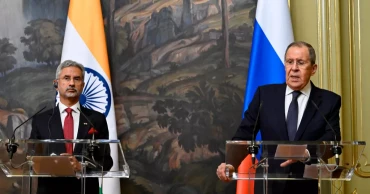
Jaishankar meets Putin and Lavrov in Moscow, praises growing trade
India's foreign minister met Wednesday with Russian President Vladimir Putin, who said relations between the countries are progressing even amid turbulent times.
Subramanyam Jaishankar's meeting was part of a five-day visit. At the start of the meeting, Putin said he would inform the Indian diplomat about the fighting in Ukraine, on which Indian Prime Minister Narendra Modi has held a neutral stance.
Also read: What to know about India's ties with Russia
"I know about his desire to do everything to resolve this problem through peaceful means," Putin said.
India is increasingly important to Russia as a market for oil exports, the backbone of its economy, as Western sanctions curtail oil shipments.
"It is very important to make our trade interaction more sustainable. We need to think about how to achieve this," Jaishankar said, according to a Kremlin transcript of the meeting's opening.
Jaishankar also met with Russian counterpart Sergey Lavrov, who said they discussed "the prospects for military-technical cooperation, including the joint production of modern types of weapons."
Also read: India stands with Bangladesh for future stability, prosperity: Indian envoy
India's foreign minister praised the "all-time high" trade turnover between the two countries, which he said exceeded $50 billion last year.
"We expect to exceed that this year. And what is important is that this trade is more balanced, it is sustainable, and it provides for fair market access," he said.
2 years ago

Ukraine celebrates Christmas on Dec. 25 for the first time, distancing itself from Russia
Christmas carried more than spiritual weight for many Ukrainians this year as the country newly observed it as a public holiday on Dec. 25 rather than the later date followed in Russia.
The change, enacted in legislation signed by President Volodymyr Zelenskyy in July, reflects both Ukrainians' dismay with the 22-month-old Russian invasion and their assertion of a national identity.
Ukraine is predominantly Orthodox Christian, but the faith is divided between two churches, one of which had long affiliation with the Russian Orthodox Church.
The Orthodox Church of Ukraine, which didn’t recognize the authority of the Russian church and had been regarded as schismatic, was granted full recognition in 2019 by the Ecumenical Patriarch of Constantinople, Orthodoxy’s top authority.
Read: Pope Francis denounces the weapons industry as he makes a Christmas appeal for peace in the world
The Ukrainian Orthodox Church, which was a branch of the Russian church, announced in 2022 after the start of the Russia-Ukraine war that it was breaking ties with Moscow and considered itself autonomous. However, its parishes continue to follow the same liturgical calendar as the Russian church and will observe Christmas on Jan. 7.
Many Ukrainians embraced the move to celebrate Christmas on Dec. 25 with enthusiasm.
“It’s historical justice,” said Yevhen Konyk, a 44-year-old serviceman who, along with his family, participated in traditional celebrations at an open-air museum in Kyiv. “We need to move forward not only with the world but also with the traditions of our country and overcome the imperial remnants we had.”
Read: Egypt floats ambitious plan to end Israel-Hamas war and create transitional Palestinian government
In the village of Kryvorivnia, thousands of worshipers, many in traditional garb including the embroidered shirts called vyshyvankas, crowded the streets and streamed to the settlement's noted elaborate wooden church.
Kryvorivnia, in the Carpathian mountains, is about 800 kilometers (500 miles) west from the frontline, but the war was on the minds of the worshipers. “People didn’t just come to observe the celebration, they came to pray," said local priest Ivan Rybaruk, who said 16 people from the village of only 1,500 residents have died in the fighting.
"People understand that we live here as safe as it could be. Missiles don’t fly here, bombs don’t explode, but we have lost a lot of guys,” said 27-year-old Olha Mynykh, standing in front of the house of a soldier who was declared missing. “People don’t feel that kind of joy. Of course, they feel joy because of Christmas because it’s impossible not to feel the light of God in the heart. But the scale of the celebration, the nature of the celebration, has obviously changed. It’s not as joyful and full of fun as before.”
Oksana Poviakel, the director of the Pyrohiv Museum of Folk Architecture and Life of Ukraine in Kyiv, where Christmas celebrations took place, said that observing the holiday on the 25th is “another important factor of self-identification.”
Read: Birthplace of Christ resembles ghost town on Christmas Eve
“We are separating ourselves from the neighbor who is currently trying to destroy our state, who is killing our people, destroying our homes, and burning our land,” she said.
Asia Landarenko, 63, said she prays every day for her son, who is currently in the military. “The state of war affects everything, including the mood. The real celebration of Christmas will be after the victory, but as the Savior was born, so will be our victory,” she said.
2 years ago

Gunman opens fire in a Prague university, killing 14 people in Czech Republic's worst mass shooting
A student opened fire Thursday at a university in Prague, killing at least 14 people, officials said, and injuring more than 20 in the Czech Republic's worst mass shooting.
The bloodshed took place in the philosophy department building of Charles University, where the shooter was a student, Prague Police Chief Martin Vondrasek said. The gunman also died, authorities said. His name has not been released.
Vondrasek said in the evening that 14 people had died and 25 were injured, after earlier reporting that 15 had died and 24 were hurt. He didn't explain the change. Authorities warned that the death toll could rise.
Also read: Gunman kills 3 people in twin Rotterdam shootings
Police gave no details about the victims or a possible motive for the shooting at the building located near the Vltava River in Jan Palach Square. Czech Interior Minister Vit Rakusan said investigators do not suspect a link to any extremist ideology or groups.
Vondrasek said police believe the gunman killed his father earlier Thursday in his hometown of Hostoun, just west of Prague, and that he had also been planning to kill himself. He didn't elaborate.
Later Thursday, Vondrasek said that based on a search of his home, the gunman was also suspected in the killing of another man and his 2-month-old daughter Dec. 15, in Prague.
Also read: A gunman in New Zealand kills 2 people ahead of Women's World Cup tournament
The chief described the shooter as an excellent student with no criminal record, but didn't provide any other information.
The gunman suffered "devastating injuries" but it wasn't clear if he killed himself or was shot to death in an exchange of gunfire with officers, Vondrasek said, adding that there was "nothing to suggest that he had an accomplice."
The shooter legally owned several guns — police said he was heavily armed Thursday and was carrying a lot of ammunition — and that what he did was "well thought out, a horrible act," Vondrasek said.
University authorities said they would tighten security in university buildings with immediate effect.
"We mourn the loss of life of members of our university community, express our deepest condolences to all the bereaved and our thoughts are with all those affected by the tragedy," Charles University said in a statement.
The building where the shooting took place is in Jan Palach Square, a busy tourist area in Prague's Old Town. It is just a few minutes' walk from the picturesque Old Town Square, a major tourist attraction where a popular Christmas market attracts thousands of visitors.
The government quickly sought to quell concerns that the massacre was back by foreign interests.
"There's no indication that it has anything to do with international terrorism," Rakusan said.
"It's a horrible crime, something the Czech Republic has never experienced," he said.
Pavel Nedoma, the director of the nearby Rudolfinum Gallery, said he watched from a window as a person standing on a balcony of the building fired a gun.
Also read: Gunman opens fire on Philadelphia streets, killing 5
Authorities evacuated everyone from the building and police said they were still searching the area, including the balcony, for explosives.
The building forms part of the square and faces a bridge across the river with a view of Prague Castle, the seat of the Czech presidency. President Petr Pavel said he was "shocked" by what happened and offered his condolences to the relatives of the victims, as did leaders of Germany, France and Slovakia, the European Union and Israel.
White House press secretary Karine Jean-Pierre sent a message of condolence.
"The president and the first lady are praying for the families who lost loved ones and everyone else who has been affected by this senseless act of violence," Jean-Pierre said. "On behalf of the United States, we send our condolences and also wish the survivors of this tragic event a speedy recovery."
The Czech government declared Saturday a national day of mourning to honor the shooting victims, Prime Minister Petr Fiala said.
Previously, the nation's worst mass shooting was in 2015, when a gunman opened fire in the southeastern town of Uhersky Brod, killing eight before fatally shooting himself.
On Thursday, where tourists, students and others would normally be enjoying the view of the iconic monument, chaos and terror instead took hold. Police vehicles and ambulances sped across the bridge with their sirens wailing. Officers sealed off the empty square.
Some video footage showed people being evacuated from the building and others trying to hide behind a wall.
Ivo Havranek, a diving instructor, said he was near the building when he heard a shot ring out, but he didn't quite believe that was what he had heard.
"Only at the moment when I saw the fully equipped riot police with bulletproof vests and shields, it looked to me that I had found myself in a movie," Havranek said. "But it was obvious that nobody was shooting a movie."
2 years ago

Putin says there will be no peace in Ukraine until Russia's goals, still unchanged, are achieved
Russian President Vladimir Putin said Thursday there would be no peace in Ukraine until the Kremlin realizes its goals, which remain unchanged after nearly two years of fighting that has sent tensions soaring between Moscow and the West.
Speaking at a year-end news conference that lasted over four hours and offered him an opportunity to reinforce his grip on power, Putin gave some rare details on what Moscow calls its "special military operation."
He dismissed the need for a second wave of mobilization of reservists to fight in Ukraine — a move that has been deeply unpopular. He said there are some 617,000 Russian soldiers there, including around 244,000 troops who were called up to fight alongside professional military forces.
Also read: North Korean and Russian officials discuss economic ties as Seoul raises labor export concerns
"There will be peace when we will achieve our goals," Putin said, repeating a frequent Kremlin line. "Victory will be ours."
Putin highlighted Russian military gains in Ukraine as the conflict's second winter approached.
"Almost all along the line of contact our armed forces, let's put it modestly, are improving their positions, almost all in an active stage of action and there is an improvement in the position of our troops all along," he said.
"The enemy has declared a big counteroffensive, but he hasn't achieved anything anywhere," Putin added, claiming that the latest Ukrainian attempt to create a bridgehead on the eastern bank of the Dnieper River also fizzled and Ukrainian troops suffered heavy losses.
Also read: Blinken defends bypassing Congress to sell weapons to Israel and presses lawmakers to help Ukraine
He alleged Kyiv was sacrificing its troops in order to show some success to its Western sponsors as it seeks more aid.
"I believe it's stupid and irresponsible on behalf of the country's political leadership, but it's their business," he said.
Putin, who has held power for nearly 24 years and announced last week he is running for reelection, was greeted with applause as he arrived in the hall in central Moscow. He didn't hold his traditional news conference last year after his military failed to capture Kyiv and as the Ukrainian army retook lost territory.
But with Ukrainian President Volodymyr Zelenskyy pleading for more U.S aid amid a stalling counteroffensive and fracturing Western support, he decided to face reporters once more — although the session is heavily choreographed and more spectacle than scrutiny.
It was the first time that Putin took questions from Western journalists since the fighting in Ukraine began. Ordinary citizens were able to submit questions alongside those from journalists, and Russian media said at least 2 million were sent in advance.
The news conference began with questions about Ukraine and highlighted concerns some Russians have about another wave of mobilization.
"There is no need" for mobilization now, Putin said, because 1,500 men are recruited every day. As of Wednesday, 486,000 soldiers have signed contracts with the military, he said.
His remarks about another mobilization were met with skepticism by some independent Russian media, which noted he had promised not to draft reservists for Ukraine and then reversed course and ordered a "partial" call-up. The move, which he announced in September 2022, prompted thousands of Russians to flee the country.
He reiterated that Moscow's goals in Ukraine — "de-Nazification, de-militarization and a neutral status" of Ukraine — remain unchanged. He had spelled out those loosely defined objectives the day he sent in troops February 2022.
The claim of "de-Nazification" refers to Russia's false assertions that Ukraine's government is heavily influenced by radical nationalist and neo-Nazi groups — an allegation derided by Kyiv and the West.
Putin has also demanded that Ukraine remain neutral and refrain from joining NATO.
He reaffirmed his claim that much of today's Ukraine, including the Black Sea port of Odesa and other coastal areas, historically belonged to Russia and were given away by Soviet founder Vladimir Lenin.
While Moscow had accepted the new reality after the USSR's collapse in 1991, Putin said he was forced to respond to what he described as an attempt by the West to turn Ukraine into a tool to challenge and threaten Russia.
"Russians and Ukrainians are one people, and what's going on now is a huge tragedy, a civil war between brothers who have found themselves on the opposite sides," he added.
Putin's last news conference was in 2021 as the U.S warned that Russia was about to send troops into Ukraine. He delayed an annual state-of-the-nation address until February 2023.
Relations with the U.S. since then have plunged to new lows as the conflict continued. Russia detained Moscow-based U.S. journalist Evan Gershkovich in March.
Shortly before Putin spoke, a Russian court ruled that Gershkovich, 32, must stay behind bars until at least Jan. 30.
U.S citizen Paul Whelan, a corporate security executive from Michigan, also has been jailed in Russia since his 2018 arrest on espionage-related charges.
Russia recently rejected an offer to bring home Gershkovich and Whelan, both labeled by the U.S. government as wrongfully detained.
"We're not refusing to return them," Putin said Thursday, adding he wanted to reach an agreement but "it's not easy." He refused to elaborate but said Washington "must hear us" and make an offer that satisfies Russia.
On the Israeli-Hamas war, Putin again deplored the death of thousands of women and children in Gaza, citing U.N. Secretary-General Antonio Guterres, who called it a "graveyard for children."
Putin urged stronger efforts to protect civilians and urged greater humanitarian aid, adding that Russia proposed setting up a field hospital in Gaza near the border with Egypt but Israel responded it would be unsafe. He reaffirmed a call for implementing a U.N. resolution on the creation of a Palestinian state with East Jerusalem as its capital.
Putin appeared calm and relaxed during questions, although he frequently cleared his throat, blaming the air conditioning. The event is primarily aimed at a domestic audience and is a chance for him to appear personally involved in resolving the problems of ordinary Russians and reinforce his authority ahead of the March 17 election.
Responding to a final question about what kind of warning he would have given to himself from today's perspective when he started his first term in 2000, Putin said he would have warned against "naivety and excessive trustfulness regarding our so-called partners."
He also fielded questions from children in Russian-annexed Crimea about the leaking roof and mold in their sports hall, and a woman who addressed "my favorite president" to complain about the rising price of eggs. Putin apologized and blamed "a glitch in the work of the government," for not increasing imports quickly enough.
Journalists lined up in freezing temperatures to enter the hall hours before Putin's arrival. Some donned traditional dress, including elaborate hats to catch his attention or held identifying placards.
Although the event is tightly controlled, some online questions that Putin ignored appeared on screens in the hall.
"Mr. President, when will the real Russia be the same as the one on TV?" one text message said, apparently referring to the Kremlin's control over the media that portrays Putin positively and glosses over the country's problems.
Another read: "I'd like to know, when will our president pay attention to his own country? We've got no education, no health care. The abyss lies ahead."
Putin was asked by an artificial intelligence version of himself, speaking with his face and voice, on whether he uses body doubles — a subject of intense speculation by some Kremlin watchers. Putin brushed off the suggestion.
"Only one person should look like myself and talk in my voice -- that person is going to be me," he said, deadpanning: "By the way, this is my first double."
2 years ago

Oxford University Press has named 'rizz' as its word of the year
Oxford University Press has named “rizz″ as its word of the year, highlighting the popularity of a term used by Generation Z to describe someone’s ability to attract or seduce another person.
Read: Bangladesh offers quality education at affordable cost
It topped “Swiftie” (an enthusiastic fan of Taylor Swift), “situationship” (an informal romantic or sexual relationship) and “prompt” (an instruction given to an artificial intelligence program) in the annual decision by experts at the publisher of the multivolume Oxford English Dictionary.
The four finalists were selected by a public vote and the winner was announced on Monday.
Rizz is believed to come from the middle of the word charisma, and can be used as a verb, as in to “rizz up,” or chat someone up, the publisher said.
Read: BUET Professor Syeda Sultana Razia wins 2023 OPCW The Hague Award
“It speaks to how younger generations create spaces — online or in person — where they own and define the language they use,” the publisher said. “From activism to dating and wider culture, as Gen Z comes to have more impact on society, differences in perspectives and lifestyle play out in language, too.”
2 years ago