Europe

As Turkey heads to runoff presidential race, domestic issues loom large
Turkish President Recep Tayyip Erdogan, who has parlayed his country’s NATO membership and location straddling Europe and the Middle East into international influence, is favored to win reelection in a presidential runoff Sunday, despite a host of domestic issues.
Erdogan, 69, who has amassed greater powers during his 20 years in office, finished a first-round election on May 14 just short of a victory and also retained a majority in parliament. That came despite rampant inflation and the aftermath of a catastrophic earthquake that killed over 50,000 people in the country’s south.
His challenger in the runoff is Kemal Kilicdaroglu, the 74-year-old leader of the main opposition social democratic Republican People’s Party and the joint candidate of a six-party alliance, who has promised to undo years of democratic backsliding under Erdogan, to repatriate Syrian refugees and promote rights of women.
Here’s a look at the main domestic issues shaping the election, and where Erdogan and his challenger stand:
ERDOGAN'S ECONOMICS
Contrary to the mainstream economic theory of interest rate increases helping to keep consumer prices in check, Erdogan maintains that high borrowing rates cause inflation. The Central Bank of the Republic of Turkey, under pressure from the president, repeatedly slashed interest rates to boost growth and exports.
Instead, the value of the Turkish lira nosedived, and the rate cuts exacerbated a cost-of-living crisis. Inflation peaked at 85% in October. The official April figure was 44%, although independent groups say they think the actual rate is much higher.
To offset the impacts of inflation and win back votes, Erdogan has engaged in a public spending spree ahead of the elections, increasing the minimum wage and pension payments.
The opposition alliance has promised to restore the central bank's independence and a return to orthodox economic policies, if Kilicdaroglu becomes president.
Erdogan reportedly has asked Mehmet Simsek, his internationally respected former finance minister, to return to the position, a sign that a new government may embrace more orthodox policies, if the Turkish leader wins a third presidential term.
On Thursday, Erdogan described Turkey’s economy, banking system and financial system as “sound.” He also said, however, that Gulf states, which he did not name, had “deposited money” in Turkey, providing temporary "relief."
RECOVERING FROM DISASTER
Turkey is grappling with a difficult recovery from February's 7.8 magnitude earthquake, the deadliest quake in the country's modern history. It destroyed or damaged more than 300,000 buildings. Hundreds of thousands of residents are sheltering in temporary accommodation like tents. Some 658,000 people were left jobless, according to the International Labor Organization.
The World Bank estimates that the earthquake caused $34.2 billion in “direct damages” — an amount equivalent to 4% of Turkey's 2021 gross domestic product. The recovery and reconstruction costs could add up to twice that much, the international financial institution said.
Erdogan’s government, meanwhile, has been accused of setting the stage for the devastation with lax building code enforcement. Some people left homeless or struggling to earn money also found the government's earthquake response to be slow.
Despite the criticism, in the parliamentary election Erdogan’s alliance won 10 out 11 provinces in areas affected by the quake, signaling that the president’s focus on rebuilding during the campaigning has paid off. Erdogan has pledged to construct 319,000 homes within the year and has attended a number of groundbreaking ceremonies, trying to persuade voters that only he can rebuild lives and businesses.
Kilicdaroglu says his government would give houses to quake victims for free instead of the 20-year repayment plan envisaged by Erdogan’s government.
REFUGEES NO LONGER SO WELCOME
Refugees, especially those fleeing civil war in neighboring Syria, were once greeted with open arms in Turkey, but anti-migration sentiment is on the rise amid the economic downturn. A shortage of housing and shelters in the quake-hit provinces has increased calls for Syrian refugees to go home.
The soft-mannered Kilicdaroglu had vowed to repatriate Syrians within two years, saying he would seek European Union funds to build homes, schools, hospitals and roads in Syria and encourage Turkish entrepreneurs to open factories and other businesses there. In a bid to woo nationalist voters in the lead up to the runoff race, Kilicdaroglu hardened his tone, saying he would send refugees packing within a year of being elected. He has since also won the backing of an anti-migrant party.
Under mounting public pressure, Erdogan’s government has begun constructing thousands of brick homes in Turkish-controlled areas of northern Syria to encourage voluntary returns. On Thursday, Erdogan announced in a television interview that Qatar was funding a separate housing project that would help resettle up to a million Syrians.
His government is also seeking reconciliation with Syrian President Bashir Assad to ensure their safe return.
Erdogan said Thursday there are some 4 million refugees in Turkey, including around 3.4 million Syrians, but anti-migrant parties say the figure is closer to 13 million.
A MORE DEMOCRATIC TURKEY?
The coalition of six parties has declared a commitment to restore Turkey as a parliamentary democracy and to give citizens greater rights and freedoms should their alliance win the elections.
Erdogan succeeded in getting a presidential system of governance narrowly approved by referendum in 2017 and introduced in 2018. The new system abolished the office of the prime minister and concentrated a vast amount of powers in the hands of the president.
The alliance has outlined plans for a greater separation of powers, including an increased role for parliament and an independent judiciary.
Kilicdaroglu has also promised to do away with a law that makes insulting the president a criminal offense punishable by prison. He has pledged to abide by decisions of the European Court of Human Rights, which have called for the release of former pro-Kurdish party co-chair Selahattin Demirtas and philanthropist businessman and human rights activist Osman Kavala from prison.
But lacking a parliamentary majority, Kilicdaroglu would face an uphill battle implementing the democratic reforms even if he is elected.
WILL THE ELECTION AFFECT WOMEN’S AND LGBTQ+ RIGHTS?
Seeking to widen his support from voters, Erdogan has expanded his own political alliance with two nationalist parties to include a small Islamist party and also secured the backing of a radical Kurdish-Islamist party.
The parties newly recruited into Erdogan's camp have Islamic agendas, which have raised fears about the future of women’s rights in Turkey. They want to scrap laws on alimony and domestic violence protection, arguing they encourage women to leave their husbands and threaten traditional family values.
Erdogan already has removed Turkey from a European convention that aims to prevent domestic violence - a nod to religious groups that claimed the treaty encourages divorce and LGBTQ+ rights. Pandering to his pious and conservative supporters, Erdogan and other members of his ruling party have called LGBTQ+ individuals “deviants.”
The Kilicdaroglu-led alliance has vowed to rejoin the European treaty and to uphold the rights of women and minority communities. Kilicdaroglu has also reached out to conservative women, assuring them they will be able to continue wearing Islamic-style headscarves that were once banned in schools and government offices under Turkey’s secular laws.
WHAT ABOUT FOREIGN POLICY?
Under Erdogan, Turkey has, at times, become a difficult NATO ally, often pursuing its own agenda. It has cultivated close ties with Russian President Vladimir Putin and blocked the alliance's expansion. However, it has also emerged as a key mediator between Russia and Ukraine, helping broker a crucial deal that allowed Ukrainian grain shipments and alleviate a food crisis.
The opposition alliance has signaled it would pursue a more Western-oriented foreign policy and seek to rebuild ties with the United States, the European Union and NATO allies.
The Kilicdaroglu-led opposition says it would work for Turkey’s reinstatement to the U.S.-led F-35 fighter jet program, from which the country was ousted following the Erdogan government’s purchase of a Russian-made air defense system.
At the same time, a Kilicdaroglu-led government is expected to try to balance Turkey’s economic ties with Russia.
An opposition win also could result in Turkey ending its veto of Sweden’s request to join NATO. Erdogan’s government has blocked Sweden’s accession into the alliance, pressing the country to crackdown on Kurdish militants and other groups that Turkey regards as terrorist threats.
3 years ago
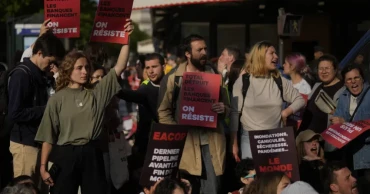
Climate protesters face tear gas at oil major TotalEnergies shareholder meeting in Paris
French police threw a security cordon around a shareholders' meeting in Paris of oil major TotalEnergies on Friday, spraying tear gas and pushing back climate protesters who chanted, "Be gentle, police officers, we're doing this for your kids!"
Shareholders, some escorted into the meeting by police, ran a gauntlet of the peaceful, earnest and mostly young demonstrators, who waved signs attacking the climate record of the French energy giant that has reaped colossal profits from price surges that followed Russia's invasion of Ukraine.
Their signs declared, "The last pipeline before the end of the world" and "Listen to the scientists: No more fossil projects."
Protesters sat down in surrounding streets and linked arms to block access to the meeting in a famed Paris concert hall. Police officers carried some protesters to move them out of the way. They sprayed tear gas from canisters to force people back.
It comes after climate protesters tried to rush the stage of the Shell shareholder meeting in London on Tuesday, with security guards dragging and carrying them away.
Dozens of activists also forced the delay of the start of the meeting by chanting "Shut down Shell," while others shouted, held signs and linked arms outside as security tried to remove them.
The tactics come as demonstrators contest the burning of coal, oil, natural gas and biomass blamed for air pollution that researchers say kills 1.2 million people worldwide per year and is driving the climate crisis, causing deadly weather extremes, hunger, heat deaths, migration and environmental destruction.
The United Nations chief has pleaded for an end to new fossil fuel exploration and for rich countries to quit coal, oil and gas by 2040.
Citing the protests, TotalEnergies had told shareholders beforehand that they could vote remotely.
Protesters came hours before the meeting, as dawn was breaking, to try to stop it from going ahead. The standoff with police evolved from there.
"We have no choice but to be here every single time they are here," demonstrator Camille Etienne said.
3 years ago

Scarred by war, Ukrainian children carry on after losing parents, homes and innocence
The two children squinted to see through the thick smoke that hung in the air after a deafening blast shook their small home in Ukraine's eastern Donetsk region.
The pair, ages 9 and 10, called out for their father. Only eerie silence followed.
Then Olha Hinkina and her brother, Andrii, rushed to the bomb shelter, as they had been taught. When the booms stopped and the smoke cleared, they found their father on the porch — motionless and covered in blood after being struck by a Russian projectile.
"Father was killed at seven in the morning," said Andrii, who now lives in the safer western city of Lviv, near the border with Poland.
The two siblings join a generation of Ukrainian children whose lives have been upended by the war. Russia's full-scale invasion has subjected them to constant bombardment, uprooted millions from their homes and turned many into orphans.
Hundreds of kids have been killed. For the survivors, the wide-ranging trauma is certain to leave psychological scars that will follow them into adolescence and adulthood.
"Even if children fled to a safer area, it doesn't mean they forgot everything that happened to them," said psychologist Oleksandra Volokhova, who works with children who escaped the violence.
At least 483 children have lost their lives and nearly 1,000 have been wounded, according to figures from Ukraine's general prosecutor's office.
Meanwhile, UNICEF says an estimated 1.5 million Ukrainian children are at risk of depression, anxiety, post-traumatic stress disorder and other mental health issues, with potentially lasting effects.
Nearly 1,500 Ukrainian children have been orphaned, the National Social Service of Ukraine said.
The largest number of child casualties comes from Donetsk, the epicenter of many battles, where 462 children have been killed or wounded, according to Ukrainian officials.
That figure does not include casualties from the Russian occupied city of Mariupol, which is also part of Donetsk province, where Ukrainian officials have found it difficult to track the dead and wounded.
Before the war tore them apart, the Hinkin family was like any other living in the village of Torske, which today is just 35 kilometers (22 miles) from the front.
With the death of their father in October, the children were orphaned. Their mother died years before the war.
Six months later, the siblings appear to be moving past the worst of their ordeal.
Police and volunteers evacuated them to a safer area in western Zakarpattia region, where they were cared for by government social services and a Ukrainian charity organization called SOS Children's Villages, which provided housing and counseling.
Their story became known in and around Torske after police released a widely seen video that showed their father's body being removed from the family home.
"We knew the village. We knew where they lived. We knew these people," said Nina Poliakova, 52, from the nearby town of Lyman.
Although she fled last year with her family to Lviv, Poliakova continued to follow news from her native area. Then tragedy struck her life as well when her 16-year-old foster son died suddenly from a heart condition.
She also has a 16-year-old foster daughter she took in with her husband in 2016 from the occupied town of Horlivka, where hostilities with Russian-backed separatists began, years before the 2022 invasion.
Mired in grief, Poliakova received a call one day from a local center supporting children. The caller asked if she would be willing to meet the Hinkin siblings.
At their first meeting, they talked mostly about the Hinkin family home and the domestic animals they had. One of Andrii's favorite activities was to feed the pigs.
Poliakova decided to welcome the two children into her extended family.
"We had that tragedy in our family, and then fate just brought us together," Poliakova said. "Now many children have been left alone, without parents. Children need care, love. They seek to be embraced and comforted."
Many foundations have emerged to help children overcome the trauma of war, including a group called Voices of Children, which has processed around 700 requests from parents looking for help with children suffering from chronic stress, panic attacks and symptoms of PTSD.
The pleas have changed as the war has progressed, according to a report issued by the charity. During this past winter, parents sought help after noticing behavioral changes in their children including apathy, aggression and anxiety, sensitivity to loud noises and anti-social habits.
"A child's psyche remains more malleable than that of adults, and with timely and quality support, we understand that a child can more easily overcome any traumatic events," said Olena Rozvadovska, the head of Voices of Children.
Recovering from months living so close to combat lines was difficult for the siblings, Poliakova said.
"They were very scared," she said. Olha would cry and hug her every time she heard the air-raid sirens. Andrii was relatively calm during the day but would start screaming in the middle of the night.
A charity known as Sincere Heart has operated short-term recovery camps for children and their mothers since the start of the invasion last year. More than 8,000 people have used the camp services.
Poliakova took her three foster children there. She wanted to help revive the childhood they lost to the war.
At the camp they played with other children who had similar experiences and took part in art sessions, dance classes and other activities designed to help children express emotions.
Sounds of laughter and play resonate at the camp full of kids from the war-ravaged regions of Donetsk, Luhansk, Zaporizhzhia, Kherson and other areas. Many witnessed bombings and experienced the loss of a parent. Some recovered from war-related wounds.
During an art session, the children were given white T-shirts and instructed to express their feelings through drawing. Most painted in the blue and yellow of the Ukrainian flag and scribbled the phrase "glory to Ukraine."
Olha Hinkina painted a heart in blue and yellow.
"Children reflect what lies on the surface," Rozvadovska said. "They are growing up in an atmosphere of the colors of our flag, the daily updates from the front line, the pride for the army that is standing."
Recovery is within reach for the children, she added. They can grow stronger because they have survived.
"They carry the experience that helped them to survive," she said. "Maybe it even made them more resilient and adaptive."
When Andrii Hinkin remembers his hometown, he doesn't recall the bombs, the smoke or the thunderous explosions. He remembers it as a beautiful village.
Asked what are his biggest dreams, he responds timidly. "I want to grow up."
3 years ago

Russia signs deal to deploy tactical nuclear weapons in Belarus
Russia and Belarus signed a deal on Thursday formalizing the procedure for deploying Russian nuclear weapons on Belarusian territory. Control of the weapons will remain with Moscow.
The move formalized the deal agreed on earlier by Russian President Vladimir Putin and Belarusian President Alexander Lukashenko. Putin previously announced in March that his country planned to deploy tactical, comparatively short-range and small-yield nuclear weapons in Belarus. The inking of the deal comes as Russia braces for Ukraine's much-anticipated counteroffensive.
Both Russian and Belarusian officials framed the step as driven by hostility from the West.
"Deployment of nonstrategic nuclear weapons is an effective response to the aggressive policy of countries unfriendly to us," Belarusian Defense Minister Viktor Khrenin said in Minsk during a meeting with his Russian counterpart, Sergei Shoigu.
"In the context of an extremely sharp escalation of threats on the western borders of Russia and Belarus, a decision was made to take countermeasures in the military-nuclear sphere," Shoigu added.
Belarus's Ministry of Defense said the agreement refers to a "special storage facility on the territory of the Republic of Belarus."
No detail was announced regarding when the weapons would be deployed in Belarus, but Putin previously said that the construction of storage facilities for tactical nuclear weapons in Belarus would be completed by July 1.
Exiled Belarusian opposition leader Sviatlana Tsikhanouskaya condemned the move.
"We must do everything to prevent Putin's plan to deploy nuclear weapons in Belarus, as this will ensure Russia's control over Belarus for years to come," Tsikhanouskaya told The Associated Press. "This will further jeopardize the security of Ukraine and all of Europe."
Independent Belarusian military analyst Aliaksandr Alesin said about two-thirds of Russia's arsenal of medium-range nuclear-tipped missiles were held in Belarus during the Cold War, adding that there are dozens of Soviet-era storage facilities that could still be used to store such weapons.
Soviet nuclear weapons stationed in Belarus, Ukraine, and Kazakhstan were moved to Russia in a U.S.-brokered deal after the dissolution of the Soviet Union in 1991.
"Documents in Minsk on the return of nuclear weapons were defiantly signed just at the moment when Ukraine declared a counteroffensive and Western countries are handing over weapons to Kyiv," Alesin told the AP.
"This Belarusian nuclear balcony should spoil the mood for politicians in the West, since nuclear missiles are capable of covering Ukraine, all of Poland, the Baltic states and parts of Germany."
Khrenin also announced plans to "build up the combat potential of the regional grouping of Russia and Belarusian troops," including the transfer to Minsk of the Iskander-M missile system, capable of carrying a nuclear charge, and the S-400 anti-aircraft missile system.
Russia and Belarus have an alliance agreement under which the Kremlin subsidizes the Belarusian economy, via loans and discounted Russian oil and gas. Russia used Belarusian territory as a staging ground for invading neighboring Ukraine and has maintained a contingent of troops and weapons there.
3 years ago

Turkish voters weigh final decision on next president, visions for future
Two opposing visions for Turkey's future are on the ballot when voters return to the polls Sunday for a runoff presidential election that will decide between an increasingly authoritarian incumbent and a challenger who has pledged to restore democracy.
President Recep Tayyip Erdogan, a populist and polarizing leader who has ruled Turkey for 20 years, is well positioned to win after falling just short of victory in the first round of balloting on May 14. He was the top finisher even as the country reels from sky-high inflation and the effects of a devastating earthquake in February.
Kemal Kilicdaroglu, the leader of Turkey's pro-secular main opposition party and a six-party alliance, has campaigned on a promise to undo Erdogan's authoritarian tilt. The 74-year-old former bureaucrat has described the runoff as a referendum on the direction of the strategically located NATO country, which is at the crossroads of Europe and Asia and has a key say over the alliance's expansion.
“This is an existential struggle. Turkey will either be dragged into darkness or light,” Kilicdaroglu said. “This is more than an election. It has turned into a referendum.”
In a bid to sway nationalist voters ahead of Sunday's runoff, the normally soft-mannered Kilicdaroglu (pronounced KEH-lich-DAHR-OH-loo) shifted gear and hardened his stance, vowing to send back millions of refugees if he is elected and rejecting any possibility of peace negotiations with Kurdish militants.
The social democrat had previously said he planned to repatriate Syrians within two years, after establishing economic and safety conditions conducive to their return.
He has also repeatedly called on 8 million people who stayed away from the polls in the first round to cast votes in the make-or-break runoff.
Erdogan scored 49.5% of the vote in the first round. Kilicdaroglu received 44.9%.
At 69, Erdogan is already Turkey's longest-serving leader, having ruled over the country as prime minister since 2003 and as president since 2014. He could remain in power until 2028 if reelected.
Under Erdogan, Turkey has proven to be an indispensable and sometimes troublesome NATO ally.
It vetoed Sweden’s bid to join the alliance and purchased Russian missile-defense systems, which prompted the United States to oust Turkey from a U.S.-led fighter-jet project. Yet together with the U.N., Turkey also brokered a vital deal that allowed Ukraine to ship grain through the Black Sea to parts of the world struggling with hunger.
This week, Erdogan received the endorsement of the nationalist third-place candidate, Sinan Ogan, who garnered 5.2% of the vote. The move was seen as a boost for Erdogan even though Ogan’s supporters are not a monolithic bloc and not all of his votes are expected to go to Erdogan.
Erdogan’s nationalist-Islamist alliance also retained its hold on parliament in legislative elections two weeks ago, further increasing his chances for reelection as many voters are likely to want to avoid a split government.
On Wednesday, the leader of a hard-line anti-migrant party that had backed Ogan threw its weight behind Kilicdaroglu after the two signed a protocol pledging to send back millions of migrants and refugees within the year.
Kilicdaroglu’s chances of turning the vote around in his favor appear to be slim but could hinge on the opposition’s ability to mobilize voters who did not cast ballots in the first round.
“It’s not possible to say that the odds are favoring him, but nevertheless, technically, he stands a chance,” said professor Serhat Guvenc of Istanbul’s Kadir Has University.
If the opposition can reach the voters who previously stayed home, "it may be a different story.”
In Istanbul, 45-year-old Serra Ural accused Erdogan of mishandling the economy and said she would vote for Kilicdaroglu.
She also expressed concerns over the rights of women after Erdogan extended his alliance to include Huda-Par, a hard-line Kurdish Islamist political party with alleged links to a group that was responsible for a series of gruesome killings in the 1990s. The party wants to abolish mixed-gender education, advocates for the criminalization of adultery and says women should prioritize their homes over work.
“We don’t know what will happen to women tomorrow or the next day, what condition they’ll be in,” she said. “To be honest Huda-Par scares us, especially women.”
Mehmet Nergis, 29, said he would vote for Erdogan for stability.
Erdogan "is the guarantee for a more stable future,” Nergis said. “Everyone around the world has already seen how far he has brought Turkey.”
He dismissed the country’s economic woes and expressed confidence that Erdogan would make improvements.
Erdogan’s campaign has focused on rebuilding areas that were devastated by the earthquake, which leveled cities and left more 50,000 dead in Turkey. He has promised to build 319,000 homes within the year.
In the parliamentary election, Erdogan’s alliance won 10 out 11 provinces in the region affected by the quake despite criticism that his government’s initial disaster response was slow.
“Yes, there was a delay, but the roads were blocked,” said Yasar Sunulu, an Erdogan supporter in Kahramanmaras, the quake’s epicenter. “We cannot complain about the state ... It gave us food, bread and whatever else needed."
He and his family members are staying in a tent after their house was destroyed.
Nursel Karci, a mother of four living in the same camp, said she too would vote for Erdogan.
Erdogan "did all that I couldn’t,” she said. “He clothed my children where I couldn’t clothe them. He fed them where I couldn’t ... Not a penny left my pocket.”
Erdogan has repeatedly portrayed Kilicdaroglu as colluding with the outlawed Kurdistan Workers’ Party, or PKK, after the opposition party leader received the backing of the country’s pro-Kurdish party.
During a rally in Istanbul, Erdogan broadcast a faked video purporting to show a PKK commander singing the opposition’s campaign song to hundreds of thousands of his supporters. On Monday, Erdogan doubled down on the narrative, insisting that the PKK has thrown its support to Kilicdaroglu whether the video is “faked or not.”
“Most analysts failed to gauge the impact of Erdogan’s campaign against Kilicdaroglu,” Guvenc said. “This obviously did strike a chord with the average nationalist-religious electorate in Turkey.”
“Politics today is about building and sustaining a narrative which shadows the reality," he added. "Erdogan and his people are very successful in building narratives that eclipse realities.”
3 years ago

UK inflation falls to lowest level in over a year but food prices keep decline in check
Inflation in the U.K. has fallen to its lowest level since the immediate aftermath of Russia's invasion of Ukraine, though elevated food prices meant it didn't fall as much as anticipated.
The Office for National Statistics said Wednesday that the inflation rate, as measured by the consumer prices index, dropped to 8.7% in the year to April from 10.1% in March, largely because last year's energy spike in the wake of the invasion dropped out of the annual comparison. The fall took inflation to its lowest level since March 2022, a month after the war began.
Though welcome, the decline wasn't as big as anticipated, especially as prices in the wholesale gas market have been falling for months. The consensus in financial markets was that it would ease back further to 8.3%,
One of the main reasons why inflation is consistently running higher than anticipated — and generally higher than other nations in the Group of Seven — is that food prices remain elevated, as anyone doing the weekly shopping at their supermarket can attest to. The statistics agency said that food prices were still 19% higher than they were the year before.
“The rate of inflation fell notably as the large energy price rises seen last year were not repeated this April, but was offset partially by increases in the cost of second-hand cars and cigarettes," the statistics agency's chief economist Grant Fitzner said.
“However, prices in general remain substantially higher than they were this time last year, with annual food price inflation near historic highs," he added.
While welcoming the fall in inflation into single digits, Treasury chief Jeremy Hunt said “food prices are still running too high.”
On Tuesday, Hunt held discussions with food manufacturers over the cost of food and ways to ease pressure on households. No measures to ease the burden on households were announced.
“Surging food prices are particularly painful for low-income families, three-in-five of whom are already reporting that they are having to cut back on food and other essentials,” said James Smith, research director at the Resolution Foundation.
Overall, Wednesday's figures back up the International Monetary Fund's assessment on Tuesday that inflation in the U.K. is likely to remain stubbornly high over the coming years and only return to the Bank of England’s target of 2% in mid-2025, six months longer than it predicted earlier this year.
Like other central banks, the Bank of England has been raising interest rates aggressively over the past 18 months or so to a 15-year high of 4.5% after inflation spiked sharply, first because of bottlenecks caused by the coronavirus pandemic and then Russia’s invasion of Ukraine.
Bank of England Gov. Andrew Bailey, also on Tuesday, reiterated his stance that borrowing costs would have to rise again if inflation remained stubbornly high. He also conceded that policymakers have perhaps been caught off guard by the pace at which food prices have risen and remained elevated since the invasion of Ukraine, one of the world's most important agricultural nations.
Samuel Tombs, chief U.K. economist at Pantheon Macroeconomics, said that a further increase in the bank's interest rate to 4.75% in June is now “firmly on the table” following the above-consensus April outcome, and in light of the “sensitivity of households’ inflation expectations to food price changes.”
3 years ago

Russia claims it repelled one of war's most serious cross-border attacks
Russia's military said Tuesday it quashed what appeared to be one of the most serious cross-border attacks from Ukraine since the war began, claiming to have killed more than 70 attackers in a battle that lasted around 24 hours.
Moscow blamed the raid that began Monday on Ukrainian military saboteurs. Kyiv portrayed it as an uprising against the Kremlin by Russian partisans. It was impossible to reconcile the two versions, to say with certainty who was behind the attack or to ascertain its aims.
The battle — which took place in southwest Russia's Belgorod region, about 80 kilometers (45 miles) north of the city of Kharkiv, in eastern Ukraine — was a fresh reminder of how Russia itself remains vulnerable to attack, along with Russian-occupied regions of Ukraine.
The region is a Russian military hub holding fuel and ammunition depots and was included in Russian President Vladimir Putin's order last year to increase the state of readiness for attacks and improve defenses.
Kremlin spokesman Dmitry Peskov refused to say how many attackers were involved in the assault or comment on why efforts to put down the attackers took so long.
Such cross-border attacks embarrass the Kremlin and highlight the struggles it faces in its bogged-down invasion of Ukraine.
The Belgorod region, like the neighboring Bryansk region and other border areas, has witnessed sporadic spillover from the war, which Russia started by invading Ukraine in February 2022.
Far from the 1,500-kilometer (932-mile) front line in southern and eastern Ukraine, Russian border towns and villages regularly come under shelling and drone attacks, but this week's attack is the second in recent months that also appears to have involved an incursion by ground forces. Another difference from earlier cross-border attacks is that Russia's effort to repel it continued into a second day for the first time.
Russian Defense Ministry spokesman Igor Konashenkov claimed local troops, air strikes and artillery routed the attackers.
“The remnants of the nationalists were driven back to the territory of Ukraine, where they continued to be hit by fire until they were completely eliminated,” Konashenkov said, without providing evidence. He did not mention any Russian casualties.
Russian forces destroyed four armored combat vehicles and five pickup trucks the attackers used, he said. Local officials alleged the invaders also used drones and artillery.
The governor of the Belgorod region, Vyacheslav Gladkov, said the raid targeted the rural area around Graivoron, a town about 5 kilometers (3 miles) from the border. Twelve civilians were wounded in the attack, he said, and an older woman died during an evacuation.
The Russian news portal RBK, quoting unidentified sources in the regional interior ministry and territorial police, said Graivoron came under heavy shelling that lasted about five hours early Monday. After that, tanks fired at the Graivoron border checkpoint while the adjacent village of Kozinka came under mortar and rocket fire, RBK said, citing the same sources. Gladkov later reported that a Koznika villager had been killed.
The attacking force was made up of 10 armored vehicles and an unspecified number of troops, RBK said.
Earlier Tuesday, the regional governor urged residents who had evacuated not to return home until they received official instructions to do so. He said a “counterterrorism operation” was completed by early Tuesday evening.
Gladkov also said fire from the Ukrainian side of the border on Tuesday hit the Borisovka area, about 20 kilometers (20 miles) northeast of Graivoron. No casualties were reported, he said without elaborating on the incident.
The regional governor complained in a video late Tuesday that federal authorities' claims for the past year that “everything is under control” do not ring true in light of this attack and prior assaults. He appealed again to the Kremlin to strengthen defenses.
Since the war began, drones, explosions and missiles have hit fuel and ammunition depots, railroad equipment, bridges and air bases on Russian territory and Russia-occupied areas of Ukraine. Assassinations of Russian-appointed government officials and other public figures have also taken place in those areas.
Ukraine said Russian citizens belonging to murky groups called the Russian Volunteer Corps and the Freedom of Russia Legion were behind the assault.
Ukrainian Deputy Defense Minister Hanna Maliar said the attackers were Russian dissidents unhappy about Putin’s policies.
“These are Russian patriots, as we understand it. People who actually rebelled against the Putin regime,” she said.
The Freedom of Russia Legion said on Telegram the goal was to “liberate” the region.
The Russian Volunteer Corps implied on Telegram that the attack was over, adding: “One day, we’ll come to stay.” The post went up at around the same time as the Russian Defense Ministry claimed to have quashed the assault.
The U.K. Defense Ministry said it was “highly likely” that Russian security forces were fighting partisans in at least three locations in Belgorod.
“Russia is facing an increasingly serious multi-domain security threat in its border regions, with losses of combat aircraft, improvised explosive device attacks on rail lines and now direct partisan action,” it said Tuesday.
Russia’s Investigative Committee, its top law enforcement agency, announced an investigation into alleged terrorism and attempted murder in connection with the raid.
Belgorod officials earlier this year said they had spent nearly 10 billion rubles ($125 million; 116 million euros) on fortifications to protect the region.
Peskov, the Kremlin spokesman, said the raid “elicits deep concerns” and that a "bigger effort” was required to prevent future attacks.
The Russian Volunteer Corps claimed to have breached the border in early March. The shadowy group describes itself as “a volunteer formation fighting on Ukraine’s side.” It's not clear if it — or the Freedom of Russia Legion — has any ties with the Ukrainian military.
Elsewhere, Ukrainian forces made minor progress against Russian forces on the edge of Bakhmut, the eastern Ukrainian city that Moscow claims to have captured, according to Maliar, the Ukrainian deputy defense minister.
She said Tuesday that Ukrainian troops still controlled the southwestern outskirts of the city and that fighting was continuing in the suburbs, on Russia’s flanks.
3 years ago

Russia's Wagner boss says more than 20,000 of his troops died in Bakhmut battle
The head of the Russian private army Wagner says his force lost more than 20,000 fighters in the drawn-out battle for Bakhmut, with about 20% of the 50,000 Russian convicts he recruited to fight in the 15-month war dying in the eastern Ukrainian city.
The figure was in stark contrast with claims from Moscow that it lost just over 6,000 troops in the war, and is higher than the official estimate of the Soviet losses in the Afghanistan war of 15,000 troops between 1979-89. Ukraine hasn't said how many of its soldiers have died since Russia's full-scale invasion in February 2022.
Analysts believe the nine-month fight for Bakhmut alone have cost the lives of tens of thousands of soldiers, among them convicts who reportedly received little training before being sent to the front.
Russia’s invasion goal of “demilitarizing” Ukraine has backfired because Kyiv’s military has become stronger with the supply of weapons and training by its Western allies, Wagner chief Yevgeny Prigozhin said in an interview published late Tuesday with Konstantin Dolgov, a pro-Kremlin political strategist.
Prigozhin also said the Kremlin’s forces have killed civilians during the war, something Moscow has repeatedly and vehemently denied.
Prigozhin, a wealthy businessman with longtime links to Russian President Vladimir Putin, is known for his bluster -- often spiced with obscenities -- and has previously made unverifiable claims, some of which he later backtracked on.
Earlier this month, his spokespeople published a video of him shouting, swearing and pointing at about 30 uniformed bodies lying on the ground, saying they were Wagner fighters who died in a single day. He claimed the Russian Defense Ministry had starved his men of ammunition and threatened to give up the fight for Bakhmut.
He also said in Tuesday's interview it was possible that Kyiv’s anticipated counteroffensive in coming weeks, given continued Western support, might push Russian forces out of southern and eastern Ukraine as well as annexed Crimea.
“A pessimistic scenario: the Ukrainians are given missiles, they prepare troops, of course they will continue their offensive, try to counterattack," he said. "They will attack Crimea, they will try to blow up the Crimean bridge (to the Russian mainland), cut off (our) supply lines. Therefore, we need to prepare for a hard war.”
The Ukrainian General Staff said Wednesday that “heavy fighting” is continuing inside Bakhmut, days after Russia said that it completely captured the devastated city.
Bakhmut lies in Donetsk province, one of four provinces Russia illegally annexed last fall and only partially controls.
The head of Ukraine’s ground forces, Oleksandr Syrskyi, said that Kyiv’s forces “are continuing their defensive operation” in Bakhmut, and have attained unspecified “successes” on the city’s outskirts. He gave no further details.
Ukrainian officials have insisted the battle for Bakhmut isn’t over.
A Ukrainian commander in Bakhmut told The Associated Press on Tuesday that the Ukrainians have a plan to push the Russians out of all occupied territory.
“But now we don’t need to fight in Bakhmut, we need to surround it from flanks and block it,” Yevhen Mezhevikin said. "Then we should ‘sweep’ it. This is more appropriate, and that’s what we are doing now.”
Elsewhere, Russian forces shot down “a large number” of drones in Russia’s southern Belgorod region, a local official said Wednesday, a day after Moscow announced that its forces crushed a cross-border raid in the area from Ukraine.
The drones were intercepted overnight over the province, Belgorod Gov. Vyacheslav Gladkov said in a Telegram post. He said that no one had been hurt, but unspecified administrative buildings, residential buildings and cars were damaged.
Ukrainian officials made no immediate comment.
Russia said the previous day that it beat back one of war’s most serious cross-border attacks, with the Defense Ministry saying that more than 70 attackers were killed in a battle in the Belgorod region that lasted around 24 hours. It made no mention of any Russian casualties.
Russian Defense Ministry spokesman Igor Konashenkov said that local troops, airstrikes and artillery routed the attackers.
Twelve local civilians were wounded in the attack, officials said, and an older woman died during an evacuation.
Details of the incident in the rural region, lying about 80 kilometers (45 miles) north of the city of Kharkiv in eastern Ukraine and far from the front lines of the almost 15-month war, are unclear.
Moscow blamed the incursion that began Monday on Ukrainian military saboteurs. Kyiv described it as an uprising against the Kremlin by Russian partisans. It was impossible to reconcile the two versions, to say with certainty who was behind the attack or to ascertain its aims.
The region is a Russian military hub holding fuel and ammunition depots. Moscow officials declined to say how many attackers were involved in the assault or comment on why efforts to put down the attackers took so long.
The Belgorod region, like the neighboring Bryansk region and other border areas, has witnessed sporadic spillover from the war, which Russia started by invading Ukraine in February 2022.
At least three civilians died and 18 others were wounded in Ukraine on Tuesday and overnight, the Ukrainian presidential office reported Wednesday, including in the southern Kherson region where two elderly people died in air strikes.
3 years ago

German police conduct searches in investigation of climate activists
Authorities raided 15 properties across Germany on Wednesday and seized assets in an investigation into the financing of protests by the Last Generation climate activist group, prosecutors said.
Munich prosecutors said they were investigating seven people, ranging in age from 22 to 38, on suspicion of forming or supporting a criminal organization. They launched the inquiry following numerous criminal complaints they received since mid-2022.
Members of Last Generation have repeatedly blocked roads across Germany in an effort to pressure the government to take more drastic action against climate change.
In recent weeks, they have brought the traffic to a halt on an almost daily basis in Berlin, gluing themselves to busy intersections and highways. Over the past year, they have also targeted various art works and exhibits.
Their tactics have drawn sharp criticism. On Monday, Chancellor Olaf Scholz said he thought it was "completely nutty to somehow stick yourself to a painting or on the street."
Prosecutors said the people under investigation are accused of organizing and promoting a campaign to "finance further criminal offenses" by the group and collecting at least 1.4 million euros ($1.5 million). Two of them also are suspected of trying to sabotage an oil pipeline that connects the Bavarian city of Ingolstadt with the Italian port of Trieste.
Wednesday's searches — accompanied by orders to seize two bank accounts and other assets — aimed to secure evidence on the membership structure of Last Generation and on its financing. There were no arrests.
Last Generation has acknowledged that its protests are provocative, but it argues that by stirring friction it can encourage debate within society about climate change.
3 years ago

UK inflation falls to lowest level in over a year but food prices remain elevated
Official figures show that inflation in the U.K. has fallen to its lowest level since the immediate aftermath of Russia's invasion of Ukraine, which caused energy and food costs to surge.
The Office for National Statistics said Wednesday that the consumer price index dropped to 8.7% in the year to April from 10.1% in March, largely because last year's energy spike in the wake of the invasion dropped out of the annual comparison. The fall took inflation to its lowest level since March 2022, a month after the war began.
Though welcome, the fall wasn't as big as anticipated. The consensus in financial markets was that it would ease back further to 8.3%,
The main reason why inflation is consistently running higher than anticipated is that food prices remain elevated.
"The rate of inflation fell notably as the large energy price rises seen last year were not repeated this April, but was offset partially by increases in the cost of second-hand cars and cigarettes," the statistics agency's chief economist Grant Fitzner said.
"However, prices in general remain substantially higher than they were this time last year, with annual food price inflation near historic highs," he added.
3 years ago