europe
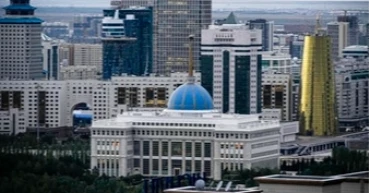
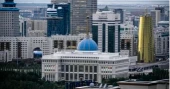
Kazakhs to vote in newly energized parliament elections
Voters in Kazakhstan will cast ballots Sunday after a short but active campaign for seats in the lower house of parliament that is being reconfigured in the wake of deadly unrest that gripped the resource-rich Central Asian nation a year ago.
The snap election comes on the third anniversary of the resignation as president of Nursultan Nazarbayev, who had led Kazakhstan since independence following the breakup of the Soviet Union in 1991 and who had established immense influence. His successor, Kassym-Jomart Tokayev, was widely expected to continue Nazarbayev's authoritarian course and even renamed the capital as Nur-Sultan in his predecessor's honor.
But the country's political landscape changed markedly after a wave of violence in January 2022 when provincial protests initially sparked by a fuel price hike engulfed other cities, notably the commercial capital, Almaty, and became overtly political as demonstrators shouted “Old man out!” in reference to Nazarbayev. More than 220 people, mostly protesters, died as police harshly put down the unrest.
Amid the violence, Tokayev removed Nazarbayev from his powerful post as head of the national security council. He restored the capital’s previous name of Astana, and the parliament repealed a law granting Nazarbayev and his family immunity from prosecution.
Tokayev also initiated reforms to strengthen the parliament, reduce presidential powers and limit the presidency to a single seven-year term. Under the reforms, a third of the lower house of parliament's 98 seats will be chosen in single-mandate races rather than by party list.
Tokayev's Amanat party holds the overwhelming majority of seats in the current parliament and the rest belong to parties that are largely loyal to Amanat. Although opinion surveys indicate that Amanat will remain the largest party in the new parliament, the likely final balance is unclear.
More than 400 candidates, most of them self-nominated, are competing in the single-mandate races, and the national elections commission authorized two additional parties to enter the proportional contest.
The widened competition appears to have energized the electorate.
Although electioneering was allowed to start only in mid-February, “the campaign so far appears lively, in particular online and in the single-mandate electoral districts with a large number of candidates,” said an assessment from the elections observation mission of the Organization for Security and Cooperation in Europe.
Candidates have raised a wide array of issues including further political reforms, housing and rising food prices, and the country does not show a clear path forward. But many are encouraged by the expanded election opportunity.
“There is hope that the upcoming parliamentary election that will be held under the new mixed electoral system will bring change and facilitate democratization and political liberalization in Kazakhstan,” analyst Assel Nussopova wrote for the Astana Times newspaper.
3 years ago

Russian attacks continue in wake of Putin arrest warrant
Widespread Russian attacks continued in Ukraine following the International Criminal Court’s decision to issue an arrest warrant for Russian President Vladimir Putin and Russia’s commissioner for children’s rights.
Ukraine was attacked by 16 Russian drones on Friday night, the Ukrainian Air Force said in the early hours of Saturday. Writing on Telegram, the air force command said that 11 out of 16 drones were shot down “in the central, western and eastern regions.” Among areas targeted were the capital, Kyiv, and the western Lviv province.
The head of the Kyiv city administration, Serhii Popko, said Ukrainian air defenses shot down all drones heading for the Ukrainian capital, while Lviv regional Gov. Maksym Kozytskyi said Saturday that three of six drones were shot down, with the other three hitting a district bordering Poland. According to the Ukrainian Air Force, the attacks were carried out from the eastern coast of the Sea of Azov and Russia’s Bryansk province, which borders Ukraine.
The Ukrainian military additionally said in its regular update Saturday morning that Russian forces over the previous 24 hours launched 34 airstrikes, one missile strike and 57 rounds of anti-aircraft fire. The Facebook update said that falling debris hit the southern Kherson province, damaging seven houses and a kindergarten.
According to the Ukrainian statement, Russia is continuing to concentrate its efforts on offensive operations in Ukraine’s industrial east, focusing attacks on Lyman, Bakhmut, Avdiivka, Marinka and Shakhtarsk in Ukraine’s eastern Donetsk province. Pavlo Kyrylenko, regional Gov. of the Donetsk province, said one person was killed and three wounded when 11 towns and villages in the province were shelled on Friday.
Further west, Russian rockets hit a residential area overnight Friday in the city of Zaporizhzhia, the regional capital of the partially occupied province of the same name. No casualties were reported, but houses were damaged and a catering establishment destroyed, Anatoliy Kurtev of the Zaporizhzhia City Council said.
Read more: International court issues an arrest warrant for Putin
The International Criminal Court said Friday that it has issued an arrest warrant for Putin for war crimes, accusing him of personal responsibility for the abductions of children from Ukraine, together with Russia’s commissioner for children’s rights, Maria Lvova-Belova.
It is the first time the global court has issued a warrant against a leader of one of the five permanent members of the U.N. Security Council.
The move was immediately dismissed by Moscow — and welcomed by Ukraine as a major breakthrough.
Its practical implications, however, could be limited as the chances of Putin facing trial at the ICC are highly unlikely because Moscow does not recognize the court’s jurisdiction or extradite its nationals.
U.K. military officials said Saturday that Russia is likely to widen conscription. In its latest intelligence update, the U.K. defense ministry said that deputies in the Russian Duma, the lower house of Russia’s parliament, introduced a bill Monday to change the conscription age for men to 21-30, from the current 18-27.
The ministry said that, at the moment, many men aged 18-21 claim exemption from military service because they are in higher education. The change would mean that they would eventually still have to serve. It said the law will likely be passed and come into force in January 2024.
3 years ago

Scholtz visits Japan to firm up economic, defense ties
German Chancellor Olaf Scholz and Japanese Prime Minister Fumio Kishida on Saturday held the first round of government consultations in Tokyo as they seek to strengthen economic and defense ties in a global landscape dominated by China's growing influence and the war in Ukraine.
Scholz brought six of his ministers for talks with Japanese counterparts to deepen cooperation in the economy and national security in the Indo-Pacific region, as well as other global issues including China’s assertiveness in pressing its maritime territorial claims and its closer ties with Russia.
“I believe the government consultation will be a springboard to bring cooperation between Japan and Germany even closer,” Kishida said in his opening remarks at the meeting. Kishida said the focus of the talks is on economic security, the Indo-Pacific region, Russia’s war on Ukraine and other mutual concerns.
Germany has similar “government consultations” framework with several countries. Of the 17 members of Scholtz’s Cabinet, six of them, including economy, finance, foreign, interior, transport and defense ministers, are traveling with him.
The two defense ministers met separately and confirmed the German armed forces' continued engaement in the Indo-Pacific region and stronger military cooperation between the two countries.
Japanese Defense Minster Yasukazu Hamada and his German counterpart Boris Pistorius agreed to coordinate closely in future regional deployments of the German military and step up joint exercises. They also agreed to seek a legal framework to facilitate increased joint defense activities, as well as cooperation in defense equipment and technology, the Japanese Defense Ministry said in a statement.
Japan, noting growing threats from China and North Korea, has been expanding military cooperation beyond its main ally, the United States, and has developed partnerships with Australia, Britain, European and Southeast Asian nations. Kishida's government last year adopted a new national security strategy under which Japan is deploying long-range cruise missiles to strengthen its strike-back capability, a major break from the country's postwar self-defense-only principle.
Scholtz visited Japan last year before going to China, making a point of prioritizing Germany’s economic ties with Tokyo over Beijing. Scholz is pushing to diversify Germany’s trade partners, while speaking out against a complete decoupling from China.
Japan, along with the United States, is seeking ways to stand up to increasing Chinese economic influence in the region. Tokyo also wants to reinforce economic security with other democracies in areas such as supply chains and the protection of sensitive technologies, apparently as a counter to China.
But Japan, which is a top U.S. ally and a major trade partner with China, is in a delicate situation and must balance its position between the two superpowers.
For Germany, China was its biggest trading partner in 2021 for the sixth consecutive year, as business ties have flourished even though political relations have turned tense.
3 years ago

International court issues an arrest warrant for Putin
The International Criminal Court said on Friday it issued an arrest warrant for Russian President Vladimir Putin for war crimes because of his alleged involvement in abductions of children from Ukraine.
The court said in a statement that Putin “is allegedly responsible for the war crime of unlawful deportation of (children) and that of unlawful transfer of (children) from occupied areas of Ukraine to the Russian Federation.”
It also issued a warrant Friday for the arrest of Maria Alekseyevna Lvova-Belova, the Commissioner for Children’s Rights in the Office of the President of the Russian Federation, on similar allegations.
The move was immediately dismissed by Moscow and welcomed by Ukraine as a major breakthrough. Its practical implications, though, could well be negligible.
Even if the court has court has indicted world leaders before, it was the first time it issued a warrant against one of the five permanent members of the U.N. Security Council.
The court’s president, Piotr Hofmanski, said in a video statement that while the ICC’s judges have issued the warrants, it will be up to the international community to enforce them. The court has no police force of its own to enforce warrants.
“The ICC is doing its part of work as a court of law," he said. "The judges issued arrest warrants. The execution depends on international cooperation.”
The chances of a trial of any Russians at the ICC remains extremely unlikely, as Moscow does not recognize the court’s jurisdiction— a position it vehemently reaffirmed on Friday.
Kremlin spokesman Dmitry Peskov insisted that Russia doesn’t recognize the ICC and considers its decisions “legally void.” He added that Russia considers the court’s move “outrageous and unacceptable.”
Peskov refused to comment when asked if Putin would avoid making trips to countries where he could be arrested on the ICC’s warrant.
Ukrainian officials were jubilant.
“The world changed," said presidential adviser Mykhailo Podolyak. Foreign Minister Dmytro Kuleba said the “wheels of justice are turning," and added that "international criminals will be held accountable for stealing children and other international crimes.”
Olga Lopatkina, a Ukrainian mother who struggled for months to reclaim her foster children who were deported to an institution ran by Russian loyalists, welcomed the news of the arrest warrant. “Good news!” she said in an exchange of messages with the Associated Press. “Everyone must be punished for their crimes.”
Ukraine also is not a member of the international court, but it has granted it jurisdiction over its territory and ICC prosecutor Karim Khan has visited four times since opening an investigation a year ago.
The ICC said its pre-trial chamber found “reasonable grounds to believe that each suspect bears responsibility for the war crime of unlawful deportation of population and that of unlawful transfer of population from occupied areas of Ukraine to the Russian Federation, in prejudice of Ukrainian children.”
The court statement said that “there are reasonable grounds to believe that Mr. Putin bears individual criminal responsibility” for the child abductions “for having committed the acts directly, jointly with others and/or through others (and) for his failure to exercise control properly over civilian and military subordinates who committed the acts.
After his most recent visit, in early March, ICC prosecutor Khan said he visited a care home for children two kilometers (just over a mile) from front lines in southern Ukraine.
“The drawings pinned on the wall ... spoke to a context of love and support that was once there. But this home was empty, a result of alleged deportation of children from Ukraine to the Russian Federation or their unlawful transfer to other parts of the temporarily occupied territories,” he said in a statement. “As I noted to the United Nations Security Council last September, these alleged acts are being investigated by my Office as a priority. Children cannot be treated as the spoils of war.”
And while Russia rejected the allegations and warrants of the court as null and void, others said the ICC action will have an important impact.
“The ICC has made Putin a wanted man and taken its first step to end the impunity that has emboldened perpetrators in Russia’s war against Ukraine for far too long," said Balkees Jarrah, associate international justice director at Human Rights Watch. "The warrants send a clear message that giving orders to commit, or tolerating, serious crimes against civilians may lead to a prison cell in The Hague.”
Prof. David Crane, who indicted Liberian President Charles Taylor 20 years ago for crimes in Sierra Leone, said dictators and tyrants around the world "are now on notice that those who commit international crimes will be held accountable to include heads of state.”
Taylor was eventually detained and put on trial at a special court in the Netherlands. He was convicted and sentenced to 50 years' imprisonment.
“This is an important day for justice and for the citizens of Ukraine,” Crane said in a written comment to the Associated Press Friday.
On Thursday, a U.N.-backed inquiry cited Russian attacks against civilians in Ukraine, including systematic torture and killing in occupied regions, among potential issues that amount to war crimes and possibly crimes against humanity.
The sweeping investigation also found crimes committed against Ukrainians on Russian territory, including deported Ukrainian children who were prevented from reuniting with their families, a “filtration” system aimed at singling out Ukrainians for detention, and torture and inhumane detention conditions.
But on Friday, the ICC put the face of Putin on the child abduction allegations.
3 years ago
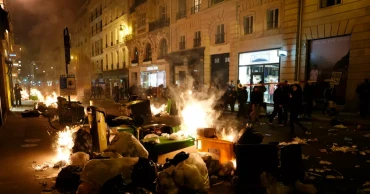
Anger spreads in France over Macron's retirement bill push
Protesters disrupted traffic in Paris on Friday as angry critics, political opponents and labor unions around France blasted President Emmanuel Macron's decision to force a bill raising the retirement age from 62 to 64 through parliament without a vote.
Opposition parties were expected to start procedures later Friday for a no-confidence vote on the government led by Prime Minister Elisabeth Borne. The vote would likely take place early next week.
Macron ordered Borne on Thursday to wield a special constitutional power to push the highly unpopular pension bill through without a vote in the National Assembly, France's lower house of parliament.
Also Read: France’s Macron risks his government to raise retirement age
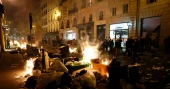
His calculated risk infuriated opposition lawmakers, many citizens and unions. Thousands gathered in protest Thursday at the Place de la Concorde, which faces the National Assembly building. As night fell, police officers charged the demonstrators in waves to clear the Place. Small groups then moved through nearby streets in the chic Champs-Elysees. neighborhood setting street fires.
Similar scenes repeated themselves in numerous other cities, from Rennes and Nantes in eastern France to Lyon and the southern port city of Marseille, where shop windows and bank fronts were smashed, according to French media.
French Interior Minister Gérald Darmanin told radio station RTL on Friday that 310 people were arrested overnight. Most of the arrests, 258, were made in Paris, according to Darmanin.
The trade unions that had organized strikes and marches against a higher retirement age said more rallies and protest marches would take place in the days ahead. “This retirement reform is brutal, unjust, unjustified for the world of workers,” they declared.
Macron has made the proposed pension changes the key priority of his second term, arguing that reform is needed to keep the pension system from diving into deficit as France, like many richer nations, faces lower birth rates and longer life expectancy.
Macron decided to invoke the special power during a Cabinet meeting a few minutes before a scheduled vote in the National Assembly, where the legislation had no guarantee of securing majority support. The Senate adopted the bill earlier Thursday.
Opposition lawmakers demanded the government to step down. If the expected no-confidence motion passes, which requires approval from more than half of the Assembly, it would be a first since 1962 and force the government to resign.
Macron could reappoint Borne if he chooses, and a new Cabinet would be named. If the motion does not succeed, the pension bill would be considered adopted.
3 years ago

France’s Macron risks his government to raise retirement age
French President Emmanuel Macron ordered his prime minister to wield a special constitutional power Thursday that skirts parliament to force through a highly unpopular bill raising the retirement age from 62 to 64 without a vote.
His calculated risk set off a clamor among lawmakers, who began singing the national anthem even before Prime Minister Elisabeth Borne arrived in the lower chamber. She spoke forcefully over their shouts, acknowledging that Macron's unilateral move will trigger quick motions of no-confidence in his government.
The fury of opposition lawmakers echoed the anger of citizens and workers' unions. Thousands gathered at the Place de la Concorde facing the National Assembly, lighting a bonfire. As night fell, police charged the demonstrators in waves to clear the elegant Place. Small groups of those chased away moved through nearby streets in the chic neighborhood setting street fires. At least 120 were detained, police said.
Similar scenes repeated themselves in numerous other cities, from Rennes and Nantes in the east to Lyon and the southern port city of Marseille, where shop windows and bank fronts were smashed, according to French media. Radical leftist groups were blamed for at least some of the destruction.
Also Read: France’s development agency signs deal with Bangladesh to support energy efficiency scheme
The unions that have organized strikes and marches since January, leaving Paris reeking in piles of garbage, announced new rallies and protest marches in the days ahead. “This retirement reform is brutal, unjust, unjustified for the world of workers,” they declared.
Macron has made the proposed pension changes the key priority of his second term, arguing that reform is needed to keep the pension system from diving into deficit as France, like many richer nations, faces lower birth rates and longer life expectancy.
Macron decided to invoke the special power during a Cabinet meeting at the Elysee presidential palace, just a few minutes before the scheduled vote in France’s lower house of parliament, because he had no guarantee of a majority.
“Today, uncertainty looms" about whether a majority would have voted for the bill, Borne acknowledged, but she said “We cannot gamble on the future of our pensions. That reform is necessary.”
Borne prompted boos from the opposition when she said her government is accountable to the parliament. Lawmakers can try to revoke the changes through no-confidence motions, she said.
“There will actually be a proper vote and therefore the parliamentary democracy will have the last say,” Borne said.
She said in an interview Thursday night on the TV station TF1 that she was not angry when addressing disrespectful lawmakers but “very shocked.”
“Certain (opposition lawmakers) want chaos, at the Assembly and in the streets,” she said.
Opposition lawmakers demanded the government step down. One Communist lawmaker called the presidential power a political “guillotine.” Others called it a “denial of democracy” that signals Macron’s lack of legitimacy.
Marine Le Pen said her far-right National Rally party would file a no-confidence motion, and Communist lawmaker Fabien Roussel said such a motion is “ready” on the left.
“The mobilization will continue,” Roussel said. “This reform must be suspended.”
The leader of The Republicans, Eric Ciotti, said his party won’t “add chaos to chaos” by supporting a no-confidence motion, but some of his fellow conservatives at odds with the party’s leadership could vote individually.
A no-confidence motion, expected early next week, needs approval by more than half the Assembly. If it passes — which would be a first since 1962 — the government would have to resign. Macron could reappoint Borne if he chooses, and a new Cabinet would be named.
If no-confidence motions don't succeed, the pension bill would be considered adopted.
The Senate adopted the bill earlier Thursday in a 193-114 vote, a tally largely expected since the conservative majority of the upper house favored the changes.
Raising the retirement age will make workers put more money into the system, which the government says is on course to run a deficit. Macron has promoted the pension changes as central to his vision for making the French economy more competitive. The reform also would require 43 years of work to earn a full pension.
Leftist leader Jean-Luc Melenchon told the crowd at the Concorde that Macron has gone “over the heads of the will of the people.” Members of Melenchon’s France Unbowed party were foremost among the lawmakers singing the Marseillese in an attempt to thwart the prime minister.
Economic challenges have prompted widespread unrest across Western Europe, where many countries, like France, have had low birthrates, leaving fewer young workers to sustain pensions for retirees. Spain’s leftist government joined with labor unions Wednesday to announce a “historic” deal to save its pension system.
Spain's Social Security Minister José Luis Escrivá said the French have a very different, unsustainable model and “has not addressed its pension system for decades." Spain's workers already must stay on the job until at least 65 and won’t be asked to work longer — instead, their new deal increases employer contributions for higher-wage earners.
3 years ago

Pentagon video shows Russian jet dumping fuel on US drone
The Biden administration released video Thursday of a Russian fighter jet dumping fuel on a U.S. Air Force surveillance drone as the U.S. sought to hold Russia responsible for the collision that led to the drone's crash into the Black Sea without escalating already fraught tensions with the Kremlin.
Poland, meanwhile, said it's giving Ukraine a dozen MiG-29 fighter jets, becoming the first NATO member to fulfill Kyiv's increasingly urgent requests for warplanes.
The U.S. military's declassified 42-second color footage shows a Russian Su-27 approaching the back of the MQ-9 Reaper drone and releasing fuel as it passes, the Pentagon said. Dumping the fuel appeared to be aimed at blinding the drone's optical instruments to drive it from the area.
On a second approach, either the same jet or another Russian Su-27 that had been shadowing the MQ-9 struck the drone's propeller, damaging a blade, according to the U.S. military, which said it then ditched the aircraft in the sea.
The video excerpt does not show the collision, although it does show the damage to the propeller.
Russia said its fighters didn't strike the drone and claimed the unmanned aerial vehicle went down after making a sharp maneuver.
While calling out Russia for "reckless" action, the White House tried to strike a balance to avoid exacerbating tensions. U.S. officials said they have not been able to determine whether the Russian pilot intentionally struck the American drone and stressed that lines of communication with Moscow remain open.
"I can't point to that video and say this is a deliberate attempt to escalate or ... tangibly bring about Putin's false claim that this is about the West versus Russia.," White House National Security Council spokesman John Kirby said. "We have made clear on many occasions, we do not seek a conflict with Russia."
Russian President Vladimir Putin argues that by providing weapons to Ukraine and sharing intelligence information with Kyiv, the U.S. and its allies have effectively become engaged in the war, now in its 13th month.
Nikolai Patrushev, the secretary of Russia's Security Council, said Wednesday that an attempt would be made to recover the drone debris.
U.S. officials have expressed confidence that nothing of military value would remain from the drone even if Russia retrieved the wreckage. They left open the possibility of trying to recover portions of the downed $32 million aircraft, which they said crashed into waters that were 4,000 to 5,000 feet (1,200 to 1,500 meters) deep, although the U.S. does not have any ships in the area.
Russia and NATO member countries routinely intercept each other's warplanes, but Tuesday's incident marked the first time since the Cold War that a U.S. aircraft went down during such a confrontation, raising concerns it could bring the United States and Russia closer to a direct conflict.
Moscow has repeatedly voiced concern about U.S. intelligence flights near the Crimean Peninsula, which Russia seized from Ukraine in 2014 and illegally annexed.
The top U.S. and Russian defense and military leaders spoke Wednesday about the destruction of the drone, underscoring the event's seriousness.
The calls between U.S. Defense Secretary Lloyd Austin and Russian Defense Minister Sergei Shoigu, as well as between Joint Chiefs of Staff Chairman Gen. Mark Milley and Gen. Valery Gerasimov, chief of Russian General Staff, were the first since October.
The Russian Defense Ministry said in its report of the call with Austin that Shoigu accused the U.S. of provoking the incident by ignoring flight restrictions the Kremlin had imposed because of its military operations in Ukraine. The U.S. said the drone was operating in international airspace.
The MQ-9, which has a 66-foot (20-meter) wingspan, includes a ground control station and satellite equipment. It is capable of carrying munitions, but Air Force Brig. Gen. Pat Ryder, a Pentagon spokesperson, would not say whether the ditched drone had been armed.
The video's release is the latest example of the Biden administration making public intelligence findings over the course of the war. The administration has said it wants to highlight Russian malicious activity as well as plans for Russian misinformation operations so allies remain clear-eyed about Moscow's intent.
The White House deferred to Austin on the decision to release it, with the Pentagon and President Joe Biden's national security aides agreeing it was important to let the world see what happened, according to an administration official familiar with the decision-making process. The official, who requested anonymity to discuss the deliberations, said it took time to go through the declassification process and insisted the administration was not concerned it would further escalate tensions with Russia.
Because the video does not show the actual collision, some involved in the decision to release the footage wondered whether the Russians would seize on that as proof there was no contact between the jet and the drone, according to another official familiar with the discussions about making it public. Those concerns were overcome when the Pentagon explained that the video showed the immediate aftermath and damage to the drone's propeller, which could have come only from a collision, according to the second official, who spoke on condition of anonymity in order to disclose the details.
Separately, Polish President Andrzej Duda said Warsaw would give Ukraine four Soviet-made MiG-29s "within the next few days" and that the rest needed servicing and would be supplied later. The Polish word he used to describe the total number of warplanes can mean between 11 and 19.
"They are in the last years of their functioning but they are in good working condition," Duda added. He did not say whether other countries would follow suit, although Slovakia has said it would send Ukraine its disused MiGs.
While Ukrainian President Volodymyr Zelenskyy has pleaded for fighter jets from the West, some NATO members — including the U.S. — have expressed hesitancy.
The White House said Poland gave the U.S. advanced notice of its decision to provide the MiGs.
Kirby, the White House spokesman, called Poland's providing the fighter jets a sovereign decision and cheered the Poles for continuing to "punch above their weight" in assisting Kyiv, but insisted that Duda's decision would have no bearing on the U.S. president's decision, thus far, not to provide American-made F-16s.
Before Russia's full-scale invasion in February 2022, Ukraine had several dozen MiG-29s it inherited in the 1991 demise of the Soviet Union, but it's unclear how many remain in service.
Duda said Poland's air force would replace the planes it gives to Ukraine with South Korean-made FA-50 fighters and American-made F-35s.
A crucial ally of Kyiv, Poland hosts thousands of U.S. troops and is taking in more people fleeing the war in the neighboring country than any other nation. It has suffered invasions and occupations by Russia for centuries and still fears Russia despite being a member of NATO.
Authorities in Warsaw also said the security services have detained members of a Russian espionage ring, alleging they were preparing acts of sabotage in Poland and had been monitoring railroad routes used to transport weapons into Ukraine.
3 years ago

Poland to be 1st NATO member to give Ukraine fighter jets
Poland said Thursday it plans to give Ukraine about a dozen MiG-29 fighter jets, which would make it the first NATO member to fulfill Kyiv's increasingly urgent requests for warplanes to defend itself against the Russian invasion.
Warsaw will hand over four of the Soviet-made warplanes "within the next few days," President Andrzej Duda said, and the rest needed servicing but would be supplied later. The Polish word he used to describe the total number can mean between 11 and 19.
"They are in the last years of their functioning, but they are in good working condition," Duda said.
He did not say whether other countries would follow suit, although Slovakia has said it would send its own disused MiGs to Ukraine. Poland also was the first NATO nation to provide Ukraine with German-made Leopard 2 tanks.
On Wednesday, Polish government spokesman Piotr Mueller said some other countries also had pledged MiGs to Kyiv, but did not identify them. Both Poland and Slovakia had indicated they were ready to hand over their planes, but only as part of a wider international coalition doing the same.
The government in neighboring NATO member Germany appeared caught off guard by Duda's announcement.
"So far, everyone has agreed that it's not the time to send fighter jets," German Defense Minister Boris Pistorius told reporters. "I don't have any confirmation from Poland yet that this has happened."
The White House called Poland's move a sovereign decision and lauded the Poles for continuing to "punch above their weight" in assisting Kyiv, but it stressed the move would have no bearing on President Joe Biden, who has resisted calls to provide U.S. F-16s to Ukraine.
"There's no change in our view with respect to fighter aircraft at this time," White House National Security Council spokesman John Kirby said. "That is our sovereign decision. That is where we are, other nations can speak to their own" decisions.
The White House said Poland notified the U.S. of its decision to provide MiGs before Duda announced the move.
Before Russia's full-scale invasion in February 2022, Ukraine had several dozen MiG-29s it inherited in the 1991 collapse of the Soviet Union, but it's unclear how many remain in service after more than a year of fighting.
The debate over whether to provide non-NATO member Ukraine with fighter jets started last year, but NATO allies expressed concern about escalating the alliance's role in the war. The hesitation continued even as Ukrainian President Volodymyr Zelenskyy made increasingly vocal pleas for Western supporters to share their warplanes.
Duda made the announcement during a joint news conference in Warsaw with the visiting Czech President Petr Pavel.
Duda said Poland's air force would replace the planes it gives to Ukraine with South Korea-made FA-50 fighters and American-made F-35s.
Poland has provided Ukraine with crucial support during the war. It is hosting thousands of American troops and has taken in more Ukrainians than any other nation during the refugee exodus sparked by the Russian invasion.
The central European nation experienced Russian invasions and occupations for centuries and still fears Russia despite being a NATO member.
3 years ago
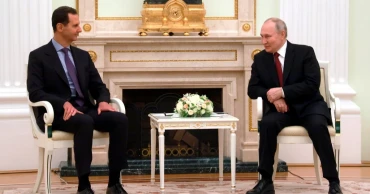
Putin, Assad discuss rebuilding Syria, regional issues
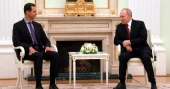
Russian President Vladimir Putin hosted Syrian leader Bashar Assad in the Kremlin on Wednesday for talks that focused on rebuilding Syria after a devastating civil war and efforts to stabilize the region.
Welcoming Assad at the start of the meeting, which took place on the anniversary of Syria's 12-year uprising-turned-civil war, Putin emphasized the Russian military's "decisive contribution" to stabilizing the country.
Russia has waged a military campaign in Syria since September 2015, teaming up with Iran to allow Assad's government to fight armed opposition groups and reclaim control over most of the country. While Russia now concentrates the bulk of its military resources in Ukraine, Moscow has maintained its military foothold in Syria and kept warplanes and troops at its bases there.
Assad thanked Putin for backing Syria's sovereignty and territorial integrity, noting that the Kremlin's support has remained strong despite the fighting in Ukraine.
"Even though Russia now is also conducting the special operation, its position has remained unchanged," Assad said, using the Kremlin's "special military operation" term for the Russian action in Ukraine and voicing support for Moscow's effort.
The two rounds of talks between the leaders, the first one involving senior officials from both countries and then a one-on-one encounter over lunch, lasted for more than three hours. The Russian and Syrian defense ministers also met separately to discuss military cooperation.
Assad's office said on Twitter that the two leaders discussed "joint cooperation in various forms and developments on the regional and international arenas." It noted that Assad "renewed Syria's position in support of Russia's right to defend its national security."
Moscow has provided robust political support to Assad at the United Nations and actively mediated to help repair his government's ties with regional powers.
Some Arab countries that had called in the past for the downfall of Assad have sent aid following the catastrophic Feb. 6 earthquake that hit Turkey and Syria killing more than 50,000 including over 6,000 in Syria.
International sympathy following the quake appeared to have sped up the regional rapprochement, with some calling for dialogue with Syria and for bringing the country back to the 22-member Arab League more than a decade after its membership was suspended over the crackdown in the early months of the uprising that turned into war.
As part of the ongoing rapprochement, the foreign ministers of Egypt and Jordan recently made their first visit to Damascus since the conflict began in March 2011 and met with Assad.
On Wednesday, Assad also thanked Putin for sending rescue teams and engaging its military based in Syria to conduct salvage efforts and help deal with the quake's aftermath.
Prior to the earthquake, Russia had been mediating talks between Turkey and Syria.
Turkey has backed armed opposition groups in Syria that have sought to overturn Assad's government during the civil war, which has killed nearly 500,000 people and displaced half of the country's prewar population. Syria has demanded that Turkey withdraws from an enclave it controls in northwestern Syria in order for Damascus to normalize its relations with Ankara.
In December, Moscow hosted surprise talks between the Syrian and Turkish defense ministers. Arab media reported that one of the main topics that Assad will discuss with Putin during their meeting on Wednesday is reconciliation between Syria and Turkey.
Asked before Putin's talks with Assad if they could play a role in restoring Syria's ties with Turkey, Kremlin spokesman Dmitry Peskov responded that "the issue of the Syrian-Turkish relations will undoubtedly be part of the talks' agenda."
Even though Turkey has backed Syrian opposition fighters in the north, Ankara and Damascus share dismay over the U.S.-backed Kurdish-led Syrian Democratic Forces in Syria's northeast. Turkey-backed opposition fighters have clashed with the SDF in the past, accusing them of being an arm of Turkey's outlawed Kurdistan Workers' Party, or PKK. The PKK has for decades waged an insurgency within Turkey against the government in Ankara.
Assad's government has cast the SDF as a secessionist force that has been pilfering the country's wealth while controlling Syria's major oil fields.
Assad's office said in a statement after the talks that Putin and Assad talked about "regional initiatives supported by Moscow." It said Assad emphasized that Syria supports dialogue "if it leads to achieving the interests of the Syrian people and the unity and integrity of the Syrian territory and leads to clear results, the first of which is the continuation of the fight against terrorism and the exit of illegal foreign forces present on its territory." The statement didn't elaborate.
The Syrian, Turkish and Russian deputy foreign ministers and a senior Iranian envoy were expected to hold talks Wednesday and Thursday in Moscow to discuss "counterterrorism efforts" in Syria, although Syria's Deputy Foreign Minister Ayman Sousan was quoted by pro-government media as saying that the meeting "is still under discussion."
3 years ago

US, Russian military chiefs resume contact to discuss drone
Defense Secretary Lloyd Austin spoke to his Russian counterpart on Wednesday about the destruction of a U.S. drone over the Black Sea after an encounter with Russian fighter jets, which brought the two countries closest to direct conflict since Moscow's invasion of Ukraine a year ago.
It was the first call between Austin and Defense Minister Sergei Shoigu since October. And Gen. Mark Milley, chairman of the Joint Chiefs of Staff, had a similar call with his Russian counterpart, Gen. Valery Gerasimov, the chief of the General Staff of the Russian armed forces.
"We take any potential for escalation very seriously. And that's why I believe it's important to keep the lines of communication open," Austin said at a Pentagon press briefing. "I think it's really key that we're able to pick up the phone and engage each other. And I think that that will help to prevent miscalculation going forward."
The U.S. military said it ditched the Air Force MQ-9 Reaper in the sea after a Russian fighter jet poured fuel on the surveillance drone and then struck its propeller while it was flying in international airspace. Russia has denied that it caused the accident. The U.S. has said it was working on declassifying surveillance footage from the drone that would show Tuesday's crash.
That the top U.S. and Russian defense and military leaders were talking so soon after the incident underscored the seriousness of the encounter over the Black Sea and that both sides recognized the need to tamp down the risks of escalation. Since Russia's invasion of Ukraine, contact between U.S. and Russian military leaders has been limited, with Russian officials refusing to take U.S. military calls in the early months of the war.
There are still questions as to whether Russia meant to down the drone, even though the moments that led up to its crash were "intentional," said Milley, who stood alongside Austin at the briefing.
"We know that the intercept was intentional. We know that the aggressive behavior was intentional," Milley said.
However, he told reporters that it was still unclear whether the collision itself was intentional. And he pushed back against Russia's contention that the fighter jets did not come in contact with the drone.
"We have absolute evidence of the contact," Milley said. "It's very aggressive. ... We have video evidence and all that."
Milley and Austin also left open the possibility that the U.S. could try to recover portions of the downed $32 million drone, which Milley said crashed into waters that were 4,000 to 5,000 feet (1,200 to 1,500 meters) deep.
Other U.S. officials said the U.S. doesn't have military ships in the region, and won't likely seek to recover wreckage. The Black Sea has been closed since early 2022 to military vessels that do not have a home port along its shores.
The officials, who spoke on the condition of anonymity to provide details not yet made public, said Russia has already sent ships to the area and attempted to recover pieces of the drone.
Milley downplayed the significance of any potential recovery by Russia.
"It probably broke up. There's probably not a lot to recover," he said. "As far as the loss of anything of sensitive intelligence, etc. ... we would take — and we did take — mitigating measures. So we're quite confident that whatever was of value is no longer of value."
U.S. officials have refused to detail what steps were taken to protect sensitive technology on the drone or the video it collected during its surveillance mission. But officials have long acknowledged that the U.S. can remotely remove sensitive information from high-tech drones and make systems inoperable so they aren't of much value.
Milley and Austin also said the incident would not stop the U.S. from flying wherever international law allows.
Details of Milley's call with Gerasimov would be kept private, Joint Staff spokesman Army Col. Dave Butler said in a statement. Gerasimov was named the new commander of the Russian forces in Ukraine in January and its previous commander demoted in an apparent sign of Russian President Vladimir Putin's dissatisfaction with the state of the war, which has been stalemated.
If the call between Austin and Shoigu was de-escalatory in private, it was not apparent from Russia's public statements.
Russian Foreign Minister Sergey Lavrov told reporters earlier Wednesday that Russia has declared certain areas of the Black Sea off-limits to any aerial traffic during the conflict and suggested the U.S. was trying to provoke an escalation through the flights. The drone crashed near Ukraine's Crimean Peninsula, which Russia seized in 2014 and illegally annexed.
"Any incidents that could provoke confrontation between the two great powers, the two largest nuclear powers, raise very serious risks," Lavrov said.
The Russian Defense Ministry said Shoigu, in the call with Austin, noted that the flights of U.S. drones near Crimea were "provocative" and risked escalating tensions in the Black Sea. He said Russia would respond "in kind to all provocations" in the future, but also noted that the two nuclear powers must act responsibly and maintain channels of communication.
Asked about the call, Austin declined to provide any details.
Austin and Shoigu first spoke about Russia's invasion of Ukraine in May 2022. At the time it was the highest level U.S.-Russian contact of the war.
In October, they spoke twice in three days as the threat of an escalation was high. Shoigu had accused Ukraine of planning to use a dirty bomb, a claim that was strongly rejected by U.S. and Western allies, who accused Russia of seeking a false pretext to justify further escalation, potentially including the use of a tactical nuclear weapon.
3 years ago