europe

UK says Falklands are British as Argentina seeks new talks
Britain has reasserted its sovereignty over the Falkland Islands after Argentina pulled out of a cooperation agreement and demanded new talks over the South Atlantic territory that sparked a 1982 war between the two countries.
The pronouncement came after Argentine Foreign Minister Santiago Cafiero said on Twitter that he informed British Foreign Secretary James Cleverly about his country’s decision when the pair met on the margins of the Group of 20 summit in India last week.
“The Falkland Islands are British,” Cleverly tweeted late Friday. “Islanders have the right to decide their own future — they have chosen to remain a self-governing U.K. Overseas Territory.’’
Earlier, Cafiero said he told Cleverly that Argentina had decided to pull out of a 2016 agreement in which the the two countries pledged to work together on a variety of issues. While that agreement sought to improve cooperation in the South Atlantic, both sides continued to assert their claims to sovereignty over the Falkland Islands, known as Islas Malvinas in Argentina.
Cafiero also said he proposed new talks in line with a 1965 U.N. General Assembly resolution that encouraged Britain and Argentina to find a peaceful solution to the dispute over the islands.
Argentina has long claimed sovereignty over the islands, which are about 300 miles (480 kilometers) from South America and home to some 3,500 people.
Also Read: Here’s why it’s so hard to buy vegetables in the UK
Argentina argues that the islands were illegally taken from it in 1833. Britain, which says its territorial claim dates to 1765, sent a warship to the islands in 1833 to expel Argentine forces who had sought to establish sovereignty over the territory.
Argentina invaded the islands in 1982, triggering a two-month war that claimed the lives of 255 British service members, three islanders and 649 Argentine personnel. The Argentine forces were ultimately expelled and Britain reasserted its control.
Residents in 2013 voted overwhelmingly in favor of remaining an overseas territory of the United Kingdom.
David Rutley, Britain’s minister for the Americas, expressed disappointment in Argentina’s decision.
“Argentina has chosen to step away from an agreement that has brought comfort to the families of those who died in the 1982 conflict,’’ Rutley, who recently visited Buenos Aires, said on Twitter. “Argentina, the U.K. and the Falklands all benefited from this agreement.’’
3 years ago

Civilians flee embattled town as Ukrainian pullout looms
Pressure from Russian forces mounted Saturday on Ukrainians hunkered down in Bakhmut, as residents attempted to flee with help from troops who Western analysts say may be preparing to withdraw from the key eastern stronghold.
A woman was killed and two men were badly wounded by shelling while trying to cross a makeshift bridge out of the city in Donetsk province, according to Ukrainian troops who were assisting them.
A Ukrainian army representative who asked not to be named for operational reasons told The Associated Press that it was now too dangerous for civilians to leave Bakhmut by vehicle and that people had to flee on foot instead.
Bakhmut has for months been a prime target of Moscow’s grinding eastern offensive in the war, with Russian troops, including forces from the private Wagner Group, inching ever closer.
An AP team near Bakhmut on Saturday saw a pontoon bridge set up by Ukrainian soldiers to help the few remaining residents reach the nearby village of Khromove. Later they saw at least five houses on fire as a result of attacks in Khromove.
Also Read: A year into Ukraine war, bodies dug up in once occupied town
Ukrainian units over the past 36 hours destroyed two key bridges just outside Bakhmut, including one linking it to the nearby town of Chasiv Yar along the last remaining Ukrainian resupply route, according to U.K. military intelligence officials and other Western analysts.
The U.K. defense ministry said in the latest of its regular Twitter updates that the destruction of the bridges came as Russian fighters made further inroads into Bakhmut’s northern suburbs.
The Institute for the Study of War, a Washington-based think tank, assessed late on Friday that Kyiv's actions may point to a looming pullout from parts of the city. It said Ukrainian troops may “conduct a limited and controlled withdrawal from particularly difficult sections of eastern Bakhmut,” while seeking to inhibit Russian movement there and limit exit routes to the west.
Capturing Bakhmut would not only give Russian fighters a rare battlefield gain after months of setbacks, but it might rupture Ukraine’s supply lines and allow the Kremlin’s forces to press toward other Ukrainian strongholds in the Donetsk region.
Civilians spoke about daily struggles as the fighting raged on nearly nonstop, reducing much of Bakhmut to rubble. Husband and wife Hennadiy Mazepa and Natalia Ishkova, who chose to remain in the city, said they lack food and basic utilities.
“Humanitarian (aid) is given to us only once a month. There is no electricity, no water, no gas," Ishkova told AP on Saturday.
“I pray to God that all who remain here will survive,” she added.
At the United Nations on Friday, deputy spokesman Farhan Haq said U.N. humanitarian staff reported “intensive hostilities” near Bakhmut and the few humanitarian partners on the ground were focusing on evacuating the most vulnerable.
Also Saturday, Russia’s defense chief traveled to eastern Ukraine to inspect troops and award them with state decorations, the Defense Ministry said.
Defense Minister Sergei Shoigu visited a command post where he was briefed by regional commander Rustam Muradov, according to a video published by the ministry. It did not disclose the command post's location.
Elsewhere, Ukraine’s emergency services reported in the morning that the death toll from a Russian missile strike that hit a five-story apartment building in southern Ukraine on Thursday rose to 11.
Emergency services said in an online statement that rescuers pulled three more bodies from the wreckage overnight, some 36 hours after a Russian missile tore through four floors of the building in the riverside city of Zaporizhzhia. A child was among those reported killed, and the rescue effort was ongoing.
Russian shelling on Saturday also killed two residents of front-line communities in the surrounding Zaporizhzhia region, the local military administration reported.
A 57-year-old woman and a 68-year-old man also died in Nikopol, a town farther west near the Zaporizhzhia nuclear power plant, as Russian forces fired artillery shells and rockets at Ukrainian-held territory across the Dnieper river, regional Gov. Serhiy Lysak reported.
In the western city of Lviv, hundreds of kilometers from the front lines, Ukrainian President Volodymyr Zelenskyy met Saturday with the head of the European Union parliament. Hours earlier, Zelenskyy held talks with U.S. Attorney General Merrick Garland and top European legal officials on how to hold Russia accountable for its actions in Ukraine.
In a joint press briefing with Zelenskyy, European Parliament President Roberta Metsola said that “all those responsible” for suspected Russian war crimes in Ukraine, including Russian President Vladimir Putin, must be brought to justice before a durable peace is achieved.
Metsola voiced support for the EU’s announcement Thursday that an international center for the prosecution of the crime of aggression — the act of invading another country — would be set up in The Hague.
She also called for Ukraine to start negotiations on joining the 27-nation bloc as early as this year and urged Western nations to keep arming Kyiv as it battles Russian forces in the east and south.
The EU agreed in June to put Ukraine on a path toward membership, setting in motion a process that could take years or even decades. However, Moscow’s invasion and Ukraine’s request for fast-track consideration have lent urgency to the negotiations.
“Ukraine’s future is in the European Union. We will walk all the way with you,” Metsola said on Twitter late Friday.
3 years ago

Station master in Greece train crash delays court appearance
The station master involved in Greece’s deadliest train crash is set to appear before a prosecutor and an examining magistrate Sunday after his deposition was postponed Saturday.
The 59-year-old is accused of placing two trains running in opposite directions on the same track. At least 57 people died when a passenger train slammed into a freight carrier late Tuesday at Tempe, 380 kilometers (235 miles) north of Athens.
The government has blamed human error, and the station master faces multiple charges of negligent homicide and bodily harm, as well as disrupting transportation. Days of protests against the perceived lack of safety measures in Greece’s rail network have taken place in the wake of the disaster.
Stephanos Pantzartzidis, the station master’s lawyer, told reporters waiting outside the courthouse Saturday in the central Greek city of Larissa that “very important new evidence emerged that force us to request a postponement” in his client's deposition.
Also Read: Bangladeshi killed in Greek train crash
The lawyer didn't elaborate. Per Greek law, authorities have not released the accused station master’s name.
Also Saturday, one of the three members of an expert panel named by the government to investigate and issue a report on the collision resigned after opposition parties and some media outlets panned his appointment.
Thanasis Ziliaskopoulos served as chairman and CEO of the country’s train operator from 2010 to 2015 and is currently the chairman of the Greek agency in charge of privatizing state-owned assets.
Funerals for some of the people killed in the crash, many of them in their teens and 20s, took place in northern Greece. The force of the crash and a resulting fire complicated the task of identifying the victims, which is being done through next-of-kin DNA testing.
Some families have yet to receive the remains of their loved ones. Police said 54 victims have been positively identified.
Also Read: Death toll from Greece train crash rises to 57
Rallies protesting the conditions that led to the tragedy continued Saturday. A peaceful rally in central Athens organized by the Communist Party’s youth wing drew over a thousand people.
A rally organized by a rail workers' union is scheduled for Sunday morning, also in Athens. The union, which is organizing rolling labor strikes, has asked members of the public to take part.
Greek media have published damning accounts of mismanagement and infrastructure neglect in Greece’s railways.
A former head of the railway employees’ union, Panayotis Paraskevopoulos, told Greek newspaper Kathimerini that the signaling system in the area where the accident occurred malfunctioned six years ago and was never repaired.
Station masters and train drivers communicate via two-way radio and track switches are operated manually over parts of the main rail line from the capital Athens to the northern city of Thessaloniki.
The station master, who formerly worked as a porter at the state-owned Hellenic Railways, or OSE, was transferred to a desk job at the Ministry of Education in 2011, when Greece’s creditors demanded personnel cuts in railways.
He transferred back to the company in June 2022 and was appointed station master in Larissa, an important railway hub, in January, after five months’ training.
Police early Friday searched a rail coordination office in Larissa, removing evidence as part of an ongoing investigation.
The since privatized train and freight operator, renamed Hellenic Train, is now owned by Italy’s Ferrovie dello Stato Italiane.
3 years ago
A year into Ukraine war, bodies dug up in once occupied town
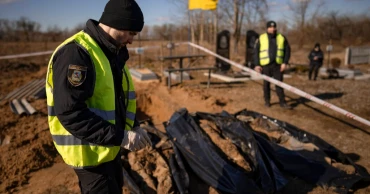
The freshly exhumed remains of three men lie in black body bags on the edge of the small cemetery in a town not far from Ukraine's capital, waiting to be taken to a morgue. None has yet been identified.
Ukrainian authorities are still unearthing people who were hastily buried in makeshift graves during Russia's brief but brutal occupation of villages and towns near Kyiv. Almost 200 bodies remain unidentified, while 280 people are listed as missing.
Oleksander Pinchuk’s mother, Halyna, is among them. They never found her body in the wreckage of her apartment building, which took a direct hit from an airstrike a year ago. Pinchuk had walked out of the building just eight hours earlier, and has not seen his mother since, he said.
On Thursday, Pinchuk stood in the winter chill, grim-faced among a small group of mourners who gathered for a religious service to commemorate the anniversary of the strike in the town of Borodyanka.
“Just look at what the Russians brought to us and what they did to our beautiful town,” said Dmytro Koshka, the priest conducting the service at the former site of the residential building. “How could we ever forget and forgive?”
Nothing remains of the structure except the outline of where it once stood. Behind it is another apartment building, blackened and empty but still standing.
Pinchuk said rescue crews only managed to get to the building last April, after Ukrainian forces retook control of Borodyanka. The crews dug through the rubble for about two weeks and located the remains of 15 people. But they found no trace of dozens more believed to have been inside the 108-apartment building.
Also Read: Kremlin accuses Ukrainian saboteurs of attack inside Russia
“We still have hope for at least some of them, but the rest, they just burned alive,” Pinchuk said, his gaze fixed, the pain of loss visible in his eyes.
Without a body to mourn over and bury, the 43-year-old hopes against hope that his mother is still alive. He heard rumors that Russian troops took more than 100 people from Borodyanka to Belarus. Perhaps she was among them.
“Until the last moment, I will think of her as alive,” he said.
The exhumation of the three bodies Thursday from two makeshift graves on the edge of Borodyanka’s cemetery meant that some families may have a chance to learn what became of their loved ones.
A passer-by found the three in early March 2022, when Russia forces still occupied the town, and he buried the bodies with the help of another man, according to Andrii Nebytov, the head of the Kyiv region's police department.
The passer-by then fled the region. He only just recently returned and told authorities about the burials, the police chief said.
One of the dead is believed to be a 50-year-old local man who was shot and partially burned in his car, but DNA tests are needed to confirm that. Nobody knows who the other two are.
There’s not much to go on to identify them. A green pencil is all that was found on one, packets of cigarettes and key fobs on another. The remains are so decomposed that identification and determining exactly how they died will require forensic tests.
The exhumations bring the number of civilian bodies found in previously Russian-occupied areas of the Kyiv region to 1,373, Nebytov said. Of that number, 197 have yet to be identified.
3 years ago

Kremlin accuses Ukrainian saboteurs of attack inside Russia
The Kremlin on Thursday accused Ukrainian saboteurs of crossing into western Russia and firing on villagers. Ukraine denied the claim and warned that Moscow could use the allegations to justify stepping up its own attacks in the ongoing war.
The exact circumstances of the reported attack in the Bryansk region were unclear, as was the strategic purpose of such an assault. The regional governor said two civilians were killed.
If confirmed, it would be another indication following drone attacks earlier this week that Kyiv may be intensifying pressure against Moscow by exposing Russian defensive weaknesses, embarrassing the Kremlin and sowing unease among Russian civilians.
Russian President Vladimir Putin blamed Ukrainian “terrorists” for the incursion, claiming that they deliberately targeted civilians, including children in “yet another terror attack, another crime.”
“They infiltrated the area near the border and opened fire on civilians,” Putin said during a video call. “They saw a civilian vehicle with civilians, with children in it, and they fired on them.”
The alleged incursion came just days after Putin ordered the Federal Security Service to tighten controls on Russia’s border with Ukraine.
While Russian war hawks have expressed dismay with what they see as Putin’s reluctance to declare martial law and launch a sweeping mobilization of soldiers, the Russian leader’s comments Thursday did not appear to signal any such moves.
Putin blamed the attack on “neo-Nazis” and said it confirmed that Russia did the right thing by invading Ukraine. “I repeat again: They will not succeed, and we will finish pushing them out,” he said.
When he ordered the invasion, the Russian leader vowed to “denazify” Ukraine, alleging falsely that radical neo-Nazi groups dominate the country led by a Jewish president. Kyiv and its Western allies dismissed his assertion as a bogus cover for an unprovoked act of aggression.
Ukraine’s military intelligence representative, Andrii Cherniak, saw the Russian claims as evidence that Moscow is facing an uprising among its own disgruntled people.
“This was done by the Russians; Ukraine has nothing to do with it,” he told The Associated Press.
A group calling itself the Russian Volunteer Corps claimed it crossed the border into Russia in a video that also urged Russians to rebel. The group’s statement did not explain what actions it took or what specific objectives it wanted to achieve.
The Russian Volunteer Corps described itself as “a volunteer formation in the Armed Forces of Ukraine.” Little is known about the group, and it was not immediately clear if it has any ties with the Ukrainian military.
The group was founded in August and consists mostly of anti-Putin far-right Russian extremists who have links with Ukrainian far-right groups, according to Michael Colborne, a researcher for the investigative website Bellingcat.
Colborne said on Twitter that Ukrainian military intelligence “very likely” approved the incursion.
Ukrainian presidential adviser Mykhailo Podolyak described the Russian claims as “a classic deliberate provocation.”
Russia “wants to scare its people to justify the attack on another country (and) the growing poverty after the year of war,” he tweeted, suggesting that Russian partisans were behind what happened in Bryansk.
Bryansk Gov. Alexander Bogomaz said the attackers killed two civilians and wounded a child in the village of Lyubechane.
Russia’s Federal Security Service said it acted together with the military to “eliminate armed Ukrainian nationalists who violated the state border.” The agency claimed later that the attackers had been pushed back into Ukraine “where a massive artillery strike was inflicted on them.” It was not possible to verify the claim.
Putin canceled a planned trip to southern Russia because of the attack. He is set to chair a weekly meeting of the Russian Security Council on Friday.
Asked by reporters whether the activity could warrant a change in the status of the conflict, Kremlin spokesman Dmitry Peskov said, “I can’t say for now.”
The raid in the Bryansk region followed a spate of drone attacks. On Tuesday, drones that the Kremlin said were launched by Ukraine flew deep inside Russian territory, including one that got within 100 kilometers (60 miles) of Moscow. The Russian Defense Ministry also said Wednesday that the military repelled a drone attack on Crimea.
In Ukraine’s southern city of Zaporizhzhia, three people were killed and six others were wounded early Thursday when a Russian missile hit a five-story apartment building, destroying several floors.
A Russian drone attack hit people standing in line for humanitarian aid in a village in southern Ukraine’s Kherson region, wounding nine people, including a 16-year-old, the regional administration said.
Ukrainian President Volodymyr Zelenskyy said Russia “wants to turn every day for our people into a day of terror,” adding that “evil will not reign in our land.”
Russian artillery, drones and missiles have pounded Ukrainian-held areas in the country’s south and east for months. Moscow denies aiming at civilian targets, but its indiscriminate shelling has wrought wide destruction in urban centers.
The war largely slowed to a grinding stalemate during the winter months, although a fierce battle continued for control of Bakhmut, a key eastern stronghold where Ukrainian officials say they might strategically withdraw.
The Ukrainian military’s general staff reported that Russian forces “continue to advance and storm the city,” but Kyiv’s troops repelled some of the attacks. Capturing the city would not only give Russian fighters a rare battlefield gain after months of setbacks, but it might rupture Ukraine’s supply lines and allow the Kremlin’s forces to press toward other Ukrainian strongholds in Donetsk.
In other developments, U.S. Secretary of State Antony Blinken and Russian Foreign Minister Sergey Lavrov talked briefly Thursday at a meeting of top diplomats from the Group of 20 nations. It was the first high-level meeting in months between Russia and the U.S.
A senior U.S. official, who spoke to reporters on condition of anonymity to discuss the private conversation, said Blinken had “disabused” Lavrov of any idea that U.S. support for Ukraine is wavering.
3 years ago

Death toll from Greece train crash rises to 57
The death toll from Tuesday night's train crash in central Greece has increased to 57, authorities said on Thursday.
Forty-eight people remain hospitalized, six of them in intensive care, Greek police spokeswoman Konstantia Dimoglidou told journalists.
A search and rescue operation is expected to conclude on Friday, Greek Fire Service spokesman Vasilios Vathrakogiannis added.
Read more: A look at some of Europe’s train disasters in recent times
An investigation is simultaneously underway to determine the causes of the crash -- how and why passengers train collided head-on with a freight train traveling in opposite directions.
A station master has been arrested and charged with manslaughter by negligence.
The government has declared a three-day national mourning until Friday and promised that problems affecting the operation of railways will be addressed to prevent such tragedies in the future.
3 years ago

Here’s why it’s so hard to buy vegetables in the UK
When European Union chief Ursula von der Leyen visited Britain last week, some joked on social media: Can you please bring us some tomatoes?
People in the U.K. have had to ration salad staples like tomatoes and cucumbers for the past two weeks amid a shortage of fresh vegetables. Shelves of fresh produce in many stores have been bare, and most major supermarkets have imposed limits on how many salad bags or bell peppers customers are allowed to buy.
Officials blame the problem on recent bad weather in Spain and North Africa, saying the shortages could persist for up to a month. But many people were quick to point out that other European countries don’t seem to be suffering the same challenges, leading some to wonder if it was a consequence of Britain’s divorce from the EU.
Britain’s government has rejected the suggestion that Brexit is to blame. But shoppers aren’t happy, and Environment Secretary Therese Coffey’s suggestion that consumers should “cherish” British produce and eat more turnips instead of imported food drew widespread mockery.
Experts say Brexit likely played a part in the food shortage, though a more complex set of factors — including climate change, the U.K.’s overreliance on imports during the winter, soaring energy costs and the competitive pricing strategies at British supermarkets — are more salient explanations.
A look at some of the factors contributing to what one European broadcaster has called Britain’s “vegetable fiasco”:
COLD WEATHER, HIGH ENERGY BILLS
Unusually cold temperatures in Spain and heavy rain and flooding in Morocco — two of the biggest tomato suppliers to the U.K. — have led to poor yields and are cited as the primary cause of the shortage.
In Spain, farmers blame recent freezing temperatures following record heat and dry conditions last year.
In the southern province of Almeria, which grows 40% of Spain’s fresh vegetable exports, the production levels of tomatoes, cucumbers and eggplants fell by over 20% during the first three weeks of February compared with the same period in 2022, according to FEPEX, an organization representing Spanish fruit and vegetable exporters. The group said the situation is improving.
Heat and drought in Europe last year also are affecting vegetable harvests in other countries, including Germany.
Separately, the Netherlands, another major tomato producer, has seen a drop in output because skyrocketing energy bills tied to Russia’s war in Ukraine meant many growers couldn’t justify the cost of turning on the LED lights in their greenhouses this winter.
Vegetable growers in the U.K. have reported that they, too, were forced to leave their greenhouses empty.
Richard Diplock, managing director at the Green House Growers based in southern England, said his energy costs are some six times higher compared with previous winters.
“We made the decision that we couldn’t afford to heat the greenhouses in December and January, and we’ve held back planting until February. Lots of tomato growers are in a similar position,” he said.
BLAMING BREXIT
The shortages in Britain — and contrasting pictures of full vegetable shelves in supermarkets in mainland Europe — led to a degree of Brexit schadenfreude in some EU news outlets.
Experts say extra bureaucracy and costs associated with Brexit have played a part, though they stress it’s not a main factor.
“One hypothesis for fewer exports to the U.K. is that if supply is constrained, why would you go to extra paperwork (to export to Britain)?” said Michael Winter, a professor of agricultural change at the University of Exeter. “If transaction costs are greater for exporting to one country compared to another, that’s going to dictate where you go.”
“Brexit has exaggerated the problem, without a doubt,” Winter added. “But I don’t want to overplay that. It’s more to do with climate change and lack of investment in our industry.”
SUPERMARKET PRICING
Farmers say another factor is how Britain’s biggest supermarkets have sought to stay competitive by keeping prices as low as possible even as food costs have spiked, a major driver of inflation that’s at the highest levels in decades.
In some EU countries, like Germany, there are no empty shelves, but the prices for fresh vegetables have shot up massively. British supermarkets are reluctant to pay more or charge customers so much, Diplock said.
“Being in the U.K., you know every week the price of a cucumber is 75p ($0.90) no matter what time of year it is,” Diplock said. “North African and Spanish producers will see a better return for supplying European supermarkets.”
“WHERE’S THE INVESTMENT?”
Even if energy costs hadn’t risen so much, British growers would not come close to making up for the shortfalls in imported produce, Diplock said.
During the winter, domestic U.K. production only accounts for 5% or less of tomatoes and cucumbers sold in British supermarkets.
The National Farmers’ Union has warned for months that overreliance on imported fresh produce leaves the U.K. vulnerable to unpredictable weather events and other external factors like the war in Ukraine.
Farmers also have complained about the lack of government investment in the sector and funding to help them cope with painfully high energy bills.
The government has spent billions to help consumers and businesses as European natural gas prices soared to record highs on Russia’s curtailed supplies.
“The bigger question is why have we, in this country, neglected horticulture,” Winter said. “This is a bit of a wake-up call.”
3 years ago

A look at some of Europe’s train disasters in recent times
A head-on collision between a passenger train and a freight train in Greece has killed dozens of people and injured scores more. Rail travel in Europe is a common and relatively affordable and convenient way for many Europeans to travel.
It also has a good safety record overall, growing safer in past years. Yet the tragedy in Greece is a reminder of how deadly crashes can be when they happen. Here is a look at some of the most deadly train crashes in recent years.
FUNICULAR FIRE
In November 2000, a cable car on a funicular railway caught fire in a mountain tunnel in Kaprun, Austria, killing 155 people. Those who died were skiers and snowboarders heading to the slopes of the Kitzsteinhorn mountain.
Read more: Rescuers comb wreckage of Greece’s deadliest train crash
HIGH-SPEED TRAIN HITS BRIDGE
In June 1998, a high-speed train traveling at 200 kph (125 mph) collided with a bridge at Eschede, Germany, causing it to collapse, a crash that killed 101 people and injured more than 100. It was Germany’s deadliest postwar rail disaster.
SPANISH COMMUTER TRAIN
In July 2013, a commuter train hurtled off the rails as it came around a bend near the northwestern Spanish city of Santiago de Compostela, killing 80 and injuring 145 others. An investigation showed the train was traveling 179 kph (111 mph) on a stretch with an 80 kph (50 mph) speed limit when it left the tracks and smashed into a wall. The case finally went to trial in October with the driver and a former railway security director accused of professional negligence. A verdict is expected in the coming months.
SPANISH SUBWAY TRAIN
A subway train traveling at excessive speed crashed in an underground tunnel in the eastern city of Valencia in July 2006, killing 43 people and injuring scores more. It took 13 years for a court to find four managers of the city’s subway system guilty of negligent manslaughter for not taking the necessary safety measures needed to prevent the tragedy.
Read more: Fiery Greece train collision kills 32, injures at least 85
TRAIN PLUNGES INTO RAVINE
In January 2006, a failure of the braking system in a train caused it to derail and plunge into a ravine outside the Montenegrin capital, Podgorica. The crash killed 45 people, including five children, and injured a further 184. It was the worst train disaster in Montenegro’s history.
EXPLOSION AT STATION
In 2009, a freight train carrying gas derailed at the Viareggio station, near the Tuscan city of Lucca, and exploded, killing 32 people. Poorly maintained axels of the train were blamed.
HEAD-ON CRASH IN LONDON
The worst rail crash in Britain in the past 30 years happened in October 1999, when a train heading out of London’s Paddington station went through a red light and crashed into an incoming high-speed train, killing 31 people. Around 400 people were injured.
COMMUTER TRAINS CRASH
In July 2016, two Italian commuter trains collided head-on in late morning between towns in the southern region of Puglia, killing 31 people and injuring scores more. An investigation found an error of communication between the stations that each train had departed from.
RUSH HOUR CRASH NEAR BRUSSELS
On Feb. 15, 2010, two commuter trains slammed into one another just outside Brussels during morning rush hour when one ran a red light. In all, 19 people were killed and 171 injured in the nation’s worst train crash. Compounding the tragedy was that a similar red-light crash had happened years before and that promises to add security measures weren’t fully implemented.
3 years ago

Rescuers comb wreckage of Greece’s deadliest train crash
Rescuers searched late into the night Wednesday for survivors amid the mangled, burned-out wrecks of two trains that collided in northern Greece, killing at least 43 people and crumpling carriages into twisted steel knots in the country’s deadliest rail crash.
The impact just before midnight Tuesday threw some passengers into ceilings and out the windows.
“My head hit the roof of the carriage with the jolt,” Stefanos Gogakos, who was in a rear car, told state broadcaster ERT. He said windows shattered, showering riders with glass.
Greek Prime Minister Kyriakos Mitsotakis called the collision of the passenger train and a freight train “a horrific rail accident without precedent in our country,” and pledged a full, independent investigation.
He said it appeared the crash was “mainly due to a tragic human error,” but did not elaborate.
The train from Athens to Thessaloniki was carrying 350 passengers, many of them students returning from raucous Carnival celebrations. While the track is double, both trains were traveling in opposite directions on the same line near the Vale of Tempe, a river valley about 380 kilometers (235 miles) north of Athens.
STATIONMASTER ARRESTED; MINISTER RESIGNS
Authorities arrested the stationmaster at the train’s last stop, in the city of Larissa. They did not release the man’s name or the reason for the arrest, but the stationmaster is responsible for rail traffic on that stretch of the tracks. He was due to appear before a prosecutor Thursday to be formally charged.
Transportation Minister Kostas Karamanlis resigned, saying he was stepping down “as a basic indication of respect for the memory of the people who died so unfairly.”
Karamanlis said he had made “every effort” to improve a railway system that had been “in a state that doesn’t befit the 21st century.”
But, he added, “When something this tragic happens, it’s impossible to continue as if nothing has happened.”
The union representing train workers announced a 24-hour strike for Thursday, while protests by left-wing groups broke out in Athens late Wednesday. Athens metro workers also called a 24-hour strike for Thursday, saying they face similar problems as railway employees.
WRECKAGE MAKES RESCUE EFFORTS DIFFICULT
Emergency workers used cranes and other heavy machinery to move large pieces of the trains, revealing more bodies and dismembered remains. The operation was to continue overnight, with firefighters proceeding painstakingly through the wreckage.
“It’s unlikely there will be survivors, but hope dies last,” rescuer Nikos Zygouris said.
Larissa’s chief coroner, Roubini Leondari, said 43 bodies had been brought to her for examination and would require DNA identification as they were largely disfigured.
“Most (of the bodies) are young people,” she told ERT. “They are in very bad condition.”
Greece’s firefighting service said 57 people remained hospitalized late Wednesday, including six in intensive care. More than 15 others were discharged after receiving treatment.
More than 200 people who were unharmed or suffered minor injuries were taken by bus to Thessaloniki, 130 kilometers (80 miles) to the north. Police took their names as they arrived, in an effort to track anyone who may be missing.
Hellenic Train, which operates all of Greece’s passenger and cargo trains, including those that collided, offered its “heartfelt condolences” to the victims’ families. The company belongs to Italy’s state railways.
Eight rail employees were among the dead, including the two drivers of the freight train and the two drivers of the passenger train, according to Yannis Nitsas, president of the Greek Railroad Workers Union.
The union called the one-day strike to protest what it said was chronic neglect of Greece’s railways by successive governments.
“Unfortunately, our long-standing demands for staff hirings, better training and above all use of modern safety technology always end up in the wastepaper basket,” it said in a statement.
PASSENGERS SAY TRAIN CRASH WAS LIKE AN EXPLOSION
A teenage survivor who did not give his name to reporters said that just before the crash he felt sudden braking and saw sparks — and then there was a sudden stop.
“Our carriage didn’t derail, but the ones in front did and were smashed,” he said, visibly shaken. He used a bag to break the window of his car, the fourth, and escape.
Gogakos said the crash felt like an explosion, and some smoke entered the carriage. He said some passengers escaped through windows but that after a few minutes, crew members were able to open the doors and let people out.
Multiple cars derailed, and at least one burst into flames.
“Temperatures reached 1,300 degrees Celsius (2,372 degrees Fahrenheit), which makes it even more difficult to identify the people who were in it,” fire service spokesperson Vassilis Varthakoyiannis said.
A man who was trying to ascertain the fate of his daughter, who was on the train, said he had a harrowing phone conversation with her before she was cut off.
“She told me, ‘We’re on fire. ... My hair is burning,’” he told ERT, without giving his name.
GREECE GOES FROM CARNIVAL TO MOURNING
Many of the passengers were students returning to Thessaloniki from Carnival, but officials said but no detailed passenger list was available. This year was the first time the festival, which precedes Lent, was celebrated in full since the start of the pandemic in 2020.
The government declared three days of national mourning from Wednesday, while flags flew at half-staff outside all European Commission buildings in Brussels.
Visiting the accident scene, Prime Minister Mitsotakis said the government must help the injured recover and identify the dead.
“I can guarantee one thing: We will find out the causes of this tragedy, and we will do all that’s in our power so that something like this never happens again,” Mitsotakis said.
It was the country’s deadliest rail crash on record. In 1968, 34 people died in a crash in the southern Peloponnese region.
Greek President Katerina Sakellaropoulou broke off an official visit to Moldova to visit the scene, laying flowers beside the wreckage.
Pope Francis offered condolences to the families of the dead in a message sent to the president of the Greek bishops conference by the Vatican’s secretary of state,
Condolences poured in from around the world, including neighboring Turkey, Greece’s historic regional rival. Turkish President Recep Tayyip Erdogan expressed sorrow and wishes for a speedy recovery for those injured, his office said.
Despite the frosty relations between the two NATO members, Greece’s leadership had called Erdogan last month following a massive earthquake that killed tens of thousands in Turkey.
In Athens, several hundred members of left-wing groups marched late Wednesday to protest the train deaths. Minor clashes broke out as some protesters threw stones at the offices of Greece’s rail operator and riot police and set dumpsters on fire. No arrests or injuries were reported.
3 years ago

Finland’s Parliament gives final approval for NATO bid
Finland’s Parliament gave final approval Wednesday to the Nordic country’s bid to join NATO, with lawmakers signing off on membership along with the required legislation.
The 200-seat Eduskunta legislature voted 184-7 to authorize Finland’s accession to NATO, clearing the last required domestic hurdle to becoming part of the 30-member Western military alliance.
Two of NATO’s 30 existing members, Turkey and Hungary, have yet to ratify the joint application Finland and neighboring Sweden made last year. Admitting new members requires unanimous approval.
Finnish Prime Minister Sanna Marin’s center-left government initiated the vote, seeking to secure the approval of her country’s lawmakers before an April 2 general election.
President Sauli Niinisto has pledged to sign Wednesday’s legislative decisions into law before the election.
Finland and Sweden, which are close partners culturally, economically and politically, applied together to join NATO in May 2022. Their bid is historic as Finland has remained military non-aligned since World War II, and Sweden has not been in a military conflict in the past 200 years.
Most of the opposition to accepting Finland and Sweden as new NATO members comes from Turkey, which wants stronger action, mostly from Sweden, against groups that Ankara considers as terrorist organizations.
Swedish Prime Minister Ulf Kristersson said Wednesday that Sweden needs a law which forbids participation in terrorist organizations -- a move considered important for Turkey to sign off on Sweden’s NATO application.
“For far too long, Sweden has had too lax legislation regarding the possibility of participating in terrorist activities without it being a crime,” Swedish news agency TT quoted Kristersson as saying.
Such a law is expected to be take effect by June 1, TT reported.
NATO Secretary-General Jens Stoltenberg said Tuesday in Helsinki that adding Finland and Sweden as members was “a top priority” for the alliance. He urged Turkey and Hungary to ratify the Nordic countries’ accession.
Turkey has agreed to resume talks with Finland and Sweden in Brussels this month to iron out obstacles and issues that Ankara has, especially with Sweden.
Meanwhile, Hungary’s parliament was scheduled to start debating the Nordic duo’s NATO membership on Wednesday, with expected ratification at the end of March.
A senior Hungarian lawmaker said last week that Hungary was planning to send a delegation to Finland and Sweden to resolve “political disputes” that have raised doubts among some Hungarian lawmakers of whether to support their NATO bids.
3 years ago