arts-culture

'Golper Provat': A unique rendezvous of readers, writers at D’s Bistro
Intending to celebrate this year's International Mother Language Day, D's Bistro, a unique cafe in the capital’s Uttara, in collaboration with JCI Dhaka Sparks, organized a Bangla book recitation event titled ‘Golper Provat’ with the hope of connecting readers and authors under one roof.
Supported by Cosmos Foundation, this is a month-long event to be held every Saturday morning and the inaugural session was arranged on February 10.
The inaugural session of this month-long weekly event featured three writers - mythology, history, and historical fiction author SM Niaz Mowla; poet Nizamul Huda - a teacher, traveller and avid thinker; and the writer of the first book about Artificial Intelligence in Bangla titled ‘ChatGPT and AI Millionaire’, published in this year Amar Ekushey Book Fair, Mehedi Hassan Rifat.
With the vibrant presence of enthusiastic readers and thinkers, including renowned actress and singer Shampa Reza, the last Saturday of this year’s winter was celebrated with engaging conversations on not only books but also many of society’s norms, beliefs, myths and more.
2 years ago

Curtain raises for Sammilita Sangskritik Jote's Amar Ekushey 2024 cultural tribute
Chorusing the slogan “Ekush Mane Matha Noto Na Kora,” Sammilita Sangskritik Jote began its nine-day Amar Ekushey cultural tribute on Thursday.
An inauguration ceremony marking the festivities was held at the Central Shaheed Minar on Thursday afternoon, where the speakers urged the cultural activists to be united and active to build a terrorism-communalism and exploitation-oppression-free Bangladesh.
The series of events was Inaugurated by eminent cultural personality Ramendu Majumdar. The inaugural ceremony was chaired by Sammilita Sangskritik Jote President Ghulam Quddus.
Bangladesh Abritti Samannay Parishad and Sammilita Sangskritik Jote General Secretary, reciter Md Ahkam Ullah delivered the welcome speech. The Convenor of the Amar Ekushey festivities committee, renowned dramatist Jhuna Chowdhury also spoke at the event.
The inaugural programme then was followed by solo and group recitations, dance and street play.
From February 8 to 16, the Amar Ekushey cultural events will continue at the Central Shaheed Minar and from February 17 to February 21st, the events will continue at the Martyred Intellectuals Memorial, Rayer Bazar in the capital.
Sammilita Sangskritik Jote and other cultural organisations observe the Language Martyrs Day or International Mother Language Day every year with such events, honouring the martyrs in the 1952 Language Movement.
2 years ago

Sangeet Oikko Bangladesh felicitates Rezwana Choudhury Bannya on receiving 'Padma Shri'
Sangeet Oikko Bangladesh, the umbrella organisation for several of the country's music-related groups, has honoured the eminent Rabindra Sangeet artist Rezwana Choudhury Bannya, who has recently been named as one of the distinguished recipients of India’s prestigious "Padma Shri" award by the Government of India.
On Monday (February 5) evening, the representative team of Sangeet Oikko Bangladesh congratulated the iconic singer at her residence in the capital with floral greetings on behalf of the organisation.
Rezwana Chowdhury Bannya to receive prestigious Padma Shri award
Secretary Generals of the organisation Shahid Mahmud Jangi and Naquib Khan, alongside Sangeet Oikko’s Publicity and Publication Secretary, National Film Award-winning lyricist Zulfikar Russell, went to felicitate Bannya, who is also the President of the organisation.
Bannya received Bangladesh's highest civilian award, the Independence Award, in 2016 for her contribution to the country’s music. This time, the eminent artist was awarded India's fourth highest civilian honour, the 'Padma Shri' for her distinguished service in the field of art.
Lyricists’ Association of Bangladesh, Singers’ Association of Bangladesh, Music Composers’ Society Bangladesh, and Bangladesh Musicians Foundation have united under the banner of 'Sangeet Oikya Bangladesh' in 2021 to protect the rights of people associated with the country’s music industry.
This organisation is working together with the Ministry of Cultural Affairs and the Bangladesh Copyright Office to create links between all parties in music and formulate jointly developed proposals for the betterment of the industry.
The first and current committee members of the organisation include President Rezwana Choudhury Bannya, Secretary Generals Shaheed Mahmud Jangi, Naquib Khan, and Kumar Bishwajit, Finance and Department Secretary Asif Iqbal, Information Technology and International Affairs Secretary Hasan Abidur Reza Jewel, Cultural Secretary Bappa Mazumder, Publicity and Publication Secretary Zulfikar Russell, and Executive Members Manam Ahmed, Kabir Bakul, Shawkat Ali Imon, and Joy Shahriar.
India’s highest civilian honour is "Bharat Ratna," followed by "Padma Vibhushan," "Padma Bhushan" and "Padma Shri" in chronological order. These awards are conferred for special contributions in different sectors.
This year, the Indian government has nominated 132 distinguished people for the Padma Awards. Five of them are receiving the "Padma Vibhushan," 17 are receiving the "Padma Bhushan" and 110 are receiving the "Padma Shri’" award, including Bannya.
Earlier in 2021, the Indian government awarded the "Padma Shri" to the leading personalities of the cultural arena of Bangladesh, including Chhayanaut President Professor Sanjida Khatun and Lieutenant Colonel (Retd) Quazi Sazzad Ali Zahir, Bir Protik.Previously, archaeologist Enamul Haque and social worker Jharnadhara Chowdhury also received the "Padma Shri" award, while late-eminent educationist Professor Anisuzzaman and diplomat Syed Moazzem Ali received 'Padma Bhushan' from the Government of India.
2 years ago
12th Kibria Print Fair underway in Dhaka's Kalakendra
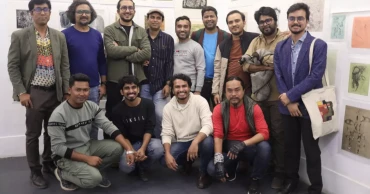
The 12th Kibria Print Fair, currently ongoing at Kalakendra in Dhaka's Lalmatia, is bringing together 19 printing studios and institutions from across the country to showcase their exquisite artworks.
Kibria Printmaking Studio has been organising the fair, also known as the ‘Kibria Mela’, since 2012 to pay tribute to the late eminent printmaker Mohammad Kibria. Since the first print fair, the Kibria Mela has worked towards promoting printmaking more accessible to artists and enthusiasts.
Typically held every year in the first week of February, this year’s fair which was Inaugurated on Friday, is displaying artworks created using different techniques such as woodcut, intaglio, lithography, etching and others.
Department of Printmaking, Faculty of Fine Arts, Dhaka University; Painting-Oriental-Printmaking Department, Faculty of Fine Arts, Rajshahi University; Printmaking Discipline, Fine Arts School, Khulna University; Department of Fine Arts, Jatiyo Kabi Kazi Nazrul Islam University, Trishal, Mymensingh; Department of Printmaking, Faculty of Fine Arts, Jagannath University; Department of Fine Arts, Islamic University Bangladesh, Kushtia; Printmaking Studio, Department of Fine Arts, UODA; Department of Fine Arts, Rabindra Maitree University, Kushtia; Bengal Arts Programme under the Bengal Foundation; Safiuddin Printmaking Studio; Shunno Art Space; Cosmos Atelier 71; Karkhana Art Space; Studio 48; Flame Arts Open Studio; Mazumder's Print Land; Kaalnee Art Studio; Kibria Printmaking Studio; Kalakendra, Dhaka; and Govt. College of Art & Craft, Agartala, Tripura, India are participating in this year’s fair.
The inauguration ceremony on Friday was joined by several eminent artists including Syed Abul Barq Alvi, Shahid Kabir, Rashid Amin, DU FFA Dean Nisar Hossain and others.
Besides works by emerging printmakers, the fair is featuring artworks created by prominent artists, namely, Abul Barq Alvi, Rafiqun Nabi, Nisar Hossain, Shahid Kabir, Wakilur Rahman, Fareha Zeba, Shishir Bhattacharjee, Samarjit Roy Chowdhury, and others.
Cosmos Atelier 71, the art wing of Cosmos Foundation and one of the regular participants at the fair, is displaying over 40 artworks in this year’s edition.
The 12th Kibria Print Fair will remain open from 4 pm to 8 pm till February 10.
2 years ago

Dhaka Makers unveil a tapestry of talent in 2nd edition
Emerging as a unique platform for over 100 local and contemporary artists and artisans, Dhaka Makers, an independent arts and crafts festival opened its second season on Thursday at the Aloki Convention Center in the capital.
After its highly acclaimed inaugural season back in June last year, the platform which has already established itself as an urban rendezvous for creative, contemporary local artists and artisans, the second edition of Dhaka Makers aims to continue showcasing their work and foster connections within the creative community on an even greater scale.
A wide variety of events are available throughout the four-day festival, such as arts and crafts classes, a Makers' Market with over 100 entrepreneurs, an art gallery called Jadughar that showcases the works of 85 artists, and a scrumptious food pavilion curated by Sameera Wadood.
The festival celebrates Dhaka's cultural wealth with nightly performances by performers from different musical styles, including Tashfee, Labik Kamal Gourob, Imran Ahmed Trio, Joler Gaan, and others.
City Bank takes centre stage as the Title Partner for the event, with support from other partners such as EMK Center and Goethe Institute. Strategic Partners include Aloki Convention Center, Emerald Events, ICE Today, Deshar Works, and Bhai Bhai Productions. Media Partners contributing to the festival's outreach are Haal Fashion and Somoy TV.
2 years ago

PM unveils new graphic novel on Bangabandhu’s travel to China
Prime Minister Sheikh Hasina unveiled a new graphic novel based on Bangabandhu Sheikh Mujibur Rahman's book "Amar Dekha Noya Chin" (The New China as I Saw) on Thursday, February 1, following the inauguration of the Ekushey Book Fair. The unveiling took place at the Centre for Research and Information (CRI) stall located in the Bangla Academy premises, where she also purchased a copy of the book.
The Prime Minister entered the fair at 4:40 pm and, after visiting several stalls and viewing the exhibits on display, she made her way to the CRI stall.
Read: ‘Amar Dekha Noya Chin’: Illuminating Bangabandhu’s travel account
Nasrul Hamid, a trustee of CRI, introduced Prime Minister Sheikh Hasina to those present at the stall before she unveiled a major attraction of this year's book fair, the graphic novel "Amar Dekha Noya Chin". The Prime Minister also participated in a photo session with the book. Following this, she visited several other stalls before departing from the fair premises.
Like every year, the CRI stall is set up in the Bangla Academy premises, with the newly published graphic novel "Amar Dekha Noya Chin" being the highlight of their display. CRI’s first foray into this genre was the graphic novel "Mujib", aimed at introducing Bangabandhu to children and young adults. Following the success of "Mujib", they planned to adapt another popular book written by the Father of the Nation into a graphic novel format.
The graphic novel's publisher is CRI trustee Radwan Mujib Siddiq, with illustrations by Sabyasachi Mistry. Siddiq Ahmed contributed to the narrative and dialogue, while the project's curation and editing were managed by Shibu Kumar Shill.
2 years ago

CRI stall ready to welcome visitors at Ekushey Book Fair
At the Ekushey Book Fair 2024, the Centre for Research and Information (CRI) stall is all set to welcome bookworms. Located at the Bangla Academy premises as usual, this year’s stall introduces a new attraction — a graphic novel based on another book by Bangabandhu, titled “Amar Dekha Noya Chin” (The New China as I Saw). Alongside this novel, the stall will also feature the previously published graphic novel “Mujib” and other books by CRI.
Nasrul Hamid, a trustee of CRI, was present on Thursday to oversee the final preparations of the stall, including arranging the books and ensuring everything was in order before the unveiling of the graphic novel. He shared on his verified Facebook page, “The CRI stall (No. 878-879, Bangla Academy premises) is ready for visitors at the Ekushey Book Fair. Honorable Prime Minister Sheikh Hasina will soon unveil the graphic novel ‘Amar Dekha Noya Chin’.”
CRI shared that “Mujib” was their first venture into graphic novels, aimed primarily at graphic novel enthusiasts and to present Bangabandhu in a way that children and teenagers could easily understand. Following the great reception of “Mujib”, CRI planned to adapt another popular book by the Father of the Nation into a graphic novel for readers.
The graphic novel’s publisher is CRI trustee Radwan Mujib Siddiq, with illustration by Sabyasachi Mistry. Siddiq Ahmed worked on the narrative and dialogue, while Shibu Kumar Shill was responsible for project curation and editing.
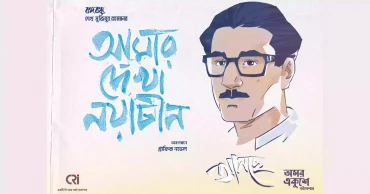
The cover of the book shows a young Bangabandhu Sheikh Mujibur Rahman in a suit and his iconic glasses, with images of significant Chinese landmarks in the background. This book recounts Sheikh Mujibur Rahman’s journey to China in 1952 to attend a peace conference — a trip he couldn’t fully document at the time but wrote about in detail while in prison in 1954. Nearly 65 years later, in 2019, this travelogue was published as a book with the assistance of Prime Minister Sheikh Hasina, daughter of Bangabandhu.
2 years ago
‘Amar Dekha Noya Chin’: Illuminating Bangabandhu’s travel account
Center for Research and Information (CRI) is poised to make another significant contribution to Bangladesh’s literary landscape with the release of a new graphic novel titled “Amar Dekha Noya China” (New China in My Eyes). This graphic novel artistically portrays the profound insights and experiences of Bangabandhu Sheikh Mujibur Rahman, the Father of the Nation, during his pivotal 1952 visit to China.
In a year marked by upheaval, Mujib’s journey to China exposed him to diverse developmental concepts. Despite his subsequent imprisonment by the Pakistan Army, Bangabandhu meticulously documented his observations and reflections two years later while in captivity.
Read: All set for Ekushey Boi Mela 2024
This graphic novel is not just a historical recount; it represents a transformative approach to narrating history. “Amar Dekha Noya China” comes after an earlier landmark initiative of CRI that saw a series of ten episodes on Mujib’s life – the first graphic novel in the country based on the autobiography of the Father of the Nation. “Mujib”, the graphic novel series, earned high praises from top cartoonists, writers, as well as young readers.
Through these initiatives, CRI’s objective is to kindle patriotism in young minds through the engaging medium of graphic novels.
Read: Winners of Bangla Academy Literary Award 2023 announced
These graphic novels provide a rare glimpse into the mind of a leader who, starting as an ordinary boy from a remote village, ignited a movement for independence.
The launch of “Amar Dekha Noya China” is eagerly anticipated at the Ekushey Book Fair, starting tomorrow (February 1, 2024). The book will be available at the CRI stall (878-879), offering readers a unique window into the early life of a leader whose vision shaped a nation’s destiny.
Published by Radwan Mujib Siddiq, a trustee of CRI, this graphic novel was sketched by Sabbasachi Mistri and the project director is Shibu Kumar Shill.
2 years ago

All set for Ekushey Boi Mela 2024
The month-long Amar Ekushey Boi Mela 2024 is scheduled to take place from February 1 to February 29.
The fair will be held on the Bangla Academy premises and the adjacent venue at the Suhrawardy Udyan in the capital, according to a press conference held on Tuesday at the academy's AKSB auditorium.
Books worth Tk47 crore sold in Amar Ekushey Book Fair in 27 days
Prime Minister Sheikh Hasina will inaugurate the fair on Thursday, February 1.
She will also distribute the Bangla Academy Literary Award 2023 among the recipients at the inaugural ceremony and unveil the covers of several new books, including "Collected Works of Sheikh Mujibur Rahman: Volume-2," published by Bangla Academy.
Curtain falls on Amar Ekushey Book Fair 2023
Bangla Academy Director General and Amar Ekushey Book Fair Directory Committee President poet Nurul Huda, Bangla Academy Secretary Dr Md Hasan Kabir, Director of Public Relations-IT and Training Department Sameer Kumar Sarkar, Amar Ekushey Book Fair 2024 associate BKash Limited’s Chief Marketing Officer (CMO) Mir Nawbut Ali and Secretary of Amar Ekushey Book Fair Committee Dr KM Mujahidul Islam briefed the details of this year's Ekushey Book Fair at the press conference, conducted by the academy’s Public Relations Officer poet Pias Majid, on Tuesday.
Kid’s zone of Ekushey Book Fair abuzz with little book lovers
Bangla Academy President and novelist Selina Hossain will chair the innaugural ceremony of the book fair, while Cultural Affairs Secretary Khalil Ahmed will be present as a special guest.
Bangla Academy Director General, poet Nurul Huda, will deliver the welcome remarks.
The territory of this year’s book fair will cover a total area of 11,50,000 square feet, like the previous editions. A total of 937 units have been allocated to 635 organisations this year.
Out of this, 173 units have been allocated to 120 organisations on the academy premises and 764 units to 515 organisations at the Suhrawardy Udyan section, compared to 901 units to 601 organisations last year.
The fair will also have 37 pavilions (one on the Academy premises and 36 in the Suhrawardy Udyan section).
At the press conference, it was announced that the Bangla Academy is solely organising the fair this year without any event management associates for the first time since 2006 and has brought some changes in setting up book stalls and other facilities, including food courts.
"This year, the outer path of the fair has been relocated closer to the Kali Mandir gate due to the metro rail station's placement. There will also be eight entry and exit ways in the TSC, Doyel Chattar, MRT Basing Plant, and Engineering Institution areas," Dr Mujahidul Islam said at the press conference.
The food stalls are located within the Engineers' Institution's boundaries and have been structured in a way so that they won’t create any disturbance to the readers attending the book fair. The fairgoers will also have access to the prayer area, restrooms, and other facilities," he added.
The traditional "Shishu Prohor" segment will take place for the child fairgoers every Friday and Saturday from 11 am to 1 pm The dedicated "Shishu Chattar" will remain in its previous place, adjacent to the temple area, like last year.
There will be seminars on the main stage of the fair venue at 4:00 pm every day, followed by cultural events. The Little Magazine premises have been shifted near the open stage of Suhrawardy Udyan, which will cater to around 170 LittleMags stalls.
The fair venue was first extended to Suhrawardy Udyan in 2013 to accommodate more spaces for the fair, besides its fixed venue at the Bangla Academy.
There will be strict security arrangements in and around the venue by the Bangladesh Police, RAB, BGB, and other security enforcement agencies to prevent any unpleasant incidents. The entire fair zone will be closely monitored with more than 300 CCTV cameras.
The "Chittaranjan Saha Memorial Award" will be distributed to the best publishers. At the same time, the "Munir Chowdhury Memorial Award" will be conferred upon three organisations for publishing the best books during the 2023 fair.
In addition to that, the "Rokanuzzaman Khan Dadabhai Memorial Award" will be awarded to the best children's book, and the "Artist Qayyum Chowdhury Memorial Award" will be awarded to the best-designed stall at the fair.
The month-long book fair is arranged every year in February to commemorate the sacrifices of people who gave their lives on February 21, 1952, for establishing Bangla as the mother tongue.
The traditional Amar Ekushey Book Fair began informally in 1972 on Bangla Academy premises; however, the academy officially took the responsibility to arrange the fair regularly, every year since 1978.
It was then named "Amar Ekushey Grantha Mela," and a guideline was laid out in this regard in 1984.
The fairgoers can visit the fair from 3 pm to 9 pm on regular days and from 11 am to 9 pm on holidays. However, all entrance points will be closed after 8.30 pm.
On February 21, International Mother Language Day, fairgoers can enter the fair at 8 am.
2 years ago

Exhibition of Japanese Dolls “NINGYŌ- Art and Beauty of Japanese Dolls’’ to be held in Dhaka February 2
An exhibition of Japanese Dolls titled “NINGYŌ- Art and Beauty of Japanese Dolls’’ will be held at Bangladesh Shilpakala Academy on February 2.
The event organized by the Japan Foundation, in collaboration with the Embassy of Japan in Bangladesh will remain open to visitors till Monday, February 16.In this exhibition, the themes are divided into 4 sections: “Ningyō to pray for children’s growth,” “Ningyō as fine art,” “Ningyō as folk art,” and “Spread of Ningyō culture. “NINGYŌ” means “dolls” in Japanese.
Read: 'Shilpakala Padak' 2021 & 2022 announced honouring 20 cultural luminaries, institutions
This exhibition explores the Japanese doll and its culture nurtured in the history and folklore of Japan with a focus on the " Ningyō to pray for children’s growth " used in the seasonal festivals, "Ningyō as fine art " for appreciation, which is characterized by various techniques, technologies, and styles, " Ningyō as folk art " that focus on local diversity and simple beauty, and finally " Spread of Ningyō culture " which covers the diversity of dolls continuing to today.
The Embassy of Japan hopes people in Bangladesh will be charmed by the beautiful presentations of the Japanese dolls.
2 years ago