usa

Biden hosts Philippines leader Marcos as China tensions grow
President Joe Biden is set to host President Ferdinand Marcos Jr. of the Philippines for White House talks Monday as concerns grow about the Chinese navy’s harassment of Philippine vessels in the South China Sea.
Marcos’ visit to Washington comes after the U.S. and the Philippines last week completed their largest war drills ever and as the two countries’ air forces on Monday will hold their first joint fighter jet training in the Philippines since 1990. The Philippines this year agreed to give the U.S. access to four more bases on the islands as the U.S. looks to deter China’s increasingly aggressive actions toward Taiwan and in the disputed South China Sea.
Meanwhile, China has angered the Philippines by repeatedly harassing its navy and coast guard patrols and chasing away fishermen in waters that are close to Philippine shores but that Beijing claims as its own.
Before departing for Washington on Sunday, Marcos said he was “determined to forge an ever stronger relationship with the United States in a wide range of areas that not only address the concerns of our times but also those that are critical to advancing our core interests.”
Monday’s Oval Office meeting is the latest high-level diplomacy with Pacific leaders by Biden as his administration contends with increased military and economic assertiveness by China and worries about North Korea’s nuclear program. Marcos’ official visit to Washington is the first by a Philippine president in more than 10 years.
The U.S. president last week hosted South Korean President Yoon Suk Yeol for a state visit during which the two leaders introduced new steps aimed at deterring North Korea from launching an attack on its neighbors. Biden is scheduled to travel to Japan and Australia in May.
The two sides are expected to discuss the security situation and come out with new economic, education, climate and other initiatives as part of Marcos’ four-day visit to Washington, according to two senior Biden administration officials.
The officials, who briefed reporters on the condition of anonymity to preview the leaders’ meeting, said the White House will use the visit to announce the transfer of three C-130 aircraft and coastal patrol vessels to the Philippines, a new U.S. trade mission focused on increasing American investment in the Philippines’ innovation economy, new educational programing and more.
Increased Chinese harassment of vessels in the South China Sea has added another dimension to the visit. On April 23, journalists from The Associated Press and other outlets were aboard the Philippine coast guard’s BRP Malapascua near Second Thomas Shoal when a Chinese coast guard ship blocked the Philippine patrol vessel steaming into the disputed shoal. The Philippines has filed more than 200 diplomatic protests against China since last year, at least 77 since Marcos took office in June.
State Department spokesperson Matthew Miller on Saturday called media reporting on the encounters a “stark reminder” of Chinese “harassment and intimidation of Philippine vessels as they undertake routine patrols within their exclusive economic zone.”
“We call upon Beijing to desist from its provocative and unsafe conduct,” Miller said.
U.S. and Taiwanese officials have also been unnerved by recent critical comments by China’s ambassador to the Philippines, Huang Xilian, over the Philippines granting the U.S. military increased access to bases.
Huang at an April forum reportedly said the Philippines should oppose Taiwan’s independence “if you care genuinely about the 150,000 OFWs” in Taiwan, using the acronym for overseas Filipino workers.
China claims the self-ruled island as its own. The Philippines, like the U.S., has a “One China” policy that recognizes Beijing as the government of China but allows informal relations with Taiwan. Marcos has not explicitly said that his country would assist the United States in any armed contingency in Taiwan.
The officials described Huang’s comments as one of many recent provocative actions by the Chinese to put pressure on the Philippines. The locations of three of the four new bases are concerning to Beijing — two are in the Isabela and Cagayan provinces, which face north toward Taiwan. A third, in Palawan, is near the disputed Spratly Islands in the South China Sea.
One official said that Marcos still desires to work closely with both Washington and Beijing but that he “finds himself in a situation” in which “the steps that China is taking are deeply concerning.”
Close U.S.-Philippines relations were not a given when Marcos took office. The son and namesake of the late Philippines strongman had seemed intent on following the path of his predecessor, Rodrigo Duterte, who pursued closer ties with China.
Before Marcos took office last year, Kurt Campbell, coordinator for Indo-Pacific affairs on the White House National Security Council, acknowledged that “historical considerations” could present “challenges” to the relationship with Marcos Jr. It was an oblique reference to long-standing litigation in the United States against the estate of his father, Ferdinand Marcos.
A U.S. appeals court in 1996 upheld damages of about $2 billion against the elder Marcos’ estate for the torture and killings of thousands of Filipinos. The court upheld a 1994 verdict of a jury in Hawaii, where he fled after being forced from power in 1986. He died there in 1989.
Biden and Marcos met in September during the U.N. General Assembly, where the U.S. president acknowledged the two countries’ sometimes “rocky” past.
During their private meeting, Biden, a Democrat, stressed to Marcos his desire to improve relations and asked Marcos how the administration could “fulfill your dreams and hopes” to do that, according to the senior administration official.
Marcos is also slated to visit the Pentagon, meet Cabinet members and business leaders and make remarks at a Washington think tank during his visit.
3 years ago

Another bank failure in US: First Republic Bank sold to JP Morgan
Regulators seized troubled First Republic Bank early Monday and sold all of its deposits and most of its assets to JPMorgan Chase Bank in a bid to head off further banking turmoil in the U.S.
San Francisco-based First Republic is the third midsize bank to fail in two months. It is the second-biggest bank failure in U.S. history, behind only Washington Mutual, which collapsed at the height of the 2008 financial crisis and was also taken over by JPMorgan.
First Republic has struggled since the March collapses of Silicon Valley Bank and Signature Bank and investors and depositors had grown increasingly worried it might not survive because of its high amount of uninsured deposits and exposure to low interest rate loans.
The Federal Deposit Insurance Corporation said early Monday that First Republic Bank's 84 branches in eight states will reopen as branches of JPMorgan Chase Bank and depositors will have full access to all of their deposits.
Regulators worked through the weekend to find a way forward before U.S. stock markets opened. Markets in many parts of the world were closed for May 1 holidays Monday. The two markets in Asia that were open, in Tokyo and Sydney, rose.
"Our government invited us and others to step up, and we did," said Jamie Dimon, chairman and CEO of JPMorgan Chase.
As of April 13, First Republic had approximately $229 billion in total assets and $104 billion in total deposits, the FDIC said.
At the end of last year, the Federal Reserve ranked it 14th in size among U.S. commercial banks. The FDIC estimated its deposit insurance fund would take a $13 billion hit from taking First Republic into receivership. Its rescue of Silicon Valley Bank cost the fund a record $20 billion.
Before Silicon Valley Bank failed, First Republic had a banking franchise that was the envy of most of the industry. Its clients — mostly the rich and powerful — rarely defaulted on their loans. The bank has made much of its money making low-cost loans to the wealthy, which reportedly included Meta Platforms CEO Mark Zuckerberg.
Flush with deposits from the well-heeled, First Republic saw total assets more than double from $102 billion at the end of 2019's first quarter, when its full-time workforce was 4,600.
But the vast majority of its deposits, like those in Silicon Valley and Signature Bank, were uninsured — that is, above the $250,000 limit set by the FDIC. And that worried analysts and investors. If First Republic were to fail, its depositors might not get all their money back.
Those fears were crystalized in the bank's recent quarterly results. The bank said depositors pulled more than $100 billion out of the bank during April's crisis. San Francisco-based First Republic said that it was only able to stanch the bleeding after a group of large banks stepped in to save it with $30 billion in uninsured deposits.
Since the crisis, First Republic has been looking for a way to quickly turn itself around. The bank planned to sell off unprofitable assets, including the low interest mortgages that it provided to wealthy clients. It also announced plans to lay off up to a quarter of its workforce, which totaled about 7,200 employees in late 2022.
Investors remained skeptical. The bank's executives have taken no questions from investors or analysts since the bank reported its results, causing First Republic's stock to sink further.
And it's hard to profitably restructure a balance sheet when a firm has to sell off assets quickly and has fewer bankers to find opportunities for the bank to invest in. It took years for banks like Citigroup and Bank of America to return to profitability after the global financial crisis 15 years ago, and those banks had the benefit of a government-aided backstop to keep them going.
3 years ago

Biden's diverse coalition of support risks fraying in 2024
Former Sen. Joe Lieberman, the Connecticut Democrat-turned-Independent long known for his centrist views, voted for Joe Biden in 2020. But as Biden’s reelection campaign begins, Lieberman is preparing to recruit a third-party candidate capable of defeating the Democratic president.
“Centrists and moderates feel that he’s governed more from the left than they hoped,” Lieberman, a leader of the group, No Labels, said of Biden in an interview. “He hasn’t been able to be the unifier that he promised to be.”
Biden’s political challenges are not confined to voters in the middle. In the days since he formally launched his 2024 campaign, key members of the sprawling political coalition that lifted him over former President Donald Trump in 2020 are far from excited about the prospect of four more years. That underscores the test confronting Biden as he aims to motivate the coalition of African Americans, Latinos, young people, suburban voters and independents to show up for him again.
John Paul Mejia, the 20-year-old spokesman for the progressive Sunrise Movement, says Biden has simply not done enough to ensure the young voters who rallied behind him in 2020 would do so again.
“Young people are starving for more,” Mejia said, pointing to Biden’s recent decision to approve two controversial fossil fuel projects in Alaska. “Biden has to demonstrate the extent to which he’s willing to be a fighter. We’ve seen this sort of two-step on the promises he made to young people.”
Biden has also struggled to fulfill key promises to Black voters, perhaps the most loyal group in his political base. While he tapped Ketanji Brown Jackson to become the first Black woman on the Supreme Court, he has been unable to follow through on pledges to protect voting rights against a wave of Republican-backed restrictions or enact policing reform to help stop violence against people of color at the hands of law enforcement.
“There’s work to be done,” said Rep. Jasmine Crockett, D-Texas, a 42-year-old African American former civil rights attorney who joined Congress in January. “I’m not going to sugar coat it.”
Crockett recalled the palpable excitement among the Black community for Barack Obama’s reelection. With Biden, there’s “a number of people who are concerned and scared” largely because of his age, while others are “indifferent and waiting,” despite what she described as Biden’s overall strong record of achievement.
Nearly 18 months before Election Day 2024, however, it’s unclear how much this lack of enthusiasm will weigh on Biden’s reelection prospects. For all the concern, no high-profile Democratic primary challengers have emerged, and none are expected to. To date, only progressive author Marianne Williamson and anti-vaccine activist Robert F. Kennedy Jr. are mounting symbolic challenges to Biden, who has the official support of the Democratic National Committee.
Vermont Sen. Bernie Sanders, Biden’s chief rival in the 2020 primary, told The Associated Press just hours after Biden announced that he was endorsing the president and encouraged other progressive leaders to do so as well.
“I intend to do everything I can to see that he is reelected,” Sanders said in an interview.
Instead of excitement for the 80-year-old president’s reelection, leaders from key factions in Biden’s coalition report a serious sense of duty — and fear of the alternative. Trump is currently considered the favorite to claim the Republican presidential nomination, although he’s facing opposition from a half dozen rivals.
“It would be a mistake to underestimate Trump or whoever the Republican candidate might be,” Sanders said. “There’s a lot of discontent in this country. There’s a lot of anger in this country.”
Indeed, 74% of U.S. adults believe the country is headed in the wrong direction, according to an AP-NORC poll conducted a week before Biden’s announcement.
The poll found that only about half of Democrats think Biden should run again. Despite their reluctance, 81% of Democrats said they would probably support Biden in a general election if he is the nominee. That includes 41% who said they definitely would and 40% who said they probably would.
The warning signs in the Biden coalition are clear.
Just 41% of Black adults want the Democratic president to run again, and only 55% said they are likely to support him in the general election if he is the nominee. Among Latinos, only 27% want Biden to run again in 2024 and 43% said they would definitely or probably support him.
Younger Democrats also remain a reluctant part of Biden’s coalition, the AP-NORC poll shows.
Just 25% of those under age 45 said they would definitely support Biden in a general election, compared with 56% of older Democrats.
Still, an additional 51% of younger Democrats say they would probably vote for Biden in a 2024 general election.
Meanwhile, just 14% of independents — adults who don’t lean toward either party, who represent a small percentage of the American electorate — want Biden to run again. And only 24% said they’d support him in the general election if he is the Democratic nominee.
Biden’s team dismisses the numbers, yet acknowledges that in a party as diverse as the Democrats, some may have other preferred candidates for president. It’s just that none of those other people can win, they say, adding that while Biden might not be someone’s first choice, he’s often everyone’s second.
Meanwhile, Lieberman said he would likely soon begin interviewing potential candidates for No Label’s third-party alternative, but he said the group would only field a candidate if polling suggested the so-called unity ticket had a viable path to the presidency.
“If No Labels does not run a bipartisan unity ticket, and the two candidates are Trump and Biden, to me, it’s an easy choice,” Lieberman said. “I will vote for Biden.”
3 years ago

Shooting kills 2 men, injures 3rd victim in Seattle park
Two men were killed and a third person was wounded during a shooting in a Seattle park Saturday night, police said.
Police responded to a report of a shooting at Cal Anderson Park around 10:30 p.m., the Seattle Police Department said in a statement.
Officers found three men with gunshot wounds and provided first aid until Seattle Fire Department personnel arrived. One man succumbed to his injuries at the scene, police said.
Two other victims were transported from the park in the Capitol Hill neighborhood to Harborview Medical Center, where the second man died, police said.
The third shooting victim was listed in critical condition, police said.
Investigators were searching for a man who reportedly left the scene before officers arrived, police said.
3 years ago

Army identifies 3 soldiers killed in Alaska helicopter crash
The U.S. Army identified on Saturday the three soldiers who were killed when two helicopters collided in Alaska while returning from a training mission.
The helicopters were headed to Fort Wainwright from a mission in the Donnelly Training Area when they crashed at 1:39 p.m. Thursday, about 50 miles (80 kilometers) east of Healy.
The U.S. Army announced Friday that it has grounded aviation units for training after 12 soldiers died within the last month in helicopter crashes in Alaska and Kentucky.
“The move grounds all Army aviators, except those participating in critical missions, until they complete the required training,” the Army said in a statement.
Killed in Thursday's crash were Chief Warrant Officer 3 Christopher Robert Eramo, 39, of Oneonta, New York; Chief Warrant Officer 2 Kyle D. McKenna, 28, of Colorado Springs, Colorado; and Warrant Officer 1 Stewart Duane Wayment, 32, of North Logan, Utah.
A fourth soldier was injured and was taken to Fairbanks Memorial Hospital and was listed in stable condition. He was not identified Saturday.
“The battalion is devastated and mourning the loss of three of our best,” said Lt. Col. Matthew C. Carlsen, the 1-25th AB commander. Their loss can't be compared to the suffering felt by the soldiers' families, he said.
“The entire team has come together to focus our thoughts, prayers, and actions to provide and sustain them with whatever comfort and support they need at this time, and I promise that this will continue long into the future,” he said.
A Safety Investigation Team from the U.S. Army Combat Readiness Center, based at Fort Novosel, Alabama, is leading the safety investigation, officials said in an email.
Department of Defense instructions and Army regulations prohibit the investigators from releasing any information to the public concerning the causes, analysis or internal recommendations, the statement said.
“The loss of these Soldiers is devastating and is being felt by family, friends and military communities across Alaska,” said Maj. Gen. Brian Eifler, commanding general of the 11th Airborne Division. “The families of Fort Wainwright and 1-25 are as strong a team as I’ve ever seen. Our hearts are heavy, and our thoughts and prayers are with the families, friends and loved ones of the fallen.”
3 years ago

Known for laughs, DC dinner spotlights risks of journalism
The White House Correspondents' Association dinner — known for its fun albeit ferocious jabs at Washington — took a more solemn tone this year as what many see as the brazen attack on press freedom across the globe was on painful display.
Upon arriving at the Washington Hilton on Saturday, President Joe Biden and first lady Jill Biden met privately with the parents of Wall Street Journal reporter Evan Gershkovich, who has been imprisoned in Russia since March. He was charged with spying, despite strong denials from his employer and the U.S. government. Some guests wore buttons with “Free Evan” printed on them.
Also among the 2,600 people attending the gala is Debra Tice, the mother of Austin Tice, who has not been heard from since disappearing at a checkpoint in Syria in 2012. U.S. officials say they operate under the assumption that he is alive and are working to try to bring him home.
Also Read: Jailed US reporter in Russian court to appeal detention
“They are among hundreds of journalists around the world who are wrongfully detained for the simple act of doing journalism — which is not a crime,” said Tamara Keith, a White House correspondent for NPR and the association’s president.
The Bidens also made a beeline for Brittney Griner, the WNBA star and Olympic gold medalist who was detained in Russia for nearly 10 months last year before her release in a prisoner swap. Griner is attending with her wife, Cherelle, as guests of CBS News.
The black-tie dinner draws a wide array of celebrities and media moguls to Washington, with parties being held across the capital. Among those in attendance are actor Liev Schreiber, singer John Legend and his wife, Chrissy Teigen, the model and television personality.
Also Read: Russia charges Journal reporter with espionage: Report
Actor and former California Gov. Arnold Schwarzenegger opened the dinner with a pre-taped video about the importance of a free and independent press. Biden and Vice President Kamala Harris are seated on the stage along with comedian Roy Wood Jr., a correspondent for “The Daily Show,” as the featured entertainer.
Wood gave a preview of where his jokes were headed, predicting that Florida Gov. Ron DeSantis wasn’t likely to end his culture clashes or stop his feud with Disney just because of a few jibes. The comedian told CNN not to expect DeSantis to say, "'You know what, man, you’re right. Go ahead and put Black history back in them books.’ ... He’s fighting Mickey Mouse. You can’t change that person’s mind with a joke.”
The venue is a familiar one for Biden, who attended several as vice president to Barack Obama. The Washington event returned last year after being sidelined by the pandemic in 2020 and 2021. Biden was the first president in six years to accept the invitation after Donald Trump shunned the event while in office.
Biden took the opportunity last year to take aim at his many critics, including Republicans and the leader of their party: Trump. This year, he is coming not only as the commander in chief but as a presidential contender.
3 years ago
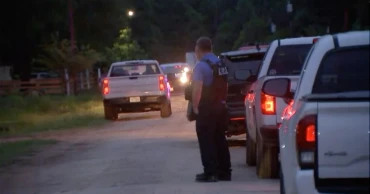
Texas man kills 5 neighbors after they complained of gunfire
A Texas man went next door with a rifle and fatally shot five of his neighbors, including an 8-year-old boy, after they asked him to stop firing rounds in his yard because they were trying to sleep, authorities said Saturday.
The suspect, identified as 38-year-old Francisco Oropeza, remained at large more than 18 hours after the shooting and authorities warned that he might still be armed. The attack happened just before midnight Friday near the town of Cleveland, north of Houston, on a street where some residents say it is not uncommon to hear neighbors unwind by firing off guns.
San Jacinto County Sheriff Greg Capers said Oropeza used an AR-style rifle, and as the search for him dragged into Saturday evening, authorities had widened their efforts to as far as “10 to 20 miles" from the murder scene. He said Oropeza may still have a weapon but that he believes authorities have the rifle used in the shooting.
Capers said they found clothes and a phone while combing a rural area that includes dense layers of forest but that tracking dogs had lost the scent.
Also Read: Police: 5 people killed in shooting at home north of Houston
“He could be anywhere now,” Capers said.
Capers said the victims were between the ages of 8 and 31 years old and that all were believed to be from Honduras. All were shot “from the neck up," he said.
The attack was the latest act of gun violence in what has been a record pace of mass shootings in the U.S. so far this year, some of which have also involved semiautomatic rifles.
The mass killings have played out in a variety of places — a Nashville school, a Kentucky bank, a Southern California dance hall, and now a rural Texas neighborhood inside a single-story home.
Capers said there were 10 people in the house — some of whom had just moved there earlier in the week — but that that no one else was injured. He said two of the victims were found in a bedroom laying over two children in an apparent attempt to shield them.
A total of three children found covered in blood in the home were taken to a hospital but found to be uninjured, Capers said.
Also Read: 2 US Army helicopters crash in Alaska, killing 3 soldiers
FBI spokesperson Christina Garza said investigators do not believe everyone at the home were members of a single family. The victims were identified as Sonia Argentina Guzman, 25; Diana Velazquez Alvarado, 21; Julisa Molina Rivera, 31; Jose Jonathan Casarez, 18; and Daniel Enrique Laso, 8.
The confrontation followed the neighbors walking up to the fence and asking the suspect to stop shooting rounds, Capers said. The suspect responded by telling them that it was his property, Capers said, and one person in the house got a video of the suspect walking up to the front door with the rifle.
The shooting took place on a rural pothole-riddled street where single-story homes sit on wide 1-acre lots and are surrounded by a thick canopy of trees. A horse could be seen behind the victim's home, while in the front yard of Oropeza's house a dog and chickens wandered.
Rene Arevalo Sr., who lives a few houses down, said he heard gunshots around midnight but didn't think anything of it.
“It's a normal thing people do around here, especially on Fridays after work,” Arevalo said. “They get home and start drinking in their backyards and shooting out there.”
Capers said his deputies had been to Oropeza's home at least once before and spoken with him about “shooting his gun in the yard.” It was not clear whether any action was taken at the time. At a news conference Saturday evening, the sheriff said firing a gun on your own property can be illegal, but he did not say whether Oropeza had previously broken the law.
Capers said the new arrivals in the home had moved from Houston earlier in the week, but he said he did not know whether they were planning to stay there.
Across the U.S. since Jan. 1, there have been at least 18 shootings that left four or more people dead, according to a database maintained by The Associated Press and USA Today, in partnership with Northeastern University. The violence is sparked by a range of motives: murder-suicides and domestic violence; gang retaliation; school shootings; and workplace vendettas.
Texas has confronted multiple mass shootings in recent years, including last year's attack at Robb Elementary School in Uvalde; a racist attack at an El Paso Walmart in 2019; and a gunman opening fire at a church in the tiny town of Sutherland Springs in 2017.
Republican leaders in Texas have continually rejected calls for new firearm restrictions, including this year over the protests of several families whose children were killed in Uvalde.
A few months ago, Arevalo said Oropeza threatened to kill his dog after it got loose in the neighborhood and chased the pit bull in his truck.
“I tell my wife all the time, ‘Stay away from the neighbors. Don’t argue with them. You never know how they're going to react,'” Arevalo said. “I tell her that because Texas is a state where you don't know who has a gun and who is going to react that way.”
3 years ago

Police: 5 people killed in shooting at home north of Houston
A Texas man went next door with a rifle and began shooting his neighbors, killing an 8-year-old and four others inside the house, after the family asked him to stop firing rounds in his yard because they were trying to sleep, authorities said Saturday.
San Jacinto County Sheriff Greg Capers said authorities were still searching for the 39-year-old suspect following the overnight shooting in the town of Cleveland, about 45 miles (72 kilometers) north of Houston. He said the suspect, whom he did not identify, used an AR-style rifle in the shooting.
“Everyone that was shot was shot from the neck up, almost execution-style,” Capers said during a news conference at the scene.
Capers said there were 10 people in the house and that no one else was injured. He said two of the victims, all believed to be from Honduras, were found laying over two children inside.
“The Honduran ladies that were laying over these children were doing it in such an effort as to protect the child,” according to Capers, who said a total of three blood-covered children were found in the home but were determined to be uninjured after being taken to a hospital.
Capers said two other people were examined at the scene and released.
The confrontation followed family members walking up to the fence and asking the suspect to stop shooting rounds, Capers said. The suspect responded by telling them that it was his property, according to Capers, and that one person in the house got a video of the suspect walking up to the front door with the rifle.
Three of the victims were women and one was a man. Their names were not released. Capers said the victims were between the ages of 8 and about 40 years old.
Authorities have previously been to the suspect's home, according to Capers. “Deputies have come over and spoke with him about him shooting his gun in the yard,” he said.
Capers said some of those in the house had just moved from Houston earlier in the week, but he did not know whether they were planning to stay there.
The U.S. is setting a record pace for mass killings in 2023. The violence is sparked by a range of motives: murder-suicides and domestic violence; gang retaliation; school shootings and workplace vendettas. All have taken the lives of four or more people at once since Jan. 1.
3 years ago

2 US Army helicopters crash in Alaska, killing 3 soldiers
Two U.S. Army helicopters crashed Thursday in Alaska while returning from a training flight, killing three soldiers and injuring a fourth.
Two of the soldiers died at the crash near Healy, Alaska, and a third died on the way to a hospital in Fairbanks. A fourth soldier was being treated at a hospital for injuries, the Army said in a statement.
The names of those killed were being withheld until relatives could be notified, the Army said.
Each AH-64 Apache helicopter was carrying two people at the time of the crash, John Pennell, a spokesperson for the U.S. Army Alaska, said earlier Thursday.
The helicopters were from the 1st Attack Battalion, 25th Aviation Regiment at Fort Wainwright, based near Fairbanks.
“This is an incredible loss for these soldiers’ families, their fellow soldiers, and for the division,” Maj. Gen. Brian Eifler, commanding general of the 11th Airborne Division, said in the Army statement. “Our hearts and prayers go out to their families, friends and loved ones, and we are making the full resources of the Army available to support them.”
The Army said the cause of the crash was under investigation and more details would be released when they become available.
The crash is the second accident involving military helicopters in Alaska this year.
In February, two soldiers were injured when an Apache helicopter rolled after taking off from Talkeetna. The aircraft was one of four traveling to Joint Base Elmendorf-Richardson in Anchorage from Fort Wainwright.
In March, nine soldiers were killed when two U.S. Army Black Hawk medical evacuation helicopters crashed during a routine nighttime training exercise about 30 miles (48 kilometers) northeast of Fort Campbell, Kentucky.
Healy is located about 10 miles (16.09 kilometers) north of Denali National Park and Preserve, or about 250 miles (402 kilometers) north of Anchorage.
Healy is a community of about 1,000 people located on the Parks Highway in Alaska’s interior region. It is a popular place for people to spend the night while visiting the nearby park, which is home to Denali, the continent’s tallest mountain.
Healy is also famous for being the town closest to the former bus that had been abandoned in the backcountry and was popularized by the book “Into the Wild” and the movie of the same name. The bus was removed and taken to Fairbanks in 2020.
3 years ago

Trial opens in E. Jean Carroll’s rape lawsuit against Trump
A nearly 30-year-old rape claim against Donald Trump went to trial Tuesday as jurors in the federal civil case heard a former advice columnist’s allegation of being attacked in a luxury department store dressing room. The former president says nothing happened between them.
E. Jean Carroll will testify that what unfolded in a few minutes in a fitting room in 1996 “would change her life forever,” one of her lawyers, Shawn Crowley, said in an opening statement.
“Filled with fear and shame, she kept silent for decades. Eventually, though, silence became impossible,” Crowley said. And when Carroll broke that silence in a 2019 memoir, the then-president “used the most powerful platform on Earth to lie about what he had done, attack Ms. Carroll’s integrity and insult her appearance.”
Trump — who wasn't in court but hasn't ruled out testifying —- has called Carroll a “nut job” who fabricated the rape claim to sell her book. Defense attorney Joe Tacopina told jurors Tuesday that her story was wildly implausible and short of evidence.
He accused her of pursuing the case for money, status and political reasons, urging the jurors from heavily Democratic New York to put aside any animus they themselves might hold toward the Republican ex-president and ex-New Yorker.
Also Read: Rape lawsuit trial against Donald Trump set to get underway
“You can hate Donald Trump. That’s OK. But there’s a time and a secret place for that. It’s called a ballot box in an election. It’s not here in a court of law,” Tacopina told the six-man, three-woman panel. “Nobody’s above the law, but no one is beneath it.”
The trial stands to test Trump's “Teflon Don” reputation for shaking off serious legal problems and to reprise accounts of the type of sexual misconduct that rocked his 2016 presidential campaign as he seeks office again. Trump denies all the claims, saying they are falsehoods spun up to damage him.
The trial comes a month after he pleaded not guilty in an unrelated criminal case surrounding payments made to bury accounts of alleged extramarital sex.
Carroll's suit is a civil case, meaning that no matter the outcome, Trump isn't in danger of going to jail. She is seeking unspecified monetary damages and a retraction of Trump statements that she alleges were defamatory.
Among his comments: “She’s not my type," which her lawyers say was tantamount to calling her too unattractive to assault.
Jurors — whose names are being kept secret to prevent potential harassment — range in age from 26 to 66 and include a janitor, a physical therapist and people who work in security, health care collections, a library, a high school and other settings.
They were questioned about their news-watching habits (which vary from watching “everything” to ignoring it all), political donations and support for any of a roster of right- and left-wing groups. They were asked, too, whether they used Trump’s social media platform, read Carroll’s former Elle magazine column and even if they’d seen Trump’s former reality show “The Apprentice” — and whether any of these and other matters would make it difficult for them to be fair.
Carroll, 79, is expected to testify as soon as Wednesday that a chance encounter with Trump, 76, turned violent, and that he defamed her when responding to the rape allegations.
She says that after she ran into the future president at Manhattan's Bergdorf Goodman on an unspecified spring Thursday evening in 1996, he invited her to shop with him for a woman's lingerie gift before they teased one another to try on a bodysuit. Carroll says they ended up alone together in a store dressing room, where Trump pushed her against a wall and raped before she fought him off and fled.
Her suit argues that she was psychologically scarred by the alleged attack, and then subjected to an onslaught of hateful messages and reputational damage when Trump painted her as a liar.
“This case is Ms. Carroll's chance to clear her name, to pursue justice,” Crowley said.
Tacopina countered that it was “an affront to justice.”
He suggested her account of being violently raped in the Fifth Avenue store, with no one around, was preposterous. Also, Tacopina noted, there was no record that Carroll had any injuries, sought out a doctor or therapist, asked the store about surveillance video or even wrote about the alleged attack in her diary.
“It all comes down to: Do you believe the unbelievable?” he asked in his opening statement.
Also Read: Trump's day in court as criminal defendant: What to know
Jurors are also expected to hear from two other women who say they were sexually assaulted by Trump. The jury will also see the infamous 2005 “Access Hollywood” video in which Trump is heard asserting that celebrities can grab women sexually without asking.
Carroll's allegations normally would be too old to bring to court. But in November, New York state enacted a law allowing for suits over decades-old sexual abuse claims.
The Associated Press typically does not name people who say they have been sexually assaulted unless they come forward publicly, as Carroll has done.
3 years ago