Others

MSF welcomes Indian government standing strong against EFTA trade deal’s harmful intellectual property provisions
In a welcome move on Thursday, the Indian Commerce Ministry confirmed its rejection of Switzerland’s demand for data exclusivity for medicines in the India-EFTA trade deal, and emphasised the importance of protecting the country’s generic drug production and supply.
Doctors Without Borders/Médecins Sans Frontières (MSF), Public Eye, and Delhi Network of Positive People yesterday issued a joint statement highlighting their concerns about the damaging intellectual property provisions that were being negotiated in the India-EFTA trade deal that could negatively impact access to affordable medicines for millions of people in India and around the world.
One of the key concerns was the proposal to introduce an additional IP barrier, data exclusivity, as it would delay the registration of generic versions of new medicines or new formulations for a set period, even when there is no patent on the medicine.
"We welcome the Indian Commerce Ministry’s strong stand against the inclusion of data exclusivity in its trade talks with EFTA. We appeal to India to continue to reject all harmful intellectual property provisions in this and other trade deals that may limit India's supply of affordable generic medicines for millions of people in India and around the world," said Farhat Mantoo, Executive Director, MSF South Asia.
2 years ago

At least 8 children among 22 hit by gunfire at end of Chiefs' Super Bowl parade; 1 person killed
Eight children were among 22 people hit by gunfire in a shooting at the end of Wednesday's parade to celebrate the Kansas City Chiefs' Super Bowl win, authorities said, as terrified fans ran for cover and yet another high-profile public event was marred by gun violence. One person was killed, a mother of two identified by her radio station as a DJ.
Kansas City Police Chief Stacey Graves detailed the shooting's toll at a news conference and said three people had been taken into custody. She said she has heard that fans may have been involved in apprehending a suspect but couldn’t immediately confirm that.
“I’m angry at what happened today. The people who came to this celebration should expect a safe environment.” Graves said. Police did not immediately release any details about the people taken into custody or about a possible motive for the shootings. She said firearms had been recovered, but not what kind of weapons were used.
“All of that is being actively investigated,” she said.
Gunfire, rockets and carnage: Israelis are stunned and shaken by unprecedented Hamas attack
It is the latest sports celebration in the U.S. to be marred by gun violence, following a shooting that injured several people last year in downtown Denver after the Nuggets' NBA championship, and gunfire last year at a parking lot near the Texas Rangers' World Series championship parade.
Social media users posted shocking video of police running through a crowded scene as people hurriedly scrambled for cover and fled. One video showed someone apparently performing chest compressions on a shooting victim as another person, seemingly writhing in pain, lay on the ground nearby. People screamed in the background.
Another video showed two people chase and tackle a person, holding them down until two police officers arrived.
Radio station KKFI said in a Facebook post Wednesday evening that Lisa Lopez-Galvan, host of “Taste of Tejano,” was killed in the shooting.
“This senseless act has taken a beautiful person from her family and this KC Community,” KKFI said in a statement.
Texas man kills 5 neighbors after they complained of gunfire
Lopez-Galvan, whose DJ name was “Lisa G,” was an extrovert and devoted mother from a prominent Latino family in the area, said Rosa Izurieta and Martha Ramirez, two childhood friends who worked with her at a staffing company. Izurieta said Lopez-Galvan had attended the parade with her husband and her adult son, a die-hard Kansas City sports fan who also was shot.
“She's the type of person who would jump in front of a bullet for anybody — that would be Lisa,” Izurieta said.
The shooting outside Union Station happened despite more than 800 police officers who were in the building and around the area, including on top of nearby buildings, said Mayor Quinton Lucas, who attended with his wife and mother and had to run for cover when gunfire broke out.
“I think that’s something that all of us who are parents, who are just regular people living each day, have to decide what we wish to do about,” Lucas said. “Parades, rallies, schools, movies. It seems like almost nothing is safe.”
Kansas City has long struggled with gun violence, and in 2020 it was among nine cities targeted by the U.S. Justice Department in an effort to crack down on violent crime. In 2023 the city matched a record with 182 homicides, most of which involved guns.
Lucas has joined with mayors across the country in calling for new laws to reduce gun violence, including mandating universal background checks.
Lisa Money, a resident of the city, was trying to gather some confetti near the end of the parade when she heard somebody yell, “Down, down, everybody down!”
At first Money thought somebody might be joking until she saw the SWAT team jumping over the fence.
“I can’t believe it really happened. Who in their right mind would do something like this? This is supposed to be a day of celebration for everybody in the city and the surrounding area. and then you’ve got some idiot that wants to come along and do something like this,” she said.
Kevin Sanders, 53, of Lenexa, Kansas, said he heard what sounded like firecrackers and then people started running. After that initial flurry, calm returned, and he didn’t think much of it. But 10 minutes later, ambulances started showing up.
“It sucks that someone had to ruin the celebration, but we are in a big city,” Sanders said.
University Health spokeswoman Nancy Lewis said the hospital was treating eight gunshot victims. Two were in critical condition and six were in stable condition, she said. The hospital also was treating four people for other injuries resulting from the chaos after the shooting, Lewis said.
Lisa Augustine, spokesperson for Children’s Mercy Kansas City, said the hospital was treating 12 patients from the rally, including 11 children, some of whom suffered gunshot wounds.
St. Luke’s Hospital of Kansas City received one gunshot patient in critical condition and three walk-ins with injuries that were not life-threatening, spokesperson Laurel Gifford said.
“When you have this many casualties, it’s going to get spread out among a lot of hospitals so that you don’t overwhelm any single ER,” said Jill Jensen Chadwick, news director for University of Kansas Health System, which received at least one person injured in the shooting.
Chiefs trainer Rick Burkholder said that he was with coach Andy Reid and other coaches and staff members at the time of the shooting, and that the team was on buses and returning to Arrowhead Stadium.
“We are truly saddened by the senseless act of violence that occurred outside of Union Station at the conclusion of today's parade and rally," the team said in a statement.
Missouri’s Republican Gov. Mike Parson and first lady Teresa Parson were at the parade during the gunfire but were unhurt. “Thanks to the professionalism of our security officers and first responders, Teresa and I and our staff are safe and secure,” Parson said in a statement.
President Joe Biden was briefed on the shooting and will continue to receive updates, a White House spokesperson said. White House officials were in touch with state and local leaders, and federal law enforcement was on the scene supporting their local counterparts.
Areas that had been filled with crowds were empty after the shooting, with police and firefighters standing and talking behind an area restricted by yellow tape.
Throngs had lined the route earlier, with fans climbing trees and street poles or standing on rooftops for a better view. Players rolled through the crowd on double-decker buses, as DJs and drummers heralded their arrival. Owner Clark Hunt was on one of the buses, holding the Lombardi Trophy.
The city and the team each chipped in around $1 million for the event commemorating Travis Kelce, Patrick Mahomes and the Chiefs becoming the first team since Tom Brady and the New England Patriots two decades ago to defend their title.
2 years ago

Islamic State militants attack Syrian military barracks and kill 9 troops, war monitors say
Militants from the Islamic State group attacked military barracks in central Syria this week, killing nine soldiers, an opposition war monitor said. The Syrian army and officials have not confirmed the attack.
IS claimed responsibility for the attack on Monday near the town of Al-Sukhna, saying its fighters also seized weapons abandoned by fleeing soldiers and set fire to the barracks. The militants' statement claiming responsibility was posted late on Tuesday.
The attack was the latest in intensifying clashes in the desert in eastern Syria between the militants and the Syrian army, supported by Iran-backed militias.
The Britain-based Syrian Observatory for Human Rights, a war monitoring group, says IS has carried out 41 attacks so far this year there.
The Observatory said three Syrian troops were wounded in addition to the nine killed in Al-Sukhna.
IS militants have found refuge in the desert in remote areas in Syria and along the Iraqi-Syrian border, where they continue to stage attacks nearly five years after the group was defeated in Syria in 2019.
U.S. troops in northeastern Syria and U.S.-backed Kurdish-led Syrian Democratic Forces have conducted numerous operations against the remaining IS militants. The United States has approximately 900 troops in Syria focused on countering the group's remnants.
Since war erupted in Gaza on Oct. 7 following Hamas' surprise attack and incursion into southern Israel, U.S. bases in eastern Syria and Iraq have come under regular attack by an umbrella group of Iran-backed Iraqi militias called the Iraqi Islamic Resistance.
The militias say the attacks are in response to Washington's support for Israel.
2 years ago

Indian Prime Minister Narendra Modi offers stump re-election speech on international stage in UAE
Indian Prime Minister Narendra Modi gave a stump speech for his re-election on a global stage Wednesday in the United Arab Emirates, describing his years in power as pushing for "minimum government, maximum governance."
Modi's comments come as he prepares for the inauguration of a stone-built Hindu temple near Abu Dhabi, the country's capital, after meeting with the Emirati leader he's repeatedly described as "his brother." That personal touch seems aimed at further cementing ties with the UAE, an oil-rich country that supplies India's energy needs while also serving as a home for some 3.5 million of his countrymen abroad.
"I believe that people should neither feel the absence of a government, but at the same time, nor should there be pressure from the government," Modi said in a speech before the World Governments Summit in Dubai. "In fact, I believe that the government should interfere as little as possible in the lives of people."
Modi entered the hall at the summit in Dubai, accompanied by the city-state's ruler, Sheikh Mohammed bin Rashid Al Maktoum. Now on his seventh trip to the UAE since becoming prime minister, Modi already received a warm welcome from the autocratic nation's president, Sheikh Mohammed bin Zayed Al Nahyan, also the ruler of Abu Dhabi.
Modi described a series of his government's achievements, while also broadly touching on challenges facing the world.
"Terrorism, with every passing day, has been taking on new forms and is posing new challenges to mankind. Even climate-related challenges are becoming bigger with the passage of time," Modi said. "On the one hand, there are domestic concerns and on the other the international systems seem in disarray. And amidst all of this, every government faces a very big challenge of safeguarding its relevance."
He added: "It is as a friend to the world that India is moving forward."
Modi's arrival came as Indian police on Tuesday used tear gas and detained some farmers who clashed with them and tried to break barricades, blocking their way to New Delhi to demand guaranteed crop prices. In 2021, farmers camped for months in the Indian capital after Modi withdrew controversial agriculture laws that had triggered the earlier protests.
The latest protests could pose a significant challenge for Modi and his governing Bharatiya Janata Party ahead of the coming elections in India, the world's largest democracy. However, Modi is widely expected to win a third term.
Modi's visit highlights the nations' long-standing economic and historic ties, from spice selling and gold smuggling in the UAE's formative years to tens of billions of dollars' worth of annual bilateral trade today.
The countries signed a free trade deal in 2022 aimed at doubling their bilateral trade to $100 billion. The countries have agreed to allow India to settle some payments in rupees as opposed to dollars, lowering transaction costs.
The relationship also underscores the Emirates' realpolitik foreign policy. The UAE has embraced Modi as Muslims in India increasingly come under attack by Hindu nationalist groups. Modi received the Emirates' top civilian honor in 2019 even as he stripped statehood from the disputed Muslim-majority region of Kashmir.
Modi's original visit to the Emirates in 2015 was the first by an Indian prime minister in 34 years.
2 years ago
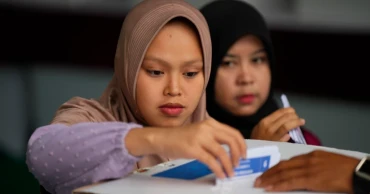
Indonesian voters are choosing a new president in one of the world's largest elections
Indonesian voters were choosing a new president Wednesday as the world’s third-largest democracy aspires to become a global economic powerhouse a quarter-century after shaking off a brutal dictatorship.
The front-runner, Defense Minister Prabowo Subianto, is the only candidate with ties to the Suharto era. He was a special forces commander at the time and has been accused of human rights atrocities, which he vehemently denies.
Two former provincial governors, Anies Baswedan and Ganjar Pranowo, are also vying to succeed the immensely popular President Joko Widodo, who is serving the final of his two terms in office. Widodo’s rise from a riverside slum to the presidency has shown the vibrancy of Indonesia’s democracy in a region rife with authoritarian regimes.
Widodo's successor will inherit an economy with impressive growth and ambitious infrastructure projects, including the ongoing transfer of the nation's capital from congested Jakarta to the frontier island of Borneo at a staggering cost exceeding $30 billion.
The stakes in Indonesia as the world’s third-largest democracy elects a new president
The election also has high stakes for the United States and China, since Indonesia has a huge domestic market, natural resources like nickel and palm oil, and diplomatic influence with its Southeast Asian neighbors.
Polls opened at 7 a.m. in each of the three time zones across the tropical nation's 17,000 islands inhabited by 270 million people. The logistics of the vote were daunting: Ballot boxes and ballots were transported by boats, motorcycles, horses and on foot in some of the more far-flung locations.
A fierce thunderstorm flooded several streets of Jakarta at dawn Wednesday. Last week, damage from heavy rains in Central Java's Demak regency prompted the postponement of the election in 10 villages.
Aside from the presidency, some 20,000 national, provincial and district parliamentary posts were being contested by tens of thousands of candidates in one of the world's largest elections, which authorities expect to be largely peaceful. About 10,000 aspirants from 18 political parties were eyeing the national parliament’s 580 seats alone.
A defense minister and 2 former governors vie for Indonesia’s presidency
The official vote tally is a laborious process that could take about a month, but early results based on sampling from registered private polling and survey groups are considered a reliable indicator of the official results.
Subianto, the oldest presidential candidate at 72, lost in two previous runs to Widodo but is now the front-runner, based on independent surveys. He picked Widodo’s eldest son, Gibran Rakabuming Raka, as his vice-presidential running mate in a move that could shore up his chances given the outgoing president's popularity.
Raka, 36, was allowed to run when the Constitutional Court made an exception to the minimum age requirement of 40. The court was then headed by Widodo’s brother-in-law, who was removed by an ethics panel for not recusing himself, and Widodo was accused of favoritism and nepotism.
Critics have accused Widodo of trying to build a political dynasty despite his being the first president to emerge outside the political and military elite since the 1998 end of the dictatorial rule of Suharto, characterized by widespread human rights violations, plunder and political unrest.
Subianto, a former lieutenant general who married one of Suharto's daughters, was a longtime commander in the army special forces, called Kopassus. He was dishonorably discharged in 1998 after Kopassus forces kidnapped and tortured political opponents of Suharto.
Of at least 22 activists kidnapped that year, 13 remain missing to this day, and their families protest weekly outside the presidential palace demanding the activists be accounted for. Subianto never faced a trial and vehemently denied any involvement, although several of his men were tried and convicted.
During the campaign period that concluded last weekend, Subianto and his strategists used AI and social media platforms like TikTok to soften his image by portraying him as a cuddly grandfather to his youthful running mate. Rejected by human rights activists, he danced on the campaign stage and promised to generate nearly 20 million jobs in his first term if elected.
Baswedan, the former head of an Islamic university, served as governor of Jakarta until last year. A former Fulbright scholar, Baswedan was education and culture minister from 2014 to 2016, when Widodo removed him from the Cabinet after accusing him of failing to address problems by thousands of students affected by forest fires.
Baswedan opposes Widodo’s plan to move the Indonesian capital from Jakarta to Nusantara on Borneo island, which involves constructing government buildings and residential enclaves by clearing lush tropical rainforests.
In an interview with The Associated Press last month, he said democracy in Indonesia is under threat, given Subianto’s choice of the president's son as running mate.
“This means that there is a decline in trust, it means that our democracy is experiencing a decline in quality, it means that many legal rules are being bent,” he said.
Pranowo is the ruling party candidate but does not have Widodo's support. He was a national legislator for the ruling Indonesian Democratic Party of Struggle for 10 years before being elected in 2013 for the first of two terms as governor of vote-rich Central Java region.
While governor, Pranowo refused to allow Israel to participate in the Under-20 FIFA World Cup to be held in his province. FIFA subsequently dropped Indonesia as host of the games, angering Indonesian soccer fans and Widodo.
Israel and Indonesia, the world’s largest Muslim-majority nation, do not have diplomatic ties.
Under Widodo, Indonesia saw a period of remarkable growth averaging 5% annually, except in 2020, when the economy contracted due to the coronavirus pandemic.
His economic roadmap, called “Golden Indonesia 2045,” projects Indonesia becoming one of the world’s top five economies with GDP of up to $9 trillion, exactly a century after it won independence from Dutch colonizers.
2 years ago

OpenAI CEO warns that 'societal misalignments' could make artificial intelligence dangerous
The CEO of ChatGPT-maker OpenAI said Tuesday that the dangers that keep him awake at night regarding artificial intelligence are the "very subtle societal misalignments" that could make the systems wreak havoc.
Sam Altman, speaking at the World Government Summit in Dubai via a video call, reiterated his call for a body like the International Atomic Energy Agency to be created to oversee AI that's likely advancing faster than the world expects.
"There's some things in there that are easy to imagine where things really go wrong. And I'm not that interested in the killer robots walking on the street direction of things going wrong," Altman said. "I'm much more interested in the very subtle societal misalignments where we just have these systems out in society and through no particular ill intention, things just go horribly wrong."
However, Altman stressed that the AI industry, like OpenAI, shouldn't be in the driver's seat when it comes to making regulations governing the industry.
"We're still in the stage of a lot of discussion. So there's you know, everybody in the world is having a conference. Everyone's got an idea, a policy paper, and that's OK," Altman said. "I think we're still at a time where debate is needed and healthy, but at some point in the next few years, I think we have to move towards an action plan with real buy-in around the world."
OpenAI, a San Francisco-based artificial intelligence startup, is one of the leaders in the field. Microsoft has invested some $1 billion in OpenAI. The Associated Press has signed a deal with OpenAI for it to access its news archive. Meanwhile, The New York Times has sued OpenAI and Microsoft over the use of its stories without permission to train OpenAI's chatbots.
OpenAI's success has made Altman the public face for generative AI's rapid commercialization — and the fears over what may come from the new technology.
The UAE, an autocratic federation of seven hereditarily ruled sheikhdoms, has signs of that risk. Speech remains tightly controlled. Those restrictions affect the flow of accurate information — the same details AI programs like ChatGPT rely on as machine-learning systems to provide their answers for users.
The Emirates also has the Abu Dhabi firm G42, overseen by the country's powerful national security adviser. G42 has what experts suggest is the world's leading Arabic-language artificial intelligence model. The company has faced spying allegations for its ties to a mobile phone app identified as spyware. It has also faced claims it could have gathered genetic material secretly from Americans for the Chinese government.
G42 has said it would cut ties to Chinese suppliers over American concerns. However, the discussion with Altman, moderated by the UAE's Minister of State for Artificial Intelligence Omar al-Olama, touched on none of the local concerns.
For his part, Altman said he was heartened to see that schools, where teachers feared students would use AI to write papers, now embrace the technology as crucial for the future. But he added that AI remains in its infancy.
"I think the reason is the current technology that we have is like ... that very first cellphone with a black-and-white screen," Altman said. "So give us some time. But I will say I think in a few more years it'll be much better than it is now. And in a decade it should be pretty remarkable."
2 years ago

Biden welcomes King of Jordan as framework for hostage deal is decided in Israel-Hamas conflict
President Joe Biden is hosting Jordan’s King Abdullah II in Washington Monday and the two leaders are expected to discuss the ongoing effort to free hostages held in Gaza, and growing concern over a possible Israeli military operation in the port city of Rafah.
It is the first meeting between the allies since three American troops were killed last month in a drone strike against a U.S. base in Jordan. Biden blamed Iran-backed militias for the fatalities, the first for the U.S. after months of strikes by such groups against American forces across the Middle East since the start of the Israel-Hamas war.
The meeting with King Abdullah II comes as Biden and his aides are working to broker another pause in Israel's war against Hamas in order to send humanitarian aid and supplies into the region and get hostages out. The White House faces growing criticism from Arab-Americans over the administration's continued support for Israel in the face of growing casualties in Gaza.
Read: Biden warns of a 'nightmare' future for the country if Trump should win again, and lists reasons why
It appeared a deal for another pause in the fighting was getting close. A senior U.S. administration official said Sunday that after weeks of shuttle diplomacy and phone conversations, a framework was essentially in place for a deal that could see the release of the remaining hostages held by Hamas in Gaza in exchange for a halt to fighting.
The official, who spoke on the condition of anonymity to discuss the negotiations, acknowledged that gaps remained but declined to specify what they are. The official said Israeli military pressure on Hamas in Khan Younis over the last several week s has helped bring the militant group closer to accepting an agreement. The potential for an agreement took up the majority of Biden’s call Sunday with Israeli Prime Minister Benjamin Netanyahu.
The official said the two leaders also had a significant back and forth about the potential expansion of Israeli military operations into Rafah and that Biden reiterated U.S. opposition to the idea under the “current conditions” while more than 1.3 million people are sheltering there.
It was the most forceful language yet from the president on the possible operation. Biden, who last week called Israel’s military response in Gaza “over the top,” also sought “urgent and specific” steps to strengthen humanitarian aid. Israel’s Channel 13 television said the conversation lasted 45 minutes.
Read: US hits hard at militias in Iraq and Syria, retaliating for fatal drone attack
The official said the Israelis “made clear they would not contemplate an operation" in Rafah without safeguarding the civilian population. The official said the U.S. is not sure there is a feasible or implementable plan to relocate civilians out of Rafah to allow military operations to take place.
Jordan and other Arab states have been highly critical of Israel’s actions and have eschewed public support for long-term planning over what happens next, arguing that the fighting must end before such discussions can begin. They have been demanding a cease-fire since mid-October as civilian casualties began to skyrocket.
Biden had planned to visit Jordan during his trip to Israel in October shortly after the Oct. 7 attack by Hamas, but the trip was scrapped. On his way home from Israel, Biden announced he'd helped broker the first deal to pause fighting temporarily and to open the crossing in Rafah to humanitarian aid.
In the months since, members of his administration have made repeated trips to the region to engage with leaders there.
2 years ago

54 people are confirmed dead in a landslide that buried a gold-mining village in south Philippines
The death toll from a massive landslide that hit a gold-mining village in the southern Philippines has risen to 54 with 63 people still missing, authorities said Sunday.
The landslide hit the mountain village of Masara in Davao de Oro province on Tuesday night after weeks of torrential rains.
Davao de Oro’s provincial government said in a Facebook post that 54 bodies had been recovered. At least 32 residents survived with injuries but 63 remained missing, it said. Among those missing were gold miners who had been waiting in two buses to be driven home when the landslide struck and buried them.
Read: 29 dead after bus plunges off cliff in central Philippines
The search operation has been hampered by poor weather and fears of more landslides. More than 1,100 families have been moved to evacuation centers for their safety, disaster response officials said.
The area has been swamped by heavy rains in the weeks before the landslide struck. Earthquakes also damaged houses and buildings in the region in recent months, officials said.
2 years ago

Gender equality in science essential to building better future for all: Guterres
UN Secretary-General António Guterres has stressed that gender equality in science is essential to building a better future for all.
"Sadly, women and girls continue to face systemic barriers and biases that prevent them from pursuing careers in science," he said in a message on the occasion of the International Day of Women and Girls in Science, celebrated on 11 February.
The Secretary-General believes that it is essential that women and girls participate equally in scientific discoveries and innovations, whether in the field of climate change, health or artificial intelligence". "This is the only way to ensure that science benefits everyone," he said.
Today, women make up only a third of the global scientific community and, compared to men, they get less funding, are underrepresented in publications and hold fewer senior positions in major universities.
In some places, women and girls have limited or no access to education. Guterres described this situation as not only harmful to the societies concerned, but also a terrible violation of human rights.
"Addressing gender inequalities requires overcoming gender stereotypes and promoting role models that encourage girls to pursue scientific careers, developing programmes that encourage the advancement of women in science, and creating work environments that nurture women's talents. especially those of women from minority groups," he added.
"Women and girls belong in science. It is time to recognize that inclusion fosters innovation, and let every woman and girl fulfil her true potential," the UN chief concluded.
2 years ago

Furor over Messi no-show in Hong Kong game deepens with Argentina's tour of China canceled
The fallout from Lionel Messi’s failure to play in a club exhibition match in Hong Kong has spread with both of Argentina’s friendly matches as part of a tour of mainland China next month canceled by local football authorities.
The Beijing Football Association said on Saturday it would not organize Argentina’s scheduled friendly against Ivory Coast in Beijing in March, reportedly saying to local media: “Beijing does not plan, for the moment, to organise the match in which Lionel Messi was to participate.”
The news comes a day after Chinese sports authorities canceled Argentina’s scheduled exhibition match against Nigeria.
World Cup champion Argentina, captained by Messi, last month scheduled a tour of China during the international break from March 18-26 with games lined up against Nigeria in Hangzhou and Ivory Coast in Beijing.
But Messi, on tour with his Inter Miami club, outraged fans in Hong Kong when he didn’t play against a local selection last Sunday and remained on the bench. Messi said he had a groin injury. But his excuse didn’t wash in Hong Kong after he played for 30 minutes on Wednesday in Tokyo against Vissel Kobe.
2 years ago