Others

Global Refugee Forum-2023 begins in Geneva Wednesday
Global Refugee Forum (GRF), the largest international conference on refugee issues, will take place in Geneva, Switzerland, from December 13-15.
It will seek to focus the international discussion on solutions rather than crises, said the UN refugee agency, UNHCR.
Co-hosted by UNHCR, the UN Refugee Agency, and the Government of Switzerland, the forum has been co-convened by Colombia, France, Japan, Jordan and Uganda.
It aims to focus a range of actors on finding solutions to the plight of refugees, and to support the objectives of the Global Compact on Refugees as affirmed by the United Nations General Assembly in December 2018.
Participants – including states, the private sector, international financial institutions, UN agencies, humanitarian and development organizations, cities and local authorities, NGOs, refugee-led organizations, faith groups and others – will take stock of the progress made since the first GRF in 2019 and make concrete pledges and contributions to improve the lives of 36.4 million refugees around the world.
Contributions to the GRF can take many forms: financial, material or technical assistance, including places for resettlement and other paths to admission to third countries, enabling better resourced countries to share the responsibility for refugees; as well as measures to support host communities, prevent conflict and build peace. Organizations can pledge alone or combine efforts in groups.
Some of the world’s leading companies, foundations and philanthropists will be represented at the GRF, emphasizing the important and multifaceted role of the private sector in supporting refugees.
These actors are already making a key contribution to life-saving assistance and sustainable solutions. Private sector contributions include direct support to refugee and host community entrepreneurs as well as refugee-led organizations; the provision of jobs and skilling opportunities; pro bono legal and consulting services, such as financial services, clean energy and digital learning solutions.
Also read: Support desperate Rohingya refugees following Indonesia: UN expert
During the GRF, 32 UN organizations and 49 UN Country Teams will sign up to a “UN Common Pledge 2.0”, committing to support refugee-hosting countries with the inclusion of refugees in national plans, budgets and service delivery systems – such as education, health, water and sanitation, housing and social protection; as well as access to decent work.
Including refugees on the same basis as nationals is essential – at least until they can return safely home.
It is also a cost-effective solution to transition away from humanitarian assistance, particularly in protracted situations, while enhancing refugee self-reliance and resilience.
Also read: Prolonged presence of Rohingya refugees not an option: Bangladesh tells UN
US Assistant Secretary of State for the Bureau of Population, Refugees, and Migration Julieta Valls Noyes will travel to Geneva, Switzerland December 12-15, 2023.
In Geneva, Assistant Secretary Noyes will join the U.S. delegation at the Global Refugee Forum (GRF), the largest international gathering on refugees, held every four years.
At the GRF, the Assistant Secretary will participate in high-level meetings with senior government officials, as well as non-governmental and international organization partners, on topics including refugee employment and entrepreneurship, private sector engagement, and solutions for Rohingya refugees.
She will chair a high-level event on the MIRPS Support Platform, a donor coordination and awareness-raising forum to foster regional solutions to forced displacement, bolstering efforts by governments in Central America and Mexico.
Also read: Rohingya refugees in Bangladesh face new crisis as funding diminishes: UN
The Assistant Secretary will chair a Senior Officials’ meeting of the Resettlement Diplomacy Network, a multilateral initiative launched by the United States in 2022 to drive strategic diplomatic engagement on global refugee resettlement and protection.
US Assistant Secretary Noyes will participate in a U.S.-hosted dinner with the World Economic Forum calling on humanitarian and development organizations, donors, development finance institutions, foundations, investors, and others to mobilize $10 billion in capital to establish or grow 1,000 businesses in fragile or frontier markets by 2030.
2 years ago

Suicide bomber attacks police station in northwest Pakistan, killing 22 officers and wounding 32
A suicide bomber detonated his explosive-laden vehicle at a police station’s main gate in northwest Pakistan early Tuesday, killing at least 22 officers and wounding 32 others, and causing a part of the building to collapse upon impact, officials said, in one of the deadliest attacks in recent months.
Some militants also opened fire and a shootout ensued for hours between them and security forces before three attackers were gunned down, local police officer Kamal Khan said.
The death toll from the attack was likely to rise as some of the officers were in critical condition, authorities said. The bodies of the 22 security forces killed were transferred to a hospital, Mohammad Adnan, a senior police official told reporters.
Israel presses on with Gaza bombardments, including in areas where it told civilians to flee
Police launched a search operation in the surrounding area to apprehend the militants who got away, officials said.
The attack happened in Dera Ismail Khan, a city in Khyber Pakhtunkhwa province bordering Afghanistan, Khan said. The province is a former stronghold of the militant Pakistani Taliban group, also known as Tehreek-e-Taliban Pakistan, or TTP.
4, including Swechchhasebak Dal activist , arrested for crude bomb attacks in Dhaka
The newly formed militant group Tehreek-e-Jihad Pakistan, or TJP — believed to be an offshoot of the TTP — claimed responsibility for the attack in a statement, saying it targeted the officers who were at the police station. The statement also claimed that 20 officers were killed. However, this couldn’t be independently verified.
A larger number of security forces from across the country have had a constant presence lately at the Daraban police station where they were conducting intelligence-based operations against militants in the area with help from local police, said Khan
Pakistan’s caretaker Interior Minister Sarfraz Bugti denounced the onslaught in a statement and conveyed his condolences to those who were “martyred”. He couldn’t immediately confirm the number of officers killed in the attack which he called an act of “terrorism.”
Several crude bombs explode in front of Divisional Commissioner’s office in Dhaka’s Segunbagicha
Khyber Pakhtunkhwa has witnessed a rise in violence with several deadly incursions this year. In January, at least 101 people were killed, mostly police officers, when a suicide bomber disguised as a policeman attacked a mosque in the northwestern city of Peshawar.
The Pakistani Taliban have stepped up attacks on security forces since 2022. Authorities say the insurgents have become emboldened while living openly in Afghanistan since the Taliban takeover of that country in 2021.
The TTP, though a separate group, is closely allied with the Afghan Taliban.
Dera Ismail Khan is located near South Waziristan, a former sanctuary for militants. Pakistan’s army carried out multiple operations against militants there after some attacked an army-run school, killing more than 150 people, mostly school children, in 2014.
2 years ago

As COP28 nears finish, critics say proposal 'doesn't even come close' to what's needed on climate
Negotiators from around the world haggled deep into the night to try to strike a deal to halt global warming at United Nations climate talks, with Western powers and vulnerable developing countries worried that a proposed text fell far short of goals to save the planet.
A new draft released Monday of what's known as the global stocktake — the part of talks that assesses where the world is at with its climate goals and how it can reach them — called for countries to reduce “consumption and production of fossil fuels, in a just, orderly and equitable manner."
The release triggered a frenzy of fine-tuning by government envoys and rapid analysis by advocacy groups, just hours before the planned late morning finish to the talks on Tuesday — even though many observers expect the finale to run over time, as is common at the annual U.N. talks.
Bangladesh climate envoy Saber Chowdhury said a revised text would be presented Tuesday morning that takes into account the many comments from participants.
“It’ll be new. To what extent it’s improved remains to be seen,” he said shortly after the session ended at around 2 a.m.
In a closed-door meeting late Monday, some country delegation chiefs needled COP28 President Sultan al-Jaber’s frequent calling of the goal to limit warming to 1.5 degrees Celsius (2.7 degrees Fahrenheit) since preindustrial times his “north star,” saying the president’s proposal misses that star.
“It is not enough to say 1.5, we have to do 1.5. We have to deliver accordingly,” Norway minister Espen Barth Eide said.
Some Pacific Island nations argued the text amounted to a death sentence.
The proposed text “doesn’t even come close to delivering 1.5 as a north star,” Tuvalu’s delegation chief Seve Paeniu said. “For us this is a matter of survival. We cannot put loopholes in our children’s futures.”
Small island nations are some of the most vulnerable places in a world of rising temperatures and seas. Final decisions by COPs have to be by consensus. Activists said they feared that potential objections from fossil fuel countries, such as Saudi Arabia, had watered down the text.
United States climate envoy John Kerry says the language on fossil fuels in the text “does not meet the test” of keeping 1.5 alive.
“I, like most of you here, refuse to be part of a charade” of not phasing out fossil fuels, Kerry said. “This is a war for survival.”
Kerry's remarks received a round of applause from the room. But when he left the meeting, climate activists confronted Kerry, calling for more action, saying their future was at stake.
“Young voters like me who want to vote for Biden and who want to vote Democratic are not feeling that our voices are being heard and that we need a transition away and out of fossil fuels,” said activist Elizabeth Morrison.
2 years ago

US imposes visa restrictions on nearly 300 Guatemalan lawmakers, others for ‘undermining democracy’
The Biden administration announced on Monday that it has imposed visa restrictions on nearly 300 Guatemalan lawmakers, private sector leaders and their families it accuses of "undermining democracy and the rule of law.”
Guatemala faces mounting criticism by world leaders and watchdogs accusing it of attempts to block progressive President-elect Bernardo Arévalo from taking office in January.
The victory of Arévalo and his Seed Movement party is seen as a threat to those who have long wielded power in Guatemala. The anti-corruption crusader has been a target for months, with arrests of party members, raids and repeated requests to lift his immunity so prosecutors can investigate him directly.
The State Department in a statement condemned “ongoing anti-democratic actions” by prosecutors and other actors and noted “intent to delegitimize Guatemala’s free and fair elections and prevent the peaceful transition of power.”
Read: Oman suspends issuing all types of visas to Bangladeshi citizens
The State Department did not provide The Associated Press with the names of those subject to visa restrictions.
In its statement, it said those individuals were “responsible for, or complicit in” political targeting of opposition, intimidation of peaceful protestors, raids, opening of ballot boxes and lifting of immunity of electoral magistrates who certified the election.
Last week, prosecutors alleged that minutes seized during a raid of electoral offices showed that results from the presidential runoff vote Arévalo won in August had irregularities and were therefore void.
Arévalo accused the prosecution of seeking to undermine his ability to govern, and was quickly backed by a growing number of international entities such as the Organization of American States and the European Union, which had sent observers to monitor the election and confirmed that voting adhered to democratic standards.
Read: US says will review all violent incidents for possible visa restrictions
The visa restrictions imposed by the United States were likely prompted by a series of controversial congressional votes in November. One targeted four electoral magistrates, who later left the country. Another passed a budget that critics say would simultaneously handicap Arévalo in delivering on campaign promises while boosting funding for offices that have supported alleged democratic attacks.
EU foreign policy chief Josep Borrell said Friday that the bloc was also contemplating sanctions on those attempting to reverse the vote.
“These latest actions and statements of the Public Prosecutor’s Office of Guatemala represent an attempt at a coup d’etat, spearheaded by politically motivated prosecutors,” Borrell said in a statement. “They show contempt for the clear will of Guatemala’s citizens.”
2 years ago

Palestinians hope a vote in the UN General Assembly will show wide support for a Gaza cease-fire
The Palestinians are hoping that a vote Tuesday in the U.N. General Assembly on a nonbinding resolution demanding an immediate humanitarian cease-fire will demonstrate widespread global support for ending the Israel-Hamas war, now in its third month.
After the United States vetoed a resolution in the Security Council on Friday demanding a humanitarian cease-fire, Arab and Islamic nations called for an emergency session of the 193-member General Assembly on Tuesday afternoon to vote on a resolution making the same demand.
Unlike Security Council resolutions, General Assembly resolutions are not legally binding. But as U.N. spokesperson Stephane Dujarric said Monday, the assembly’s messages “are also very important” and reflect world opinion.
Riyad Mansour, the Palestinian ambassador to the United Nations, told The Associated Press on Sunday that the defeated resolution in the Security Council was cosponsored by 103 countries, and he is hoping for more cosponsors and a high vote for the General Assembly resolution on Tuesday.
Read: Iraq scrambles to contain fighting between US troops and Iran-backed groups, fearing Gaza spillover
In the first U.N. response to the Gaza war, the General Assembly on Oct. 27 called for a “humanitarian truce” in Gaza leading to a cessation of hostilities. The vote was 120-14 with 45 abstentions.
After four failures, the Security Council on Nov. 15 adopted its first resolution after the outbreak of the Israel-Hamas war, calling for “urgent and extended humanitarian pauses” in Gaza to address the escalating crisis for Palestinian civilians during Israel’s aerial and ground attacks.
That vote in the 15-member council was 12-0 with the United States, United Kingdom and Russia abstaining. The U.S. and U.K. said they abstained because the resolution did not condemn Hamas’ Oct. 7 attack on Israel in which about 1,200 people were killed and 240 abducted, and Russia because of its failure to demand a humanitarian cease-fire, which Israel and the United States oppose.
As the death toll in Gaza has mounted during Israel’s campaign to obliterate Hamas, calls for a cease-fire have escalated, and on Friday the U.S. was isolated in its support for Israel in the Security Council, where the vote was 13-1 with the United Kingdom abstaining.
Read: Battles rage across Gaza as Israel indicates it's willing to fight for months or more to beat Hamas
The Security Council meeting and vote last Friday were a response to a letter from U.N. Secretary-General Antonio Guterres, who invoked Article 99 of the U.N. Charter, which enables a U.N. chief to raise threats he sees to international peace and security. He warned of a “humanitarian catastrophe” in Gaza and urged the council to demand a humanitarian cease-fire.
Guterres said he raised Article 99 — which hadn’t been used at the U.N. since 1971 — because “there is a high risk of the total collapse of the humanitarian support system in Gaza.” The U.N. anticipates this would result in “a complete breakdown of public order and increased pressure for mass displacement into Egypt,” he warned.
Gaza is at “a breaking point” and desperate people are at serious risk of starvation, Guterres said, stressing that Hamas’ brutality against Israelis on Oct. 7 “can never justify the collective punishment of the Palestinian people.”
Like the Security Council resolution, the draft General Assembly resolution makes no mention of Hamas or the Oct. 7 attacks on Israel.
Read: Gaza sees intense fighting as Israel advances with renewed US support
It expresses “grave concern over the catastrophic humanitarian situation in the Gaza Strip and the suffering of the Palestinian civilian population” and says Palestinian and Israeli people must be protected in accordance with international humanitarian law.
In addition to an immediate humanitarian cease-fire, the draft demands that all parties comply with international humanitarian law, “notably with regard to the protection of civilians,” and calls for “the immediate and unconditional release of all hostages, as well as ensuring humanitarian access.”
2 years ago

Italy to throw away 500,000 tonnes of food over Xmas
Italy's households throw away 500,000 tonnes of food every year over the Christmas holidays, consumer association Assoutenti said on Sunday.
It said fresh produce like fruit and vegetables are among the most frequently thrown-away foods, along with pasta, seafood, panettoni and even spumante sparkling wine.
The association estimates that the average Italian family will chuck up to 80 euros worth of food in the bin over the festive period.
It said the value of waste in Italy's food sector added up nine billion euros a year and around 6.5 billion euros of that was thrown away in the home.
2 years ago

UN officials and activists ramp up the urgency as climate talks enter final days
Delegates at the United Nations climate talks have little time left to decide how the world plans to cap planet-warming emissions and keep the worst of warming at bay, ramping up the urgency as new drafts were expected on key outcomes of the summit.
U.N. Secretary General Antonio Guterres returned to the summit on Monday and said it was “time to go into overdrive to negotiate in good faith and rise to the challenge.” He said negotiators in particular must focus on the reduction of greenhouse gas emissions and climate justice.
He said the global stocktake — the part of talks that assesses where the world is at with its climate goals and how it can reach them — should "phase out all fossil fuels” in order to reach the goal of limiting the rise of global temperatures to 1.5 degrees Celsius (2.7 degrees Fahrenheit) compared with pre-industrial times.
READ: COP28: Civil society urges compensation for most vulnerable countries
"We can’t keep kicking the can down the road,” Guterres said in brief remarks. “We are out of road and almost out of time.”
Nearby, about 15 silent protesters held out cards that spelled out “hold the line.”
Simon Stiell, the executive secretary of the U.N. Framework Convention on Climate Change, told journalists Monday morning that the “climate wolves” remained at the world’s doors as negotiations reach their climax at the summit.
“We do not have a minute to lose in this crucial final stretch and none of us have had much sleep,” Stiell said. He added that “the areas where options need to be negotiated have narrowed significantly,” in particular how to reduce planet-warming emissions and the “transition with the proper means of support to deliver it.”
READ: At COP28, sticking points remain on fossil fuels and adapting to climate as talks near crunch time
When asked directly if it was a possibility that negotiators could leave Dubai without a deal, Stiell did not deny that could happen.
“One thing is for certain: I win, you lose is a recipe for collective failure,” he said.
Sticking points for the global stocktake are along familiar lines. Many countries, including small island states, European countries and Latin American nations, are calling for a phase-out of fossil fuels, responsible for most of the warming on Earth. But other nations want weaker language that will allow oil, gas and coal to keep burning in some way.
“All countries want ambition, but some countries have their priorities one place and other countries another place,” said Espen Barth Eide, the Foreign Minister of Norway. “So this can still both end up as a very successful COP, and it can also be much less successful depending on where we find the final language.”
READ: Bangladesh moving ahead with enhanced national mechanism amid loss and damage breakthrough at COP28
He said that more developing countries would support a fossil fuel phase-out “if that is coupled with a clear promise from developed countries that they will help overcome the burden.”
As of midday on Monday, delegates were still waiting on a new draft of the global stocktake.
But Barth Eide said: “I am much more concerned about having a good text than an early text. So if if the hours delay means that it will be better, I think that’s worth it.”
2 years ago

Blinken defends bypassing Congress to sell weapons to Israel and presses lawmakers to help Ukraine
Secretary of State Antony Blinken on Sunday defended the emergency sale to Israel of nearly 14,000 rounds of tank ammunition and also called for quick congressional approval of more than $100 billion in aid for Israel, Ukraine and other national security priorities.
Blinken said the needs of Israel's military operations in Gaza justify the rare decision to bypass Congress. “Israel is in combat right now with Hamas,” he said during television interviews. “And we want to make sure that Israel has what it needs to defend itself against Hamas."
The tank ammunition and related support constitute only a small portion of military sales to Israel, Blinken said, and that the rest remains subject to congressional review. "It’s very important that Congress‘s voice be heard in this,” he said.
The decision to proceed with the sale of more than $106 million for tank shells came as the Biden administration's larger aid package is caught up in a debate over U.S. immigration policy and border security.
Blinken noted that President Joe Biden has said he is willing to make significant compromises to get the aid package moving. ``It’s something the president is fully prepared to engage on," Blinken said.
The stakes are especially high for Ukraine, America's top diplomat said, given that “we are running out of funding” for the Ukranians.
"This is a time to really step up because if we don’t, we know what happens. (Russian President Vladimir) Putin will be able to move forward with impunity and we know he won't stop in Ukraine.”
Blinken appeared on ABC's “This Week” and CNN's “State of the Union.”
2 years ago
Over 300 Rohingyas fleeing Myanmar arrive in Indonesia's Aceh after weeks at sea
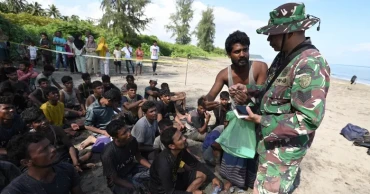
Two boats carrying more than 300 Rohingya Muslims, including emaciated women and children, arrived at Indonesia’s northernmost province of Aceh on Sunday morning after being adrift for over weeks.
One boat, which had been at sea for about one and a half months and carrying 135 passengers, arrived at a beach in Lamreh village in Aceh Besar Regency. Shahidul Islam, a 34-year-old survivor, said they left their refugee camp in Bangladesh. “The boat was sinking. We had no food or water left.”
The other boat carrying nearly 180 people docked at a beach in Blang Raya village at Pidie Regency. It has been adrift in the Andaman Sea without adequate supplies for about 27 days. Mahmud Husein, 25, a survivor, said he gave 40,000 taka ($363) to the boat owner to help him leave Bangaldesh.
Read: Israel moves into Gaza's second-largest city and intensifies strikes in bloody new phase of the war
“We came to Indonesia, but we want to go to other countries if other countries want to help us,” Husein said.
Another boat, carrying more refugees, embarked from Bangaldesh at the same time, Husein confirmed, but it remained missing. The U.N. refugee agency warned that people onboard could die if more is not done to rescue them.
About 740,000 Rohingya Muslims have fled Buddhist-majority Myanmar to camps in Bangladesh since August 2017, following a brutal counterinsurgency campaign. Myanmar security forces have been accused of mass rapes, killings and the burning of thousands of Rohingya homes, and international courts are considering whether their actions constitute genocide.
Since November, more than 1,500 Rohingya refugees have arrived by boat in Indonesia’s Aceh province. Some were denied landing by the residents in Aceh Utara district and Sabang island, sparking concerns from human rights organizations.
Rijalul Fitri, head of Blang Raya village in Aceh, said Sunday they do not want them in their village. “We stayed up all night so as not to allow them to dock, but at 2.30 a.m., they arrived,” he said.
Fitri was adamant about the refugees’ relocation, saying, “they can’t stay here.”
President Joko Widodo on Friday said in a statement that Indonesia’s government suspects a surge in human trafficking because of the increasing number of Rohingya Muslims that have entered the country over the past few weeks, especially in Aceh.
Read: At least 85 civilians killed by a Nigerian army drone attack
Police in the city of Lohkseumawe — where there is a camp for Rohingya Muslim refugees — arrested three Aceh residents for human trafficking. They are charged with taking money, 1.8 million rupiah ($115) to smuggle 30 refugees from the camp to the city of Medan in North Sumatra province, said Henki Ismanto, the Lhokseumawe police chief.
Most of the refugees leaving by sea attempt to reach Muslim-majority Malaysia, in search of work. Indonesia, where Muslims comprise nearly 90% of the country’s 277 million people, has been detaining them .
2 years ago

US vetoes UN resolution demanding immediate humanitarian ceasefire in Gaza
The United States vetoed a United Nations resolution demanding an immediate humanitarian cease-fire in Gaza, where Israeli troops rounded up Palestinian men in the northern part of the territory for interrogation, seeking Hamas militants.
The U.N. vote came after Secretary-General Antonio Guterres for the first time invoked Article 99 of the U.N. Charter, which enables a U.N. chief to raise threats he sees to international peace and security. He warned of a “humanitarian catastrophe” in Gaza.
UN experts urge States to unite for peace and push for ceasefire in Gaza
U.S. Deputy Ambassador Robert Wood said halting military action would allow Hamas to continue to rule Gaza and “only plant the seeds for the next war.”
Around 1,200 people have died on the Israeli side, mainly civilians killed during Hamas’ Oct. 7 attack that triggered the war. The Health Ministry in Hamas-run Gaza said the death toll in the territory has surpassed 17,400, with more than 46,000 wounded. The ministry does not differentiate between civilian and combatant deaths, but said 70% of the dead were women and children.
Desperation grows among Palestinians trapped with little aid as Israel battles Hamas in Gaza
2 years ago