Others

UN experts urge States to unite for peace and push for ceasefire in Gaza
Member States of the United Nations must use all measures at their disposal and their influence to promote an immediate and permanent ceasefire in Gaza, UN human rights experts* said, issuing a clarion call for peace ahead of a crucial Security Council vote in New York today.
“UN Member States must mobilise now and act collectively to save Gaza from total destruction and mass mortality, in order to preserve the raison d’être of the United Nations,” the experts said. “Member states must act at the Security Council or the General Assembly as applicable, to push for a permanent ceasefire in Gaza,” they said.
The UN experts welcomed Secretary-General Antonio Guterres’ letter to the UN Security Council, based on Article 99 of the United Nations Charter, calling on the Council to take urgent action to avert a total collapse of public order and the humanitarian system in Gaza.
“We extend our fullest support to Secretary-General Guterres, as he assumes greater leadership in the effort to end the humanitarian catastrophe unfolding in Gaza,” the experts said.
UN humanitarian agencies sounded the alarm this week that the situation in Gaza was ‘apocalyptic.’
The experts deplored the collapse of the temporary humanitarian ceasefire and the resumption of Israel’s large-scale military operations in Gaza on 1 December. Over the past seven days, Israeli bombardment has killed more than 2,000 Palestinians, increasing the total number of Palestinian fatalities since the start of hostilities to above 17,000. Seventy percent of those killed in the violence are reportedly women and children. Relentless military operations and ever-expanding evacuation orders have displaced 85 percent of Gaza’s population. “These actions could possibly amount to the forcible transfer of a population – a crime against humanity,” the experts said.
The Israeli military’s massive bombardment, in a manner inconsistent with international humanitarian law, has not spared hospitals, schools, refugee camps, residential buildings, markets and religious establishments, where civilians should be safe and protected from indiscriminate and disproportionate attacks. The experts expressed alarm that the entry and provision of humanitarian aid has dwindled since the resumption of hostilities, due to shortages in basic supplies, lack of fuel, disrupted communications, movement restrictions and severe insecurity in the besieged Gaza strip. They suggested that such actions could be tantamount to collective punishment, which is prohibited under international humanitarian law.
“In the short term, a ceasefire is an essential precondition for urgently stabilising the humanitarian situation in Gaza. To ensure the basic safety and needs of the civilian population, especially women and children in Gaza in the longer term, consultations and preparations must now be launched towards the deployment of an international protective presence in the entire Occupied Palestinian Territory under the supervision of the UN,” the experts said. They called for the support and inclusion of Palestinian civil society, as an integral part of any decision-making to ensure the needs of affected communities are taken into account.
“UN Member States must do all that they can to end the epic suffering in Gaza and restore international peace and security, before we reach a point of no-return,” the experts warned.
2 years ago

Climate talks shift into high gear. Now words and definitions matter at COP28
The mood is about to shift, the hours grow longer and the already high sense of urgency somehow amp up even more as the United Nations climate summit heads into its final week.
Every sentence, every word — especially those about the future elimination of planet-warming fossil fuels — will matter at the U.N. conference in oil-built Dubai in the United Arab Emirates. Professional negotiators who have been working on getting options into shape will turn over their work to senior national officials, many at minister levels, who will have to make the tough political choices.
"We're heading into quite a political process, less access into the negotiating rooms, negotiations will go deep into the night, a number of nights," said David Waskow, international climate initiative director for the World Resources Institute.
Also read: UN chief uses rare power to warn Security Council of impending 'humanitarian catastrophe' in Gaza
The central question of the talks: What to do about the fossil fuels that are causing climate change. Activists, experts and many developing nations say they must be phased out quickly in favor of clean energy alternatives that can avert the worst damage on a warming planet. They accuse big energy companies and oil-rich nations of dragging their feet by supporting a slower and ambiguous "phase down."
Even with the hard work to come, some of those who are about to do it have this sense of optimism, especially because everyone has the day off on Thursday.
"We had a pretty damn good week here in Dubai already. Now, obviously, there are some complicated issues to still resolve. We all know that. Nobody is ducking and nobody is going to pretend about that," U.S. Special Envoy John Kerry said. "The negotiators are basically trying to put together in each section a relevant a set of options. And then we ministers will have the fun and pleasure next week of kind of noodling through those options."
Also read: COP28 ministerial meeting begins Friday; success hinges on outcome of the meeting
Multilateral negotiations — involving in this case nearly 200 parties — are much different and often more difficult than the horse-trading two countries can do in bilateral talks, said veteran diplomat Adnan Amin, the COP28 CEO.
The key document is called Global Stocktake. It's the first of its kind in U.N. climate negotiations, saying how far the world has come from the 2015 Paris agreement — where nations agreed to limit warming to 1.5 degrees Celsius (2.7 degrees Fahrenheit) since preindustrial times — and what it has to do next. A draft came out late Monday and negotiators have been poring over it. Next, officials like Amin will get "a very clear sense by the end of the week where people stand on the text."
Amin said there's a rhythm to these climate talks.
Also read: COP28: PM’s climate change envoy Saber Chowdhury calls for universal and inclusive financing mechanism
"You start off very hopeful, euphoria," Amin said. "Things are happening. Then the negotiations get hard and people start spreading rumors and conjecture and a little bit of depression, and then things start to come up again. And the clarity of the negotiation process becomes clearer. Then you have the political engagement, and that's where the real intensity and excitement comes."
This is all going the way it should, even if it seems overwhelming, said German special climate envoy Jennifer Morgan.
"There's now a text with many, many brackets (choices), 30 different groups of options for the global stocktake that now needs to be consolidated so that ministers next week can start getting into each of those topics and finding solutions," Morgan said. "There's this moment when one thinks, oh, my gosh, so many texts, so many brackets. But I think, actually the process is going along as it should."
EU negotiators say the core document is in pretty good shape and are confident the key issues are clearly defined. Options remain open for ministers taking over the negotiations which is not often the case at this stage of these difficult multilateral talks.
Also read: Bangladesh wins Global Center on Adaptation Award for local climate leadership at COP28
They expect a new text with the latest amendments to be issued in the early hours of Friday morning, for talks to begin in earnest on Friday at a ministerial level and for a presidential-led process similar to talks Glasgow or Paris.
EU countries, along with small island countries — oft-victimized by climate change — and some progressive Latin American countries are aligned on calling for a phase-out of fossil fuels, negotiators said. While there will be strong resistance to this measure, officials are confident references to fossil fuels will appear in the final text for the first time and within a timeline compatible with U.N. science reports.
Representatives for poor nations and climate advocates are putting a lot of pressure on negotiators for the fossil fuel sections.
"The success of COP28 will not depend on speeches from big stages," said Uganda climate activist Vanessa Nakate. "It will depend on leaders calling for a just and equitable phase-out of all fossil fuels without exceptions and distractions."
Wopke Hoekstra, the European Union climate commissioner said the bloc will make a big push on the issue, "giving it our all."
A phase-out "will cost money," Avinash Persaud, climate envoy for Barbados said, asking who'll pay. "I don't understand why they are pushing for it to be global. United States and Canada are two of the richest countries and largest producers of fossil fuels. Why don't we have phase-out there? It's the cheapest place to phase-out and will have the biggest impacts."
Kerry said he gets that.
"There has to be a fairness in the air here," Kerry said. "You know, we don't want people just coming ... feeling maybe, you know, punched a little bit here."
And it's not just fossil fuel language.
"One way or another, next week is going to be really difficult," said Power Shift Africa policy adviser Amy Gillian-Thorpe. "I think we're leaving the lights on the second week. And that's really unfortunate that we haven't been able to move forward, particularly on adaptation issues."
Kerry said the sense of urgency will win out.
"I'm not telling you that everybody's going to come kumbaya on the table," Kerry said. "But I am telling you we're going to make our best effort to get the best agreement we can to move as far as we can, as fast as we can, and that's what people in the world want us to do. It's time for adults to behave like adults and get the job done."
2 years ago

UN chief uses rare power to warn Security Council of impending 'humanitarian catastrophe' in Gaza
U.N. Secretary-General Antonio Guterres used a rarely exercised power to warn the Security Council on Wednesday of an impending “humanitarian catastrophe” in Gaza and urged its members to demand an immediate humanitarian cease-fire.
His letter to the council's 15 members said Gaza's humanitarian system was at risk of collapse after two months of war that has created “appalling human suffering, physical destruction and collective trauma,” and he demanded civilians be spared greater harm.
Guterres invoked Article 99 of the U.N. Charter, which says the secretary-general may inform the council of matters he believes threaten international peace and security. “The international community has a responsibility to use all its influence to prevent further escalation and end this crisis," he said.
Netanyahu says Israel must retain control of security in Gaza after the war
U.N. spokesman Stephane Dujarric said he expects the secretary-general to address the Security Council on Gaza this week and to press for a humanitarian cease-fire.
A short draft resolution circulated to council members late Wednesday by the United Arab Emirates, the Arab representative on the council, would act on Guterres’ letter under Article 99. It demands “an immediate humanitarian cease-fire” and expresses “grave concern over the catastrophic situation in the Gaza Strip and the suffering of the Palestinian civilian population.”
Earlier Wednesday, the 22-nation Arab Group at the U.N. strongly backed a cease-fire.
Riyad Mansour, the Palestinian U.N. ambassador, said it is essential that the U.N.’s most powerful body demand a halt to the conflict.
Israel moves into Gaza's second-largest city and intensifies strikes in bloody new phase of the war,
But the United States, Israel’s closest ally, has veto power in the Security Council and has not supported a cease-fire.
On Tuesday, U.S. deputy ambassador Robert Wood told reporters that the role of the Security Council in the Israeli-Gaza war “is not to get in the way of this important diplomacy going on on the ground … because we have seen some results, although not as great results as we want to see.”
A Security Council resolution at this time, he said, “would not be useful.”
Mansour said a ministerial delegation from Arab nations and the 57-member Organization of Islamic Cooperation will be in Washington on Thursday to meet U.S. officials and press for an immediate cease-fire.
Israel strikes in and around Gaza's second-largest city in a bloody new phase of the war
Israel’s U.N. Ambassador Gilad Erdan said the secretary-general invoked Article 99 to pressure Israel, accusing the U.N. chief of “a new moral low” and “bias against Israel.”
“The secretary-general’s call for a ceasefire is actually a call to keep Hamas’ reign of terror in Gaza,” Erdan said in a statement. “Instead of the secretary-general explicitly pointing to Hamas’ responsibility for the situation and calling on the terrorist leaders to turn themselves in and return the hostages, thus ending the war, the secretary-general chooses to continue playing into Hamas’ hands.”
In his letter, Guterres denounced “the abhorrent acts of terror” and brutal killing of more than 1,200 people in Israel by Hamas militants on Oct. 7 and the abduction of some 250 people in the attack that started the war. He urged the immediate release of more than 130 still held captive.
But Guterres noted the worsening state of Gaza under Israel’s ongoing military action, which it says is aimed at obliterating Hamas. More than 16,200 people have been killed, and some 80% of Gaza's 2.3 million people have been forcibly displaced into increasingly smaller areas.
“Amid constant bombardment by the Israel Defense Forces, and without shelter or the essentials to survive, I expect public order to completely break down soon due to the desperate conditions, rendering even limited humanitarian assistance impossible,” Guterres warned.
A total collapse of the humanitarian system in Gaza, he said, would have “potentially irreversible implications for Palestinians as a whole and for peace and security in the region.”
Dujarric, the U.N. spokesman, told reporters earlier that invoking Article 99 was “a very dramatic constitutional move by the secretary-general." The only previous mention of Article 99 was in a December 1971 report by then Secretary-General U Thant to the council expressing his conviction that the situation in East Pakistan, now Bangladesh, and the Indian subcontinent threatened international peace and security, Dujarric said.
“One doesn’t invoke this article lightly,” Dujarric said. “I think given the situation on the ground and the risk of complete collapse, not only of our humanitarian operations but of civil order, it’s something that he felt needed to be done now.”
2 years ago
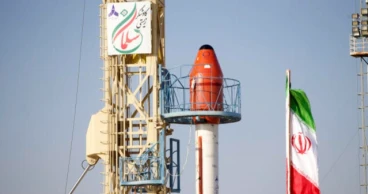
Iran says it sent a capsule capable of carrying animals into orbit as it prepares for human missions
Iran said Wednesday it sent a capsule into orbit capable of carrying animals as it prepares for human missions in coming years.
A report by the official IRNA news agency quoted Telecommunications Minister Isa Zarepour as saying the capsule was launched 130 kilometers (80 miles) into orbit.
Read: Israel moves into Gaza's second-largest city and intensifies strikes in bloody new phase of the war
Zarepour said the launch of the 500-kilogram (1,000-pound) capsule is aimed at sending Iranian astronauts to space in coming years. He did not say if any animals were in the capsule.
He told state TV that Iran plans to send astronauts into space by 2029 after further tests involving animals.
State TV showed footage of a rocket named Salman carrying the capsule.
Iran occasionally announces successful launches of satellites and other space crafts. In September, Iran said it sent a data-collecting satellite into space. In 2013, Iran said it sent a monkey into space and returned it successfully.
Read: World Insights: Media outlets of developing countries call for louder voice of Global South
Reports said the country’s Defense Ministry built and launched the Salman rocket while the capsule was built by the Iranian civil space agency. Media reports did not say where the launch took place. Iran usually makes launches from Imam Khomenei Space Center in northern Semnan province.
It says its satellite program is for scientific research and other civilian applications. The U.S. and other Western countries have long been suspicious of the program because the same technology can be used to develop long-range missiles.
In 2020, Iran’s Revolutionary Guard said it put the Islamic Republic’s first military satellite into orbit, unveiling what experts described as a secret space program.
2 years ago

Russian President Vladimir Putin to visit Saudi Arabia and UAE, host of COP28 climate talks
Russian President Vladimir Putin on Wednesday will visit both Saudi Arabia and the United Arab Emirates as Dubai hosts the United Nations' COP28 climate talks — despite facing an arrest warrant from the International Criminal Court over the war in Ukraine.
Neither Saudi Arabia nor the UAE has signed the ICC founding treaty, meaning they don't face any obligation to detain Putin over the warrant accusing him of being personally responsible for the abductions of children from Ukraine during his war on the country.
However, the visit comes as armed U.N. police patrol a portion of Dubai's Expo City now considered international territory for the talks, again highlighting the Emirates' expansive business ties to Russia that have exploded in the time since grinding Western sanctions have targeted Moscow. Ukrainians on hand for the event expressed outrage over Putin being in the country at the same time they described him as committing environmental crimes in their country.
Read: Putin to discuss Israel-Hamas war during a 1-day trip to Saudi Arabia and UAE
“It is extremely upsetting to see how the world treats war criminals, because that’s what he is, in my opinion,” said Marharyta Bohdanova, a worker at the Ukrainian pavilion at COP28, wiping away tears. "Seeing how people let people like him in the big events, ... treating him like a dear guest, is just so hypocritical in my opinion.”
Officials at Russia's pavilion declined to speak to The Associated Press.
A readout on Putin's trip from the state-run Tass news agency published early Wednesday offered no suggestion Putin might come to the COP28 site, instead quoting Russian presidential aide Yury Ushakov saying he'd land and have a “meeting at the palace” and one-on-one talks with Emirati leader Sheikh Mohammed bin Zayed Al Nahyan.
The visit comes after COP28 saw a parade of Western leaders including U.S. Vice President Kamala Harris, French President Emmanuel Macron, British Prime Minister Rishi Sunak and others backing Ukraine speak at the summit. So did Belarusian President Aleksandr Lukashenko, long a Putin ally.
Read: Putin begins visit in China underscoring ties amid Ukraine war and Israeli-Palestinian conflict
The U.N.'s Framework Convention on Climate Change's spokesperson Alexander Saier said at a press conference that he is “not aware that Mr. Putin will come to the conference, but I would also need to check the host country with the Ministry of Foreign Affairs.” He declined to immediately answer whether U.N. police would be obligated to make an arrest.
The Emirati organization committee for COP28 referred questions to the UAE's Foreign Ministry, which did not immediately respond. The UAE repeatedly feted the now-deposed Sudanese leader Omar al-Bashir in the past despite an ICC warrant seeking his arrest over charges of genocide and crimes against humanity in Darfur.
Putin last visited the UAE in 2019, receiving a warm welcome from Sheikh Mohammed, then the crown prince of Abu Dhabi. In the time since, however, the world has greatly changed.
The Russian president isolated himself during the coronavirus pandemic. He launched an invasion targeting Ukraine in February 2022, a grinding war that continues on today and has been a topic for Ukrainian diplomats at the COP28 talks.
“I’m talking about his crimes and this person is literally right now here, somewhere near me," said Alina Abramenko, another worker at the Ukrainian pavilion that highlights the environmental damage wrought by the war. "You know, it’s really strange.”
Meanwhile, the Israel-Hamas war remains a major concern for the Mideast, particularly the UAE, which reached a diplomatic recognition with Israel in 2020. Recent attacks by Yemen's Iranian-backed Houthi rebels also threatens commercial shipping in the Red Sea as Iran's nuclear program continues it rapid advances since the collapse of the 2016 nuclear deal.
Read: Russia not just building a nuclear power plant but also creating a peaceful atomic industry in Bangladesh: Putin
Putin is scheduled to meet with Iranian President Ebrahim Raisi on Thursday for what Ushakov has described as “a rather lengthy conversation.” The two countries have been discussing ways to get around the Western sanctions targeting them.
Putin will travel onto Saudi Arabia and meet with powerful Crown Prince Mohammed bin Salman on the one-day trip, Ushakov said. Those discussions likely will focus on Moscow's other major concern in the Middle East — oil.
Russia is part of OPEC+, which is a group of cartel members and other nations that have managed production to try and boost crude oil prices. Last week, the group expanded some output cuts into next year and brought up-and-coming oil supplier Brazil into the fold. Benchmark Brent crude traded Wednesday around $77 a barrel, down from nearly $100 in September, over concerns about a weakening economy worldwide.
2 years ago

Israel moves into Gaza's second-largest city and intensifies strikes in bloody new phase of the war
Israel said Tuesday that its troops had entered Gaza’s second-largest city as intensified bombardment sent streams of ambulances and cars racing to hospitals with wounded and dead Palestinians, including children, in a bloody new phase of the war.
The military said its forces were “in the heart” of Khan Younis, which has emerged as the first target in the expanded ground offensive into southern Gaza that Israel says aims to destroy Hamas. Military officials said they were engaged in the “most intense day” of battles since the ground offensive began more than five weeks ago, with heavy firefights also taking place in northern Gaza.
The assault into the south threatens to fuel a new wave of displaced Palestinians and a worsening of Gaza's humanitarian catastrophe. The U.N. said 1.87 million people — more than 80% of Gaza’s population — have been driven from their homes, and that fighting is now preventing distribution of food, water and medicine outside a tiny sliver of southern Gaza. New military evacuation orders are squeezing people into ever-smaller areas of the south.
Israel strikes in and around Gaza's second-largest city in a bloody new phase of the war
Bombardment has grown fiercer across the territory, including areas where Palestinians are told to seek safety. In the central Gaza town of Deir al-Balah, just north of Khan Younis, a strike Tuesday destroyed a house where dozens of displaced people were sheltering. At least 34 people were killed, including at least six children, according to an Associated Press reporter at the hospital who counted the bodies.
Footage from the scene showed women screaming from an upper floor of a house shattered to a concrete shell. In the wreckage below, men pulled the limp body of a child from under a slab next to a burning car. At the nearby hospital, medics tried to resuscitate a young boy and girl, bloodied and unmoving on a stretcher.
Israel's assault in retaliation for Hamas's Oct 7 attack has killed more than 15,890 people in Gaza — 70% of them women and children — with more than 42,000 wounded, according to the Health Ministry in Gaza. The ministry does not differentiate between civilian and combatant deaths. It says hundreds have been killed or wounded since a weeklong cease-fire ended Friday, and many still are trapped under rubble.
Israel says it must remove Hamas from power to prevent a repeat of the attack that ignited the war, when Hamas and other militants killed about 1,200 people, mostly civilians, and took captive some 240 men, women and children.
Prime Minister Benjamin Netanyahu said Tuesday the military would have to retain open-ended security control over the Gaza Strip long after the war ends. His comments suggested a renewed direct Israeli occupation of Gaza, something the United States says it opposes.
Israel’s military calls for more evacuations in southern Gaza as it widens offensive
Netanyahu said only the Israeli military can ensure Gaza remains demilitarized. “No international force can be responsible for this,” he said at a news conference. “I’m not ready to close my eyes and accept any other arrangement.”
Under U.S. pressure to prevent further mass casualties, Israel says it is being more precise as it widens its offensive and is taking extra steps to urge civilians to evacuate out of its path. Weeks of bombardment and a ground offensive obliterated much of northern Gaza.
The military accuses Hamas of using civilians as human shields when the militants operate in dense residential areas. But Israel has not provided accounting for targeting in individual strikes, some of which have leveled entire city blocks and complexes of dozens of multi-story apartment towers.
Military Chief of Staff Herzi Halevi acknowledged that Israeli forces use heavy force against civilian structures, saying militants keep weapons in houses and buildings so fighters in civilian clothes can use them to fire on troops.
“Striking them requires significant use of fire, both to target the enemy but also to, of course, protect our forces,” he said. “Therefore the forces operate powerfully.”
BATTLES IN KHAN YOUNIS AND NORTH GAZAHalevi said his forces had begun the “third phase of the ground operations,” moving against Hamas in the south after seizing much of the north. Israel has not given specific details on troop movements.
Residents said troops advanced to Bani Suheila, on Khan Younis' eastern edge. Israeli forces also appear to be moving to partially cut across the strip between Khan Younis and Deir al-Balah. Satellite photos from Sunday showed around 150 Israeli tanks, armored personnel carriers and other vehicles on the main road between the two cities.
The past days brought some of the heaviest bombardment of the entire war, the U.N.’s humanitarian affairs office OCHA said.
Witnesses said a strike Tuesday hit a school in Khan Younis where hundreds of displaced people were sheltering. Casualties overwhelmed the nearby Nasser Hospital, where wounded men and children were lain on a bloody floor amid a tangle of IV tubes. In the morgue, a woman draped herself over the stretcher where her dead husband and child lay among at least nine bodies.
“What’s happening here is unimaginable,” said Hamza al-Bursh, who lives near the school. “They strike indiscriminately.”
In northern Gaza, the military said its troops were battling Hamas militants in the Jabaliya refugee camp and the district of Shujaiya, capturing Hamas positions and destroying rocket launchers and underground infrastructure.
The battles in the north signaled the tough resistance from Hamas since Israeli forces moved in on Oct. 27. The military says 86 of its soldiers have been killed in the Gaza offensive and that thousands of Hamas fighters have been killed, though it has not produced evidence.
Even after weeks of bombardment, Hamas’ top leader in Gaza, Yehya Sinwar — whose location is unknown — was able to conduct complex cease-fire negotiations and orchestrate the release of more than 100 Israeli and foreign hostages in exchange for 240 Palestinian prisoners last week. Palestinian militants have also kept up their rocket fire into Israel.
FEWER PLACES TO GOAfter the full-scale evacuation of northern Gaza ordered by Israel early in the war, most of Gaza’s population of 2.3 million is squeezed into the 90 square miles of central and southern Gaza.
Since moving into the south, the Israeli military has ordered people out of nearly two dozen neighborhoods in and around Khan Younis. That further reduced the area where civilians can seek refuge by more than a quarter. It was not clear how many people followed the evacuation call.
“Nowhere is safe in Gaza, and there is nowhere left to go,” Lynn Hastings, the U.N. humanitarian coordinator for the Palestinian territories, said Monday. “The conditions required to deliver aid to the people of Gaza do not exist. If possible, an even more hellish scenario is about to unfold.”
For the past two days, aid distribution — mainly just supplies of flour and water — has been possible only in the city of Rafah, at the far south by the border, the U.N. said. Locations deeper inside Gaza, including Khan Younis, Deir al-Balah and northern Gaza, could not be reached because of fighting.
Dr. Nasser Bolbol, head of neonatal intensive care at the European Gaza Hospital in Khan Younis, said acute hunger was spreading, with some deaths of children from dehydration and undernourishment, after nearly two months with only limited aid entering the territory, under an Israeli seal.
“Gaza is entirely covered in death and darkness,” he said.
STILL HOSTAGEFamily members of hostages still held in Gaza held tense talks with Netanyahu and the war cabinet Tuesday. Observers present said more than 100 people attended the nearly three-hour meeting. Some relatives shouted at cabinet members, perceiving they did not have any immediate plans to rescue some 138 hostages still captive. Nearly half the room left in disappointment before the meeting ended.
During the gathering, five hostages released during the truce shared harrowing details of their experience. One spoke of Hamas fighters “touching” female hostages, and another said militants shaved off a male hostage’s body hair to humiliate him, according to a group representing the hostages’ families. Others said they were deprived of water.
A doctor who treated some of the 110 released hostages told the AP separately that at least 10 women and men among those freed were sexually assaulted or abused, but did not provide further details. He spoke on condition of anonymity to protect the hostages’ identities.
Noam Peri, whose 80-year-old father is still being held captive, said the meeting with Netanyahu and the war cabinet was not a relaxed discussion.
“After 60 days, people are tired and worried,” Peri said.
2 years ago

More bodies found after sudden eruption of Indonesia's Mount Marapi, raising confirmed toll to 23
Rescuers searching the hazardous slopes of Indonesia's Mount Marapi volcano found the last body of climbers who were caught by a surprise weekend eruption, raising the number of confirmed dead to 23, officials said Wednesday.
About 75 climbers started their way up the nearly 2,900-meter (9,480-foot) mountain in Agam district of West Sumatra province on Saturday and became stranded.
Some 52 climbers were rescued after the initial eruption Sunday, and 11 others were initially confirmed dead. New eruptions on Monday and Tuesday spewed more hot ash as high as 800 meters (2,620 feet) into the air, reducing visibility and temporarily halting search and recovery operations, said Abdul Malik, chief of the Padang Search and Rescue Agency.
The bodies of two climbers were located on Monday and nine more on Tuesday, the National Search and Rescue Agency said.
Indonesia’s Marapi volcano erupts for the second day as 12 climbers remain missing
West Sumatra's Police Chief Suharyono said the body of the last climber was found early Wednesday, just a few meters (yards) from the eruption site, bringing the death toll rise to 23.
The rescuers contended with bad weather and difficult terrain, along with winds that brought heat from the eruptions, while distraught relatives gathered at a relief post command in Batu Palano on the mountain slope, hoping for news of missing family members.
Twenty bodies had been taken to a hospital for identification by Wednesday morning, as more than 300 rescuers, including police and soldiers, struggled to bring the others down the mountain and search for the missing climber, said Suharyono who goes by a single name like many Indonesians.
Marapi has stayed at the third highest of four alert levels since 2011, indicating above-normal volcanic activity under which climbers and villagers must stay more than 3 kilometers (1.8 miles) from the peak, according to Indonesia's Center for Volcanology and Geological Disaster Mitigation.
UNHCR welcomes recent boat rescues, safe disembarkation in Indonesia
Officially, climbers were only allowed below the danger zone and had to register at two command posts or online. However, local officials acknowledge that many people may have climbed higher than permitted.
Marapi spewed thick columns of ash as high as 3,000 meters (9,800 feet) in Sunday's eruption and hot ash clouds spread for several kilometers (miles). Nearby villages and towns were blanketed by tons of volcanic debris that blocked sunlight, and authorities recommended that people wear masks to protect themselves from the ash.
About 1,400 people live on Marapi’s slopes in Rubai and Gobah Cumantiang, the nearest villages, about 5 to 6 kilometers (3 to 3.7 miles) from the peak.
Marapi is known for sudden eruptions that are difficult to predict because the source is shallow and near the peak, and its eruptions are not caused by a deep movement of magma, which sets off tremors that register on seismic monitors.
Marapi has been active since a January eruption that caused no casualties. It is among more than 120 active volcanoes in Indonesia, which is prone to seismic upheaval due to its location on the Pacific “Ring of Fire,” an arc of volcanoes and fault lines encircling the Pacific Basin.
2 years ago

World Insights: Media outlets of developing countries call for louder voice of Global South
Representatives from developing countries at the fifth World Media Summit being held in the Chinese cities of Guangzhou and Kunming have made a strong call for a louder voice of the Global South.
In an era of increasing global interconnectedness, a louder voice from the Global South has become more imperative than ever before, and the media also shoulder the responsibility for promoting global common development through exchanges and cooperation, they said.
Read: A Nigerian military attack mistakenly bombed a religious gathering and killed civilians
President of Prensa Latina News Agency, Luis Enrique Gonzalez Acosta, said he takes this summit as an opportunity to collaborate with other media outlets in providing objective and responsible reports that can amplify the voices of developing countries and jointly address the challenges facing the Global South.
"We must not be afraid to position ourselves as the voice of the Global South," said Iqbal Surve, chairman of South Africa's Independent Media. "Our narrative, our communication, our stories must be about the possibility of global growth and development."
Media's role extends beyond conveying facts, Surve said, adding that it should catalyze social-economic change and development.
"If we have one task only as a social responsibility, that task is to ensure that media must be a change agent in the world today, to promote a common humanity and a shared future and shared prosperity," he added.
South-South cooperation among media is crucial in ensuring that the voices of developing countries are heard worldwide, said experts present at the summit. It plays a significant role in fostering diverse and inclusive narrative perspectives on a global scale, they said.
Read: Blinken will return to Israel as the US hopes to see further extensions of the Gaza ceasefire
Creating a grand shared narrative that would promote common prosperity is imperative, said Seife Deribe Endale, CEO of Ethiopian News Agency.
"We are now in the critical juncture to create an inclusive media ecosystem through the lens of alternative narratives like that of the BRICS," he said, adding that the true and success stories of Ethiopia and the whole of Africa need to be heard worldwide.
South-South communication is of great importance, said Maria Bernarda Llorente, president of Telam, Argentina's official news agency. Communication between developing countries is fundamental to building relations, she added.
To foster more dialogues among nations and cultivate a culture of peace and understanding within the international system, it is crucial and urgent to formulate a shared agenda in response to global threats, she said.
Roger Agana, managing director of News Ghana, said the world needs to know a real Africa and a real China. "As African media, we do have a story to tell," he said.
2 years ago

At least 85 civilians killed by a Nigerian army drone attack
At least 85 civilians were killed when an army drone attack erroneously targeted a religious gathering in northwest Nigeria, officials confirmed Tuesday, as the president ordered a probe into the latest in a series of such deadly mistakes in Nigeria's conflict zones.
The strike took place Sunday night in Kaduna state's Tudun Biri village while residents observed the Muslim holiday marking the birthday of the Prophet Muhammad, government officials said. The military believed it was "targeting terrorists and bandits," officials said.
At least 66 people also were injured in the attack, the National Emergency Management Agency said in a statement. Eighty-five bodies, including of children, women and the elderly, have been buried so far, as a search continues for any additional victims, the agency said.
Read: Pakistan arrests 17 suspects in connection to the weekend bus shooting that killed 10
Nigeria's army chief, Lt. Gen. Taoreed Lagbaja, apologized for the drone strike during a visit to the village Tuesday and said it had been carried out "based on the observation of some tactics usually employed by bandits."
"Unfortunately, the reports we got revealed it was innocent civilians that the drone conducted a strike on," Lagbaja said.
Since 2017, some 400 civilians have been killed by airstrikes that the military said were targeting armed groups in the deadly security crisis in the country's north, according to the Lagos-based SBM Intelligence security firm.
"The incidence of miscalculated airstrikes is assuming a worrisome dimension in the country," said Atiku Abubakar, Nigeria's former vice-president and the main opposition presidential candidate in this year's election.
Read: Philippine president blames foreign militants for a bombing that killed 4 Christian worshippers
Nigerian President Bola Tinubu ordered "a thorough and full-fledged investigation into the incident." However, such investigations and their outcomes are often shrouded in secrecy.
Nigeria's military often conducts air raids as it fights the extremist violence and rebel attacks that have destabilized Nigeria's north for more than a decade, often leaving civilian casualties in its wake, including in January when dozens were killed in Nasarawa state and in December 2022 when dozens also died in Zamfara state.
Maj. Gen. Edward Buba, a spokesman for Nigeria's Defense Headquarters, said in a statement Tuesday that terror suspects often "deliberately embed themselves within civilian population centers," though he wasn't speaking specifically about Sunday's holiday gathering.
Read: Rohingya man killed in clash between ARSA and RSO in Cox’s Bazar
Analysts have in the past raised concerns about the lack of collaboration among Nigerian security agencies as well as the absence of due diligence in some of their special operations in conflict zones.
One major concern has been the proliferation of drones within Nigerian security agencies such that "there is no guiding principle one when these can be used," according to Kabir Adamu, the founder of Beacon Consulting, a security firm based in Nigeria's capital, Abuja.
"The military sees itself as a little bit over and above civilian accountability as it were," Adamu said.
In the incident in Nasarawa in January, when 39 people were killed, the Nigerian air force "provided little information and no justice" over the incident, Human Rights Watch said.
Such incidents are enabled by a lack of punishment for erring officers or agencies, according to Isa Sanusi, Amnesty International's director in Nigeria.
"The Nigerian military is taking lightly the lack of consequences ... and the civilians they are supposed to protect are the ones paying the price of their incompetence and lack of due diligence," Sanusi told The Associated Press.
2 years ago

Putin to discuss Israel-Hamas war during a 1-day trip to Saudi Arabia and UAE
Russian President Vladimir Putin will make a one-day trip to the United Arab Emirates and Saudi Arabia focused on the Israeli-Hamas war and host the Iranian president in Moscow this week, the Kremlin said Tuesday.
Putin will make working visits to both countries on Wednesday, Kremlin spokesman Dmitry Peskov said.
The talks will focus on bilateral relations, the war between Israel and Hamas and other international issues, Peskov said. Issues related to oil price caps under OPEC+ will also be on the agenda, he added.
Read: Israeli military says ground offensive expanded to every part of Gaza
Putin's trip was first announced on Monday by his foreign affairs adviser Yuri Ushakov, who didn't give a date for the visits when he spoke to the Russian news outlet Life.
“I hope that these will be very useful negotiations, which we consider extremely important,” Ushakov was quoted as saying by Life.
Putin will make the visit at a time when Russia wants to advance its role as a power broker in the conflict in the Middle East.
Putin will host Iranian President Ebrahim Raisi in the Kremlin on Thursday, Peskov added.
The Russian president visited China in October and recently made several trips to former Soviet nations.
Read:Palestinian death toll in Gaza tops 15,200
The International Criminal Court issued an arrest warrant for Putin in March for war crimes, accusing him of personal responsibility for the abductions of children from Ukraine.
Since the warrant was issued, Putin chose not to attend a BRICS summit in South Africa because the country would be obliged to arrest Putin upon arrival as it is a signatory to the international court’s treaty.
Neither Saudi Arabia nor the UAE have signed the ICC’s founding treaty.
The notice against Putin in March was the first time the global court issued a warrant against a leader of one of the five permanent members of the U.N. Security Council. The ICC said in a statement that Putin is accused of the war crime of ” unlawful deportation ″ of children from occupied areas of Ukraine to Russia.
2 years ago