Others

Video of Mexican mother bravely shielding son as bear devours tacos and enchiladas inches away goes viral
A Mexican mother bravely shielded her son after a bear leapt on a picnic table and devoured the tacos and enchiladas meant for the boy’s birthday dinner, inches from his face.
Silvia Macías of Mexico City had traveled to the Chipinque Park on the outskirts of the northern city of Monterrey to celebrate the 15th birthday of her son, Santiago, who has Down syndrome.
Soon after they sat down to eat the food they had brought, the bear showed up and gulped down french fries, enchiladas, tacos and salsa. A video shot by her friend, Angela Chapa, shows Macías sitting stoically, inches from the bear’s mouth, holding Santiago and shielding his eyes with her hand. She kept her eyes downcast, to avoid anything the bear might consider a challenge.
“The worst thing was that Santiago might get scared,” Macías recalled Tuesday in an interview with The Associated Press. “Santiago is very afraid of animals, a cat or a dog, any animal scares him a lot.”
Habiganj Chhatra League president removed after video clip goes viral
“That’s why I covered his eyes, because I didn’t want him to see it and scream or run. I was afraid that if he got scared or screamed or scared the bear, that the bear would react,” she said of the incident Monday.
Macías said that she and Chapa had previously thought about the possibility of a bear encounter — they are not unknown in the park, though usually the bears come out more toward dawn or dusk, not midday — and they had come up with a plan.
“We are going to play a game where we cover Santiago’s eyes and we are going to act like statues,” she recalled rehearsing the plan.
New WHO guidance on HIV viral suppression and scientific updates released at IAS 2023
And that is exactly what they did: Santiago remained motionless, even though “the bear was very close to us, we heard him as he growled, as he ate, you could smell the bear. It was really very very close.”
Asked if he had been scared, Santiago, who attends middle school in Mexico City, said “yes, a lot.”
Their resourceful friend Angela, who filmed the scene, lives in Monterrey and knew the proper behavior for a black bear encounter: never run.
She noticed a plate of enchiladas the bear had not eaten — the bear appeared to prefer french fries, and as a true Mexican, had eaten the salsa — and she tossed the enchilada far away, after showing it to the animal. As expected, the animal followed the food and Angela stood in front of the bear, shielding Macías and her son and allowing them to retreat quietly and slowly.
Modi breaks silence over Manipur 'ethnic violence' after viral video shows mob molesting women
Eventually, the bear went away.
Santiago got his birthday tacos replaced, and all ended well.
Macías says she doesn’t consider herself a hero.
“I just think I’m a mother who protected her cub,” she said.
2 years ago

India and Canada steer clear, in UN speeches, of their dispute over Sikh separatist leader’s killing
Indian and Canadian diplomats didn’t directly address their countries’ row over the killing of a Sikh separatist leader, but they obliquely underscored some key talking points as they addressed world leaders at the U.N. General Assembly on Tuesday.
Foreign Minister Subrahmanyam Jaishankar said that the world must not “countenance that political convenience determines responses to terrorism, extremism and violence.” Canadian U.N. Ambassador Robert Rae, by turn, insisted that “we cannot bend the rules of state-to-state relations for political expediency.”
Relations between the two countries frayed after Canadian Prime Minister Justin Trudeau said last week that India may have been involved in the June killing of a Canadian citizen in a Vancouver suburb.
India and US army chiefs call for free and stable Indo-Pacific as Chinese influence grows
Canada has yet to provide any public evidence to support the claim about the slaying of Hardeep Singh Nijjar, 45. Killed by masked gunmen, Nijjar was a leader in what remains of a once-strong movement to create an independent Sikh homeland, known as Khalistan, and India had designated him a terrorist.
India’s foreign ministry dismissed the allegation as “absurd” and accused Canada of harboring “terrorists and extremists.” It also implied that Trudeau was trying to drum up domestic support among the Sikh diaspora.
“Such unsubstantiated allegations seek to shift the focus from Khalistani terrorists and extremists, who have been provided shelter in Canada and continue to threaten India’s sovereignty and territorial integrity,” the ministry said in a statement last week.
India has accused Canada for years of giving free rein to Sikh separatists, including Nijjar. While the active insurgency ended decades ago, Prime Minister Narendra Modi’s government has warned that Sikh separatists were trying to stage a comeback. New Delhi has pressed countries like Canada, where Sikhs make up more than 2% of the population, to do more to stop a separatist resurgence.
At least 20 dead in gas station explosion as Nagorno-Karabakh residents flee to Armenia
After Trudeau aired his claim, India suspended visas for Canadians, there were tit-for-tit expulsions of diplomats, and Ottawa said it might reduce consulate staff over safety concerns.
But the dispute is unfolding against a backdrop of geopolitical priorities for both countries. Canada and other Western countries have been seeking to strengthen ties with India as a way to counter Chinese power. Days after airing the allegation about Nijjar’s killing, Trudeau said Canada was “ not looking to provoke or cause problems.”
And India, which is trying to showcase its global stature after a fruitful turn heading the Group of 20 industrialized nations, wasn’t seen as keen to use the U.N.'s global platform to draw attention to Canada’s accusation and widen a rift that has already grabbed headlines internationally. Experts have said India likely would prefer to treat the matter as an issue just between the two countries involved.
India also has a habit, at the U.N., of keeping its criticisms veiled.
Hence Tuesday’s exchange of what could be read, at most, as subtle swipes.
Jaishankar’s mention of “terrorism, extremism and violence” echoed his ministry’s rhetoric last week about Canada’s claims. But it also resembled India’s frequent complaints about Pakistan. New Delhi accuses its neighbor of sponsoring terrorism by arming and training insurgents fighting for the independence of Indian-controlled Kashmir or for its integration into Pakistan. Islamabad denies it.
The Biden administration is poised to allow Israeli citizens to travel to the US without a US visa
Rae’s comments, meanwhile, came after Trudeau told reporters Thursday that Canada was standing up for “the international rules-based order” and “the rule of law” in its approach to Nijjar’s killing. But Rae’s remarks didn’t name any nation that might be trying to “bend the rules.”
“But the truth is: If we don’t adhere to the rules that we’ve agreed to, the very fabric of our open and of our free societies may start to tear,” Rae said.
The remarks were tucked into a speech that dilated on climate change, immigration, gender equality, Haiti’s troubles, Russia’s war in Ukraine, and the need for the international community “to create unity where there is division.”
“We have to find inside ourselves the capacity to recognize the importance of accepting differences,” he said. “And if we can do that, then we can create a United Nations that will be worthy of the name.”
Jaishankar sought to spotlight his country’s aspirations on the world stage. The world’s most populous nation and an increasingly muscular economic power, India has held itself out as “the voice of the Global South” and of developing countries’ frustrations with a lopsided international order.
“When we aspire to be a leading power, this is not for self-aggrandizement, but to take on greater responsibility and make more contributions,” he said. “The goals we have set for ourselves will make us different from all those whose rise preceded ours.”
2 years ago
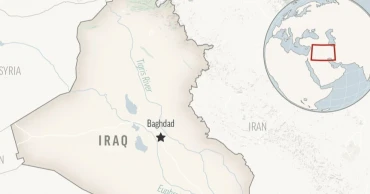
A fire at a wedding hall in northern Iraq kills at least 114 people and injures 150, authorities say
A fire that raced through a hall hosting a Christian wedding in northern Iraq killed at least 100 people and injured 150 others, authorities said Wednesday, warning the death toll could rise higher.
The fire happened in Iraq's Nineveh province in its Hamdaniya area, authorities said. That's a predominantly Christian area just outside of the city of Mosul, some 335 kilometers (205 miles) northwest of the capital, Baghdad.
Television footage showed flames rushing over the wedding hall as the fire took hold. In the blaze's aftermath, only charred metal and debris could be seen as people walked through the scene of the fire, the only light coming from television cameras and the lights of onlookers' mobile phones.
Sweetmeat shop catches fire in Dhaka's Lalbagh
Survivors arrived at local hospitals, receiving oxygen and bandaged, as their families milled through hallways and outside as workers organized more oxygen cylinders.
The health department in Nineveh province raised the death toll to 114. Health Ministry spokesman Saif al-Badr earlier put the number of injured at 150 via the state-run Iraqi News Agency.
“All efforts are being made to provide relief to those affected by the unfortunate accident,” al-Badr said.
Prime Minister Mohammed Shia al-Sudani ordered an investigation into the fire and asked the country's Interior and Health officials to provide relief, his office said in a statement online.
Najim al-Jubouri, the provincial governor of Nineveh, said some of the injured had been transferred to regional hospitals. He cautioned there were no final casualty figures yet from the blaze, which suggests the death toll still may rise.
35 killed in petrol warehouse fire in Benin
There was no immediate official word on the cause of the blaze but initial reports by the Kurdish television news channel Rudaw suggested fireworks at the venue may have sparked the fire.
Civil defense officials quoted by the Iraqi News Agency described the wedding hall's exterior as being decorated with highly flammable cladding that were illegal in the country.
“The fire led to the collapse of parts of the hall as a result of the use of highly flammable, low-cost building materials that collapse within minutes when the fire breaks out,” civil defense said.
It wasn't immediately clear why authorities in Iraq allowed the cladding to be used on the hall, though corruption and mismanagement remains endemic two decades after the U.S.-led invasion that toppled Saddam Hussein.
Fire at SK+F Pharmaceuticals godown in Tongi doused
While some types of cladding can be made with fire-resistant material, experts say those that have caught fire at the wedding hall and elsewhere weren’t designed to meet stricter safety standards and often were put onto buildings without any breaks to slow or halt a possible blaze. That includes the 2017 Grenfell Fire in London that killed 72 people in the greatest loss of life in a fire on British soil since World War II, as well as multiple high-rise fires in the United Arab Emirates.
The fire was the latest disaster to strike Iraq’s shrinking Christian minority, which over the past two decades has been violently targeted by extremists first from al-Qaida and then the Islamic State militant group. Although the Nineveh plains, the historic homeland, was wrested back from the Islamic State group six years ago, some towns are still mostly rubble and lack basic services. Many Christians have left for Europe, Australia or the United States.
The number of Christians in Iraq today is estimated at 150,000, compared to 1.5 million in 2003. Iraq’s total population is more than 40 million.
2 years ago

India and US army chiefs call for free and stable Indo-Pacific as Chinese influence grows
India's army chief on Tuesday said the country was committed to maintaining a free and stable Indo-Pacific, where the sovereignty and territorial integrity of all nations is respected, as global concern grows over Chinese influence in the region.
General Manoj Pande made the comments at the Indo-Pacific Army Chiefs Conference, hosted by India and the U.S., which is focused on boosting military diplomacy and collaboration as well as promoting peace and stability in the Indo-Pacific region. Army chiefs and delegations from 30 countries are attending the two-day event, which concludes Wednesday.
Pande said that while countries in the region are working toward a free Indo-Pacific, “we are witnessing manifestations of interstate contestations and competition" — a veiled reference to China, which has stepped up its activities in the region.
India had been riding a geopolitical high. But it comes to the UN with a mess on its hands
Neither Pande nor the U.S. Army chief, Randy George, explicitly mentioned China in their remarks.
When asked about Chinese expansion at a press briefing, George said the region was a critical priority for the U.S. “It's why we are out here and why we exercise more than anywhere else in the Pacific, to build all of this. What this conference proves... is (our) unity and commitment,” the U.S. chief said.
At the opening ceremony held after, Pande said India's outlook was focused on the peaceful resolution of disputes, avoiding force and adhering to international law. He added that in addition to challenges in maritime security, the region also faced security and humanitarian concerns on land, including territorial disputes and over “artificially expanded islands to acquire real estate and establish military bases” — another veiled reference to China.
Canada’s interests currently pale in comparison to India’s massive strategic importance: BBC cites experts
China’s territorial claims in the East China and South China seas over islands have rattled Beijing’s smaller neighbors in Southeast Asia as well as Japan. Meanwhile the relationship between New Delhi and Beijing has deteriorated since 2020, when Indian and Chinese troops clashed along their undefined border in the Himalayan Ladakh region, leaving 20 Indian and four Chinese soldiers dead.
A delegation led by Chief of Army Staff of Bangladesh is also participating in the Conference.
2 years ago

At least 20 dead in gas station explosion as Nagorno-Karabakh residents flee to Armenia
Separatist authorities in Nagorno-Karabakh said Tuesday that at least 20 people were killed and nearly 300 others injured by an explosion at a gas station.
The breakaway region’s health department said that 13 bodies have been found and seven people have died of injuries after the explosion at the gas station outside the regional capital of Stepanakert late Monday.
Read: 35 killed in petrol warehouse fire in Benin
It said that 290 people have been hospitalized and scores of them remain in grave condition.
The explosion occurred as thousands of Nagorno-Karabakh residents are fleeing the region for Armenia after Azerbaijan’s swift military operation last week to fully reclaim the region after a three-decade separatist rule.
Read: Mohammadpur Krishi Market fire doused nearly after 28 hrs
2 years ago

Taylor Swift turns out to see Travis Kelce, Kansas City Chiefs play Chicago Bears
Travis Kelce put the ball in Taylor Swift's court, and she wound up bringing it to Arrowhead Stadium after all.
The 12-time Grammy Award winner took advantage of an invitation from the All-Pro tight end to see the Kansas City Chiefs play the Chicago Bears at Arrowhead Stadium on Sunday. Swift was decked out in red and white while watching alongside Kelce's mother, Donna, from one of the glass-enclosed suites on a sun-splashed afternoon in Kansas City.
She got quite a show, too. Kelce grabbed a 3-yard TD pass in the third quarter, and the reigning Super Bowl champions went on to a 41-10 win.
Kelce did not speak to reporters afterward, but he was spotted leaving Arrowhead with Swift by his side.
“He told me at the last minute” that Swift was coming to the game, said Chiefs quarterback Patrick Mahomes, who threw for 272 yards and three scores. “Some things with Trav, he says it and you don't know if it's true or not, he says it so calmly.”
Swift is on a break from her Eras Tour, which resumes Nov. 9 in Buenos Aires, Argentina.
Swift has always been reluctant to discuss her personal life in public, but rumors have been flying about the pop superstar and the football player. They began when Kelce said on his “New Heights” podcast that he was disappointed that he didn't have the chance to meet Swift and gift her a friendship bracelet during her stop in Kansas City on her Eras Tour.
Then, during an appearance on “The Pat McAfee Show,” Kelce said: “I threw the ball in her court and told her, ‘I’ve seen you rock the stage in Arrowhead. You might have to come see me rock the stage in Arrowhead and see which one’s a little more lit.'"
Just about everyone has been trying to get the dirt on Swift and Kelce, even pestering his brother and Philadelphia Eagles center Jason Kelce for details. He was asked about the potential relationship on 94.1 WIP in Philadelphia.
“I don’t really know what’s happening in Travis’ love life. I try to keep his business kind of his business and stay out of that world,” Jason Kelce said. “But having said that, I think he’s doing great and I think that it’s all 100% true.”
Just about in the Kansas City locker room was left joking about their tight end and their newest famous fan Sunday, including coach Andy Reid, who joked that “I set them up.”
“I'm not a big Swifty,” Chiefs offensive lineman Trey Smith said. “But maybe she's a good luck charm. Why not?”
2 years ago
The Biden administration is poised to allow Israeli citizens to travel to the US without a US visa
The Biden administration is poised to admit Israel this week into an exclusive club that will allow its citizens to travel to the United States without a U.S. visa despite Washington's ongoing concerns about the Israeli government’s treatment of Palestinian Americans.
U.S. officials say an announcement of Israel’s entry into the Visa Waiver Program is planned for late in the week, just before the end of the federal budget year on Saturday, which is the deadline for Israel’s admission without having to requalify for eligibility next year.
The Department of Homeland Security administers the program, which currently allows citizens of 40 mostly European and Asian countries to travel to the U.S. for three months without visas.
Homeland Security Secretary Alejandro Mayorkas is set to make the announcement Thursday, shortly after receiving a recommendation from Secretary of State Antony Blinken that Israel be admitted, according to five officials familiar with the matter who spoke Sunday on condition of anonymity because the decision has not yet been publicly announced.
Read: With no end in sight for Ukraine war, Biden at UN says world must remain united against Russian aggression
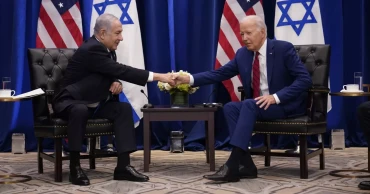
Blinken’s recommendation is expected to be delivered no later than Tuesday, the officials said, and the final announcement will come just eight days after President Joe Biden met with Israeli Prime Minister Benjamin Netanyahu in New York on the sidelines of the U.N. General Assembly. The leaders did not raise the issue in their brief remarks to reporters at that meeting but it has been a subject of intense negotiation and debate for months as has been the Biden administration's effort to secure a deal to normalize relations between Israel and Saudi Arabia.
Both State and the Homeland Security departments said they had “nothing to announce publicly at this time,” adding that the two agencies will make a “final determination in the coming days.” The U.S. is working with Israel toward “fulfilling the full range of law enforcement, national security, and immigration related requirements” of the program, according to the State Department.
Israel’s admission has been a priority for successive Israeli leaders and will be a major accomplishment for Netanyahu, who has sparred frequently with the Biden administration over Iran, the Palestinian conflict and most recently a proposed remake of Israel’s judicial system that critics say will make the country less democratic.
Netanyahu’s far-right government has drawn repeated U.S. criticism over its treatment of Palestinians, including its aggressive construction of West Bank settlements, its opposition to Palestinian statehood and incendiary anti-Palestinian comments by senior Cabinet ministers.
The U.S. move will give a welcome boost at home to Netanyahu. He has faced months of mass protests against his judicial plan and is likely to come under criticism from the Palestinians, who say the U.S. should not be rewarding the Israeli government at a time when peace efforts are at a standstill.
Read: US House of Representatives to open Biden impeachment inquiry
Israel met two of the three most critical criteria over the past two years — a low percentage of visa application rejections and a low visa overstay rate — to join the U.S. program. It had struggled to meet the third, which is a requirement for reciprocity that means all U.S. citizens, including Palestinian Americans, must be treated equally when traveling to or through Israel.
Claiming national security reasons, Israel has long had separate entry requirements and screening processes for Palestinian Americans. Many complained that the procedures were onerous and discriminatory. Americans with Palestinian residency documents in the West Bank and Gaza Strip were largely barred from using Israel’s international airport. Instead, like other Palestinians, they were forced to travel through either Jordan or Egypt to reach their destinations.
In recent months, Israel has moved to adjust its entry requirements for Palestinian Americans, including allowing them to fly in and out of Ben Gurion International Airport in Tel Aviv and going directly to the West Bank and Israel proper, according to the officials. Israel also has pledged to ease movement for Palestinian Americans traveling in and out of the Hamas-ruled Gaza Strip.
New regulations took effect earlier this month to codify the changes, although concerns remain and the Homeland Security Department intends to stress in its announcement that it will continue to monitor the situation to ensure that Israel complies, according to the officials. Failure to comply could result in Israel’s suspension from the program, the officials said.
Palestinian American activists have been critical of the impending decision, which has been expected for some time due to the priority placed on it by both the Israeli and U.S. governments.
“There are so many problems with this decision," said Yousef Munayyer, the head of the Palestine-Israel Program and senior fellow at Arab Center Washington. “The reciprocity requirement is clearly still not being met since Israeli policy continues to treat some Americans, specifically Palestinian Americans, differently. The administration however seems committed at the highest levels to overlooking this continued discrimination against American citizens to rush Israel into the program before the deadline.”
Read: Biden, Modi and G20 allies unveil rail and shipping project linking India to Middle East and Europe
Munayyer said it was “unclear why the Biden administration seems dead set on offering political victories for Benjamin Netanyahu at a time when his far-right government is outraging Palestinians and many Israelis with their extremist agenda.”
Under the waiver program, Israelis will be able to travel to the U.S. for business or leisure purposes for up to 90 days without a visa simply by registering with the Electronic System for Travel Authorization.
2 years ago

UN meeting calls for finding new effective vaccine against deadly TB
As the UN member nations approved a political declaration to end tuberculosis (TB) around the world by 2030, world leaders and experts have laid emphasis on finding out a new and effective vaccine against the world’s oldest and deadliest infectious diseases.
The UN member states formally adopted the declaration of the High-Level Meeting (HLM) on the Fight Against Tuberculosis at the 78th United Nations General Assembly (UNGA) on Friday.
The declaration lays out ambitious new targets for the next five years that include reaching 90 per cent of people with TB prevention and care services, providing social benefit packages to those who have the disease, and licensing at least one new vaccine.
WHO: Tuberculosis cases rise for the first time in years
According to the World Health Organization (WHO) TB is the second leading infectious killer worldwide after COVID-19 as it claimed the lives of 1.6 million people alone in 2021 although it is a preventable and curable disease. The only available vaccine against TB is more than a century old.
Addressing the meeting, Dennis Francis, President of the General Assembly, asked: “Why, after all the progress we have made — from sending a man to the moon to bringing the world to our fingertips — have we been unable to defeat a preventable but curable disease that kills over 4,400 people a day?”
He called on stakeholders to use all tools at their disposal to advance science and innovation until a vaccine is found.
Reporting on tuberculosis: icddr,b-led USAID ACTB announces media fellowship for journalists
UN Deputy Secretary-General Amina Mohammed called for action to tackle the main drivers of TB - poverty, undernutrition, lack of access to healthcare, the prevalence of HIV infections, diabetes, mental health, and smoking.
She pointed out that armed conflict, economic upheavals and climate disasters create a breeding ground for the spread of infectious diseases in a vicious cycle that perpetuates inequality, and urged States to prioritize tuberculosis in their national agenda.
Sharing her personal heart-breaking story of losing her 50-year-old father to tuberculosis 37 years ago this week, Amina stressed: “What we need is a vaccine. Let’s end tuberculosis now. It’s possible.”
Tedros Adhanom Ghebreyesus, Director-General of WHO, also emphasized the need for a new vaccine, noting that the only licensed vaccine was developed more than a century ago.
He said the WHO established a TB Vaccine Acceleration Council to facilitate the development, licensing and equitable use of new vaccines.
Tuberculosis remains a major public health threat: icddr,b
The WHO DG said many of the targets established at the first high-level tuberculosis meeting in 2018 were not met, mainly because of the COVID-19 pandemic.
He also said the goal of treating 44 million people with TB fell short by about 10 million people, and the goal of reaching 30 million people with preventive treatment fell short by about half.
Besides, Tedros said there are also about 500,000 drug-resistant TB cases each year.
Bertrand Pfouminzhouer Kampoer, Executive Director of For Impacts in Social Health and Civil Society Taskforce, gave an overview of the Francophone Africa Regional Adaptation of Map TB Assessment.
In the ensuing discussion, speakers underscored the importance of implementing an inclusive and multisectoral approach to fighting TB, including drawing lessons from the COVID‑19 pandemic, with some sharing progress to that end, while others spotlighted challenges and identified key areas for action.
Many delegations spotlighted their successes in fighting TB, including Saudi Arabia’s representative who reported that, working with public and private partners and communicating the importance of early detection, his country was able to reduce TB incidents by 21 per cent and death rates by 12.3 per cent compared to 2018, putting it on track to achieve its goals in line with the global strategy.
Pointing out that “TB is a social disease”, the representative of the International Federations of Medical Students underlined that addressing the social, economic and environmental determinants of TB must be done with the meaningful engagement of all sectors.
2 years ago

Rupert Murdoch’s exit stirs strong feelings in Britain, where he upended the media
Before he hit America, Rupert Murdoch ripped through Britain’s media like a tornado.
His newspapers changed the political and cultural weather and swung elections. His satellite television channels upended the staid broadcasting scene.
Journalists and politicians in the U.K. both hailed and reviled the 92-year-old mogul after he announced Thursday that he was stepping down as leader of his companies Fox and News Corp., handing control to his son Lachlan.
For The Times of London, which he owns, Murdoch was “a trailblazer who changed the media.” Former Prime Minister Boris Johnson said the tycoon “did more than any press baron in the last 100 years to promote the cause of the global free media that is indispensable for democracy and progress.”
Family suing Google after man drove off collapsed bridge while following map directions
But to his critics, Murdoch was an unaccountable, malevolent presence in British life. Nathan Sparkes of Hacked Off, a press reform group that aims to curb tabloid wrongdoing, said Murdoch “presided over a company where widespread illegality occurred and was subsequently covered up.” Ex-Labour Party leader Jeremy Corbyn argued that Murdoch’s outlets had “poisoned global democracy and spread disinformation on a mass scale.”
U.K. Treasury chief Jeremy Hunt told LBC radio: “He is someone who, love him or loathe him, had a defining influence on all of our lives over the last half-century.”
The Australian upstart was all but unknown in Britain when he bought flagging Sunday newspaper the News of the World in 1969, acquiring daily paper The Sun soon after. A hands-on owner, he reinvigorated Britain’s stodgy, class-ridden newspaper scene with papers that embraced sports, celebrity, prize giveaways and sex — most infamously with The Sun’s topless “Page 3 girls.”
In a 1989 BBC interview, Murdoch put his success down to his antipodean roots, saying Australians came to the U.K. with “greater determination and greater energy,” unfettered by respect for “the rules of the ‘old world.’”
Britain, France and Germany say they will keep their nuclear and missiles sanctions on Iran
“We did things that people said couldn’t be done,” he said.
Populist, pomposity-puncturing and patriotic, Murdoch’s tabloids undeniably had flair. Critics deplored headlines like “Up yours, Delors,” directed at then-European Commission President Jacques Delors, and “Gotcha!” — the Sun’s reaction when a British submarine sank the Argentine cruiser Belgrano, killing more than 300 sailors, during the 1982 Falklands War.
The Sun’s coverage of the 1989 Hillsborough stadium disaster, in which 96 Liverpool soccer fans were killed, sparked outrage by making false allegations against the victims. More than three decades later, many Liverpudlians still refuse to read The Sun.
But politicians from both right and left courted and feared Murdoch, who added The Times and Sunday Times to his stable in 1981.
An arch-conservative who also hates the establishment, he was an enthusiastic supporter through the 1980s of Conservative leader Margaret Thatcher, who shared Murdoch’s enmity toward powerful trade unions. After Thatcher’s Conservative successor John Major unexpectedly triumphed in the 1992 election, the tabloid boasted: “It’s the Sun wot won it.”
Tony Blair’s success in securing Murdoch’s backing helped Blair’s Labour Party win a landslide victory in 1997. Like other politicians, Blair denied giving Murdoch anything in return for his support — though plenty of skeptics doubted that.
“There was no deal on issues to do with the media with Rupert Murdoch, or indeed with anybody else, either express or implied,” Blair told a 2012 inquiry into media ethics, sparked by revelations that rocked Murdoch’s U.K. empire.
In 2011 it emerged that employees of the News of the World had eavesdropped on the phones of celebrities, politicians, royals and even a teenage murder victim. Murdoch was forced to shut the newspaper, several executives were put on trial and former editor Andy Coulson went to prison.
Since then, Murdoch’s News Corp. has paid tens of millions in compensation to alleged victims, including many who say they were targeted by The Sun. Prince Harry is among celebrities currently suing The Sun over alleged hacking, which the paper has never admitted.
Comedian Russell Brand denies allegations of sexual assault published by three UK news organizations
Murdoch has condemned the phone hacking and other media misdeeds but claims he was unaware of its scope and blamed a small number of rogue staff.
A newspaperman at heart, Murdoch sensed by the 1980s that the media was changing and that pay television would be a central plank of the future. He launched satellite broadcaster Sky Television from a London industrial estate in 1989 on what he admitted was a “wing and a prayer.”
Sky nearly collapsed early on but was salvaged when Murdoch secured the rights to show live Premier League soccer matches in 1992. Sports helped the company, later known as BSkyB, become a British broadcasting behemoth.
But the phone-hacking scandal forced Murdoch to drop a bid to take full control of Sky, in which he held a roughly 40% share. He sold his stake in the broadcaster to Comcast in 2018.
Murdoch still owns the Times, Sunday Times and Sun newspapers and struggling news channel Talk TV, but many industry-watchers suspect Lachlan Murdoch, who has much less interest in newspapers than his father, will eventually jettison the British papers.
For now, Rupert Murdoch remains a magnet for the powerful, and those who seek power, in Britain. The guest list for his summer party in June included Prime Minister Rishi Sunak, many members of his Cabinet and opposition Labour Party leader Keir Starmer.
2 years ago

Peacekeeping operations facing division among members states, warns UN peacekeeping chief
UN peacekeeping operations are confronted with a multitude of challenges, with the most significant being the division among member states, the UN peacekeeping chief said on Friday.
"Peacekeeping operations are facing a number of challenges. The biggest challenges of all is the division across our member states," Jean-Pierre Lacroix, the UN undersecretary-general for peace operations, told reporters during a press briefing announcing that Ghana will host the 2023 United Nations Peacekeeping Ministerial in Accra on Dec. 5-6.
10 Most Earthquake-prone Countries around the World
The presence of this division creates a distinct political landscape, one in which peacekeeping operations receive diminished political backing. More critically, it also results in reduced support for the political processes associated with each of these missions, and certainly, a lack of unanimous support, added Lacroix.
The UN peacekeeping chief stressed that "we also face other challenges resulting from the evolution of conflict, new kind of threats, the use of misinformation, disinformation, the use or the impact of the negative use of digital technology, new form of attacks against our peacekeepers, and so on and so forth."
Build resilience against adverse impact of climate change: World leaders tell UN meet
In response to a question regarding how the division affects peacekeeping, Lacroix said it is having "a significant impact."
Considering the situation, he emphasized the necessity to enhance partnerships.
Speaking of the upcoming meeting in Accra, Lacroix said the meeting "will be mostly about not only continuing but reinforcing the very good partnership that we've had so far with our member states."
Lacroix said this is the first time that the peacekeeping ministerial level meeting will be held in Africa. "And we believe that it is an important signal due to the presence of many peacekeeping operations in the continent of Africa, but also in terms of the important contribution that many African countries" including Ghana, are bringing to peacekeeping.
According to the UN peacekeeping chief, the meeting will have two objectives -- to discuss the key challenges that are being faced by peacekeeping operations, to look at the efforts that are being made to overcome these challenges, and to adapt peacekeeping to the new environment, new political environment and security environment in which it operates.
"And the second objective, which is related to the first one, is to register pledge announcement by troop and police contributing countries, by participants, so that ... our members can continue performing their duties," he said.
Youth participant from Save the Children in Bangladesh joins UN General Assembly-2023 in New York
On the rationale behind selecting Ghana as the meeting's host, Lacroix said it's evident that Ghana stands out as one of the largest and most steadfast proponents of peacekeeping, boasting a formidable track record as one of the leading troop-contributing nations to peacekeeping efforts.
2 years ago