Others

Thailand's parliament is set to choose a prime minister, but it might not be the election winner
Thai lawmakers are gathering Thursday to select a new prime minister, a process whose outcome is far from certain even though the country's most progressive party won both the popular vote and the most seats in the House of Representatives in the most recent election.
Thailand's May 14 election was regarded as a major political turning point. The reformist Move Forward Party's victory appeared to spell an end to nine years of unpopular army-supported rule. Two months later, it is unclear if that mandate for change will be honored.
Parliament is due to vote on whether to make Move Forward's leader, 42-year-old businessman Pita Limjaroenrat, the country's prime minister. His party captured 151 of the 500 House seats but has assembled a coalition government-in-waiting. The eight parties in the coalition won 312 seats combined, a healthy majority.
“This is a party leading a coalition, and they’ve won the election,” Thitinan Pongsudhirak, a political scientist at Bangkok’s Chulalongkorn University, said. “In most other countries, they would be in office by now.”
One of several potential roadblocks to Pita taking power is that the prime minister is elected through a joint vote of the House and the 250-seat Senate, whose members owe their positions to the military-backed regime established by a 2014 coup. Pita, or any other candidate, therefore needs a minimum of 376 votes to become head of government.
Thailand's prime minister, who seized power in a 2014 coup, quits politics after losing election
The biggest bone of contention between the liberals backing Move Forward and the deeply conservative Senate is the campaign pledge of Pita’s party to amend a law that makes defaming the royal family punishable by three to 15 years in prison.
The monarchy is sacrosanct to members of Thailand’s royalist establishment, and even minor reforms that might improve and modernize the monarchy’s image are anathema to them. Move Forward’s coalition partners also have not endorsed the proposed legal change, and other parties ruled out joining the coalition because of the idea.
Thitinan thinks that given the massive voter support for Move Forward and the Pheu Thai Party, its top partner and political ally, Pita stands a good chance “because of mounting public pressure on the senators. It will depend on the will, the resilience and the intransigence of the royalist conservative establishment.”
But if Pita cannot win over enough senators, his options appear nil. The options for the eight-party coalition as a whole appear more viable.
One is for the Pheu Thai Party to put forward one of its members as a candidate for prime minister, a possibility that once would have been unthinkable.
Pheu Thai used to be the royalist establishment’s public enemy No. 1. The party is closely affiliated with former Prime Minister Thaksin Shinawatra, a billionaire populist who was ousted in a 2006 military coup, in part because his popularity rubbed royalists the wrong way.
Thailand eyes deeper ties with Bangladesh: Thai Envoy
Thaksin-backed parties finished first in every election from 2001 until this past May but were blocked or forced from power each time. The 2014 coup, for example, seized power from a government that Thaksin’s sister, Yingluck Shinawatra, had formed.
Pheu Thai enrolled three of its members as potential prime minister candidates this year, including Thaksin’s daughter. Paetongtarn Shinawatra. It is a measure of the shift in political winds that Pheu Thai is now regarded as a party that royalists can deal with, compared with Move Forward, which they dismiss as radical.
Paetongtarn’s colleague, real estate developer Srettha Thavisin, is considered more likely to have his name put forward if Pita isn't election, at least partly as reassurance to the business community. But the possibility that any proposed coalition including Move Forward won’t be approved complicates the numbers game.
The departure of Move Forward would probably require Pheu Thai to enlist allies from among military-friendly parties, which it vowed, with hedging, not to do. In the long run, seeking such an alliance could erode Pheu Thai's credibility with supporters who stuck by the party and boost support for Move Forward while it's in opposition.
Another cost could involve ceding the prime minister’s seat to a newly enlisted coalition partner, the key one being the Bhumjaithai Party, which polled third in the May election and secured 71 House seats. The party's leader, Anutin Charnvirakul, was health minister in the outgoing government and has made no secret of his political ambitions.
If Pita and Move Forward somehow prevail -- and it could take several votes over a period of weeks -- their political survival still would sit on a knife’s edge.
There have been fears that Thailand’s conservative ruling establishment would use what its political opponents consider to be dirty tricks to cling to power. For a decade and a half, it has repeatedly utilized the courts and supposedly independent state agencies to issue questionable rulings to cripple or sink political opponents.
On Wednesday, the Election Commission said it concluded there was evidence that Pita had violated election law, and referred his case to the Constitutional Court for a ruling. If the court accepts the case and finds him guilty, he could lose his House seat, get kicked out of politics and face a prison sentence.
The alleged violation involves undeclared ownership of media company shares, which are banned for Thai lawmakers. Political scientist Thitinan describes the charge and other legal complaints against Pita as “bogus” and something many people, especially voters who backed him, would be unwilling to tolerate.
“It all depends on how far the royalist conservative establishment wants to go after Pita and prevent a democratic outcome,” he said.
Depending how they are resolved, the efforts to block Pita and Move Forward could prove dangerous and cause Thailand unnecessary pain, said Michael Montesano, a Thai studies expert who is an associate senior fellow at Singapore’s ISEAS–Yusof Ishak Institute.
“At the end of the day, the political system and those who would dominate need to move into closer correspondence with the realities of Thai society and with the aspirations of its younger, well educated members,” Montesano said. “The biggest question is whether this transition will be painful and even violent, or whether it will be constructive and thus serve the country’s future prospects."
2 years ago
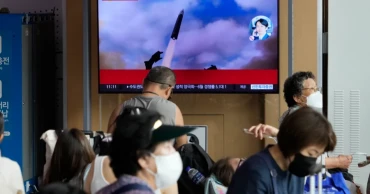
North Korea launches long-range missile toward sea after making threat over alleged US spy flights
North Korea launched a long-range ballistic missile toward its eastern waters Wednesday, its neighbors said, two days after the North threatened “shocking” consequences to protest what it called a provocative U.S. reconnaissance activity near its territory.
South Korea's military detected the long-range missile launch from the North’s capital region around 10 a.m., the South's Joint Chiefs of Staff said in a statement. It said South Korea's military bolstered its surveillance posture and maintained readiness in close coordination with the United States.
Japanese Defense Minister Yasukazu Hamada told reporters that the North Korean missile was likely launched on a lofted trajectory, at a steep angle that North Korea typically uses to avoid neighboring countries when it tests long-range missiles.
North Korea opens key party meeting to tackle its struggling economy and talk defense strategies
Hamada said the missile was expected to land at sea about 550 kilometers (340 miles) east of the coast of the Korean Peninsula outside of the Japanese exclusive economic zone.
North Korea's long-range missile program targets the mainland U.S. Since 2017, North Korea has performed a slew of intercontinental ballistic missile launches as part of its efforts to acquire nuclear-tipped weapons capable of striking major U.S. cities. Some experts say North Korea still has some technologies to master to possess functioning nuclear-armed ICBMs.
Before Wednesday's launch, the North's most recent long-range missile test happened in April, when it launched a solid-fuel ICBM, a type of weapon that experts say is harder to detect and intercept than liquid-fuel weapons.
North Korean leader’s sister vows 2nd attempt to launch spy satellite, slams UN meeting
Wednesday's launch, the North’s first weapons firing in about a month, came after North Korea earlier this week released a series of statements accusing the United States of flying a military plane close to North Korea to spy on the North.
The United States and South Korea dismissed the North’s accusations and urged it to refrain from any acts or rhetoric that raised animosities.
In a statement Monday night, Kim Yo Jong, the influential sister of North Korean sister Kim Jong Un, warned the United States of “a shocking incident” as she claimed that the U.S. spy plane flew over the North’s eastern exclusive economic zone eight times earlier in the day. She claimed the North scrambled warplanes to chase away the U.S. plane.
In another fiery statement Tuesday, Kim Yo Jong said the U.S. military would experience “a very critical flight” if it continues its illicit, aerial spying activities. The North’s military separately threatened to shoot down U.S. spy planes.
“Kim Yo-jong’s bellicose statement against U.S. surveillance aircraft is part of a North Korean pattern of inflating external threats to rally domestic support and justify weapons tests,” said Leif-Eric Easley, a professor at Ewha University in Seoul. “Pyongyang also times its shows of force to disrupt what it perceives as diplomatic coordination against it, in this case, South Korea and Japan’s leaders meeting during the NATO summit.”
North Korean leader's sister slams US for criticizing failed satellite launch
North Korea has made numerous similar threats over alleged U.S. reconnaissance activities, but its latest statements came amid heightened animosities over North Korea’s barrage of missile tests earlier this year.
2 years ago

Thailand's prime minister, who seized power in a 2014 coup, quits politics after losing election
Thailand’s Prime Minister Prayuth Chan-ocha, who served almost nine years in office after seizing power in a 2014 military coup, said Tuesday that he is leaving politics.
His announcement came after the political party for which he served as a prime minister candidate this year finished fifth in May’s general election, capturing just 36 seats in the 500-member House of Representatives.
Prayuth, 69, a former army commander, made the announcement on the Facebook page of Ruam Thai Sang Chart, or the United Thai Nation Party. He had been their nominee to return as prime minister.
Army chief returns from Thailand
“I would like to announce my retirement from politics by resigning as a member of United Thai Nation,” Prayuth wrote. “I’d like to ask the party leader, executives and members to continue their political activities with a strong ideology of protecting the institutions, the nation, the religion and the monarchy, and take care of the Thai people.”
Parliament on Thursday is due to select a new prime minister. The nominee from the top-running, progressive Move Forward Party who has assembled a majority coalition of eight parties with 312 seats in the Lower House, must win a majority vote of at least 376 of the combined vote of the House and the non-elected Senate, which has 250 members. Because of political differences with the conservative Senate, it is uncertain that the party's leader, Pita Limjaroenrat, can get approved.
After serving as prime minister in the unelected military government that came to power in the 2014 coup, Prayuth was returned to the job after the 2019 election as a candidate of the army-backed Palang Pracharath Party. Prime ministers do not need to be Members of Parliament, and Prayuth didn't contest the polls in 2019 or this year.
Thailand eyes deeper ties with Bangladesh: Thai Envoy
Had Prayuth been returned to office this year, he would only have been able to serve two more years under constitutional term limits. He was already one of Thailand’s longest-serving prime ministers.
‘They want change’: Opposition parties win big in Thailand election on promises of reform
Prayuth did not specify a reason for leaving politics but listed what he considered his accomplishments in office and said: “In these past nine years, I as prime minister have worked with my full determination and strength to protect the nation, the religion and the monarchy, and for the best interest of the beloved people."
2 years ago

NATO summit boosted by Turkey's decision to end opposition to Sweden's bid to join alliance
NATO opened its summit Tuesday with fresh momentum after Turkey withdrew its objections to Sweden joining the alliance, a step toward the unity that Western leaders have been eager to demonstrate in the face of Russia's invasion of Ukraine.
The decision by Turkish President Recep Tayyip Erdogan is a significant move toward Sweden's membership and it will alleviate tension in Vilnius, Lithuania’s capital. The deal was reached after days of intensive meetings, and it's poised to expand the alliance's strength in Northern Europe.
“Rumors of the death of NATO’s unity were greatly exaggerated," Jake Sullivan, the U.S. national security adviser, told reporters triumphantly on Tuesday.
NATO again extends Stoltenberg's mandate, happy with a safe pair of hands as the war drags on
As part of the deal, Erdogan said he would ask Turkey's parliament to approve Sweden joining NATO. Hungarian Prime Minister Viktor Orban, another holdout, is expected to take a similar step.
The outcome is a victory for President Joe Biden as well, who has touted NATO's expansion as an example of how Russia's invasion of Ukraine has backfired on Moscow. Finland has already become the 31st member of the alliance, and Sweden is on deck to become the 32nd. Both Nordic countries were historically nonaligned until the war increased fears of Russian aggression.
Because of the deal on Sweden's membership, "this summit is already historic before it has started,” NATO Secretary-General Jens Stoltenberg said.
Biden’s upcoming European trip is meant to boost NATO against Russia as the war in Ukraine drags on
Biden started his Tuesday by meeting with Lithuanian President Gitanas Nauseda, where he emphasized his commitment to transatlantic cooperation.
“Nothing happens here that doesn’t affect us," Biden said. He expressed confidence in Sweden's path to finalizing its membership in NATO.
Biden and Erdogan were scheduled to meet Tuesday evening, and it was unclear how some of the Turkish president's other demands will be resolved. He has been seeking advanced American fighter jets and a path toward membership in the European Union. The White House has expressed support for both, but publicly insisted that the issues were not related to Sweden's membership in NATO.
US, NATO had no involvement in Wagner's 'short-lived' revolt in Russia: Biden
“I stand ready to work with President Erdogan and Turkey on enhancing defense and deterrence in the Euro-Atlantic area,” Biden said in a statement late Monday.
The phrasing was a nod to Biden's commitment to help Turkey acquire new F-16 fighter jets, according to an administration official who was not authorized to comment publicly.
The Biden administration has backed Turkey’s desire to buy 40 new F-16s as well as modernization kits from the U.S. It's a move some in Congress, most notably Senate Foreign Relations Committee Chairman Bob Menendez, D-N.J, have opposed over Turkey blocking NATO membership for Sweden, its human rights record and other concerns.
Erdogan says no change in Turkey's stance on Sweden's NATO membership
In Washington, Menendez said he was “continuing to have my reservations” on providing the fighter aircraft to Turkey. If the Biden administration could show that Turkey wouldn’t use the F-16s belligerently against other NATO members, particularly its neighbor Greece, and meet other conditions, “then there may be a way forward,” Menendez told reporters.
NATO leaders still have other big questions to address at the two-day summit, particularly Ukraine’s desire to join NATO. The Baltic states — including Lithuania, which is hosting the event — have pushed for a strong show of support and a clear pathway toward membership for Ukraine.
The United States and Germany have resisted that, and Biden said last week that Ukraine wasn't ready to join. Members of NATO, he told CNN, need to “meet all the qualifications, from democratization to a whole range of other issues," a nod toward longstanding concerns about governance and corruption in Kyiv.
In addition, some fear that bringing Ukraine into NATO would serve more as a provocation to Russia than as a deterrence against aggression.
Stoltenberg wrote in Foreign Affairs on Monday that the alliance would “upgrade our political ties” by forming a NATO-Ukraine Council, which would be “a platform for decisions and crisis consultation.”
Ukrainian President Volodymyr Zelenskyy is expected to attend the summit on Wednesday and he and Biden were scheduled to meet, Sullivan said.
Stoltenberg reiterated that Ukraine will eventually become a member of NATO, a commitment first made in 2008 under President George W. Bush. The NATO chief did not outline more specifics.
However, Ukrainian Foreign Minister Dmytro Kuleba said NATO had agreed to forgo requiring a “membership action plan," a decision that he said “shortens our path to NATO.”
Stoltenberg reiterated that point on Tuesday.
“Ukraine is much closer to NATO so I think the time has come to reflect that in other NATO decisions,” he said.
Sullivan said allies were debating the “precise nature” of Ukraine's pathway to membership in the alliance. However, he promised that the summit would demonstrate how Putin's hopes for fractures within NATO will be unfulfilled.
“He has been disappointed from every turn," he said. "Vilnius will continue to disappoint him.”
Biden is on a five-day trip to Europe, with the NATO summit as its centerpiece.
The president spent Monday in the United Kingdom, where he met at Windsor Castle with King Charles III for the first time since he ascended to the throne. They discussed mobilizing financial support to combat climate change.
Biden also visited 10 Downing St. in London for talks with Prime Minister Rishi Sunak. It was their sixth meeting, a reflection of close ties between the two countries.
After the NATO summit ends on Wednesday, Biden will travel to Helsinki to celebrate Finland's recent entry into NATO and meet with Nordic leaders.
2 years ago

UN warns its development goals for 2030 are in trouble and 575 million people will remain very poor
In a grim report, the U.N. warned Monday that at the current rate of global progress 575 million people will still be living in extreme poverty and 84 million children won’t be going to school in 2030 – and it will take 286 years to reach equality between men and women.
The report on progress in achieving 17 wide-ranging U.N. goals adopted by world leaders in 2015 to improve life for the world's more than 7 billion people said that only 15% of some 140 specific targets that experts evaluated are on track to be reached by the end of the decade.
Close to half the targets are moderately or severely off track, it said, and of those 30% have either seen no movement at all or regressed including key targets on poverty, hunger and climate.
Read: Eliminate legal barriers to women owning land: UN chief
The ambitious goals for 2030 include ensuring that hunger is eradicated and nobody lives on less than $2.15 a day which is the extreme poverty line, providing every child with a quality primary and secondary school education, achieving gender equality, ensuring all people have clean water, sanitation and access to affordable energy, reducing inequalities, and taking urgent action to combat climate change.
“Unless we act now, the 2030 agenda could become an epitaph for a world that might have been,” U.N. Secretary-General Antonio Guterres said in a foreword to the report. “Failure to make progress means inequalities will continue to deepen, increasing the risk of a fragmented, two-speed world.”
The report was released ahead of a summit that Guterres has called during the annual gathering of world leaders at the U.N. General Assembly in September, which he said will be “a moment of truth and reckoning.”
Undersecretary-General for Economic and Social Affairs Li Junhua said conflicts including the war in Ukraine, climate change, the lingering effects of the COVID-19 pandemic especially its devastating financial impact on developing countries, and geopolitical tensions are all “threatening to derail hard-earned progress” toward achieving the goals.
Read: UN chief implicitly criticizes Cambodia's upcoming elections after top opposition party ban
He said in a foreword that the pandemic saw the largest decline in childhood vaccinations in three decades, an increase in tuberculosis and malaria deaths, and learning losses in 80% of the 104 countries studied. It also interrupted three decades of progress in reducing poverty, and produced the largest rise in inequality between countries in three decades, he said.
“By May 2023, the devastating consequences of war, conflict and human rights violations had displaced a staggering 110 million people of which 35 million were refugees – the highest figure ever recorded,” the ECOSOC chief said.
Li told a news conference launching the report that at the September summit, the U.N. would like political leaders to come up with “a new roadmap” to accelerate action at the global, regional and national level to achieve the goals by 2030.
With seven years left, the report said achieving the goals is “in deep trouble” and “it is time to sound the alarm.”
At current rates, it said not only will 575 million people still be living in extreme poverty in 2030 but only about one-third of countries will meet the target to reduce national poverty levels by half.
“Shockingly, the world is back at hunger levels not seen since 2005, and food prices remain higher in more countries than in the period 2015-2019,” the report said.
Read: Sudan military ruler seeks removal of UN envoy in letter to UN chief, who is 'shocked' by the demand
In 2021, the number of people suffering from hunger was close to 800 million, far above pre-pandemic levels, and in 2022 an estimated 45 million children under the age of 5 suffered from wasting and 148 million had stunted growth while 37 million were overweight, it said.
As for education, the report said years of underinvestment and learning losses mean that without a major effort not only will an estimated 84 million children be out of school in 2030 but approximately 300 million students will lack basic literacy and math skills for success in life — and only one in six countries will achieve the target of universal secondary school completion.
On tackling global warming, the report said, “If ever there was an illumination of the short-sightedness of our prevailing economic and political systems, it is the ratcheting up of the war on nature.”
Read: UN chief appoints Professor Yunus as member of advisory board of Eminent Persons on Zero Waste
The small window of opportunity to keep temperatures from rising beyond the internationally agreed threshold of 1.5 degrees Celsius (2.7 degrees Fahrenheit) to prevent the worst impacts of the climate crisis is fast closing, the report said, and the critical 1.5 degree tipping point is likely to be reached or surpassed by 2035.
2 years ago

Italy agrees to lift ban on flights from conflict-stricken Libya after 10 years
Commercial flights between Italy and conflict-torn Libya will resume in September after the Italian government agreed to lift a 10-year-long ban on civil aviation in the North African nation, one of Libya's rival governments said Sunday.
Abdul-Hamid Dbeibah, prime minister of the Tripoli-based government, said on Twitter that the Italian government of Prime Minister Giorgia Meloni informed his government of the decision.
Bangladesh wants to boost cooperation with Libya to curb illegal migration
He called the removal of the ban a "breakthrough."
The decision came after Libyan and Italian aviation officials met Sunday in the Libyan capital of Tripoli to discuss "the upcoming restoration of direct flights and the strengthening of cooperation" between the two countries, according to a statement from the Italian Embassy in Libya.
Oil-rich Libya plunged into chaos after a NATO-backed uprising toppled and killed longtime dictator Moammar Gadhafi in 2011. In the disarray that followed, the country split into rival administrations in the east and west, each backed by rogue militias and foreign governments.
Italy and other European countries banned Libyan flights from their airspace as the country descended into chaos.
Italy govt okays legal entry of 452,000 foreign workers in 3 years
Over the past decade, Libya has had direct flights to limited destinations, including cities in neighboring Egypt and Tunisia, and other Middle Eastern countries, such as Jordan.
A Libyan government statement said the two countries have agreed that one airliner from each country would operate flights starting in September. They did not name the destination cities.
Italy wants to promote legal pathways for migration: Ambassador Enrico Nunziata
2 years ago

Extremely overdue book returned to Massachusetts library 119 years later
On Feb. 14, 1904, someone curious about the emerging possibilities of a key force of nature checked out James Clerk Maxwell's "An Elementary Treatise on Electricity" from the New Bedford Free Public Library.
It would take 119 years and the sharp eyes of a librarian in West Virginia before the scientific text finally found its way back to the Massachusetts library.
The discovery occurred when Stewart Plein, the curator of rare books at West Virginia University Libraries, was sorting through a recent donation of books.
An unauthorized open-air ‘library’ on Dhaka University campus raises eyebrows
Plein found the treatise and noticed it had been part of the collection at the New Bedford library and, critically, had not been stamped "Withdrawn," indicating that while extremely overdue, the book had not been discarded.
Plein contacted Jodi Goodman, the special collections librarian in New Bedford, to alert her to the find.
"This came back in extremely good condition," New Bedford Public Library Director Olivia Melo said Friday. "Someone obviously kept this on a nice bookshelf because it was in such good shape and probably got passed down in the family."
The treatise was first published in 1881, two years after Maxwell's death in 1879, although the cranberry-colored copy now back at the New Bedford library is not considered a rare edition of the work, Melo said.
The library occasionally receives books as much as 10 or 15 years overdue, but nothing anywhere close to a century or more, she said.
Library named in memory of Abdus Salam has books, but no visitors
The treatise was published at a time when the world was still growing to understand the possibilities of electricity. In 1880, Thomas Edison received a historic patent embodying the principles of his incandescent lamp.
When the book was last in New Bedford, the nation was preparing for its second modern World Series, incumbent Republican President Theodore Roosevelt was on track to win another term, Wilbur and Orville Wright had conducted their first airplane flight just a year before and New York City was celebrating its first subway line.
The discovery and return of the book is a testament to the durability of the printed word, especially in a time of computerization and instant access to unfathomable amounts of information, Melo said.
"The value of the printed book is it's not digital, it's not going to disappear. Just holding it, you get the sense of someone having this book 120 years ago and reading it, and here it is in my hands," she said. "It is still going to be here a hundred years from now. The printed book is always going to be valuable."
Goethe and HerStory Foundation to host 'Sister Library: Mother Steals a Bicycle' on Wednesday
The New Bedford library has a 5-cent-per-day late fee. At that rate, someone returning a book overdue by 119 years would face a hefty fee of more than $2,100. The good news is the library's late fee limit maxes out at $2.
Another lesson of the find, according to Melo? It's never too late to return a library book.
2 years ago

Texas gunman in Walmart shooting gets 90 consecutive life sentences and may still face death penalty
A white gunman who killed 23 people in a racist attack on Hispanic shoppers at a Walmart in a Texas border city was sentenced Friday to 90 consecutive life sentences but could still face more punishment, including the death penalty.
Patrick Crusius, 24, pleaded guilty earlier this year to nearly 50 federal hate crime charges in the 2019 mass shooting in El Paso, making it one of the U.S. government’s largest hate crime cases.
Crusius, wearing a jumpsuit and shackles, did not speak during the hearing and showed no reaction as the sentence was read. U.S. District Judge David Guaderrama recommended that Crusius serve his sentence at a maximum security prison in Colorado and receive treatment and counseling for a severe mental health condition.
Crusius still faces a separate trial in a Texas court that could end with him getting the death penalty for carrying out one of the deadliest mass shootings in U.S. history.
8 dead as SUV hits crowd at Texas bus stop near border
As Crusius was led from the courtroom, the son of one of the victims shouted from the gallery.
“We’ll be seeing you again, coward,” yelled Dean Reckard, whose mother, Margie Reckard, was slain in the attack. “No apologies, no nothing.”
Police say Crusius drove more than 700 miles from his home near Dallas to target Hispanics with an AK-style rifle inside and outside the store. Moments before the attack began, Crusius posted a racist screed online that warned of a Hispanic “invasion” of Texas.
Police: 8 killed in Texas mall shooting, gunman also dead
In the years since the shooting, Republicans have described migrants crossing the southern U.S. border as an “invasion,” waving off critics who say the rhetoric fuels anti-immigrant views and violence.
Crusius pleaded guilty in February after federal prosecutors took the death penalty off the table. But Texas prosecutors have said they will try to put Crusius on death row when he stands trial in state court. That trial date has not yet been set.
In the U.S. government's case, Crusius received a life sentence for each of the 90 charges against him, half of which were classified as hate crimes. Attorney General Merrick Garland said after the sentencing that “no one in this country should have to live in fear of hate-fueled violence.”
Joe Spencer, Crusius’ attorney, told the judge before the sentencing that his client has a “broken brain.” He said Crusius had arrived in El Paso without a specific target in mind before winding up at the Walmart.
“Patrick’s thinking is at odds with reality … resulting in delusional thinking,” Spencer said.
Crusius became alarmed by his own violent thoughts, Spencer said, and he once left a job at a movie theater because of them. He said Crusius also searched online to look for ways to address his mental health, and he dropped out of a community college near Dallas because of his struggles.
Suspected gunman caught after 5 dead in Texas mass shooting
The sentencing in El Paso followed two days of impact statements from relatives of the victims, including citizens of Mexico and a German national. In addition to the dead, more than two dozen people were injured and numerous others were severely traumatized as they hid or fled.
One by one, family members used their first opportunity since the shooting to directly address Crusius, describing how their lives have been upended by grief and pain. Some forgave him. One man displayed photographs of his slain father and insisted that the gunman look at them.
Crusius’ family did not appear in the courtroom during the sentencing phase.
The attack was the deadliest of a dozen mass shootings in the U.S. linked to hate crimes since 2006, according to a database compiled by The Associated Press, USA Today and Northeastern University.
Before the shooting, Crusius had appeared consumed by the nation’s immigration debate, tweeting #BuildtheWall and posts that praised then-President Donald Trump’s hard-line border policies. He went further in his rant posted before the attack, sounding warnings that Hispanics were going to take over the government and economy.
Ian Hanna, an assistant U.S. attorney who prosecuted the government’s case, said Crusius had embraced the “insidious lie” that America only belonged to white people. “He wanted to eliminate a class of people,” Hanna said.
Tito Anchondo, whose brother Andre Anchondo was killed in the attack, called the sentence “the best it’s going to get” because it ensures that Crusius will be left to think about his actions in prison for the rest of his life.
“In a sense justice was served today, and in another sense I don’t think anything is ever going to be the same,” he said.
The people who were killed ranged in age from a 15-year-old high school athlete to several grandparents. They included immigrants, a retired city bus driver, teachers, tradesmen including a former iron worker, and several Mexican nationals who had crossed the U.S. border on routine shopping trips.
Two teenage girls recounted their narrow escape from Crusius’ rampage as they participated in a fundraiser for their youth soccer team outside the store, and said they are still fearful in public.
Margaret Juarez, whose 90-year-old father was slain and whose mother was wounded but survived, said she found it ironic that Crusius would spend his life in prison among inmates from racial and ethnic minorities. Others in the courtroom applauded Thursday as she celebrated their liberty.
“Swim in the waters of prison,” she told Crusius. “Now we’re going to enjoy the sunshine. … We still have our freedom, in our country.”
2 years ago

Indian authorities arrest 3 railway officials over the train crash that killed more than 290 people
India’s federal crime agency said Friday (July 07, 2023) it has arrested three railway officials in connection with one of the country’s deadliest train accidents, which killed more than 290 people last month.
The arrested men have been charged with culpable homicide without murder and destruction of evidence, the Central Bureau of Investigation said in a statement. It identified them as two signal engineers and one technician, and said the investigation is ongoing.
Error in signaling system led to train crash that killed 275 people in India, official says
June’s train crash in eastern Odisha state occurred when a packed passenger train was mistakenly diverted onto an adjacent loop line where it rammed into a stationary freight train loaded with iron ore. The collision derailed the passenger train’s coaches onto another track where they struck a passing train that was running in the opposite direction.
The two passenger trains were carrying more than 2,290 people when the collision took place. Nearly 1,000 people were injured.
India’s deadly train crash renews questions over safety as government pushes railway upgrade
After the accident, India’s Railway Minister Ashwini Vaishnaw said the cause of the crash was related to the signaling system.
India, a country of 1.42 billion people, has one of the world’s most extensive and complicated railways built during the British colonial era: more than 40,000 miles (64,000 kilometers) of tracks, 14,000 passenger trains and 8,000 stations. Spread across the country from the Himalayas in the north to the beaches in the south, it is also a system that is weakened by decades of mismanagement and neglect.
Despite efforts to improve safety, several hundred accidents happen every year, and most such crashes are blamed on human error or outdated signaling equipment.
Indian officials end rescue work for 2 wrecked passenger trains that killed over 300 people
The June crash was India’s deadliest since 1995, when two trains collided near New Delhi, killing 358 people. In 2016, a passenger train slid off the tracks between the cities of Indore and Patna, killing 146 people.
2 years ago

For the third time this week, Earth sets an unofficial heat record
Earth's average temperature set a new unofficial record high on Thursday, the third such milestone in a week that already rated as the hottest on record.
The planetary average hit 63 degrees Fahrenheit, 17.23 degrees Celsius, surpassing the 62.9 and 17.18-degree marks set Tuesday and equaled Wednesday, according to data from the University of Maine's Climate Reanalyzer, a tool that uses satellite data and computer simulations to measure the world's condition.
That average includes places that are sweltering under dangerous heat — like Jingxing, China, which checked in almost 110 degrees Fahrenheit (43.3 degrees Celsius) — and the merely unusually warm, like Antarctica, where temperatures across much of the continent were as much as 8 degrees Fahrenheit (4.5 degrees Celsius) above normal this week.
Also read: World swelters to unofficial hottest day on record
The National Oceanic and Atmospheric Administration on Thursday issued a note of caution about the Maine tool's findings, saying it could not confirm data that results in part from computer modeling.
"Although NOAA cannot validate the methodology or conclusion of the University of Maine analysis, we recognize that we are in a warm period due to climate change," NOAA said.
Still, the Maine data has been widely regarded as another troubling sign of climate change around the globe. Some climate scientists said this week they weren't surprised to see the unofficial records.
Also read: Nearly 100 die as India struggles with a sweltering heatwave in 2 most populous states
Robert Watson, a scientist and former chairman of the UN's Intergovernmental Panel on Climate Change, said governments and the private sector "are not truly committed to address climate change." Nor are citizens, he said.
"They demand cheap energy, cheap food and do not want to pay the true cost of food and energy," Watson said.
Also read: Heatwaves to impact almost every child by 2050: UNICEF report
2 years ago