Others

WHO calls for safe, ethical use of AI tools for health
The World Health Organization (WHO) has called for caution when deploying large language model tools (LLMs) generated by artificial intelligence (AI).
In a statement released Tuesday, WHO said it was imperative for the risks of LLMs to be carefully examined.
LLMs are used to improve access to health information, as decision-support tools, and to enhance diagnostic capacity in under-resourced settings.
WHO has warned that the caution normally exercised for new technologies is not being consistently applied to LLMs.
WHO notes that precipitous adoption of untested systems could lead to errors by healthcare workers, cause harm to patients, and erode trust in AI. This could undermine or delay the potential long-term benefits of such technologies.
Therefore, WHO has called for rigorous oversight of LLMs, to ensure they are used in safe, effective, and ethical ways.
As technology firms work to commercialize LLMs, policy-makers must ensure patient safety and protection, WHO noted.
Clear evidence of the benefits of LLMs must be measured before they can be used on a large scale in routine healthcare and medicine - whether by individuals, care providers or health system administrators and policy-makers.
The WHO's guidance on the ethics and governance of AI for health, released in June 2021, emphasizes the importance of applying ethical principles and appropriate governance when designing, developing, and deploying AI for health.
3 years ago

Gunmen kill 29 villagers in latest attack in hard-hit north Nigeria
Gunmen attacked villages in troubled north-central Nigeria, killing 29 people and razing houses, survivors and authorities said Tuesday.
Many villagers remained unaccounted for Tuesday evening after the attack in Plateau state, residents said. It was the latest incident in a spiral of violence mainly targeting remote communities in the West African nation.
The gunmen targeted three villages in Plateau state’s Mangu local government area late Monday night and killed several people either with gunfire or after setting their houses ablaze, resident Philip Pamshak said.
“As I am talking to you, they are still attacking people. The tension is still high and there are places the bandits still control, so people are not able to go and check if there are others killed,” Pamshak said.
Also read: Gunmen kill 15 people, abduct 5 aid workers in north Nigeria
Plateau Gov. Simon Lalong said he was disturbed by the attack and directed security forces to search for the suspects and prosecute them, according to a statement issued by his spokesman.
“He (the governor) describes this as yet another attempt by crises merchants and criminals to return the state to the dark days of pain and agony,” said Makut Macham, Lalong’s spokesman.
Such attacks have become rampant in many parts of Nigeria’s northern region, where several armed groups target villages with inadequate security, either killing or abducting residents and travelers for ransom.
Arrests are rare in such attacks, for which no group typically takes responsibility. However, authorities have in the past identified many of the attackers as former pastoralists who took up arms after decades of conflict with farmers over limited access to land and water.
The security crisis has led to thousands of deaths and defied several government and security measures in the last year.
After the latest killings in Plateau, Lalong directed the emergency response agency to visit the affected communities “to bring succor” to victims and their families, many of whom have either fled the area or have lost their homes, adding to Nigeria’s worsening humanitarian crisis.
3 years ago

State media reports Chinese fishing boat sinks in Indian Ocean; 39 on board missing
State media reports that a Chinese fishing boat operating in the Indian Ocean has sunk and all 39 crew members on board are missing.
Broadcaster CCTV said the sinking happened around 3 a.m. Tuesday. The crew includes 17 from China, 17 from Indonesia and five from the Philippines, the report said.
Chinese leader Xi Jinping and Prime Minister Li Qiang have ordered Chinese diplomats abroad, as well as the agriculture and transportation ministries, to assist in the search for survivors.
The Lupenglaiyuanyu No. 8 was based in the eastern province of Shandong, operated by the Penglaiyingyu Co. Ltd.
Also read: Cement-laden vessel sinks in Barishal river
China is believed to operate the world’s largest fishing fleet. Many of them stay at sea for months or even years at a time, supported by Chinese state maritime security agencies and a broad network of support vessels.
No word was given on the cause of the sinking.
Recovery efforts are underway in Myanmar and Bangladesh after a powerful cyclone smashed into their coastlines, causing widespread destruction and at least 21 deaths, with hundreds of others believed missing.
Chinese squid fishing ships have been documented using wide nets to illegally catch already overfished tuna as part of a surge in unregulated activity in the Indian Ocean, according to a report released in 2021 by a Norway-based watchdog group that highlights growing concerns about the lack of international cooperation to protect marine species on the high seas.
The U.S. Coast Guard was also involved in a dangerous confrontation with Chinese vessels not far from Ecuador’s Galapagos Islands in 2022 during a mission to inspect the vessels for any signs of illegal, unreported or unregulated fishing.
3 years ago
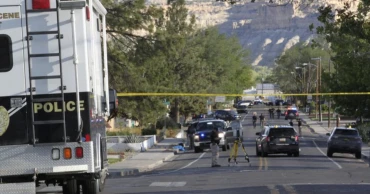
New Mexico high school student killed 3 women in 'random' shooting rampage, police say
The gunman who killed three people and wounded six others as he fired randomly while roaming his northwestern New Mexico neighborhood was a local high school student and his victims include a 97-year-old woman and her daughter, police said Tuesday.
Investigators were still trying to determine a motive for the attack by Beau Wilson, 18, in the Farmington neighborhood where he lived. They say he opened fire Monday, killing Gwendolyn Schofield, her 73-year-old daughter, Melody Ivie, and 79-year-old Shirley Voita.
Voita had worked as a nurse and was a devoted parishioner at Sacred Heart Catholic Church, said former state Rep. James Strickler, who was her friend.
“She was just a dynamite lady. She was well-loved and I’m still shocked over it,” said Strickler, who heard gunfire ring out on Monday before learning the circumstances of Voita's death.
Witnesses and police say Wilson walked through the neighborhood a short drive from downtown Farmington spraying bullets until police arrived within minutes and fatally shot him. Two police officers were among the wounded.
“The amount of violence and brutality that these people faced is unconscionable to me,” Deputy Police Chief Kyle Dowdy said.
Deputy Police Chief Baric Crum said Wilson was indiscriminately shooting at vehicles, but that some rounds also hit homes.
Dowdy said investigators do not believe Wilson knew anyone he shot.
Also read: Police: 8 killed in Texas mall shooting, gunman also dead
“We’ve discovered nothing that leads us to believe that the suspect knew" the victims, he said. “We’re pretty confident in that this was completely random.”
Bryan Brown and Brandi Dominguez were home Monday morning with their five children when the shooting began. Their doorbell camera captured yelling and the repeated pops of gunfire. Brown said it was loud and sounded as if it were coming from two different directions.
Brown was among those who ran into the street to help the victims. He said one woman had gunshot wounds to the leg and head. She asked for help and he said he tried to stop the bleeding.
“I feel bad for her family,” he said Tuesday. “I don’t even know, this kind of stuff is just uncalled for.”
Before Brown came outside, he told Dominguez and the kids to stay inside and stay down. Bullets hit the family’s home and vehicle.
Brown said his teenage son knew Wilson from school and had texted him, knowing that he lived down the street. It was only later they found out that authorities identified Wilson as the shooter.
“It just goes to show you never really know somebody until something happens,” Brown said. “He seemed like an OK kid.”
In November, after he turned 18, Wilson legally purchased at least one gun used Monday, police said. He carried three firearms in the attack, including an assault-style weapon.
Four officers fired a total of 16 rounds at Wilson, including one of the wounded officers, said San Juan County Sheriff Shane Ferrari.
Mayor Nate Duckett said Tuesday that the Farmington officer and state police officer were treated for their wounds and released from a hospital.
Authorities began receiving reports of gunshots at 10:57 a.m. and the first officer arrived at 11:02 a.m., police Chief Steve Hebbe said Monday in a video statement. Three minutes later, the gunman had been killed.
Joseph Robledo, a 32-year-old tree trimmer, said he rushed home after learning that his wife, Jolene, and their year-old daughter had sought shelter in the laundry room when gunshots rang out. A bullet went through his daughter’s window, without hitting anyone.
Jolene Robledo said they had just finished breakfast when she heard “pop, pop, pop, pop," which she first thought was a car backfiring. She said they were going to run out the back door until she heard a man curse right outside, so she quietly shut the door and hid with her daughter between the washing machine and dryer.
“I mean it was crazy. I called my husband and he could hear the gunshots over the phone,” she said. “He was freaking out and I was like, ‘don’t hang up, don’t hang up!’”
Joseph Robledo said he jumped a fence to get in through the back door. Out front, he found an older woman in the street who had been wounded while driving by. She appeared to have fallen out of her car, which kept rolling without her, he said.
“I went out to see because the lady was just lying in the road, and to figure just what the heck was going on,” Robledo said. He and others began to administer first aid.
Neighbors directed a police officer toward the suspect.
“We were telling (the officer), ‘He’s down there.’ … The cop just went straight into action,” Robledo said.
Robledo’s own family car was perforated with bullets.
“We’ve been doing yard work all last week. I just thank God that nobody was outside in front,” he said. “Obviously, elderly people — he didn’t have no sympathy for them."
Downtown Farmington, a short drive from the neighborhood, has undergone a transformation of sorts in recent years, with cafes and breweries cropping up alongside decades-old businesses that trade in Native American crafts from silver jewelry to wool weavings.
On Tuesday, orange circles of spray paint still marked the ground where police had collected evidence. Authorities were using metal detectors to search the grass in front of one of the churches along the street where gunfire erupted.
As night approached Monday, dozens of people gathered at Hills Church, a few miles (kilometers) from the attack scene, to pray at the base of a tall metal cross. Lead pastor Matt Mizell talked about living in a “dark and broken world” but told the crowd there was still hope and asked God to provide them strength.
New Mexico enacted a red-flag law in 2020 that can be used to seize guns from people who pose a danger to others or themselves. Dowdy said relatives expressed concern about Wilson’s mental health when interviewed by police but that he didn’t have enough information at this time to further elaborate.
3 years ago

Salman Rushdie makes rare public address after attack, warns free expression under threat
Writer Salman Rushdie has made a public speech, nine months after being stabbed and seriously injured onstage, warning that freedom of expression in the West is under its most severe threat in his lifetime.
Rushdie delivered a video message to the British Book Awards, where he was awarded the Freedom to Publish award on Monday evening. Organizers said the honor "acknowledges the determination of authors, publishers and booksellers who take a stand against intolerance, despite the ongoing threats they face."
He said that "we live in a moment, I think, at which freedom of expression, freedom to publish has not in my lifetime been under such threat in the countries of the West."
"Now I am sitting here in the U.S., I have to look at the extraordinary attack on libraries, and books for children in schools," he said. "The attack on the idea of libraries themselves. It is quite remarkably alarming, and we need to be very aware of it, and to fight against it very hard."
Rushdie, 75, was blinded in one eye and suffered nerve damage to his hand when he was attacked at a literary festival in New York state in August. His alleged assailant, Hadi Matar, has pleaded not guilty to charges of assault and attempted murder.
Rushdie spent years in hiding with police protection after Iran's Grand Ayatollah Ruhollah Khomeini issued a fatwa, or edict, in 1989 calling for his death over the alleged blasphemy of the novel "The Satanic Verses."
In his speech, Rushdie also criticized publishers who change decades-old books for modern sensibilities, such as large-scale cuts and rewrites to the works of children's author Roald Dahl and James Bond creator Ian Fleming.
He said publishers should allow books "to come to us from their time and be of their time."
"And if that's difficult to take, don't read it, read another book," he said.
3 years ago

South Korea and Japan use G-7 to push improvement in ties long marked by animosity
Amid the high-level efforts to deal with a raft of global emergencies, this weekend's Group of 7 summit of rich democracies will also see an unusual diplomatic reconciliation as the leaders of Japan and South Korea look to continue mending ties that have been marked for years by animosity and bickering.
At first glance the two neighbors would seem to be natural partners. They are powerful, advanced democracies and staunch U.S. allies in a region beset with autocratic threats. The continuing fallout, however, from centuries of complicated, acrimonious history, culminating in the brutal 1910-1945 Japanese colonization of the Korean Peninsula, has resulted in more wariness than friendship.
Also Read: Japan leader expresses sympathy for Korean colonial victims
A big part of the sudden recent shift in tone is a shared focus on China's growing aggressiveness, t he threat of North Korea's fast-improving arsenal of nuclear-capable missiles — and deep worry about how Russia's war in Ukraine is influencing both issues. Some diplomatic nudging by Washington, which provides military protection for both its allies and wants them to more strongly counter China's rising global influence, has also helped.
Tokyo and Seoul “understand that their survival, both nationally and politically, depends on subordinating themselves to the U.S. President Joe Biden administration’s global and regional priorities,” according to Daniel Sneider, an East Asia lecturer at Stanford University.
Japanese Prime Minister Fumio Kishida's invitation for South Korean President Yoon Suk Yeol to be a guest at the G-7 talks in Hiroshima is only the most recent sign of these reset ties. It follows back-to-back summits by the leaders, which hadn't happened in years. Japan also agreed to South Korea's request to send an experts’ team later this month to visit the destroyed Fukushima nuclear power plant to view preparation for a planned release into the ocean of treated but still slightly radioactive wastewater.
Also Read; South Korea, US, Japan hold anti-North Korea submarine drill
The G-7 summit, which runs Friday through Sunday, will allow the leaders to deepen their burgeoning relationship — Kishida, Yoon and Biden plan to meet on the sidelines — while also working to persuade the world's most powerful leaders to tighten defense cooperation as China and North Korea expand their military postures in the region.
History issues have long harried Seoul and Tokyo. Ties worsened in 2018, for instance, after South Korean court rulings ordered two Japanese companies to compensate a group of Korean plaintiffs who the companies had used for wartime slave labor. Disagreement over the rulings later spilled over to trade and military cooperation issues. Japan insists all compensation issues were settled by a 1965 treaty that normalized relations.
Yoon’s summits with Kishida came after his government announced a domestically unpopular plan in March to use South Korean corporate funds to compensate the forced laborers. The move was aimed at preventing the courts from liquidizing the Japanese companies’ local assets, which would cause a further diplomatic rupture.
Kishida agreed to a resumption of defense, trade and other talks in his meetings with Yoon, and Japan recently announced that it is negotiating an agreement with Washington and Seoul on sharing real-time data on North Korean missile launches.
Seoul and Tokyo are both worried about the geopolitical uncertainty created by Russia’s invasion of Ukraine, which has raised fears about similar Chinese aggression in the South and East China Seas and against Taiwan, the democratic, self-governing island that Beijing claims as its own. North Korea also used the global focus on the invasion to ramp up its tests of nuclear-capable missiles.
Japan is one of many nations in Asia that has territorial disputes with China, something that has strongly figured into Kishida's push to distance Japan from its post-World War II principle of self-defense only. Last year, Tokyo adopted a new national security strategy that includes the goals of acquiring preemptive strike capabilities and cruise missiles to counter threats from North Korea, China and Russia.
Alarmed by the growing North Korean threat — Pyongyang has test-launched around 100 missiles since the start of 2022 — Yoon may be using better relations with Japan as a way to forge a stronger alliance with the United States.
Yoon’s government has expanded its combined military exercises with the United States, which also included three-way drills with Japan, while seeking greater assurances from Washington that it would swiftly and decisively use its nuclear weapons to protect its allies in the event of a North Korean nuclear attack.
“There’s growing recognition (in both Tokyo and Seoul) that the region’s various security issues are becoming increasingly interconnected,” which is leading the countries to reassess their importance to each other, said Jin Chang Soo, an analyst at South Korea’s Sejong Institute.
During a recent meeting in Washington, Yoon and Biden agreed to a declaration that includes more nuclear information-sharing and regular visits to South Korea by a U.S. nuclear-powered sub.
The Biden administration may now be pushing for an extended deterrence dialogue among Washington, Seoul and Tokyo that “would convey a formidable response both to North Korea and to China, and even to a potential Chinese–Russian military axis,” Sneider recently wrote.
Hiroshima, the first target of a nuclear weapon in history, could provide a symbolic backdrop for Kishida and Yoon to raise awareness about the North Korean threat while underlining goals for nuclear non-proliferation.
In another trust-building gesture, Kishida and Yoon plan to pay their respects at a Hiroshima memorial for Korean atomic bomb victims.
Despite the improving ties, however, there's no certainty how long reconciliation will last.
After decades of poverty and dictatorship following the 1950-53 Korean War, South Korea has become a developed economic and military power. But there are large policy swings between conservative governments, like the one in power now, and liberal governments that are more wary of stronger ties with Japan and the United States.
And then there are the historical issues, including continuing court hearings on forced labor, which remain “buried like landmines, not far from the surface and ready to be set off,” Sneider said.
3 years ago

Russia launches ‘exceptional’ air attack in Kyiv with drones, missiles
Loud explosions sounded above Kyiv early Tuesday as Russia launched an intense air attack on the capital using a combination of missiles launched from the air, sea and land.
Russia's latest attack on Kyiv was “exceptional in its density — the maximum number of attacking missiles in the shortest period of time,” said Serhii Popko, the head of the Kyiv military administration.
It is the eighth time this month that Russian air raids have targeted the capital, a clear escalation after weeks of lull and ahead of a much-anticipated Ukrainian counter-offensive. It also comes as President Volodymyr Zelenksyy concludes a whirlwind European tour to greet Ukraine's key wartime allies, which spurred an additional tranche of pledged military aid.
Also Read: Zelenskyy's European tour aimed to replenish Ukraine's arsenal and build political support
“According to preliminary information the vast majority of enemy targets in the airspace of Kyiv were detected and destroyed,” said Popko.
Ukraine's Air Force said 18 missiles of various types were launched, including drones, cruise missiles and ballistic missiles. All were intercepted and shot down, said Air Force spokesman Yurii Ihnat.
Six “Kinzhal” aero-ballistic missiles were launched from MiG-31K aircraft, nine cruise missiles from ships in the Black Sea and three land-based S-400 cruise missiles targeted the capital, said Ihnat in a statement on Telegram.
After the first onslaught, Russia also launched Iranian-made Shahed attack drones and conducted aerial reconnaissance, Ihnat said.
Debris fell across several districts in the capital. In the Solomyansky district, causing a fire in a non-residential building. The fire was extinguished.
Debris set cars on fire and fell on the grounds of a zoo, but no losses were reported, said Kyiv Mayor Vitali Klitschko.
3 years ago

At least 676 people killed in Sudan clashes: UN
At least 676 people have been killed due to the clashes between the Sudanese Army and the Rapid Support Forces (RSF), according to a report of the United Nations Office for the Coordination of Humanitarian Affairs (OCHA) on Sunday.
"Clashes between the Sudan Armed Forces and the Rapid Support Forces have continued for 30 consecutive days, especially in and around Khartoum, killing at least 676 people and injuring 5,576, OCHA said.
Also Read: Sudan: 25 dead in tribal fighting, as truce talks stall
According to the report, over 936,000 people have been newly displaced by the conflict since April 15, including about 736,200 internally displaced, and about 200,000 took refuge in neighboring countries.
Since the clashes broke out in mid April, residents of the Sudanese capital Khartoum have been suffering from severe food shortages, especially after dozens of factories were looted and burned.
According to the United Nations, it is estimated that about 15.8 million Sudanese, or about one-third of Sudan's population, will need humanitarian aid in 2023, and the figure is likely to increase as a result of the war.
Also Read: 262 more Bangladeshis return home from Sudan
On May 11, the Sudanese warring parties signed in the Saudi port city of Jeddah the Declaration of Commitment to Protect the Civilians of Sudan to facilitate the delivery of emergency humanitarian aid and guarantee the safe evacuation of civilians.
However, the two sides accused each other of breaching the deal and continuing the armed clashes.
On Sunday, the Sudanese Army accused the RSF of shooting Christian worshipers in a church at Al-Masalma area in Omdurman city.
However, the RSF denied responsibility for the incident and accused the army of being behind it, calling for an independent investigation into the incident.
3 years ago

Cease-fire between Israel and armed groups in Gaza appears to hold after days of fighting
A fragile cease-fire between Israeli forces and armed groups in the Gaza Strip appeared to be holding Sunday after a five-day clash that killed 33 Palestinians and two people in Israel.
The latest round of Gaza fighting was sparked Tuesday when Israeli jets killed three top commanders from the Islamic Jihad militant group in response to earlier rocket launches from Gaza. Those killings set off a barrage of militant fire and the conflagration threatened to drag the region into another all-out war until an Egyptian-brokered cease-fire took hold late Saturday.
While the calm appeared to bring a sense of relief to Gaza's 2 million people and hundreds of thousands of Israelis who had been largely confined to bomb shelters in recent days, the agreement did nothing to address the underlying issues that have fueled numerous rounds of fighting between Israel and Palestinian militant groups in the Gaza Strip over the years.
In Gaza, residents surveyed the latest damage caused to their surroundings, with gaping holes left in the apartments serving as what Israel said were hideouts for the six senior Islamic Jihad members killed during this round. Gaza's main cargo crossing with Israel reopened Sunday after warnings that keeping it closed would force Gaza's sole power plant to shut down, deepening a power crisis.
Israel was gradually lifting restrictions on residents in southern Israel, which had borne the brunt of the rocket fire.
Israeli officials expressed satisfaction with the latest battle, having killed at least six members of Islamic Jihad's top brass in what it says were pinpointed strikes based on solid intelligence. But at least 13 of those killed in Gaza were civilians, among them children as young as 4 years old, as well as women.
Prime Minister Benjamin Netanyahu said the targeted attacks on the militants' hideouts would reverberate around the region.
"Israel's enemies in Gaza and much farther than Gaza know that even if they try to hide, we are able and prepared to reach them at any time," he told a meeting of his Cabinet.
Israel has faced criticism in the past from rights groups over the civilian casualties in its bombardments in Gaza. Israel says it does its utmost to avoid harming civilians in its strikes and says militants operate from within the territory's densely populated areas to fire rockets indiscriminately at Israeli communities.
Even if some of the strikes were precise, others destroyed the homes of uninvolved Palestinians.
"If they want to target a house, let them target it alone. Why destroy the whole neighborhood? Why?" said Mai Sarson, whose house in Deir el-Balah was reduced to ruins in an Israeli strike.
Throughout the fighting, Israel's repeated airstrikes targeting Islamic Jihad and its command centers and rocket-launching sites showed no signs of stopping the rocket fire, prompting Islamic Jihad to declare victory and sending cheering Palestinians out into the streets late Saturday.
The Israeli military reported over 1,400 launches throughout the fighting, with some rockets reaching as far as the Tel Aviv and Jerusalem areas. Israeli jets struck more than 400 targets, according to a preliminary military tally, which also showed about a fifth of the rockets were misfired and landed in Gaza, while most of the rest were either intercepted or landed in open areas.
An 80-year-old woman and a Palestinian laborer who was working inside Israel were killed by rocket fire. A Palestinian human rights group said three people, including two children, were killed in Gaza by errant rockets.
It was the latest in a long series of battles between Israel and Palestinian militants in Gaza since the Islamic militant group Hamas seized control of the seaside territory in 2007. Israel and Hamas have fought four wars, and there have been numerous smaller flareups as well.
The more powerful Hamas has praised Islamic Jihad's strikes but remained on the sidelines during the latest round of fighting, limiting the scope of the conflict. As the de facto government held responsible for the abysmal conditions in the blockaded Gaza Strip, Hamas has recently tried to keep a lid on its conflict with Israel. Islamic Jihad, on the other hand, a more ideological and unruly militant group wedded to violence, has taken the lead in the past few rounds of fighting with Israel.
Saturday's deal did not address many of the causes of the repeated fighting, including Israel's ongoing blockade of Gaza, the large arsenals of weapons possessed by Hamas and Islamic Jihad and Israeli policies in the occupied West Bank and east Jerusalem.
The Gaza violence came after more than a year of fighting in the occupied West Bank, where the Israeli military has been staging near-nightly arrest raids and Palestinians have carried out repeated attacks. Tensions could once again soar this week when nationalist Israelis hold an annual march through a sensitive area of Jerusalem's Old City, which the Palestinians view as provocative.
Israel captured the West Bank, east Jerusalem and Gaza in the 1967 Mideast war. The Palestinians claim all three areas for a future state. Israel withdrew from Gaza in 2005, but Hamas subsequently overran the territory and expelled forces loyal to the internationally recognized Palestinian Authority.
Israel and Egypt have maintained a blockade over Gaza in what Israel says is a policy aimed at preventing Hamas from arming. The Palestinians and international rights groups say the policy, which restricts the movement of people and goods in and out of Gaza, amounts to collective punishment.
3 years ago

G7 finance leaders vow to contain inflation, strengthen supply chains but avoid mention of China
The Group of Seven’s top financial leaders united Saturday in their support for Ukraine and their determination to enforce sanctions against Russia for its aggression but stopped short of any overt mention of China.
The finance ministers and central bank chiefs ended three days of talks in Niigata, Japan, with a joint statement pledging to bring inflation under control, help countries struggling with onerous debts and strengthen financial systems.
They also committed to collaborating to build more stable, diversified supply chains for developing clean energy sources and to “enhance economic resilience globally against various shocks.”
The statement did not include any specific mention of China or of “economic coercion” in pursuit of political objectives, such as penalizing the companies of countries whose governments take actions that anger another country.
Also Read: G-7 talks focus on ways to fortify banks, supply chains as China accuses group of hypocrisy
Talk this week of such moves by China had drawn outraged rebukes from Beijing. Officials attending the talks in this port city apparently balked at overtly condemning China, given the huge stake most countries have in good relations with the rising power and No. 2 economy.
The finance leaders' talks laid the groundwork for a summit of G-7 leaders in Hiroshima next week that President Joe Biden is expected to attend despite a crisis over the U.S. debt ceiling that could result in a national default if it is not resolved in the coming weeks.
Japanese Finance Minister Shunichi Suzuki said that Treasury Secretary Janet Yellen mentioned the issue in a working dinner, but he refrained from saying anything more.
While in Niigata, Yellen warned that a failure to raise the debt ceiling to enable the government to continue paying its bills would bring an economic catastrophe, destroying hundreds of thousands of jobs and potentially disrupting global financial systems. No mention of the issue was made in the finance leaders' statement.
The G-7's devotion to protecting what it calls a “rules-based international order” got only a passing mention.
The leaders pledge to work together both within the G-7 and with other countries to “enhance economic resilience globally against various shocks, stand firm to protect our shared values, and preserve economic efficiency by upholding the free, fair and rules-based multilateral system,” it said.
G-7 economies comprise only a tenth of the world’s population but about 30% of economic activity, down from roughly half 40 years ago. Developing economies like China, India and Brazil have made huge gains, raising questions about the G-7's relevance and role in leading a world economy increasingly reliant on growth in less wealthy nations.
China had blasted as hypocrisy assertions by the U.S. and other G-7 countries that they are safeguarding a “rules-based international order” against “economic coercion” from Beijing and other threats.
China itself is a victim of economic coercion, Chinese Foreign Ministry spokesperson Wang Wenbin said Friday.
“If any country should be criticized for economic coercion, it should be the United States. The U.S. has been overstretching the concept of national security, abusing export controls and taking discriminatory and unfair measures against foreign companies,” Wang said in a routine news briefing.
China accuses Washington of hindering its rise as an increasingly affluent, modern nation through trade and investment restrictions. Yellen said they are “narrowly targeted” to protect American economic security.
Despite recent turmoil in the banking industry, the G-7 statement said the financial system was “resilient” thanks to reforms implemented during the 2008 global financial crisis.
“Nevertheless, we need to remain vigilant and stay agile and flexible in our macroeconomic policy amid heightened uncertainty about the global economic outlook,” it said.
Meanwhile, inflation remains “elevated" and central banks are determined to bring it under control, it said.
Since prices remain “sticky,” some countries may see continued rate hikes, said Kazuo Ueda, Japan’s central bank governor. “The impact of the rate hikes has not been fully realized,” he told reporters.
Japan won support for its call for a “partnership” to strengthen supply chains to reduce the risk of disruptions similar to those seen during the pandemic, when supplies of items of all kinds, from medicines to toilet paper to high-tech computer chips, ran short in many countries.
Suzuki said details of that plan would be worked out later.
“Through the pandemic, we learned that supply chains tended to depend on a limited number of countries or one country,” he said, adding that economic security hinges on helping more countries develop their capacity to supply critical minerals and other products needed as the world switches to carbon-emissions-free energy.
Tensions with China, and with Russia over its war on Ukraine, inevitably loomed large during the talks in Japan, the G-7's only Asian member.
“We call for an immediate end of Russia’s illegal war against Ukraine, which would clear one of the biggest uncertainties over the global economic outlook,” the joint statement said.
The financial leaders took time to listen to ideas on how to focus more on welfare in policymaking, rather than just GDP and other numerical indicators that often drive decisions with profound impacts on people's well being.
“These efforts will help preserve confidence in democracy and a market-based economy, which are the core values of the G-7,” the finance leaders' statement concluded.
Suzuki said he and other leaders learned much from a seminar by Columbia University economist Joseph Stiglitz, a Nobel prize winner who worked in the Clinton administration and who has championed what he calls “progressive capitalism.”
It's a "very interesting view," Suzuki said, adding that “so far, we’ve been mostly focused on GDP and other numerical indicators."
3 years ago