Others
Why does US see Chinese-owned TikTok as a security threat?
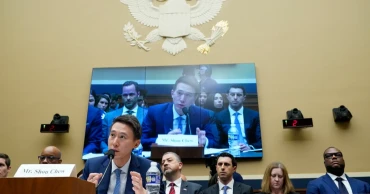
U.S. lawmakers have grilled TikTok CEO Shou Zi Chew about data security and harmful content, with some pushing to ban the popular short-video app nationwide.
A Singaporean native, Chew told the lawmakers that TikTok prioritizes user safety and as he sought to avert a ban by downplaying the app's ties to China.
Both Republican and Democratic representatives aggressively questioned Chew on topics including TikTok’s content moderation practices, its data security plans, and past spying on journalists.
Also Read: Skeptical US lawmakers grill TikTok CEO over safety, content
Here's a look at some of the concerns about TikTok and its ownership.
WHY DOES WASHINGTON SAY TIKTOK IS A THREAT?
TikTok, which has over 150 million American users, is a wholly owned subsidiary of Chinese technology firm ByteDance Ltd., which appoints its executives.
ByteDance is based in Beijing but registered in the Cayman Islands, as is common for privately owned Chinese companies. Its headquarters is in Beijing’s northwestern Haidian district, home to key universities and a hub for tech startups.
Founded by Chinese entrepreneur Zhang Yiming in 2012, ByteDance is said to be valued at around $220 billion — nearly half of its 2021 valuation of $400 billion. Publicly traded Chinese tech companies and privately held ones like ByteDance have plunged in value since the ruling Communist Party tightened control over the industry with anti-monopoly and data security crackdowns.
Western governments worry Chinese authorities could force ByteDance to hand over TikTok data on American users, exposing sensitive information. China has denied asking its companies to hand over overseas data, and TikTok insists it has never done so and would not do so.
Also Read: TikTok CEO to tell Congress app is safe, urge against ban
ByteDance says 60% of its shares are owned by non-Chinese investors such as U.S investment firms Carlyle Group and Kohlberg Kravis Roberts and Japan's SoftBank Group. Employees own 20% and its founders the remaining 20%.
Some details of the relationship between TikTok and ByteDance remain unclear to outsiders.
WHAT CHINESE RULES WORRY WESTERN GOVERNMENTS?
China's 2017 National Intelligence Law states that “any organization" must assist or cooperate with state intelligence work while a separate 2014 Counter-Espionage Law says “relevant organizations ... may not refuse" to collect evidence for an investigation.
Since ByteDance, which owns TikTok, is a Chinese company, it would likely have to abide by these rules if Chinese authorities asked it to turn over data.
Laws and regulations are only one aspect of the Communist Party’s pervasive control. There are no legal limits on the party’s powers. The authorities also can threaten to cancel licenses, conduct regulatory or tax investigations and use other penalties to compel compliance by Chinese and foreign companies operating in China.
Also Read: China appeals for fair treatment after latest TikTok bans
The party sometimes conveys orders using “window guidance,” or informal communication in private. It has used crackdowns to tighten control over technology companies and force them to align with its goals.
The Chinese government has also sought more direct control over companies by getting seats on boards of directors.
MUST TIKTOK TURN OVER DATA IF THE CHINESE GOVERNMENT SAYS SO, EVEN WITH “ PROJECT TEXAS?”
TikTok has promised to protect data on American users by storing them on servers operated by an outside contractor, Oracle Corp., in what’s known as “Project Texas.” Chew, the TikTok CEO, said all new U.S. user data are stored in the United States and the company should finish deleting older U.S. data from non-Oracle servers this year.
The fear is that ByteDance would have to hand over information it obtained from TikTok if ordered to do so by Chinese authorities, but Chew has said Project Texas will put U.S. data out of China's reach.
Also Read: TikTok dismisses calls for Chinese owners to sell stakes
ByteDance disclosed in December that four employees gained access to data about reporters and people connected to them while looking for how information about the company was leaked. Chew told the lawmakers China-based ByteDance employees may still have access to some U.S. data but that won't be the case once Project Texas is complete.
In November, TikTok’s head of privacy for Europe said some employees in China had access to information about users in Britain and the European Union.
DOES THE COMMUNIST PARTY HAVE ANY INFLUENCE ON BYTEDANCE?
In Thursday’s hearing, lawmakers repeatedly tried to pin down Chew on whether ByteDance had links to China’s communist rulers.
He deflected questions about whether staff and top executives are Communist Party members.
“I do know that the founder himself is not a member of the Communist Party, but we don’t know the political affiliation of our employees because that’s not something we ask,” Chew said.
When questioned whether ByteDance was effectively controlled by the Chinese Communist Party, Chew said he disagreed.
After a lawmaker said the Communist Party holds a “golden share” in ByteDance that allows it to control one ByteDance board seat, Chew said, “That’s not correct.”
In China, so-called golden shares held by official investment funds are one way for Beijing to gain more oversight over business by giving them a 1% stake in companies.
Also Read: White House: No more TikTok on gov’t devices within 30 days
Chew pushed back when lawmakers claimed that the Communist Party owns shares in ByteDance that give it a vote in how the company is run. “The Communist Party doesn’t have voting rights in ByteDance,” Chew said.
ByteDance’s main Chinese subsidiary is the license-holder for some of its video and information platforms that only serve the China market.
Official investment funds have also bought 1% of the Chinese subsidiary of Weibo Corp., the country’s most popular microblog platform, and also of domestic subsidiaries of Alibaba.
WHAT IS DOUYIN AND WHAT IS TIKTOK'S RELATIONSHIP WITH IT?
DouYin is ByteDance’s short-video platform for the China market. It's similar to TikTok, but its content is restricted by Chinese censorship rules that prohibit material deemed subversive or pornographic - a point emphasized by U.S. lawmakers worried about harmful content viewed by young people.
Also Read: China says TikTok ban reflects US insecurities
The Communist Party’s extensive internet filters block most users in China from seeing TikTok. ByteDance has said TikTok has “no affiliation” with Beijing ByteDance Technology Co., the subsidiary that operates DouYin; Toutiao, a news and short-video platform, and other services.
HOW DID CHINA REACT TO THE TIKTOK CEO'S WASHINGTON TESTIMONY?
Most of the social media reaction in China was sympathetic to Chew, with praise for how he handled the hostile questions lobbed at him.
Comments on the microblogging platforms Weibo and Douyin were critical of U.S. lawmakers for asking Chew leading or “trap” questions. Many commenters used a Chinese saying that means “If you want to accuse someone, there's always a way."
3 years ago

Suspected Iran drone kills US worker in Syria; US retaliates
A strike Thursday by a suspected Iranian-made drone killed a U.S. contractor and wounded five American troops and another contractor in northeast Syria, the Pentagon said. American forces said they retaliated soon after with “precision airstrikes” in Syria targeting facilities used by groups affiliated with Iran's Revolutionary Guard, with activist groups saying they killed at least four people.
The attack and the U.S. response threaten to upend recent efforts to deescalate tensions across the wider Middle East, whose rival powers have made steps toward détente in recent days after years of turmoil.
U.S. Defense Secretary Lloyd Austin said in a statement that the American intelligence community had determined the drone was of Iranian origin, but offered no other immediate evidence to support the claim.
“The airstrikes were conducted in response to today’s attack as well as a series of recent attacks against coalition forces in Syria" by groups affiliated with the Revolutionary Guard, Austin said.
Iran relies on a network of proxy forces through the Mideast to counter the U.S. and Israel, its arch regional enemy.
The Pentagon said two of the wounded service members were treated on-site, while three others and the injured contractor were transported to medical facilities in Iraq.
Overnight, videos on social media purported to show explosions in Syria’s Deir el-Zour, a strategic province that borders Iraq and contains oil fields. Iran-backed militia groups and Syrian forces control the area, which also has seen suspected airstrikes by Israel in recent months allegedly targeting Iranian supply routes.
Iran and Syria did not immediately acknowledge the strikes, nor did their officials at the United Nations in New York respond to requests for comment from The Associated Press.
The activist group Deir Ezzor 24 put the death toll from the American strikes at four people. Deir Ezzor 24, which covers news in Deir el-Zour province, said the strikes hit the city of Deir el-Zour as well as militiamen posts near Mayadeen and Boukamal. It said the strikes also wounded people, including Iraqis.
The Syrian Observatory for Human Rights, an opposition war monitor, reported that the American strikes killed six Iranian-backed fighters at an arms depot in the Harabesh neighborhood in the city of Deir el-Zour. The Observatory, which relies on a network of local contacts in Syria, said U.S. bombing at a post near the town of Mayadeen killed two fighters.
A separate American strike hit a military post near the town of Boukamal along the border with Iraq, killing another three fighters, the Observatory said.
The AP could not immediately independently confirm the activist reports.
Iran’s paramilitary Revolutionary Guard, which answers only to Supreme Leader Ayatollah Ali Khamenei, has been suspected of carrying out attacks with bomb-carrying drones across the wider Middle East.
In recent months, Russia has begun using Iranian drones in its attacks on sites across Ukraine as part of its war on Kyiv. Iran has issued a series of conflicting denials about its drones being used in the war, though Western nations and experts have tied components in the drones back to Tehran.
The exchange of strikes came as Saudi Arabia and Iran have been working toward reopening embassies in each other’s countries. The kingdom also acknowledged efforts to reopen a Saudi embassy in Syria, whose embattled President Bashar Assad has been backed by Iran in his country’s long war.
U.S. Army Gen. Michael “Erik” Kurilla, the head of the American military’s Central Command, warned that American forces could carry out additional strikes if needed. “We are postured for scalable options in the face of any additional Iranian attacks,” Kurilla said in a statement.
Addressing the U.S. House Armed Services Committee on Thursday, Kurilla warned lawmakers that the “Iran of today is exponentially more militarily capable than it was even five years ago.” He pointed to Iran’s arsenal of ballistic missiles and bomb-carrying drones.
Kurilla also alleged that Iran had launched some 78 attacks on U.S. positions in Syria since January 2021.
“What Iran does to hide its hand is they use Iranian proxies,” Kurilla said.
Diplomacy to deescalate the crisis appeared to begin immediately around the strikes. Qatar’s state-run news agency reported a call between its foreign minister and Jake Sullivan, the U.S. national security adviser. Doha has been an interlocutor between Iran and the U.S. recently amid tensions over Tehran’s nuclear program.
Qatar’s foreign minister also spoke around the same time with Iranian Foreign Minister Hossein Amirabdollahian.
Austin said he authorized the retaliatory strikes at the direction of President Joe Biden.
“As President Biden has made clear, we will take all necessary measures to defend our people and will always respond at a time and place of our choosing,” Austin said. “No group will strike our troops with impunity.”
The U.S. under Biden has struck Syria previously over tensions with Iran. In February and June of 2021, as well as August 2022, Biden launched attacks there.
U.S. forces entered Syria in 2015, backing allied forces in their fight against the Islamic State group. The U.S. still maintains the base near Hasakah in northeast Syria where Thursday's drone strike happened. There are roughly 900 U.S. troops, and even more contractors, in Syria, including in the north and farther south and east.
Since the U.S. drone strike that killed Revolutionary Guard Gen. Qassem Soleimani in 2020, Iran has sought “to make life difficult for U.S. forces stationed east of the Euphrates,” said Hamidreza Azizi, an expert with the German Institute for International and Security Affairs.
“Iran increased its support for local proxies in Deir el-Zour while trying to ally with the tribal forces in the area,” Azizi wrote in a recent analysis. “Due to the geographical proximity, Iraqi groups also intensified their activities in the border strip with Syria and in the Deir el-Zour province.”
The strikes come during the Muslim holy month of Ramadan.
Syria’s war began with the 2011 Arab Spring protests that roiled the wider Middle East and toppled governments in Egypt, Libya, Tunisia and Yemen. It later morphed into a regional proxy conflict that has seen Russia and Iran back Assad. The United Nations estimates over 300,000 civilians have been killed in the war. Those figures do not include soldiers and insurgents killed in the conflict; their numbers are believed to be in the tens of thousands.
3 years ago

SDGs: UN chief urges EU to help the world get 'back on track'
UN Secretary-General António Guterres attended a European Union (EU) summit in Brussels Thursday, seeking support for action on climate change, sustainable development and addressing the ongoing challenges linked to Russia's invasion of Ukraine.
In a joint press encounter with the President of the European Council, Charles Michel, Guterres called on EU leaders to help the world "get back on track" towards the Sustainable Development Goals (SDGs) at a time when progress in so many parts of the world had been reversed.
"We need an acceleration agenda," he said.
Guterres also highlighted the need for financial system reforms and urgent climate action.
He said the Russian invasion of Ukraine is causing "tremendous suffering" to the Ukrainian people, but also having a "huge impact" around the world.
Guterres also thanked the EU for its strong support of the UN and multilateralism overall, calling for greater cooperation in implementing his "Our Common Agenda" blueprint, and next year's Summit of the Future.
On Ukraine, he stressed the need for a "just peace" in line with the UN Charter, international law overall, and the General Assembly's resolution.
On climate change, Guterres stressed the importance of his agenda to accelerate specific actions from all parties to implement recommendations of Monday's IPCC report, "to keep the 1.5-degree limit alive."
He welcomed the European Green Deal as a significant step in this direction and encouraged the EU to scale up its financial and technological cooperation with emerging and developing economies to close the emissions gap and deliver climate justice in the form of green jobs, strengthening adaptation, implementing the loss and damage fund, and protecting vulnerable communities everywhere.
The secretary-general expressed concerns about the "perfect storm" facing many developing countries from the Covid crisis, and the cost of living crisis stemming from the invasion of Ukraine and accelerating climate change.
He underlined the importance of putting in place measures for a more equitable economic and financial system, including through banking reform, more effective debt relief, and an SDG stimulus.
3 years ago

Green goods the winning ticket amid recent slowdown in global trade: UN
Global trade slowed down in the second half of 2022, but demand for environmentally friendly goods stayed strong, the UN Conference on Trade and Development (UNCTAD) said Thursday.
According to UNCTAD's latest Global Trade Update, trade in "green goods," which use fewer resources and pollute less, grew by four percent in the second half of the year, reaching a record $1.9 trillion in 2022.
"This is good news for the planet, as these goods are key to protecting the environment and fighting climate change," said UNCTAD economist Alessandro Nicita, one of the report's authors.
Green goods that performed especially well in 2022 included electric and hybrid vehicles, non-plastic packaging and wind turbines.
The findings came days after the Intergovernmental Panel on Climate Change (IPCC) said in its flagship report that greenhouse gas emissions needed to go down now and be cut by almost half by 2030 if the goal of keeping temperatures from rising more than 1.5 degrees Celsius above pre-industrial levels is to be achieved.
Overall, global trade was worth a record $32 trillion in 2022, but deteriorating economic conditions contributed to a downward trend in the second half of the year.
According to UNCTAD, the outlook for trade remains "uncertain."
The UN body cited geopolitical tensions, high commodity prices and record levels of public debt combined with high interest rates, as reasons for concern.
UNCTAD's forecast said global trade is set to stagnate in the first half of 2023.
In the second half of the year, however, "positive factors," including a weaker US dollar – the main currency used in trade – stabilised shipping costs and fewer supply chain disruptions, could give trade a boost.
Despite global economic uncertainties, UNCTAD said growth in green goods is here to stay, fueled by momentum on climate action.
UNCTAD's latest Technology and Innovation Report released last week characterised this moment as the "beginning of a green technological revolution."
The report predicted that the market for electric cars, solar and wind energy, green hydrogen and other more environmentally friendly technologies would quadruple in value by 2030 to reach $2.1 trillion.
UNCTAD also said developed countries were seizing most of the economic opportunities related to green technologies while developing countries were falling behind.
"Missing this green technological wave because of insufficient policy attention or a lack of investment targeted at building skills and capacities would have long-lasting negative consequences," the Technology and Innovation report said.
The UNCTAD report urged the international community to support emerging green industries in developing economies through global trade rules and technology transfers – so that developing countries could "catch up economically while helping to protect the planet."
3 years ago

A fish can sense another's fear, a study shows
Our capacity to care about others may have very, very ancient origins, a new study suggests.
It might have been deep-rooted in prehistoric animals that lived millions of years ago, before fish and mammals like us diverged on the tree of life, according to researchers who published their study Thursday in the journal Science.
"Some of the mechanisms that underlie our ability to experience fear, or fall in and out of love, are clearly very ancient pathways," said Hans Hofmann, an evolutionary neuroscientist at the University of Texas at Austin, who was not involved in the research.
Scientists are usually reluctant to attribute humanlike feelings to animals. But it's generally accepted that many animals have moods, including fish.
The new study shows that fish can detect fear in other fish, and then become afraid too – and that this ability is regulated by oxytocin, the same brain chemical that underlies the capacity for empathy in humans.
The researchers demonstrated this by deleting genes linked to producing and absorbing oxytocin in the brains of zebrafish, a small tropical fish often used for research. Those fish were then essentially antisocial – they failed to detect or change their behavior when other fish were anxious.
But when some of the altered fish received oxytocin injections, their ability to sense and mirror the feelings of other fish was restored — what scientists call "emotional contagion."
"They respond to other individuals being frightened. In that regard, they behave just like us," said University of Calgary neuroscientist Ibukun Akinrinade, a co-author of the study.
The study also showed that zebrafish will pay more attention to fish that have previously been stressed out – a behavior the researchers likened to consoling them.
Previous research has shown that oxytocin plays a similar role in transmitting fear in mice.
The new research illustrates "the ancestral role" of oxytocin in transmitting emotion, said Rui Oliveira, a behavioral biologist at Portugal's Gulbenkian Institute of Science and a study co-author.
This brain processing "may have already been in place around 450 million years ago, when you and me and these little fish last had a common ancestor," explained Hofmann.
Oxytocin is sometimes thought of as a "love" hormone, but Hofmann said it's actually more like "a thermostat that determines what is socially salient in a particular situation – activating neural circuits that may make you run from danger, or engage in courtship behavior."
That could be fundamental to the survival of many animals, especially those who live in groups, said Stony Brook University ecologist Carl Safina, who was not involved in the study.
"The most basic form of empathy is contagious fear – that's a very valuable thing to have to stay alive, if any member of your group spots a predator or some other danger."
3 years ago

Russia’s security chief warns attempt to arrest Putin abroad would be ‘declaration of war’
A top Russian security official warned Thursday about the rising threat of a nuclear war and blasted a German minister for threatening Russian President Vladimir Putin with arrest, saying that such action would amount to a declaration of war and trigger a Russian strike on Germany.
Dmitry Medvedev, the deputy secretary of Russia’s Security Council chaired by Putin, said in video remarks to reporters that Russia’s relations with the West have hit an all-time bottom.
Asked whether the threat of a nuclear conflict has eased, Medvedev responded: “No, it hasn’t decreased, it has grown. Every day when they provide Ukraine with foreign weapons brings the nuclear apocalypse closer.”
He has issued a barrage of such strongly-worded statements in the past, blasting the U.S. and its NATO allies for what he described as their efforts to break up and destroy Russia. It’s been a drastic metamorphosis for the gentle-looking politician, who once was hailed by the West as a liberal hope.
In Thursday’s comments, the 57-year-old Medvedev denounced the International Criminal Court’s decision to issue an arrest warrant for Putin on charges of alleged involvement in abductions of thousands of children from Ukraine as legally null and void. He noted that the move added to a “colossal negative potential” in the already bitterly strained ties between Russia and the West.
“Our relations with the West are already worse than they have ever been in history,” he said.
Medvedev specifically blasted German Justice Minister Marco Buschmann, who said last week that Putin would be arrested on the ICC’s warrant if he visits Germany.
“Let’s imagine ... the leader of a nuclear power visits the territory of Germany and is arrested,” Medvedev said, adding that it would amount to a declaration of war against Russia. “In this case, our assets will fly to hit the Bundestag, the chancellor’s office and so on.”
He noted that Russia’s nuclear forces have provided a strong deterrent amid the fighting in Ukraine, adding that “we would have been torn to pieces without them.”
Medvedev also challenged Ukraine’s sovereignty in comments that could reflect Moscow’s plans to extend its gains.
“Honestly speaking, Ukraine is part of Russia,” he said. “But due to geopolitical reasons and the course of history we had tolerated that we were living in separate quarters and had been forced to acknowledge those invented borders for a long time.”
The soft-spoken and mild-mannered Medvedev, who served as Russia’s president from 2008 to 2012 when term limits forced Putin to shift into the prime minister’s post, was widely seen by Western officials as more liberal than his mentor. Many in the West expected Medvedev to win a second term and further soften the Kremlin’s policies, but he stepped down to allow Putin to reclaim the presidency in what Kremlin critics denounced as a cynical manipulation.
Since Putin sent troops into Ukraine more than a year ago, Medvedev has emerged as one of the most hawkish Russian officials, regularly issuing blustery remarks that combine Latin mottos and legal expressions with four-letter words, and sound much tougher than those issued by old-time Kremlin hard-liners. Observers have interpreted Medvedev’s comments as an apparent attempt to curry favor with Putin.
Medvedev launched more anti-Western diatribes Thursday, declaring that “it’s useless to have talks” with the West and speaking with contempt about Western politicians, alleging a “catastrophic drop in competence and elementary literacy of European Union leaders.”
“I have no illusions that we could communicate with them again any time soon,” he said. “It makes no sense to negotiate with certain countries and blocs — they only understand the language of force.”
Medvedev. who heads a Security Council panel coordinating weapons production, derided Western statements alleging that Russia is running out of weapons and charged Russian weapons industries have increased output.
He said that Russia will produce 1,500 battle tanks this year alone and boost production of other weapons to meet the army’s needs. His claims couldn’t be independently verified.
“The most important thing now is to make it all in necessary volumes, and we are launching new factories to do that,” Medvedev said.
He said that the Russian military already has good intelligence drones and loitering munitions, but acknowledged that it has yet to deploy long-range strike drones.
3 years ago

Japan's Kishida pledges aid for Ukraine-backing Poland
Japan's prime minister pledged Wednesday to provide Poland with development support to help the European country assist neighboring Ukraine as it defends itself from Russia's invasion.
Polish Polish Prime Minister Mateusz Morawiecki hosted Japanese Prime Minister Fumio Kishida in Warsaw a day after Kishida made a surprise visit to Kyiv and met with Ukrainian President Volodymyr Zelenskyy.
“Bearing in mind the increasing burden on Poland due to the prolonged invasion of Ukraine," Kishida said Japan would offer Poland assistance to support its role and is looking to “vigorously build up” projects.
Japan usually provides the type of promised aid to developing countries, which Poland is no longer, but the Japanese government is making a special exception, he said.
Kishida said it was crucial for like-minded countries such as Japan and Poland, to remain united in their support for Ukraine and in furthering sanctions against Russia.
During a joint news conference with Kishida, Morawiecki said that at the time when a “new geo-political order” was emerging, both countries understand the “threat to world peace and international order coming from Russia’s imperialism.”
Poland has supplied military, humanitarian and political support to Ukraine during the war that started 13 months ago.
Kishida, who is preparing to chair a Group of Seven summit in May, said that during his country's G-7 presidency, Japan "will work together with Poland to demonstrate leadership so that the international community can unite and firmly support Ukraine.”
Following talks with Morawiecki that went beyond their planned 30 minutes, Kishida also said that Japan was interested in building closer ties with regional alliances in central and eastern Europe, such as the nine NATO eastern flank members, the Visegrad Group that includes Poland, The Czech Republic, Slovakia and Hungary, and countries participating in the Three Seas economic initiative.
The Japanese government also wants to expand economic cooperation with Poland "in new fields such as high-temperature gas-cooled reactors, clean coal technology, and hydrogen,” Kishida said. More than 350 Japanese companies already operate in Poland, mainly in the manufacturing industry.
Kishida later met later with Polish President Andrzej Duda.
Kishida visited Ukraine on Tuesday while Chinese leader President Xi Jinping held talks in Moscow with Russian President Vladimir Putin, the two visits showing how various countries are lining up behind Moscow or Kyiv.
Morawiecki said the Chinese leader's visit to Moscow raised “anxiety” and that diplomatic efforts were underway to “persuade China not to back Russia in its aggressive international policy."
3 years ago

A quarter of world population lacks safe drinking water: UN
A report issued on the eve of the first major U.N. conference on water in over 45 years says 26% of the world's population doesn't have access to safe drinking water and 46% lacks access to basic sanitation.
The U.N. World Water Development Report 2023, released Tuesday, painted a stark picture of the huge gap that needs to be filled to meet U.N. goals to ensure all people have access to clean water and sanitation by 2030.
Richard Connor, editor-in-chief of the report, told a news conference that the estimated cost of meeting the goals is between $600 billion and $1 trillion a year.
But equally important, Connor said, is forging partnerships with investors, financiers, governments and climate change communities to ensure that money is invested in ways to sustain the environment and provide potable water to the 2 billion people who don't have it and sanitation to the 3.6 million in need.
According to the report, water use has been increasing globally by roughly 1% per year over the last 40 years "and is expected to grow at a similar rate through to 2050, driven by a combination of population growth, socio-economic development and changing consumption patterns."
Connor said that actual increase in demand is happening in developing countries and emerging economies where it is driven by industrial growth and especially the rapid increase in the population of cities. It is in these urban areas "that you're having a real big increase in demand," he said.
With agriculture using 70% of all water globally, Connor said, irrigation for crops has to be more efficient — as it is in some countries that now use drip irrigation, which saves water. "That allows water to be available to cities," he said.
As a result of climate change, the report said, "seasonal water scarcity will increase in regions where it is currently abundant — such as Central Africa, East Asia and parts of South America — and worsen in regions where water is already in short supply, such as the Middle East and the Sahara in Africa."
On average, "10% of the global population lives in countries with high or critical water stress" — and up to 3.5 billion people live under conditions of water stress at least one month a year, said the report issued by UNESCO, the U.N. Educational, Scientific and Cultural Organization.
Since 2000, floods in the tropics have quadrupled while floods in the north mid-latitudes have increased 2.5-fold, the report said. Trends in droughts are more difficult to establish, it said, "although an increase in intensity or frequency of droughts and 'heat extremes' can be expected in most regions as a direct result of climate change."
As for water pollution, Connor said, the biggest source of pollution is untreated wastewater.
"Globally, 80% of wastewater is released to the environment without any treatment," he said, "and in many developing countries it's pretty much 99%."
These and other issues including protecting aquatic ecosystems, improving management of water resources, increasing water reuse and promoting cooperation across borders on water use will be discussed during the three-day U.N. Water Conference co-chaired by King Willem-Alexander of the Netherlands and Tajikistan's President Emomali Rahmon opening Wednesday.
There are 171 countries, including over 100 ministers, on the speakers list along with more than 20 organizations. The meeting will also include five "interactive dialogues" and dozens of side events.
3 years ago

Japan’s Kishida in Poland for talks after visit to Ukraine
Japanese Prime Minister Fumio Kishida met with Poland’s prime minister Wednesday for talks about the region’s security and bilateral relations a day after he made a surprise visit to Kyiv where he met with Ukrainian President Volodymyr Zelenskyy.
Kishida visited Ukraine on Tuesday while Chinese leader President Xi Jinping held talks in Moscow with Russian President Vladimir Putin, the two visits showing how various countries are lining up behind Moscow or Kyiv.
In Warsaw, Kishida was greeted by Prime Minister Mateusz Morawiecki before brief talks. The Japanese leader will meet later with Polish President Andrzej Duda.
Also Read: China, Japan leaders end visits to warring capitals
Poland has been supplying military, humanitarian and political support to neighbouring Ukraine, which has been fighting to repel Russia’s full-scale invasion that began more than a year ago.
3 years ago

China, Japan leaders end visits to warring capitals
Ukraine faced more Russian drone attacks Wednesday that killed at least three people shortly after Japanese Prime Minister Fumio Kishida left Kyiv.
Kishida was back in Poland Wednesday morning, according to Japan’s Kyodo News, and is expected to return to Japan Thursday.
Kishida's surprise visit to the Ukrainian capital stole some of the attention from Chinese leader Xi Jinping's trip to Moscow where he promoted Beijing’s peace proposal for Ukraine, which Western nations have already dismissed. Xi left Moscow early Wednesday.
Early Wednesday, Ukraine faced a new series of Russian drone attacks, which killed at least three people and damaged some infrastructure across the country.
The Rival visits by Xi and Kishida, about 800 kilometers (500 miles) apart, highlighted how countries are lining up behind Moscow or Kyiv during the nearly 13-month-old war. Kishida, who will chair the Group of Seven summit in May, became the group’s last member to visit Ukraine and meet President Volodymyr Zelenskyy, after paying tribute to those killed in Bucha, a town that became a symbol of Russian atrocities against civilians.
Xi’s visit gave a strong political boost to Russian President Vladimir Putin just days after the International Criminal Court issued an arrest warrant for the Russian leader on charges of alleged involvement in abductions of thousands of children from Ukraine.
In a joint statement, Russia and China emphasized the need to “respect legitimate security concerns of all countries” to settle the conflict, echoing Moscow’s argument that it sent in troops to prevent the U.S. and its NATO allies from turning the country into an anti-Russian bulwark.
Kishida called Russia’s invasion a “disgrace that undermines the foundations of the international legal order” and pledged to “continue to support Ukraine until peace is back on the beautiful Ukrainian lands.”
XI, PUTIN BLAME NATO
The Russia-China front against the West was a prominent theme of Xi’s visit. Russia’s Deputy Foreign Minister Sergei Ryabkov accused NATO of seeking to become the world’s dominant military force. “That is why we are expanding our cooperation with China, including in the security sphere,” he said.
After the talks, Putin and Xi issued joint declarations pledging to further bolster their “strategic cooperation,” develop cooperation in energy, high-tech industries and other spheres and expand the use of their currencies in mutual trade to reduce dependence on the West.
They said they would develop military cooperation and conduct more joint sea and air patrols, but there was no mention of Chinese weapon supplies to Russia, a prospect that the U.S. and other Western allies feared. Xi and Putin announced no major progress toward implementing the Chinese peace deal, although the Russian leader said it could be a basis for ending the fighting when the West is ready.
U.S. officials have said any peace plan coming from the Putin-Xi meeting would be unacceptable because a cease-fire would only ratify Moscow’s territorial conquests and give Russia time to plan for a renewed offensive.
Putin is keen to show he has a heavyweight ally and market for Russian energy products under Western sanctions. He and Xi signed agreements on economic cooperation, noting Russian-Chinese trade rose by 30% last year to $185 billion and is expected to top $200 billion this year.
Russia stands “ready to meet the Chinese economy’s growing demand for energy resources” by boosting deliveries of oil and gas, he said, while listing other areas of cooperation, including aircraft and shipbuilding industries and other high-tech sectors.
Further contacts are planned. Xi said he invited Putin to China this year to discuss a regional initiative that seeks to extend Beijing’s influence through economic cooperation.
After meeting Kishida, Zelenskyy told reporters his team had sent his own peace formula to China but hasn’t heard back, adding that there were “some signals, but nothing concrete about the possibility of a dialogue.”
KISHIDA CONDEMNS RUSSIAN “CRUELTY”
Hours before Xi and Putin dined at a state dinner in glittering Kremlin opulence, Kishida laid flowers at a church in Bucha for the town’s victims.
“Upon this visit to Bucha, I feel a strong resentment against cruelty,” Kishida said. “I would like to represent the people in Japan, and express my deepest condolences to those who lost their loved ones, were injured as a result of this cruel act.”
Japan’s top government spokesman said Wednesday that Kishida’s visit to Ukraine was “very meaningful” for Japan’s future support for that country, while taking a leadership role as president of the Group of Seven nations in responding to the issue.
“Through Prime Minister Kishida’s visit to Ukraine, Japan was able to show not only to other members of the G-7 but also the international society including the Global South (nations) its determination to defend the rules-based international society,” he said.
Matsuno noted that the China-Russia summit took place almost at the same time as Kishida’s visit to Ukraine, and said “President Xi (Jinping)’s visit to Russia only underscored the unwavering ties between China and Russia despite Russia’s invasion of Ukraine
U.S. Ambassador to Japan Rahm Emanuel noted the “two very different European-Pacific partnerships” that unfolded Tuesday.
“Kishida stands with freedom, and Xi stands with a war criminal,” Emanuel tweeted, referring to Friday’s decision by the International Criminal Court to issue an arrest warrant for Putin, saying it wanted to put him on trial for the abductions of thousands of children from Ukraine.
DRONE ATTACKS CONTINUE
The Ukrainian military’s General Staff said that Russia struck Ukraine with Iranian-made Shahed exploding drones.
It said air defenses downed 16 of the 21 drones launched by Russia. The Kyiv military administration said that eight of the drones were downed near the Ukrainian capital.
A high school and two dormitories were partially destroyed in an overnight drone attack in the city of Rzhyshchiv, in Ukraine’s north-central Kyiv province, local officials said Wednesday morning. “As of 7 a.m., three people were killed, two people were wounded and one person was rescued. There are probably four people under the rubble,” the Ukraine’s State Emergency Service reported.
In neighboring Zhytomyr province exploding drones damaged infrastructure facilities, according to regional Gov. Vitalii Bunechko. He said Ukrainian air defenses shot down three drones.
Mikhail Razvozhayev, the Moscow-appointed head of the Black Sea port of Sevastopol, said the Russian military has fended off a drone attack on the main harbor early Wednesday.
Razvozhayev said the Russian navy destroyed three unmanned sea drones that attempted to attack Sevastopol that serves as the main base for Russia’s Black Sea Fleet. He said that Russian warships weren’t damaged in the attack, but added that several civilian facilities were slightly damaged when the drones were hit and exploded, shattering windows in several buildings near the harbor. He said there were no injuries. Ukrainian officials didn’t claim responsibility for the attacks.
3 years ago