Others

China, Indonesia launch training initiative to curb heart disease
Wearing a white coat and a face mask, Indonesian trainee Fadli Ilhami followed the instructions of a Chinese doctor who was showing him how to operate a coronary angiography.
Fadli, 32, is one of nine Indonesian doctors who relocated to Lanzhou, capital of northwest China's Gansu Province, to participate in a one-year fellowship and medical specialists training program offered by the Indonesian Ministry of Health and the First Hospital of Lanzhou University.
Fadli said that he has been provided with a valuable opportunity for further study since he could deal with a variety of different cases in Lanzhou, helping him gain both experience and confidence in the field of percutaneous coronary intervention (PCI).
"I'm deeply motivated to master PCI, with a clear vision of becoming a seasoned expert in this field," said Fadli.
The hospital has arranged experienced mentors for one-on-one guidance, combining theory and practice to boost the specialist skills of trainees, said Bai Ming, vice president at the hospital and also a leading expert in treating cardiovascular diseases.
Bai's team has persistently carried out in-depth research and extensive practice in the field of interventional cardiology over a long period of time. The heart center at this hospital is considered the premier cardiovascular care hub in northwest China.
"The goal is to train them to master diagnostic and therapeutic aspects of cardiovascular interventional procedures," Bai noted.
According to the Indonesian government, cardiovascular diseases claim around 500,000 lives each year in that country. One reason for this high mortality rate in Indonesia is the shortage of heart specialists trained in interventional cardiology.
Santi Putri Ramdhani, 40, also an Indonesian trainee, is confident she will be able to perform operations in her country once she returns to Indonesia.
"There are so many cases I have already performed in this hospital. All of our mentors are very supportive and they are very generous to share their knowledge, including technical skills, clinical judgment and decision-making," said Santi.
Xu Jizhe, an associate chief physician at the hospital and a mentor in the training program, offered knowledge regarding foundational theories and core technologies of PCI to trainees.
Fundamental procedures such as preoperative preparation and patient surface cleaning and disinfection, as well as advanced technological interventions including stent implantation, have been included in the training, which will last until next March, Xu said.
He added that, in accordance with training requirements, each trainee needs to participate in and study 300 cases of cardiovascular interventional procedures, and so far, they have finished over 200 cases.
Hariman Kristian Sitanggang, another trainee from Indonesia, expressed his gratitude to the mentoring team and voiced hope that more clinic programs would be on offer for Indonesian doctors in the future, since this kind of program is a crucial step toward reducing the number of deaths caused by cardiovascular diseases.
"The Chinese doctors are very professional and patient. They not only taught us really helpful medical knowledge, but also treated us like a family, which meant a lot to us," he said.
The trainees told Xinhua that they look forward to treating patients with cardiovascular diseases after returning home armed with medical techniques they learned in China, which should enable them to save more lives.
5 months ago

US ambassador says Trump-Erdogan ties may resolve Turkey’s F-35 ban
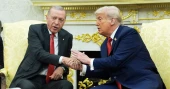
The close relationship between U.S. President Donald Trump and Turkish President Recep Tayyip Erdogan is bringing the two countries closer to resolving Turkey’s exclusion from the F-35 fighter jet program, the U.S. ambassador to Ankara said Wednesday.
Ambassador Tom Barrack, who also serves as Trump’s special envoy for Syria, said on social media that the “positive relationship” between the leaders has created a new atmosphere of cooperation, leading to the most productive discussions on the F-35 issue in nearly a decade.
Turkey was removed from the F-35 program during Trump’s first term after purchasing the Russian-made S-400 air defense system, raising U.S. concerns that the missile system could compromise F-35 security. Ankara has sought readmission, noting its $1.4 billion investment before being suspended in 2019. The U.S. also imposed sanctions under the Countering America’s Adversaries Through Sanctions Act in 2020.
Barrack said discussions continue on Turkey’s desire to rejoin the program while maintaining its S-400 system, with hopes for a breakthrough in the coming months that would satisfy both U.S. security requirements and Turkish interests.
While barred from F-35 deliveries, Turkey is strengthening its air force with Eurofighter Typhoons, U.S.-made F-16s, and developing its own KAAN fifth-generation fighter jet, expected in 2028.
Trump and Erdogan, who met at the White House in September, have maintained a strong personal rapport. Previous U.S. administrations kept Turkey at a distance due to human rights concerns, ties with Russia, and tensions with regional allies. Trump has also viewed Erdogan as a key intermediary on conflicts in Ukraine and Gaza.
5 months ago

María Corina Machado misses Nobel Peace Prize ceremony in Oslo
Venezuelan opposition leader María Corina Machado will not attend the Nobel Peace Prize ceremony in Oslo on Wednesday, the Norwegian Nobel Institute said, with her daughter receiving the award on her behalf.
Machado, who has not appeared in public for 11 months, was briefly detained last January after participating in a protest in Caracas. Nobel Institute director Kristian Berg Harpviken said the Venezuelan leader was expected in Oslo but “unfortunately, she won’t arrive in time to attend today’s ceremony or other events.”
Machado’s spokesperson, Claudia Macero, confirmed she will miss the ceremony but hoped she could join other events scheduled later in the day. Her current location was not disclosed.
Several prominent Latin American leaders, including Argentine President Javier Milei, Ecuadorian President Daniel Noboa, Panamanian President José Raúl Mulino, and Paraguayan President Santiago Peña, attended the ceremony to show solidarity with Machado.
The 58-year-old won the Nobel Peace Prize for her efforts to push for a democratic transition in Venezuela. She had previously won an opposition primary to challenge President Nicolás Maduro in last year’s presidential election, but was barred from running. Her replacement, retired diplomat Edmundo González, later sought asylum in Spain amid a government crackdown.
Human rights groups and U.N. officials have repeatedly expressed concern over the situation in Venezuela, citing arrests, disqualifications, and repression of dissent. Nobel officials noted that it is customary for family members to represent laureates unable to attend, citing past winners who were imprisoned, including Narges Mohammadi of Iran in 2023 and Ales Bialiatski of Belarus in 2022.
Venezuelan human rights activist Gustavo Tovar-Arroyo said supporters had done their best to bring Machado to Oslo, but warned that such risks are part of challenging a dictatorship.
5 months ago
Hamas urges stronger global pressure on Israel ahead of the next ceasefire stage
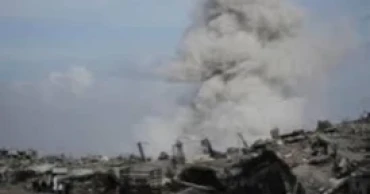
Hamas on Tuesday urged the international community to increase pressure on Israel before the group proceeds with the next stage of the Gaza ceasefire. A senior Hamas official said the group wants Israel to reopen a major border crossing, halt lethal attacks, and allow greater humanitarian access to the war-ravaged territory.
Israel, meanwhile, says it is prepared to advance to the next, more complex stage of the 20-point ceasefire plan proposed by U.S. President Donald Trump, and is insisting that Hamas first return the remains of the final Israeli hostage still held in Gaza.
Husam Badran, a member of Hamas’ political bureau, demanded that all commitments in the ceasefire’s initial phase be fully carried out before any further steps are taken. He accused Israel of continuing to demolish Palestinian homes in areas of Gaza it still controls.
According to Palestinian health authorities, Israeli airstrikes and gunfire have killed at least 376 Palestinians since the ceasefire began on Oct. 10.
Challenges to the second phaseBadran said the conditions for entering the second phase have not yet been met, signaling a firmer stance from Hamas. However, Hamas has limited bargaining power and may face strong pressure from regional actors such as Qatar and Turkey not to stall the fragile ceasefire.
Israel has accused Hamas of breaching the agreement and says its recent strikes are responses to attacks on Israeli soldiers. Israeli forces also acknowledge shooting Palestinians who approached the “Yellow Line,” a loosely defined boundary between Israeli-controlled areas and the rest of Gaza. While Israel maintains that those killed were suspected militants, some victims—among them women and children—appear to have been civilians.
Humanitarian shortfallsAid agencies, including the United Nations, warn that the humanitarian situation in Gaza remains dire and that incoming aid is far below agreed-upon levels. The ceasefire arrangement called for at least 600 aid trucks per day, but over the past month the U.N. has recorded only about 120 daily. Commercial truck numbers are unclear.
COGAT, the Israeli body overseeing aid entry, claims 600–800 trucks are arriving daily. Still, the U.N. says many goods are unaffordable and essential proteins remain scarce. It also reports that medical supplies have not significantly increased and that some hospitals continue to face acute shortages.
Israel announced Wednesday that it would start allowing Gaza-bound aid through a Jordan-Israel border crossing.
Border crossings and political plansThe ceasefire plan also requires reopening the Rafah crossing between Gaza and Egypt for two-way traffic. Israel says it is ready to let Palestinians exit Gaza through Rafah but not yet to reenter.
A U.S.-backed proposal for Gaza’s future has gained traction recently, with negotiations over upcoming ceasefire phases—expected to include Hamas’ disarmament—set to begin soon.
Israeli Prime Minister Benjamin Netanyahu said Sunday that both sides are close to entering the second ceasefire stage, pending Hamas’ return of the remaining hostage’s body. Hamas says widespread destruction from Israeli strikes has hindered their search.
Officials also say an international body to administer Gaza may be announced by year’s end.
Israel’s two-year military campaign in Gaza has killed more than 70,300 Palestinians—around half of them women and children—according to Gaza’s Health Ministry. Although the ministry operates under the Hamas-run government, it is staffed by medical professionals and its data is generally regarded as reliable internationally.
The conflict began after Hamas’ Oct. 7, 2023 attack on southern Israel, which killed roughly 1,200 people and led to the abduction of 251 hostages. Most hostages or their remains have since been returned through ceasefires or negotiated agreements.
5 months ago
Trump’s Gaza ceasefire plan enters tougher phase with major risks ahead
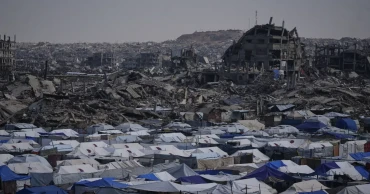
The first phase of the U.S.-brokered ceasefire between Israel and Hamas is nearing completion after two months marked by delays and disputes, even as the remains of one hostage are believed to still be in Gaza. The process now moves into a far more complex second phase that could shape the region’s future.
The 20-point plan put forward by U.S. President Donald Trump and endorsed by the UN Security Council aims to end Hamas’ rule in Gaza, rebuild the territory under international oversight, normalize Israel’s ties with Arab states and potentially open a path toward Palestinian independence.
But officials warn that if the process breaks down, Gaza could remain mired in instability for years, with Hamas retaining control of parts of the territory, Israel maintaining an open-ended military presence and civilians trapped in dire conditions reliant on aid.
Qatari Prime Minister Sheikh Mohammed bin Abdulrahman Al Thani, a key mediator, said the deal has reached a critical stage. Israeli Prime Minister Benjamin Netanyahu is expected to travel to Washington this month for talks on the way forward.
Trump’s plan includes several high-risk components.
One major element is the creation of an International Stabilization Force to secure Gaza and train Palestinian police. While countries such as Egypt, Turkey, Indonesia and Pakistan have shown interest, no commitments or deployment timeline have been finalized. A U.S. official says partner nations are meeting this month and expects forces to be deployed in early 2026, though Hamas has said it will oppose any effort to disarm it, and Israel remains wary of relying on foreign troops.
Another part of the plan is an international Board of Peace that Trump says he will lead, overseeing a committee of Palestinian technocrats who would run Gaza’s daily affairs. The board has not been formed, though former British Prime Minister Tony Blair is among the names being discussed. The challenge will be creating a body trusted by Israel, Hamas, mediators and aid agencies.
Reconstruction is also central to the plan, with Gaza devastated after months of war and most of its two million people displaced. Egypt is preparing to host a donor conference, but the UN estimates rebuilding costs at seventy billion dollars, with no financial framework yet in place.
A core requirement is the disarmament of Hamas under international monitoring. Hamas argues it will only consider freezing weapons, not surrendering them, until Israel ends its occupation. Failure to disarm could lead to renewed conflict or clashes with international forces.
Palestinians are expected to set up a technocratic committee to administer Gaza, but no names have been announced. Israel’s resistance to involving individuals linked to Hamas or the Palestinian Authority could complicate the process. There are also concerns the committee may have little real power if key decisions rest with the Board of Peace.
The ceasefire also envisions a full Israeli withdrawal from Gaza except for a buffer area along the border. Israel still controls more than half of the territory, and further withdrawals depend on conditions tied to demilitarization. There is no timeline, and top Israeli military officials have suggested the current dividing line could become a permanent defensive barrier.
Another major component is reforming the Palestinian Authority and creating conditions for a “credible pathway” to statehood. Palestinian officials say they have begun reforms, including on corruption and education. Israel opposes Palestinian statehood and any role for the authority in Gaza, which could undermine the plan’s long-term viability.
Without progress on these core issues, diplomats warn that support for the ceasefire arrangement could quickly weaken, leaving Gaza’s future uncertain.
5 months ago

Czech billionaire Babiš returns as prime minister with anti-EU, anti-Ukraine shift
Populist billionaire Andrej Babiš was sworn in on Tuesday as the Czech Republic’s new prime minister, marking a political shift expected to move the country away from supporting Ukraine and oppose key European Union policies, particularly on the environment.
Babiš, who previously served as prime minister from 2017 to 2021, said he would defend Czech interests “at home and anywhere in the world” and work to make the country “the best place for life on earth.”
President Petr Pavel tasked him with forming a government after his ANO (YES) movement won big in the October election and secured a majority coalition with the anti-migrant Freedom and Direct Democracy party and the right-wing Motorists for Themselves group.
The coalition partners have agreed on a 16-member Cabinet: ANO will control eight ministries along with the prime minister’s office, the Motorists will take four, and the Freedom party three. Pavel will appoint the full Cabinet on Monday, his office confirmed.
Together, the three parties command 108 seats in the 200-seat lower house, pushing the previous pro-Western government of Petr Fiala into opposition.
The new coalition is expected to align more closely with Hungary and Slovakia by distancing Prague from Ukraine as Russia’s war nears its fourth year. Members of the alliance are also sharply critical of EU migration and environmental policies.
Hungarian Prime Minister Viktor Orbán welcomed Babiš’s return, calling him “an old ally” and saying, “Welcome back on board Andrej!”
Babiš, 71, still faces fraud charges tied to EU subsidies. Parliament will need to lift his immunity before a court can proceed.
After losing the 2021 parliamentary election, Babiš was defeated by Pavel — a retired general — in the presidential race. Pavel agreed to appoint him as prime minister only after Babiš publicly committed to divesting his major business assets to avoid conflicts of interest.
Babiš controls roughly 200 companies through the Agrofert conglomerate. He said an independent trustee will oversee Agrofert under a trust fund structure, with an independent protector supervising the group until his death, after which his descendants will inherit it.
He also owns a network of clinics and laboratories, and one of his close ANO allies is in line to become the new health minister.
5 months ago
German leader calls for greater European security independence from US
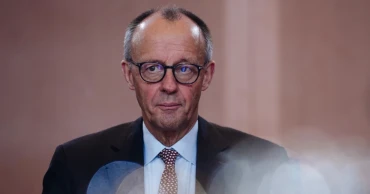
German Chancellor Friedrich Merz on Tuesday said the Trump administration’s new national security strategy highlights the need for Europe to become “much more independent” from the United States in security matters.
Merz, who leads the European Union’s largest economy, also rejected suggestions that European democracy needs saving from external influence.
The U.S. strategy, published Friday, portrays European allies as weak, shows tacit support for far-right parties, and criticizes European free speech and migration policies. European Council President António Costa on Monday warned the U.S. against interference, emphasizing that only Europeans should decide their governments.
Merz said he was not surprised by the strategy, noting it reflected the lecture U.S. Vice President JD Vance gave in Munich in February. “Some of it is understandable, but some of it is unacceptable from a European point of view,” he said in Mainz.
“That the Americans want to save democracy in Europe now, I don’t see any need for that,” Merz added. “If it needed to be saved, we would manage that alone.”
The chancellor said the strategy confirms Europe, and Germany in particular, must increase security independence from the U.S. “This is not a surprise, but it has now been confirmed again. It has been documented,” he said.
Merz noted that Vance’s speech earlier this year influenced Germany’s increased defense spending. Since taking office in May, his government has relaxed debt rules to allow higher military investment, building on efforts that began after Russia’s full-scale invasion of Ukraine in 2022.
Under pressure from Trump, NATO members, including Germany, agreed in June to a significant rise in defense spending targets.
Merz stressed the importance of partnerships, saying, “America first is fine, but America alone can’t be in your interest. You need partners in the world too. And one of the partners can be Europe. And if you can’t do anything with Europe, then at least make Germany your partner.”
5 months ago

Nicaraguans celebrate Virgin Mary amid fear at home and in US
Hundreds of Nicaraguans gathered in Miami to celebrate the Dec. 8 feast of the Immaculate Conception, singing praises to the Virgin Mary at altars set up in church parking lots and on the streets, despite fears for their safety in both Nicaragua and the United States.
The celebration, known as “gritería,” is especially meaningful this year as religious practices in Nicaragua face government crackdowns and immigrant communities in the U.S. encounter heightened enforcement.
“We’re going to do it no matter what,” said Neri Flores, who traveled from Chicago to set up an altar with his parents. “It’s tradition, family, giving back to the community, keeping up the faith and positive vibes.”
Families displayed paintings and statues of the Virgin Mary, some carried from Nicaragua decades ago. Michael Garcia, born in Miami, said, “All the blessings that we have are thanks to her. For the Virgin, there is no impossible.”
In Nicaragua, the government has intensified repression against the Catholic Church, accusing clergy of supporting unrest following protests in 2018. Many priests and laypeople have been imprisoned or exiled, and public religious celebrations face restrictions.
In the U.S., fears among Nicaraguan migrants have grown as the Trump administration moved to end temporary protections for nearly 430,000 migrants from Nicaragua and other countries.
At Miami’s St. John Bosco Catholic Parish, over a thousand people attended, singing and praying by elaborately decorated altars. Rev. Yader Centeno, the pastor, said the event was a moment to strengthen faith and send a message of freedom to those still in Nicaragua.
Some altars featured balloon arches, lights, and sound systems, while others were simple displays in car trunks. Participants sang traditional hymns and offered food, toys, and religious items to support the community.
“I’m super happy. To have this tradition outside of my country is something grand,” said Scarlet Desbas, setting up her family’s altar. Many participants undertook the elaborate preparations as a promise to the Virgin, seeking protection for themselves and loved ones.
At St. Agatha Catholic Parish, Rev. Silvio Báez, auxiliary bishop of Managua, urged the congregation to speak against oppression and faith-based persecution. “The Virgin is not going to forget our people and one day, Nicaragua will be free,” he said.
Rev. Marcos Somarriba, pastor at St. Agatha’s, noted the dire situation for the faithful in Nicaragua, calling on U.S. authorities to ensure immigration policies protect Nicaraguans who fled persecution.
Oscar Carballo, attending the altars at St. John Bosco’s, said, “Here you feel like in the patio of your home. The only thing I ask her is that we can stay here, and that there might be peace. Everywhere.”
5 months ago
UN report warns rising online violence against women journalists
A new study by UN Women has found that more than two-thirds of women journalists, human rights defenders, and activists have experienced online violence, with over 40% reporting related attacks in the real world.
The report, titled Tipping Point, highlights a growing surge in violence against women linked to the rise of social media and artificial intelligence. It surveyed more than 6,900 women across 119 countries, revealing how online abuse often spills into physical harassment.
“Online violence against women has become a growing global crisis,” UN Women said. “What begins on a screen can quickly fuel harassment, intimidation, and even real-world harm.”
About 41% of respondents said they faced offline attacks or harassment connected to digital abuse, including physical or sexual assault, stalking, verbal harassment, and swatting — a tactic that triggers false emergency responses.
Women journalists, social media influencers, and content creators focusing on human rights were most affected. The study notes that new technologies, such as deepfake images and manipulated content, are increasingly used to target them.
Lead researcher Julie Posetti said incidents of real-world harm linked to online attacks on women journalists have more than doubled over the past five years, with 42% of respondents identifying a “dangerous and potentially deadly trajectory.”
The report urges governments to strengthen laws, improve monitoring of technology-related violence, hold tech companies accountable, and encourage broader public support for victims.
“Women who speak up for human rights, report the news or lead social movements are being targeted with abuse designed to shame, silence and push them out of public debate,” said UN Women policy director Sarah Hendricks. “Increasingly, those attacks do not stop at the screen – they end at women’s front doors.”
5 months ago
Zelenskyy rejects land concessions amid US pressure
Ukrainian President Volodymyr Zelenskyy has reaffirmed his refusal to cede any territory to Russia, resisting U.S. pressure for a compromise while rallying European support for Kyiv.
In a WhatsApp exchange with reporters late Monday, Zelenskyy said Moscow demanded territorial concessions, but Ukraine had no intention or legal or moral authority to give up land.“Undoubtedly, Russia insists for us to give up territories. We, clearly, don’t want to give up anything. That’s what we are fighting for," he said.“Do we consider ceding any territories? According to the law we don’t have such right. According to Ukraine’s law, our constitution, international law, and we don’t have a moral right either.”
U.S. President Donald Trump, in a Politico interview, renewed calls for Kyiv to accept a U.S. peace plan that includes ceding territory, arguing Russia still holds the “upper hand” and Ukraine must “play ball.”
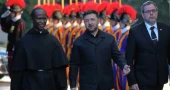
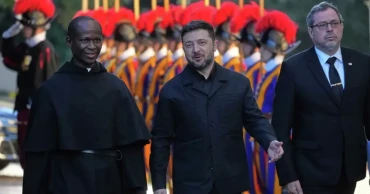
Zelenskyy met Pope Leo XIV on Tuesday at Castel Gandolfo. The pope called for sustained dialogue and urged that current diplomatic initiatives lead to a “just and lasting peace.” Later, Zelenskyy was scheduled to meet Italian Prime Minister Giorgia Meloni. The visit follows Monday talks in London with British Prime Minister Keir Starmer, French President Emmanuel Macron, and German Chancellor Friedrich Merz, aimed at strengthening Ukraine’s position amid Trump’s pressure.
U.S. and Ukrainian negotiators concluded three days of talks on Saturday to narrow differences over the peace plan, with the most contentious issue being Kyiv ceding control of the Donbas region, mostly occupied by Russia.
Trump claimed other Ukrainian officials supported the U.S. plan, saying, “They really liked it, but they said he hasn’t read it yet.” He also urged Ukraine to hold national elections despite martial law extending Zelenskyy’s term.
Zelenskyy said Monday that Trump “certainly wants to end the war” but Ukrainians understand the conflict’s realities more deeply. He noted the latest U.S. peace plan has 20 points, down from 28 after removing “obvious anti-Ukrainian points.”
European leaders strongly backed Kyiv. Starmer called the peace push a “critical stage,” stressing the need for a “just and lasting ceasefire.” Merz expressed skepticism over some U.S. documents, highlighting the need for further talks. European governments aim to back any ceasefire with strong security guarantees, something Trump has not publicly committed to.
Ukraine’s Air Force said Russia launched 110 drones overnight, downing 84. Twenty-four struck targets, causing emergency blackouts in several regions. Ukraine also conducted drone attacks in Russia. Moscow said its air defenses destroyed 121 Ukrainian drones over Russian regions and Crimea. In Chuvashia, nine people were injured and buildings damaged.
A Ukrainian Security Service strike on Dec. 5 hit an LPG terminal in Temryuk, Krasnodar region. Over 20 storage tanks burned for more than three days, and rail cars and refueling facilities were damaged, an official told AP on condition of anonymity.
5 months ago