others
Modi praised for US trade deal as opposition raises agriculture concerns
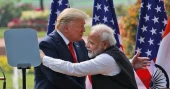
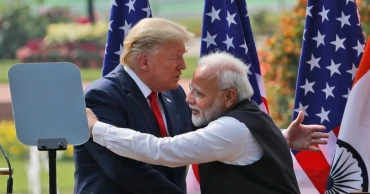
Indian lawmakers from Prime Minister Narendra Modi’s ruling coalition lauded him Tuesday for reaching a trade deal with the United States aimed at reducing tariffs on Indian goods, while opposition parties questioned its impact on sensitive sectors such as agriculture.
The deal follows U.S. President Donald Trump’s announcement Monday that he would cut import tariffs on India from 25% to 18%, six months after imposing steep duties to penalize New Delhi for continuing purchases of Russian oil, which Washington said fueled Moscow’s war against Ukraine. In exchange, Trump said Modi had agreed to halt Russian crude imports, although the Indian government has not publicly confirmed this.
Trump also said India would reduce import taxes on U.S. products to zero and commit to purchasing $500 billion worth of American goods. “This will help end the war in Ukraine, which is taking place right now, with thousands of people dying each and every week,” Trump wrote on social media. Modi responded on X, expressing that he was “delighted” with the tariff reduction and calling Trump’s “leadership vital for global peace, stability, and prosperity.”
The announcement effectively removes the penal tariff imposed on Indian exports, providing relief for exporters who had been facing combined duties as high as 50%. India had emerged as a major buyer of discounted Russian Urals, raising tensions with Washington.
In Parliament, opposition parties disrupted proceedings Tuesday, demanding clarity on the deal’s implications for agriculture, a key sector employing millions of Indians. While the U.S. seeks greater market access and zero tariffs on most of its exports, India has historically protected sectors such as agriculture and dairy from full liberalization.
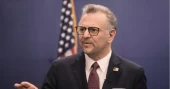
U.S. Secretary of Agriculture Brooker Rollings said the deal would help American farmers export more products to India, boosting rural incomes. In 2024, the U.S. faced a $1.3 billion agricultural trade deficit with India. Indian Trade Minister Piyush Goyal assured that sensitive sectors, including agriculture and dairy, have been protected. “India has got the best deal in comparison to the countries in the neighborhood. This will strengthen U.S.-India relations while protecting the interests of all 1.4 billion Indians,” he said.
Analysts urged caution, noting that details such as timelines, tariff reductions, and coverage of sensitive sectors remain unclear. Achieving $500 billion in U.S. imports would take decades, given current imports of around $50 billion, said trade analyst Ajay Srivastava. A senior Finance Ministry official, Arvind Shrivastava, said the deal could expand trade, create opportunities for India’s labor-intensive and manufacturing sectors in the U.S., and boost collaboration in advanced technology.
1 month ago
US, UN launch $700 million humanitarian fund for Sudan
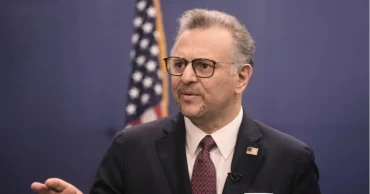
The United States and the United Nations have launched a new Sudan Humanitarian Fund with $700 million in contributions to support civilians affected by Sudan’s ongoing conflict, officials said Tuesday.
The U.S. pledged $200 million from a $2 billion fund set aside last year for global humanitarian projects, while the United Arab Emirates announced a $500 million contribution. Saudi Arabia and several other countries also promised support, though the amounts were not specified.
“Today we are signaling that the international community will work together to bring this suffering to an end, and to ensure lifesaving aid reaches communities in such desperate, desperate need,” said U.N. humanitarian chief Tom Fletcher, who leads the U.N. Office for the Coordination of Humanitarian Affairs (OCHA). Fletcher co-hosted the fundraising event in Washington with U.S. senior adviser for Arab and African affairs Massad Boulos.
Fletcher said visible progress on the initiative is expected by the start of Ramadan on February 17. Boulos added that the U.S. has proposed a “comprehensive plan” for a humanitarian truce, which could be finalized in the coming weeks.
Sudan has been engulfed in war since 2023, with the paramilitary Rapid Support Forces (RSF) and the Sudanese military fighting for control. The U.N. estimates that over 40,000 people have been killed, though the real toll is believed to be much higher. The conflict has created the world’s largest humanitarian crisis, displacing more than 14 million people and causing famine in several regions.
Recent fighting has centered in the Kordofan regions after the RSF captured el-Fasher, one of the army’s last Darfur strongholds. The military has since regained territory in Kordofan, including breaking the siege of Kadugli and nearby Dilling, and reopened a key road linking the two towns. Kadugli had been under siege since the start of the war, with famine declared there in November by the Integrated Food Security Phase Classification.
On Tuesday, the RSF carried out a drone attack on a medical center in Kadugli, killing 15 people, including seven children, according to the Sudan Doctors Network, which monitors casualties from the war.
1 month ago
Four in ten cancer cases worldwide preventable
Nearly 40% of cancer cases globally could be avoided, according to a new worldwide assessment by the World Health Organization (WHO) and its cancer research arm, the International Agency for Research on Cancer (IARC).
The analysis reviews 30 avoidable risk factors, such as tobacco use, alcohol consumption, obesity, lack of physical activity, air pollution, ultraviolet exposure, and—introduced for the first time—nine infections known to cause cancer.
The report was published ahead of World Cancer Day on 4 February, it estimates that preventable factors were responsible for 37% of all newly diagnosed cancer cases in 2022—approximately 7.1 million cases.
The findings emphasize the significant role prevention could play in reducing cancer rates worldwide.
Using data from 185 countries and covering 36 types of cancer, the study identifies tobacco as the single largest preventable cause, accounting for 15% of new cases globally. This is followed by infections at 10% and alcohol consumption at 3%.
Almost half of all preventable cancers worldwide were attributed to three types: lung, stomach, and cervical cancer. Lung cancer was mainly associated with smoking and air pollution, stomach cancer with Helicobacter pylori infection, and cervical cancer largely with human papillomavirus (HPV).
Dr André Ilbawi, WHO Team Lead for Cancer Control and a lead author of the study, said this is the first global assessment to quantify how much cancer risk comes from modifiable causes. He noted that analyzing trends across regions and population groups provides governments and individuals with actionable evidence to prevent many cancers before they develop.
Differences by sex and region
The study found a notably higher share of preventable cancers among men than women—45% of new cases in men compared with 30% in women. Among men, smoking was the dominant risk factor, responsible for 23% of new cases, followed by infections (9%) and alcohol use (4%). For women, infections were the leading preventable cause at 11%, followed by smoking (6%) and high body mass index (3%).
Dr Isabelle Soerjomataram, Deputy Head of the IARC Cancer Surveillance Unit and senior author of the report, described the study as the most comprehensive global evaluation of preventable cancer to date, highlighting the inclusion of infectious causes alongside behavioral, environmental, and occupational risks. She emphasized that tackling these factors offers a major opportunity to reduce the global cancer burden.
Preventable cancer rates varied considerably across regions. Among women, they ranged from 24% in North Africa and West Asia to 38% in sub-Saharan Africa. Among men, East Asia recorded the highest proportion at 57%, while Latin America and the Caribbean had the lowest at 28%. These variations reflect differences in risk exposure, socioeconomic conditions, prevention policies, and health system strength.
The report calls for tailored prevention strategies, including strong tobacco control, alcohol regulation, vaccination against cancer-causing infections such as HPV and hepatitis B, cleaner air, safer work environments, and healthier diets and physical activity levels.
It also stresses the importance of coordinated action across multiple sectors—including health, education, energy, transport, and labour—to reduce cancer risk. Addressing preventable causes can not only lower cancer incidence but also reduce long-term healthcare costs and improve overall population health and well-being.
1 month ago
Who Was Jeffrey Epstein? A Look at the Controversial Financier
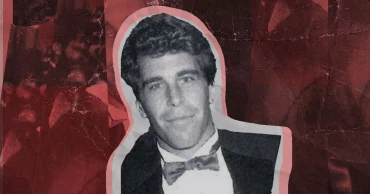
Jeffrey Epstein, the disgraced financier with a network of powerful friends, died in a New York prison cell on August 10, 2019, while awaiting trial on sex trafficking charges.
He had no chance of bail. Epstein’s death came over a decade after he was convicted for soliciting prostitution from a minor and was registered as a sex offender.
This time, he faced allegations of running a “vast network” of underage girls for sexual exploitation, to which he pleaded not guilty.
In November 2025, the US Congress approved the Epstein Files Transparency Act, requiring the Justice Department to release its files from investigations into Epstein. President Donald Trump signed the bill, and some documents were made public by the December 19 deadline, with more released in the following weeks, reports BBC.
While authorities have claimed the January 30 release marked the end of the review process, some critics argue too many documents remain withheld. The released material has illuminated Epstein’s life and connections.
Early Life and Rise to Wealth
Born and raised in New York, Epstein taught mathematics and physics at the Dalton School in the mid-1970s. Though he studied these subjects at university, he never graduated. His teaching led to a connection with a Wall Street partner at Bear Stearns, and Epstein became a partner within four years. By 1982, he founded J Epstein and Co., managing over $1 billion in client assets.
Epstein lived lavishly, owning properties in Florida, New Mexico, and New York, and mingled with celebrities, artists, and politicians. Former President Trump once described him as a “terrific guy” who enjoyed the company of young women. Trump later said he cut ties with Epstein over inappropriate behavior toward women at his Mar-a-Lago club.
Epstein’s circle also included former President Bill Clinton, actors Kevin Spacey and Chris Tucker, and UK politician Peter Mandelson. Despite these high-profile associations, Epstein maintained a private personal life and dated women like Miss Sweden winner Eva Andersson Dubin and Ghislaine Maxwell, though he never married.
Criminal Conviction and Controversial Plea Deal
In 2005, Florida police were alerted to Epstein’s abuse of a 14-year-old girl, leading to a search of his Palm Beach home and the discovery of numerous photos of young girls. Reports suggested his abuse had been ongoing for years.
Despite the gravity of his crimes, prosecutors negotiated a 2008 plea deal, allowing Epstein to serve 18 months in jail with work release privileges, avoiding federal charges that could have meant life imprisonment. He was registered as a high-risk sex offender for life.
Epstein maintained his wealth and properties post-conviction. In 2010, Prince Andrew was photographed with him, sparking controversy years later. Virginia Giuffre, an alleged victim, claimed she was forced to have sex with Andrew as a minor, which he denied, though he later settled a lawsuit filed by her.
Final Arrest and Death
Epstein was arrested on July 6, 2019, after returning from Paris. Prosecutors sought forfeiture of his New York mansion, a location tied to his alleged crimes. Denied bail, he was held in the Metropolitan Correctional Center in New York. Epstein was briefly hospitalized in July 2019 for undisclosed injuries, but never faced trial.
The Maxwell Trial
Following Epstein’s death, his former partner Ghislaine Maxwell was arrested in July 2020 for aiding his sexual exploitation of minors. In December 2021, she was convicted on five counts, including sex trafficking of a minor, and sentenced to 20 years in prison. Maxwell had introduced Epstein to many of his wealthy and influential friends, including Clinton and Andrew, and continued collaborating with him professionally for years after their romantic involvement ended.
1 month ago
US, India strike trade deal after Trump–Modi call
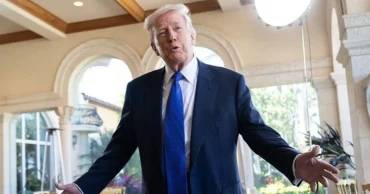
The United States and India have reached a trade agreement under which Washington will lower tariffs on Indian goods to 18% from 25%, while New Delhi has agreed to sharply reduce trade barriers and boost purchases of American products, US President Donald Trump said.
Announcing the deal on his Truth Social platform after a phone call with Indian Prime Minister Narendra Modi, Trump said India would bring both tariff and non-tariff barriers down to zero and stop buying Russian oil. As part of the agreement, an additional 25% tariff penalty imposed earlier over India’s continued purchase of Russian oil will also be withdrawn.
Trump said Modi requested an immediate trade agreement during the call, which also covered the Russia-Ukraine war, and committed to buying more than $500 billion worth of US goods. These include energy, technology, agricultural products and coal.
“He agreed to stop buying Russian oil and to buy much more oil from the United States and, potentially, Venezuela,” Trump wrote, adding that the agreement would significantly expand US exports to India.
A White House official later confirmed that tariffs linked to Russian oil purchases would be dropped and that the overall tariff rate on Indian goods would be reduced to 18%.
Modi welcomed the announcement, saying on X that he was “delighted” by the agreement. He thanked Trump on behalf of India’s 1.4 billion people and said cooperation between the two countries would unlock major opportunities for mutual benefit.
“When two large economies and the world’s largest democracies work together, it benefits our people,” Modi said.
The deal comes at a sensitive moment for India’s trade policy. Indian exports to the United States fell sharply after Washington imposed tariffs of up to 50% on Indian goods last August, the highest applied to any Asian country. In response, New Delhi had been seeking alternative trade partnerships.
Less than a week ago, India and the European Union announced a long-awaited free trade agreement aimed at cutting duties on most goods traded between India and the 27-nation bloc. European Commission President Ursula von der Leyen described it as the “mother of all deals,” with EU officials saying it could double European exports to India by 2032.
Analysts said the US-India deal signals Washington’s intent to reassert its position in global trade. Terry Haines, founder of Pangaea Policy, described the agreement as a response to perceptions that the EU was gaining ground on the United States in trade relations.
US markets edged higher following Trump’s announcement.
However, the agreement has drawn criticism from some US business groups. We Pay the Tariffs, a coalition representing about 800 small American companies, said the deal still leaves tariffs far higher than before Trump’s trade measures. Its director, Dan Anthony, said US importers previously paid an average tariff of 2.5% on Indian goods, calling the new rate a long-term tax increase rather than relief.
With inputs from BBC
1 month ago
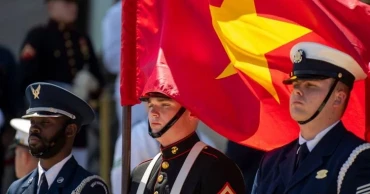
An internal document shows Vietnamese military preparing for possible US war
An internal Vietnamese military document has revealed deep concerns within Hanoi’s defense establishment about a potential American “war of aggression,” even as Vietnam maintains its highest-ever level of diplomatic relations with Washington.
The document, prepared by Vietnam’s Ministry of Defense in August 2024 and titled “The 2nd U.S. Invasion Plan,” portrays the United States as a “belligerent” power and urges vigilance against what it describes as possible US-led attempts to destabilise Vietnam’s socialist system, according to a report released on Tuesday by The 88 Project, a human rights organisation focused on Vietnam.
The disclosure comes roughly a year after Vietnam and the United States elevated their relationship to a Comprehensive Strategic Partnership, placing Washington on par with Hanoi’s ties to China and Russia. The internal assessment highlights what analysts describe as a dual-track approach in Vietnam’s foreign policy: outward diplomatic engagement alongside persistent internal suspicion.
Beyond fears of direct military conflict, the document underscores a long-standing anxiety within Vietnam’s Communist leadership about so-called “color revolutions,” mass uprisings that have toppled governments elsewhere, including Ukraine’s Orange Revolution in 2004 and the Philippines’ People Power movement in 1986. Vietnamese planners warn that external forces could exploit issues such as democracy, human rights, ethnicity and religion to engineer political change.
According to the document, while the risk of an immediate war against Vietnam is considered low, the US and its allies are seen as willing to use unconventional warfare or manufacture pretexts for intervention against countries that fall outside Washington’s strategic orbit, particularly as part of efforts to counter China’s influence in Asia.
Ben Swanton, co-director of The 88 Project and author of the analysis, said the concerns outlined in the document reflect a broad consensus within Vietnam’s government rather than the views of a marginal faction. He noted that Hanoi does not see the US as a true strategic partner and has no intention of joining any anti-China alliance.
Vietnam’s Foreign Ministry did not respond to requests for comment on the report or the document. The US State Department declined to address the contents directly but reiterated that the bilateral partnership is intended to promote shared prosperity and regional stability.
Analysts say the document offers rare insight into internal debates within Vietnam’s leadership, particularly tensions between reform-minded officials and more conservative, military-aligned figures who remain deeply shaped by memories of the Vietnam War and wary of foreign interference. While Western diplomats often view China as Hanoi’s primary security concern, the document suggests that regime stability and the threat of internal unrest remain paramount.
The assessment also reflects Vietnam’s delicate balancing act. China remains its largest overall trading partner, while the United States is its biggest export market, binding Hanoi economically to both powers even as strategic mistrust persists.
Observers say the return of US President Donald Trump for a second term has both eased and complicated Vietnamese concerns. While Washington has softened its emphasis on democracy and human rights, recent US actions abroad have reinforced fears among Vietnamese conservatives about American willingness to violate national sovereignty.
Overall, analysts suggest Vietnam’s leadership continues to engage the United States pragmatically, but with enduring caution rooted in history, ideology and fears of political destabilisation.
1 month ago
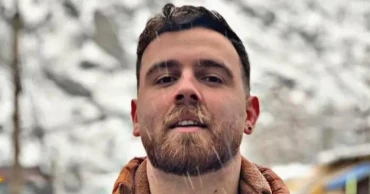
Iranian protester Erfan released on bail amid conflicting execution claims
Iranian protester Erfan Soltani, who was widely reported last month to have been sentenced to death over anti-government demonstrations, has been released on bail, according to media and rights groups.
Soltani, 26, was detained on 8 January in Fardis, near Tehran, amid nationwide protests that triggered a violent response from security forces. His family was later told by authorities that he was facing imminent execution, though no further details were provided, Norway-based Kurdish rights group Hengaw said.
Iran’s judiciary later rejected claims that Soltani had received a death sentence, stating instead that he was charged with security-related offences punishable by imprisonment, reports BBC.
His lawyer, Amir Mousakhani, told AFP that Soltani was freed on bail on Saturday and had his personal belongings, including his mobile phone, returned. A bail amount of two billion tomans—about $12,600—was posted to secure his release.
Hengaw and Iranian outlets, including semi-official news agency ISNA, also confirmed the development.
Soltani, a clothing shop owner, drew international attention after reports emerged that he was set to be executed. A relative previously told BBC Persian that a death sentence had allegedly been issued within just two days through an unusually fast legal process.
The reports prompted international reaction, including warnings from then US President Donald Trump of “very strong action” should executions proceed. Iran’s Supreme Leader Ayatollah Ali Khamenei, however, cautioned that any attack on Iran would ignite a wider regional conflict.
Iranian authorities dismissed foreign media reports about Soltani’s execution as false, while Foreign Minister Abbas Araghchi said there was no intention to carry out hangings. Hengaw later reported that Soltani’s execution had been postponed, citing family sources.
Meanwhile, human rights organisations say the death toll from the unrest continues to rise. The US-based Human Rights Activists News Agency claims more than 6,300 people have been killed since protests began in late December, with thousands more deaths under investigation. Iran Human Rights has warned the total could surpass 25,000.
Protesters have told the BBC that the scale and intensity of the crackdown were unprecedented. On Sunday, Khamenei accused demonstrators of attacking police, the Islamic Revolutionary Guard Corps and public institutions, including banks and mosques.
1 month ago
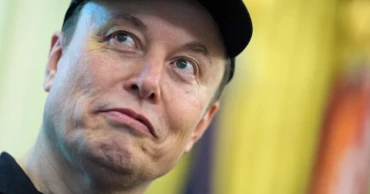
Epstein files name global elites, royals and billionaires
A newly released trove of US Justice Department documents linked to investigations into Jeffrey Epstein has named a wide range of powerful men, including tech billionaires, former heads of state, royalty and senior political figures, renewing scrutiny of their past associations with the disgraced financier.
None of those named have been charged with crimes connected to Epstein’s sexual abuse of girls and young women, and all have denied involvement in his crimes. However, the files show that several maintained friendships or contacts with Epstein even after allegations against him became widely known. Epstein died by suicide in a New York jail in 2019 while awaiting trial on federal sex trafficking charges.
Among the most prominent figures is Andrew Mountbatten-Windsor, formerly Britain’s Prince Andrew, whose name appears hundreds of times in the documents, including in Epstein’s private emails. He has long faced allegations from the late Virginia Giuffre that she was trafficked by Epstein and forced to have sex with him when she was 17, claims he has repeatedly denied. Late last year, King Charles III stripped him of his remaining royal titles.
The files also include references to Sarah Ferguson, Andrew’s former wife, who publicly apologised in 2011 for allowing Epstein to help pay off her debts. Emails show she later sought Epstein’s advice on handling media questions about their relationship, despite earlier pledging to cut all ties with him.
Billionaire entrepreneur Elon Musk appears several times in emails discussing possible visits to Epstein’s Caribbean island in 2012 and 2013, though it remains unclear whether any visit took place. Musk has said he repeatedly rejected Epstein’s invitations. Companies linked to him did not respond to requests for comment.
Virgin Group founder Richard Branson exchanged numerous emails with Epstein, including invitations to Branson’s own Caribbean island. Branson’s company said there was no wrongdoing, stressing that any contact was limited to business or group settings and ended once serious allegations against Epstein became clear.
The documents contain thousands of references to US President Donald Trump, largely involving shared news articles, political commentary and gossip. A Justice Department summary of tip-line calls alleging misconduct by prominent figures, including Trump, noted that many claims were unsubstantiated and deemed not credible by investigators.
Former US President Bill Clinton, who previously acknowledged traveling with Epstein decades ago, is also referenced. His representatives say he severed ties after Epstein faced criminal charges in 2006. No Epstein victim has publicly accused Clinton of wrongdoing.
Other figures named include Steven Tisch, co-owner of the New York Giants, who acknowledged exchanging emails with Epstein about adult women but denied any illegal conduct; film director Brett Ratner, who appears in photographs with Epstein and others; and Casey Wasserman, head of the Los Angeles 2028 Olympics organising committee, who exchanged flirtatious emails with Epstein associate Ghislaine Maxwell and later expressed regret.
Former Israeli Prime Minister Ehud Barak is shown to have stayed in contact with Epstein for years, including after his 2008 conviction. Barak has said he never witnessed any inappropriate behaviour. Larry Summers, former US Treasury secretary and ex-Harvard president, is also cited frequently, later describing his interactions with Epstein as a serious error of judgment.
Howard Lutnick, US Commerce Secretary under President Trump, appears in records showing visits to Epstein’s island with his family, though the Commerce Department said his interactions were limited and he has not been accused of wrongdoing. Google co-founder Sergey Brin, former Trump adviser Steve Bannon and several other political and business figures are also referenced.
The files further reveal that Miroslav Lajcak, Slovakia’s national security adviser and a former foreign minister, resigned after his past contacts with Epstein emerged. He has said the interactions were related to diplomatic duties and denied any misconduct.
US officials have stressed that being named in the documents does not imply criminal behaviour. The Associated Press, along with other media organisations, is continuing to review the files as part of a collaborative examination of the newly released records.
1 month ago
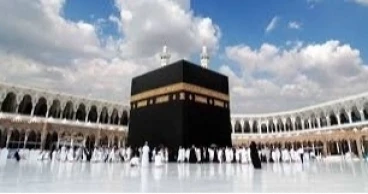
Saudi ministry suspends Umrah contracts of 1,800 foreign agencies
Saudi Arabia’s Ministry of Hajj and Umrah has suspended contracts with about 1,800 foreign Umrah travel agencies, giving them 10 days to resolve compliance issues identified during a routine performance review.
The action affects agencies operating in the Umrah sector out of an estimated total of 5,800, after evaluations found weaknesses in service quality and overall performance, according to Saudi Press Agency.
The ministry clarified that the suspension is limited to the issuance of new Umrah visas and is intended as a regulatory step to allow agencies time to address classification and compliance shortcomings. Contracts will be reinstated once the required standards are met within the given timeframe.
Read More: Hajj visa applications to open from February 8
Umrah pilgrims who already hold valid visas or have confirmed reservations will not be impacted, as services for them will continue without disruption, the ministry said.
The ministry stressed that enforcing approved classification criteria and performance benchmarks is essential to improving compliance among service providers and ensuring services meet required standards. Protecting the rights of Umrah pilgrims and maintaining uninterrupted services remain key priorities.
Ministry spokesperson Ghassan Alnwaimi said agencies that fail to correct deficiencies within the deadline will face regulatory action. He added that monitoring and evaluation mechanisms will continue to be used to strengthen the credibility of the Umrah sector and safeguard pilgrims’ rights.
1 month ago
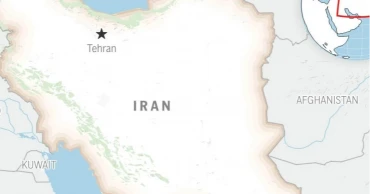
Iran labels EU militaries as terrorist groups amid rising tensions
Iran’s parliament on Sunday labeled all EU militaries as terrorist groups in response to the EU’s designation of its Revolutionary Guard..
Speaker Mohammad Bagher Qalibaf, a former Guard commander, said the designation is largely symbolic. Iran has previously used a 2019 law to reciprocally label foreign militaries as terror groups after the United States classified the Guard as such that year.
The announcement comes amid heightened Middle East tensions, with U.S. President Donald Trump weighing potential military action against Iran. The country has also scheduled live-fire drills in the strategic Strait of Hormuz, through which a fifth of the world’s oil trade passes.
Qalibaf and other lawmakers donned Guard uniforms during the parliamentary session in a show of support. He criticized the EU, saying their decision to target the Guard “goes against the interests of their own people” and blamed the bloc for following U.S. influence. Lawmakers later chanted anti-American and anti-Israel slogans.
Trump has warned Iran against killing peaceful protesters or executing detainees in the crackdown. He also raised concerns over Iran’s nuclear program, which was previously the subject of negotiations with the U.S. before Israel launched a 12-day war against Iran last June, during which the U.S. bombed three Iranian nuclear sites. Satellite observations suggest Iran may be trying to obscure activity at two of the sites.
Trump, speaking to reporters en route to Florida, avoided confirming any military decision, but reiterated that Iran should reach a “satisfactory” nuclear deal. “I don’t know that they will. But they are talking to us. Seriously talking to us,” he said.
Satellite images show new activity at Iran nuclear sites amid protest tensions
Meanwhile, Iran’s top security official Ali Larijani tweeted that “structural arrangements for negotiations are progressing,” though no direct talks with the U.S. have been confirmed, with Supreme Leader Ayatollah Ali Khamenei repeatedly ruling them out.
1 month ago