others

Russian transport plane crashes near Ukraine with 65 Ukrainian POWs on board
A Russian military transport plane carrying 65 Ukrainian prisoners of war, six crew and three people accompanying them crashed on Wednesday morning in Russia’s Belgorod region near Ukraine, Russia’s Defense Ministry said.
It wasn’t immediately clear what caused the crash, which occurred around 11 a.m. It was also not known if anyone survived.
The authorities were investigating the cause of the crash, and a special military commission was on the way to the crash site, the Defense Ministry said.
Read: Officials report at least 13 dead in shelling of a market in Russian-occupied Ukraine
Earlier Wednesday, Ukrainian President Volodymyr Zelenskyy said a major Russian missile attack that apparently was devised to overwhelm Ukraine’s air defenses had killed 18 people and injured 130. Ukraine is marking the 700th day since the full-scale invasion by Kremlin’s forces started.
The barrage employing more than 40 ballistic, cruise, anti-aircraft and guided missiles early Tuesday hit 130 residential buildings in three Ukrainian cities, “all ordinary houses,” Zelenskyy said on X, formerly Twitter.
Russia’s onslaught, which included targets in the capital Kyiv and second-largest city Kharkiv, was the heaviest in weeks and lent weight to Zelenskyy’s appeals for Western allies to provide more military aid.
“This year, the main priority is to strengthen air defense to protect our cities and towns, as well as defend frontline positions,” Zelenskyy said on X late Tuesday.
With the 1,500-kilometer (930-mile) front line largely static amid icy weather and as both sides seek to replenish their weapons stockpiles, the war recently has focused on long-range strikes. Analysts say Russia stockpiled missiles to pursue a winter campaign of aerial bombardment, while Ukraine has sought to strike inside Russia with new types of drones.
Russia may have employed decoy missiles in Tuesday’s attack in an effort to open up holes in Ukraine’s air defenses, a U.S. think tank said.
Read: Russia's intense attacks on Ukraine has sharply increased civilian casualties in December, UN says
The Washington-based Institute for the Study of War said Moscow is likely trying to acquire more ballistic missiles from foreign countries, including Iran and North Korea, because they may be more effective in some circumstances.
A further barrage of Russian S-300 missiles struck residential districts of Kharkiv late Tuesday, injuring nine people and damaging residential buildings, regional Gov. Oleh Syniehubov said.
Russia denies its forces strike civilian areas, although there is substantial evidence to the contrary.
The Russian Defense Ministry said that air defenses shot down four Ukrainian drones over the Oryol region of western Russia early Wednesday.
Oryol Mayor Yuri Parakhin said that several drones were downed over the city. He said there were no casualties, but windows were shattered in several apartment buildings in the city.
Another Ukrainian drone was downed early Wednesday over the Belgorod border region, according to regional Gov. Vyacheslav Gladkov. He said there were no casualties or damage.
Ukraine’s allies have promised to keep sending military aid packages, even though their resources are stretched. Help from the United States, by far Ukraine’s single biggest provider, has also hit political snags.
The German defense ministry announced Wednesday that it plans to send six SEA KING Mk41 multi-role helicopters from Bundeswehr stocks to Ukraine.
Since the beginning of the war military deliveries from Germany have amounted to around 6 billion euros ($6.52 billion), including substantial anti-aircraft and air defense systems, the government said.
2 years ago

Turkey's parliament approves Sweden's NATO membership
Turkish legislators on Tuesday endorsed Sweden's membership in NATO, lifting a major hurdle on the previously nonaligned country's entry into the military alliance.
Lawmakers ratified Sweden's accession protocol 287 to 55, with ruling party members saying the Nordic country's tougher stance on Kurdish militants was key to winning approval. President Recep Tayyip Erdogan also previously has linked the ratification to Turkey's desire to buy fighter jets from the U.S.
The ratification comes into effect after its publication in the Official Gazette, which was expected to be swift.
Hungary then becomes the only NATO ally not to have ratified Sweden's accession.
"Today we are one step closer to becoming a full member of NATO," Swedish Prime Minister Ulf Kristersson wrote on X, the platform formerly known as Twitter. In Washington, U.S. National Security Advisor Jake Sullivan welcomed the news, saying having Sweden in the alliance will make it "safer and stronger."
Photojournalist Motaz Azaiza from Gaza says ‘Last time you see me with this heavy, stinky vest’
NATO-member Turkey had been delaying Sweden's membership for more than a year, accusing the country of being too lenient toward groups that Ankara regards as security threats. It sought concessions from Stockholm, including moves to counter militants.
Turkey also had been angered by a series of demonstrations by supporters of the outlawed Kurdistan Workers' Party, or PKK, in Sweden as well as Quran-burning protests that roiled Muslim countries.
Sweden in the past was a "center in Europe" for the PKK, Fuat Oktay, a senior legislator in Erdogan's governing party and the head of the foreign affairs committee, told parliament.
But since then, Sweden has amended its anti-terrorism laws, curbed the PKK's financial activities, convicted a terrorism suspect and extradited another, and lifted restrictions on arms sales to Turkey, Oktay said.
"PKK-affiliated circles no longer find a comfortable room for maneuver in Sweden as they did in the past," Oktay said, explaining why the ruling party was now supporting Stockholm's bid.
Why is Canada limiting international student permits? Who will be affected? Here are the details
Sweden pledged deeper cooperation with Turkey on counterterrorism, as well as support for Turkey's ambition to revive its EU membership bid.
Last month, parliament's foreign affairs committee gave its consent to Sweden's bid in the first stage of the legislative process, after Turkish President Recep Tayyip Erdogan sent its accession protocol to lawmakers for approval.
Turkey's main opposition party also supported Sweden's membership in the alliance but a center-right party and the country's pro-Kurdish party were among parties that opposed it.
"Sweden's steps concerning its extradition of wanted criminals or the fight against terrorism have remained limited and insufficient," Musavat Dervisoglu, a legislator from the Good Party told parliament.
21 Israeli soldiers are killed in the deadliest single attack on the army since the war began
Erdogan has linked ratification of Sweden's NATO membership to the U.S. Congress' approval of a Turkish request to purchase 40 new F-16 fighter jets and kits to modernize Turkey's existing fleet. He has also urged Canada and other NATO allies to lift arms embargoes on Turkey.
Koray Aydin, another Good Party legislator, had urged parliament to hold out on ratifying Sweden's accession until the F-16 sales and the modernization kits were approved in Washington, saying Turkey would lose an important bargaining chip.
U.S. President Joe Biden's administration never formally tied the sale of the F-16s to Turkey's ratification of Sweden's NATO membership. However, numerous influential members of Congress had said they would not support the sale unless and until Turkey signed off on Sweden's accession to the alliance.
U.S. administration officials say they expect relatively quick action on the F-16 sale after the ratification.
Sullivan, the U.S. national security advisor, said after Tuesday's vote that Sweden's accession to the alliance has been a priority for Biden.
"Sweden is a strong, capable defense partner. Sweden joining NATO is in the national security interests of the United States, and will make the Alliance safer and stronger," he said.
Sweden and Finland abandoned their traditional positions of military nonalignment to seek protection under NATO's security umbrella, following Russia's invasion of Ukraine in February 2022. Finland joined the alliance in April, becoming NATO's 31st member, after Turkey's parliament ratified the Nordic country's bid.
Hungary has also stalled Sweden's bid, alleging that Swedish politicians have told "blatant lies" about the condition of Hungary's democracy. Hungary has said it would not be the last to approve accession, although it was not clear when the Hungarian parliament intends to hold a vote.
Hungarian Prime Minister Viktor Orbán announced Tuesday that he sent a letter to his Swedish counterpart, Ulf Kristersson, inviting him to Budapest to discuss Sweden's entry into NATO.
NATO requires the unanimous approval of all existing members to expand, and Turkey and Hungary were the only countries that have been holding out, frustrating other NATO allies who had been pressing for Sweden and Finland's swift accession.
2 years ago

Plane crashes in Afghanistan, rescue underway in mountains
A passenger plane heading toward Russia has crashed in northern Afghanistan's Badakhshan province, Afghan television channel TOLOnews quoted an official as saying on Sunday.
The plane crashed in the mountainous Topkhana area of Kuran-wa-Munjan district on Saturday evening, "obviously due to a technical problem," said Badakhshan's provincial director for information and culture Zabihullah Amiri.
Read: Officials report at least 13 dead in shelling of a market in Russian-occupied Ukraine
A team has been sent to the area to spot the crashed aircraft, the official added.
Abdul Wahid Rayan, spokesman for Afghanistan's Ministry of Information and Culture, said on social media that the small aircraft was traveling to Moscow when it appeared to have an engine problem.
Russian aviation authorities have reportedly confirmed that a plane with four crew members and two passengers on board disappeared from a radar screen in Afghanistan's airspace on Saturday evening.
Read: 5 killed in Poland as plane crashes into hangar
In Badakhshan, harsh winter weather and mountainous landscapes make it difficult for rescuers to reach the crash site.
2 years ago
Officials report at least 13 dead in shelling of a market in Russian-occupied Ukraine
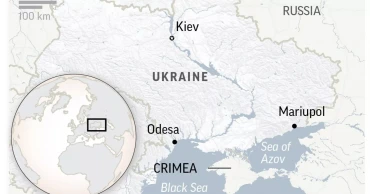
At least 13 people were killed Sunday by shelling at a market on the outskirts of the city of Donetsk in Russian-occupied Ukraine, local officials reported Sunday.
A further 10 people were injured in the strike on the suburb of Tekstilshchik, said Denis Pushilin, head of the Russian-installed authorities in Donetsk. He said that the shells had been fired by the Ukrainian military.
Kyiv has not commented on the event and the claims could not be independently verified by The Associated Press.
Emergency services continue to work on the scene, Pushilin said.
Also Sunday, fire broke out at a chemical transport terminal at Russia’s Ust-Luga port following two explosions, regional officials said. Local media reported that the port had been attacked by Ukrainian drones, causing a gas tank to explode.
Read: Justice served: 3 French officers convicted in high-profile police brutality case
The blaze was at a site run by Russia’s second-largest natural gas producer, Novatek, 165 kilometers southwest of St. Petersburg.
The head of the port in Russia’s Kingisepp region, Yuriy Zapalatskiy, said in a statement that there were no casualties, but that the district had been placed on high alert.
News outlet Fontanka reported that two drones had been detected flying towards St Petersburg Sunday morning, but that they were redirected towards the Kingisepp region. The Associated Press could not independently verify the reports.
Read: Israel's Netanyahu rejects any Palestinian sovereignty in post-war Gaza, rebuffing Biden
The Russian Ministry of Defense did not report any drone activity in the Kingisepp area in its daily briefing. It said that four Ukrainian drones had been downed in Russia’s Smolensk region, and that two more had been shot down in the Oryol and Tula regions.
Russian officials previously confirmed that a Ukrainian drone had been downed on the outskirts of St. Petersburg on Thursday.
2 years ago

Justice served: 3 French officers convicted in high-profile police brutality case
A French court convicted three police officers of “voluntary violence” towards a youth worker in a Paris suburb who suffered serious injuries to his rectum after being assaulted with a police baton during an identity check seven years ago.
All three officers received suspended prison sentences. The officer who used the baton to strike Théo Luhaka was given a suspended sentence of 12 months, while the other two present on the scene got three months each.
Luhaka, a youth worker of African descent who was 22 years old at the time, filed a lawsuit accusing the officers of assaulting him during an identity check in February 2017 in Aulnay-sous-Bois, a working-class suburb northeast of Paris with a large immigrant population.
Read: Women and children are the main victims of the Israel-Hamas war with 16,000 killed, UN says
Rights defenders have long complained of French police abusing their powers during identity checks on people of color.
The court in the town of Bobigny, about 9 kilometers (5 miles) north-east of the French capital, dropped the charge of a “permanent infirmity” in its decision on Friday. A charge of rape was dropped earlier.
Despite the light sentences, the verdict brought a sense of closure for Luhaka, the French press reported his lawyers as saying.
“It’s a decision ... that we take as a victory,” said Antoine Vey, Luhaka’s lawyer, according to the daily Le Monde. Luhaka did not speak, but had said earlier that he would be relieved if the police were convicted.
The lawyer for Marc-Antoine Castelain, the officer who received the 12-month sentence, also welcomed the verdict.
“The first impression of our client is the immense relief that, for the first time, in the eyes of France, it has been established that ... he is not a criminal,” Le Monde quoted Thibault de Montbrial as saying, adding that the court had set the record straight about his actions at the time.
Widespread anger erupted after a video surfaced online apparently showing Luhaka’s arrest on Feb. 2, 2017. The incident was followed by a week of protests in suburbs around Paris, many degenerating into violence.
Read: Japan becomes the fifth country to land a spacecraft on the moon
Rioting has accompanied police ID checks gone awry in the past. Most recently, the shooting death of Nahel Merzouk, a 17-year-old youth with Algerian roots, during a police ID check last June touched off days of rioting around France. The motorcycle police officer who fired into the stopped car driven by the young man has been charged with voluntary homicide but was released from detention during the investigation.
In the case of Théo Luhaka, Le Monde reported that Castelain, the officer who used the “telescopic baton,” was also banned from carrying a weapon or patrolling the streets for five years. The other two officers received similar bans for two years.
All three denied wrong-doing and said their reaction was justified because the young man was in “rebellion.”
2 years ago

World’s could see its first trillionaire in the next decade. Here are some of today’s richest 1%
The world might see its first trillionaire sooner than you think. And that puts a spotlight on today's richest 1%.
In an annual assessment of global inequalities published earlier this week, Oxfam International said the first trillionaire could emerge within the next decade — as the anti-poverty organization pointed to the growing wealth gap that skyrocketed globally during the COVID-19 pandemic.
Among the findings, Oxfam highlighted how the personal fortunes of the world's five richest people — Tesla CEO Elon Musk, Bernard Arnault and his family of luxury company LVMH, Amazon founder Jeff Bezos, Oracle founder Larry Ellison and investment guru Warren Buffett — have more than doubled since 2020.
To measure this jump, Oxfam pulled net worths from Forbes' real-time billionaires list as of March 2020 and the end of November 2023. Such lists fluctuate over time and even within hours — so while Buffett, for example, was the 5th richest person in November, he stood in 7th place per Forbes' Wednesday rankings.
Vivek Ramaswamy endorses Trump, suspends 2024 Republican presidential bid
Oxfam timed its report to the gathering of political and business elites in Davos, Switzerland, where the World Economic Forum meets annually. Numerous billionaires and multimillionaires also penned a letter calling on global leaders to fairly tax the super rich like themselves. Musk, Arnault, Bezos, Ellison and Buffett were not among the signatories — although Buffett has famously criticized the wealthy's lower tax rates and previously advocated for policy change in the same vein.
Here's a look at the wealth of these five billionaires spotlighted this week, and where their fortunes stand today.
Elon Musk: $226.6 billion
Elon Musk is currently considered the world's richest person, with a net worth of $226.6 billion per Forbes' real-time rankings as of Wednesday. That's down from $245.5 billion as of November 2023.
In addition to being at the helm of Tesla, Musk is CEO of rocket ship company SpaceX. In 2022, he also purchased Twitter, which is now called X, for $44 billion. While he no longer serves as CEO of the social media platform, his still holds broad influence — and has faced ample pushback from issues ranging from content moderation and hate speech to alienating advertisers.
A weekend of ferocious winter weather could see low-temperature records set in the US heartland
Bernard Arnault and family: $175.1 billion
Bernard Arnault and his family currently hold a personal fortune of $175.1 billion per Forbes. That's down from about $191.3 in November 2023.
The French businessman has served as CEO of LVMH Moët Hennessy Louis Vuitton, the world's largest luxury group, since becoming the majority shareholder in 1989. He is also president of the board for Groupe Arnault S.E., which is his family's holding company and primarily an investment firm.
Jeff Bezos: $173.6 billion
Jeff Bezos' net worth stood at $173.6 billion Wednesday per Forbes. That's up from $167.4 billion in November 2023.
Back in 1994, Bezos founded Amazon out of a Seattle garage — and his wealth skyrocketed as the company grew into the e-commerce giant it is today. He stepped down as CEO in early 2021, but still has broad influence over Amazon as executive chair and the company's biggest shareholder.
Larry Ellison: $134.9 billion
Larry Ellison currently has a personal fortune of $134.9 billion, according to Forbes, down from $145.5 in November 2023.
Ellison co-founded Oracle Corporation, a software and database management giant, in 1977 and served as CEO until 2014. He is now chief technology officer and chairman of the board. Ellison, who also had a stint on Tesla's board of directors from 2018 to 2022, has ranked high in billionaire lists for several years now.
Biden condemns white supremacy in a campaign speech at a church where Black people were killed
Warren Buffett: $119.5 billion
At the time Oxfam pulled Forbes figures for its inequality report, Warren Buffett was the world's fifth richest person with a net worth of $119.2 billion. While his personal fortune has stayed relatively stable since ($119.5 billion as of Wednesday), Meta CEO Mark Zuckerberg and Microsoft co-founder Bill Gates have surpassed him in Forbes' rankings with current net worths of $129.5 billion and $120.1 billion, respectively.
Over the years, Buffett has gained a reputation for his investment success and aggressive business tactics. He runs Berkshire Hathaway, a holding conglomerate that owns dozens of companies across sectors like insurance, manufacturing, utilities, transportation and retail.
2 years ago

7 people dead as landslide buries house in southern Philippines
A landslide set off by days of heavy rain buried a house where people were holding Christian prayers in the southern Philippines, killing at least seven people, including children, and seriously injuring two others, a disaster-response official said.
Five to 10 people remained unaccounted following the landslide in a far-flung mountain village in the gold-mining town of Monkayo in Davao de Oro province, Ednar Dayanghirang, regional chief of the government’s Office of Civil Defense, said Thursday night.
Read: 11 killed after storm hits Rio de Janeiro
Rescuers stopped their search for more victims at mid-afternoon Thursday due to heavy rains that could cause more landslides, he said. The search and rescue work resumed on Friday.
“They were praying in the house when the landslide hit,” Dayanghirang told The Associated Press by telephone. “It’s sad but it’s the reality on the ground.”
Aside from the landslide, days of heavy rains also flooded low-lying villages and displaced more than 6,000 people in two other outlying provinces, he said.
The rains were sparked by what local forecasters call a shear line – the point where warm and cold air meet. At least 20 storms and typhoons lash the Philippine archipelago each year specially during the rainy season that starts in June.
Read: An Al Jazeera journalist is the fifth member of his family killed by Israeli strikes on Gaza
In 2013, Typhoon Haiyan, one of the strongest to hit on record, left more than 7,300 people dead or missing, flattened entire villages, swept ships inland and displaced more than 5 million in the central Philippines.
2 years ago

Singapore minister is charged with corruption, accused of taking tickets to F1 races and musicals
Singaporean Transport Minister S. Iswaran was charged Thursday in the first ministerial corruption case ever seen in the Asian financial hub known for squeaky clean government.
The Corrupt Practices Investigation Bureau said in a statement that Iswaran, 61, faces 27 charges: two for corruption, 24 for receiving gifts as a public servant, and one for obstructing the course of justice. Iswaran said after leaving court that he had resigned from his post on Tuesday, and denied the charges.
He was alleged to have received goods worth nearly SG$385,000 ($286,000) between 2015 and 2022 from Malaysian property tycoon Ong Beng Seng, some in return for helping the Singapore-based businessman advance his business interests.
The gifts included free tickets for Singapore's Formula 1 Grand Prix, as well as football matches and musicals in the U.K. Ong owns the right to the local F1 race, and Iswaran was chairman of and later advisor to the Grand Prix's steering committee.
"I reject the charges and the allegations against me. I am innocent and will now focus on clearing my name,” Iswaran said in a statement.
Iswaran, a senior politician in the long-ruling People’s Action Party, was first arrested last July with Ong, who has not been charged. Both were released on bail and details were not revealed at the time. Iswaran was put on leave with a reduced salary pending the probe.
The indictment is an embarrassment to the long-ruling People's Action Party, which prides itself on a clean image. Another cabinet minister was investigated for graft in 1986, but died before charges were filed.
Prime Minister Lee Hsien Loong said Iswaran's case has been dealt with vigorously according to the law. He said he accepted Iswaran's resignation from the government and from the PAP, which has governed Singapore since it became independent following separation from Malaysia in 1965.
“I am determined to uphold the integrity of the party and the government, and our reputation for honesty and incorruptibility,” Lee said in a statement.
2 years ago

Israel's president and the OpenAI CEO will take part in Davos on Day 3 of the World Economic Forum
Israel's president and the head of ChatGPT company OpenAI will make appearances at the World Economic Forum on Thursday, the third day of the annual gathering of elites at the Swiss resort of Davos that discusses everything from conflict to computers and climate.
Israeli President Isaac Herzog could seek to return focus on the plight of Israeli hostages held by Hamas since its deadly Oct. 7 raid into Israel. Much of the world's attention has been on rising casualty counts in Gaza as Israeli forces lead a blistering military campaign aimed to quash the armed militants.
The four-day confab at Davos has taken up a vast array of topics, not least the concerns about climate change and artificial intelligence that offers economic promise to some, and peril for jobs to others.
Blinken meets labor union leaders at Davos Summit
“Artificial intelligence is now undoubtedly the most important potential contribution for global development," U.N. Secretary-General António Guterres told reporters in Davos on Wednesday, a day when leaders like French President Emmanuel Macron and President Javier Milei of Argentina also showed up.
“This is something that cannot be dealt with business as usual,” he added, saying governments were "to a certain extent, ill-equipped, ill-prepared, to deal with this new reality.”
OpenAI CEO Sam Altman, who kept his job after a turbulent executive-suite reshuffle late last year, will take part in a panel that explores how technology could “amplify our humanity," right after another discussion on whether generative AI is a “boon or bane for creativity.”
Davos 2024: Zelenskyy trying to rally support for Ukraine’s fight
Iraqi Prime Minister Mohammed Shia al-Sudani will take part in a Q&A session Thursday. On Wednesday, Iran's foreign minister defended his country's strike on what he claimed was an Israeli intelligence operations site in the autonomous Kurdish region.
The husband of U.S. Vice President Kamala Harris, Doug Emhoff, was traveling to Davos on Thursday to talk about combating antisemitism, Islamophobia and other forms of hate and to promote gender equity and women’s rights.
2 years ago

An explosion at a fireworks factory in rural Thailand kills about 20 people
An explosion at a fireworks factory in central Thailand killed about 20 people on Wednesday, according to provincial officials, though the devastation at the scene has made the death toll uncertain.
The information office of the Suphan Buri provincial government initially announced that 23 people had been killed in the mid-afternoon blast, but on Wednesday night revised its figure to 19 dead and three missing. The national Department of Disaster Prevention and Mitigation's earlier preliminary figure had been least 20 people killed.
8 burnt in explosion at petrol pump in Dhaka's Mohakhali
Suphan Buri is about 95 kilometers (60 miles) northwest of Bangkok, in the heart of Thailand’s central rice-growing region.
Photos posted on social media showed a thick plume of black smoke over the scene. Photos posted online by local rescue workers showed the factory site virtually leveled.
The office of Prime Minister Srettha Thavisin, who is in Switzerland for the World Economic Forum, distributed a video showing him being told over the phone by the regional police commander that there were 20 to 30 workers at the factory at the time of the explosion and that none of them could be found.
Youth dies in explosion at CNG filling station in Keraniganj
Rescue workers at the scene said there were no survivors. None were mentioned by provincial authorities, contradicting the disaster department’s statement that wounded people had been found.
Kritsada Manee-In, a rescue worker with the Samerkun Suphan Buri Rescue Foundation, who earlier estimated that around 15 to 17 people had been killed, said an exact count was difficult because the bodies were in pieces.
The Lunar New Year is celebrated in February, when demand for fireworks is strong in Thailand and other parts of Asia. The national disaster agency said the cause of the explosion is under investigation.
National police chief Torsak Sukvimol confirmed local news reports that there had been another explosion at the factory in November 2022 that killed one worker and seriously injured three others. He said police would pursue legal action for any wrongdoing involved in the new blast.
In July last year, a large explosion at a fireworks warehouse in southern Thailand killed at least 10 people and wounded more than 100, according to officials.
That explosion in Narathiwat province was in a residential area and damaged about 100 houses within a 500-meter (1,640-foot) radius, according to the Department of Disaster Prevention and Mitigation.
The Narathiwat governor said that blast was likely ignited by construction work in the warehouse, with sparks from metal welding causing the fireworks stored inside to catch fire and explode.
2 years ago