others

Gabonese military declare coup, Brice Oligui Nguema named as transition leader
Brice Oligui Nguema, commander-in-chief of the Gabonese Republican Guard, was named as the transition leader of the central African country on Wednesday night following a coup.
The national electoral body announced earlier in the day that President Ali Bongo had won a third term. However, the military declared on state television that the election results were canceled and placed Bongo under house arrest.
Leaders of the Gabonese military agreed by unanimous vote to appoint Nguema as president of the Committee for the Transition and Restoration of Institutions (CTRI), said Ulrich Manfoumbi Manfoumbi, the committee's spokesperson.
Read more: 17-year-old Palestinian killed during Israeli military raid in northern West Bank
Nguema ordered the reconnection of the optical fiber and the restoration of radio and television signals. He stressed the need to maintain calm and serenity in the country and preserve stability and dignity, according to the spokesperson.
Traffic restrictions between 6 p.m., local time, Wednesday and 6 a.m. the following day remain in effect until further notice, the spokesperson said.
Earlier in the day, a group of officers claimed, on behalf of the CTRI, to have seized power to "put an end to the regime in place." The announcement came after Gabon's national electoral body said on the same day that Bongo from the ruling Gabonese Democratic Party was reelected for a third term in Saturday's election.
Read more: Niger's neighbours running out of options as defence chiefs meet to discuss potential military force
In a televised statement, the officers said the election results were canceled, state institutions dissolved, and all borders closed until further notice.
In another statement released Wednesday, the military said, "President Ali Bongo is kept under house arrest, surrounded by his family and his doctors." The officers said the son of the president, Noureddin Bongo Valentin, and several other senior officials close to Bongo were arrested.
In a video clip released Wednesday afternoon, Bongo said he is at his residence while his wife and son are in other places.
"Nothing is happening. I don't know what is going on. So I am calling on you to make noise, make noise, make noise really. I'm thanking you," said Bongo in his first public appearance after the coup.
According to local media, gunfire was heard in the capital of Libreville.
Read more: US to send $200 million in military aid to Ukraine
Ali Bongo, 64, once served as minister of defense and other posts in the government. He was elected president of the Gabonese Republic in 2009 and was reelected in 2016.
In January 2019 when Bongo was in Morocco recovering from a stroke, a group of soldiers broke into the national radio station in Libreville and announced the establishment of a "national council of the restoration." The government foiled the coup attempt as security forces soon took over the radio station and detained the soldiers.
The international community has voiced concerns over Wednesday's coup in Gabon.
In a press statement, Chairperson of the African Union (AU) Commission Moussa Faki expressed great concern over the situation in Gabon and strongly condemned the coup attempt as a way to solve the post-electoral crisis. He called on all political, civil and military actors in Gabon to give priority to peaceful political avenues, and a rapid return to democratic constitutional order in the country.
French Prime Minister Elisabeth Borne said France is following the situation closely. Spokesman of the French government Olivier Veran has condemned the coup, noting that France "reiterates its desire to see the results of the election respected."
Read more: Philippine military condemns Chinese coast guard's use of water cannon on its boat in disputed sea
Russia also expressed its concerns over the situation in Gabon. Russian Foreign Ministry Spokesperson Maria Zakharova said Wednesday that it is hoped that the situation in Gabon will return to stability. She also advised that Russians temporarily refrain from traveling to this country, if there is no urgent need.
Namibian Ministry of International Relations and Cooperation Executive Director Penda Naanda said in a statement that Namibia has been following with concern about the evolving political situation in Gabon, and Namibia remains resolute in its stance on zero tolerance on acceding to power through unconstitutional means.
Ajuri Ngelale, the spokesperson for Nigerian President Bola Tinubu, said the president, who chairs the Economic Community of West African States, a regional bloc, would consult with other heads of state and government in the AU on the Gabon crisis with a view to determining the way forward for the central African country.
2 years ago

Kremlin says ‘Deliberate wrongdoing’ among possible causes of plane crash that killed Prigozhin
The Kremlin said Wednesday that "deliberate wrongdoing" is among the possible causes of the plane crash that killed mercenary leader Yevgeny Prigozhin last week.
Speaking to reporters during his daily conference call, Kremlin spokesperson Dmitry Peskov noted that "different versions" of what happened exist and "are being considered," including "let's put this way, deliberate wrongdoing."
He urged reporters to wait until the probe by the Russian Investigative Committee is concluded, and said there can't be an international investigation into it. The committee said last week it has opened a criminal case on charges of flight safety violations, a standard charge used in plane crash investigations in Russia when there is no immediate reason to suspect foul play.
Russia says it has confirmed Prigozhin died in the plane crash
A business jet carrying Prigozhin, founder and leader of the private military force Wagner, and his top lieutenants crashed halfway between Moscow and St. Petersburg last Wednesday, killing all 10 people on board.
The crash occurred exactly two months after Prigozhin mounted a short-lived armed rebellion against Russia's military leadership, posing the biggest challenge to President Vladimir Putin's authority in his 23-year rule. The Kremlin has denied involvement in the crash.
Kremlin denies role in plane crash believed to have killed Russian mercenary leader Prigozhin
Prigozhin was buried in St. Petersburg, his hometown, in a private ceremony that was shrouded in secrecy until Tuesday evening, when the mercenary leader's spokespeople revealed the location of his grave.
US intelligence says an intentional explosion brought down Wagner chief Prigozhin's plane
2 years ago

The U.N. says at least 183 people have been killed in Ethiopia over Amhara region unrest since July
The United Nations human rights office says at least 183 people have been killed in clashes in Ethiopia’s Amhara region since July as Amhara fighters resist efforts by the federal government to disband them.
The U.N. office on Tuesday also said the human rights situation in Ethiopia is deteriorating, with more than 1,000 people reportedly arrested under a state of emergency declared early this month over the unrest.
Read more: 3 US Marines killed, 20 injured in an aircraft crash in Australia during a training exercise
“Many of those detained were reported to be young people of Amhara ethnic origin suspected of being Fano supporters,” the U.N. office said, referring to the name of the Amhara militia. “Since early August, mass house-to-house searches have reportedly been taking place, and at least three Ethiopian journalists covering the situation in the Amhara region have been detained.”
The U.N. statement said detainees have reportedly been held in improvised detention centres without basic amenities. It called for those arbitrarily detained to be released and for authorities to stop “mass arrests.”
Read more: At least 32 civilians killed in eastern Congo, says the U.N.
The human rights office called for an end to the fighting as the military retakes towns that had been seized by the Amhara fighters and militia members flee into rural areas.
In one of the deadliest incidents, a health official earlier this month told The Associated Press that an airstrike on a crowded town square in the Finote Selam community killed at least 26 people. The federal government didn’t comment.
Read more: Angelina Jolie visits Burkina Faso as U.N. Special Envoy
Amhara fighters had fought alongside the military in the two-year conflict in Ethiopia’s northern Tigray region that ended in November with a peace agreement. The conflict spilled into the Amhara region when Tigray forces at one point tried to approach the capital, Addis Ababa.
Ethiopia’s government of Prime Minister Abiy Ahmed has struggled for years to contain various conflicts often along ethnic lines. The country, Africa’s second most populous, has long been seen as an important security partner in the Horn of Africa, but the government has criticized or limited outside efforts — including by U.N. investigators — to understand the toll of abuses in the conflicts.
Read more: The Latest: WHO head urges G7 boost U.N. vaccination program
2 years ago

Drones target 6 regions in biggest attack on Russia since troops sent to Ukraine, officials say
Russian officials accused Ukraine of targeting six Russian regions with drones early Wednesday in what appears to be the biggest drone attack on Russian soil since Moscow sent troops into Ukraine 18 months ago.
Drones hit an airport in the western Pskov region and started a massive fire there, the governor and local media reported. More drones were shot down over Oryol, Bryansk, Ryazan, Kaluga and the Moscow region surrounding the Russian capital, according to the Defense Ministry.
The strike in Pskov hit an airport in the region's namesake capital and damaged four Il-76 transport aircraft, Russia’s state news agency Tass reported, citing emergency officials.
Pskov regional Gov. Mikhail Vedernikov ordered all flights to and from the airport canceled Wednesday so damage could be assessed during daylight.
Russia says it has confirmed Prigozhin died in the plane crash
Footage and images posted on social media showed smoke billowing over the city of Pskov and a large blaze. Vedernikov said there were no casualties, and the fire has been contained. Unconfirmed media reports said between 10 and 20 drones could have attacked the airport.
Pskov was the only region where officials reported damage. Three drones were shot down over the Bryansk region, according to the Russian military, and two over the Oryol region, its Gov. Andrei Klychkov said. Two were downed over the Ryazan region, one more over Kaluga, and one more over the Moscow region, officials said.
Kremlin denies role in plane crash believed to have killed Russian mercenary leader Prigozhin
No damage or casualties were registered in those regions, although some Russian media cited residents of the Bryansk region as saying that they heard a loud explosion.
UN Security Council, minus China and Russia, condemns Myanmar military's killing of civilians
Also on early Wednesday, Russian-installed officials in the annexed Crimea reported repelling an attack of drones targeting the harbor of the port city of Sevastopol. Moscow-appointed governor of Sevastopol Mikhail Razvozzhayev said it wasn't immediately clear how many of the drones have been destroyed. It wasn't immediately clear if the attack caused any damage.
2 years ago

2 found dead in eastern Washington wildfires identified, more than 350 homes confirmed destroyed
The men found dead in two wildfires that ignited in eastern Washington earlier this month have been identified, and the number of homes destroyed has been confirmed at more than 350.
Carl Grub, 86, died on Aug. 18 near an intersection in Medical Lake west of Spokane in the area of the Gray fire, which started that day, according to a Friday news release from the Spokane County Medical Examiner’s Office. Grub's cause and manner of death is still pending.
18 bodies found in Greece as firefighters battle wind-driven wildfires across the country
Grub, with his brother, founded The Jensen Memorial Youth Ranch, where he taught kids interested in agriculture how to care for and raise livestock, KREM-TV reported. Earlier this year, the Junior Livestock Show of Spokane had been dedicated to Grub.
Firefighters in Greece have discovered the bodies of 18 people in an area with a major wildfire
“The world needs more people like Carl,” the Junior Livestock Show of Spokane wrote on its Facebook page. “He will be greatly missed.”
On Aug. 20, Alex Brown died in Elk, Washington, north of Spokane in an area burned by the Oregon fire. Brown, 49 died from thermal and inhalation injuries, and his manner of death listed as accidental.
Survivors of Maui's wildfires return home to blackened ruins as death toll rises to 67
The fires sparked on Aug. 18 during critical fire weather conditions. The Gray fire started west of Medical Lake, prompting mandatory evacuations and burning around Interstate 90, closing it in that area for more than two days.
About 240 homes and 86 other kinds of structures were destroyed in the Gray fire, Lily Mayea, public information officer with Northwest Team 7 on the Gray fire, said Tuesday.
The human-caused blaze has scorched 15.75 square miles (40.79 square kilometers) and was 85% contained as of Tuesday. Evacuations remain in place for some people, although none as of Tuesday were mandatory.
The Oregon fire began east of Elk and has burned 16.9 square miles (43.77 square kilometers) with 79% containment as of Tuesday. As of 4 p.m. Tuesday, all evacuation notices connected to the Oregon fire have been lifted, said Bill Queen, public information officer with Pacific Northwest Incident Management Team 3 on the Oregon fire.
He said 126 primary residences and 258 outbuildings were destroyed in the blaze.
Gov. Jay Inslee on Aug. 19 declared a statewide emergency because of the two fires and others burning around the state.
2 years ago
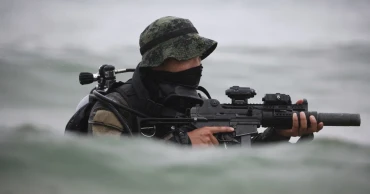
N. Korea's Kim calls for readiness to smash US-led invasion plot, as US trains with South and Japan
North Korean leader Kim Jong Un called for his military to be constantly ready for combat to thwart its rivals' plots to invade his country, state media said Tuesday, as the U.S., South Korea and Japan held a trilateral naval exercise to deal with North Korea's evolving nuclear threats.
The U.S. and South Korean militaries have been separately holding summer bilateral exercises since last week. North Korea views such U.S.-involved training as an invasion rehearsal, though Washington and its partners maintain their drills are defensive.
Kim said in a speech marking the country’s Navy Day on Monday that the waters off the Korean Peninsula have been made unstable "with the danger of a nuclear war” because of U.S.-led hostilities, according to the official Korean Central News Agency.
READ: North Korea's Kim orders sharp increase in missile production, days before US-South Korea drills
He cited the U.S. drills with its allies, the deployment of more powerful U.S. weapons assets in the waters near the Korean Peninsula, and a recent U.S.-South Korean-Japanese summit where an agreement to boost defense cooperation was reached to counter North Korea's nuclear program. Kim called President Joe Biden, South Korean President Yoon Suk Yeol and Japanese Prime Minister Fumio Kishida “the gang bosses” of the three countries.
“The prevailing situation requires our navy to put all its efforts into rounding off the war readiness to maintain the constant combat alertness and get prepared to break the enemy’s will for war in contingency,” Kim said.
Tuesday’s South Korean-U.S.-Japanese drills in international waters off South Korea’s southern Jeju island involved naval destroyers from the three countries. The training was aimed at mastering procedures for detecting, tracking and sharing information about incoming North Korean missiles, South Korea’s navy said in a statement.
The U.S. and South Korean militaries began the 11-day bilateral drills on Aug. 21. The annual Ulchi Freedom Shield training is a computer-simulated command post exercise. But they included field exercises this year.
READ: North Korean leader Kim tours weapons factories and vows to advance his arms and his war readiness
North Korea typically responds to U.S.-South Korean military drills with its own missile tests. Last Thursday, its second attempt to launch a spy satellite into space failed. The day the drills began, KCNA said Kim had observed the test-firings of strategic cruise missiles.
Since the beginning of 2022, North Korea has carried out more than 100 weapons tests, many of them involving nuclear-capable missiles designed to strike the U.S. and its allies South Korea and Japan. Many experts say North Korea ultimately wants to use its boosted military capabilities to wrest greater concessions from the U.S.
The North’s testing spree has forced the U.S. and South Korea to expand their drills, resume trilateral training involving Japan and enhance “regular visibility” of U.S. strategic assets to the Korean Peninsula. In July, the United States deployed a nuclear-armed submarine to South Korea for the first time in four decades.
Earlier this month, the leaders of the U.S., South Korea and Japan held their first-ever stand-alone trilateral summit at Camp David. During the meeting, they announced they intend to put into operation by year’s end the sharing of real-time missile warning data on North Korea and hold annual trilateral exercises.
READ: Kim vows to boost North Korea's nuclear capability after observing new ICBM launch
Kim has been pushing hard to expand his nuclear arsenal and introduce a slew of sophisticated weapons systems.
During his Navy Day speech, Kim said that military units of each service would be given new weaponry in line with the government’s decision to expand the operation of tactical nuclear weapons. He said the navy would become “a component of the state nuclear deterrence carrying out the strategic duty.”
This suggests North Korea would deploy new nuclear-capable missiles to its navy and other military services.
State media reports and photos showed Kim visiting the navy headquarters with his daughter, reportedly named Ju Ae and aged about 10. It was her first public appearance since mid-May. Kim has brought her to a series of public events since November, sparking speculation about her political status.
South Korean officials say Kim hasn't anointed her as his heir. They believe Kim likely attempts to use his daughter's public appearance as a way to show his people that one of his children would one day inherit his power in what would be the country’s third hereditary power transfer.
2 years ago

Climate activists target jets, yachts and golf in a string of global protests against luxury
Climate activists have spraypainted a superyacht, blocked private jets from taking off and plugged holes in golf courses this summer as part of an intensifying campaign against the emissions-spewing lifestyles of the ultrawealthy.
Climate activism has intensified in the past few years as the planet warms to dangerous levels, igniting more extreme heat, floods, storms and wildfires around the world. Tactics have been getting more radical, with some protesters gluing themselves to roads, disrupting high-profile sporting events like golf and tennis and even splashing famous pieces of artwork with paint or soup.
They’re now turning their attention to the wealthy, after long targeting some of the world’s most profitable companies – oil and gas conglomerates, banks and insurance firms that continue to invest in fossil fuels.
“We do not point the finger at the people but at their lifestyle, the injustice it represents,” said Karen Killeen, an Extinction Rebellion activist who was involved in protests in Ibiza, Spain, a favorite summer spot for the wealthy. She said the group is protesting unnecessary emissions such as superrich individuals going to pick up a pizza by boat. “In a climate emergency, it’s an atrocity,” she said.
Read: National Adaptation Plan aims to achieve climate-resilience by 2050
Killeen and others from climate activist group Futuro Vegetal — or Vegetable Future — spraypainted a $300 million superyacht belonging to Walmart heir Nancy Walton Laurie. Protesters held up a sign that read, “You consume, others suffer.”
In Switzerland, some 100 activists disrupted Europe’s biggest private jet sales fair in Geneva when they chained themselves to aircraft gangways and the exhibition entrance. In Germany, climate group Letzte Generation — which translates to Last Generation — spraypainted a private jet in the resort island of Sylt, in the North Sea. In Spain, activists plugged holes in golf courses to protest the sport's heavy water needs during hot dry spells.
In the U.S., Abigail Disney, the grand-niece of Walt Disney, was arrested at East Hampton Town Airport, New York, in July along with 13 other protesters for blocking cars from entering or exiting the parking lot. It was the first of up to eight actions carried out in the exclusive Hamptons area. Activists also crashed a golf course, disrupted a museum gala and demonstrated outside some private luxury homes.
“Luxury practices are disproportionately contributing to the climate crisis at this point,” said University of Maryland social scientist Dana Fisher. According to a 2021 report by nonprofit Oxfam, if all planet-warming emissions were attributed to the people producing them, the richest 1% will be responsible for around 16% of emissions by 2030. “It makes a lot of sense for these activists to be calling out this toxic behavior.”
Read: "Climate Promise-From Pledge to Impact" launched to drive ambitious climate action in Bangladesh
Richard Wilk, an economic anthropologist at Indiana University, said luxury travel is “the real culprit” in the emissions of the ultrawealthy.
He published estimates of top billionaires’ annual emissions in 2021 and found that a superyacht — with permanent crew, helicopter pad, submarines and pools — emits about 7,020 tons of carbon dioxide a year, over 1,500 times higher than a typical family car. And private aircraft in Europe alone last year caused more than 3 million tons of carbon pollution, equivalent to the average annual CO2 emissions of over half a million EU residents, according to the nonprofit Greenpeace.
But Pennsylvania State University climate scientist Michael Mann warned that attention away from the fossil fuel companies — which are responsible for at least 70% of all emissions — and toward the rich could be “playing right into the hands of the fossil fuel industry and the ‘deflection campaign’ they’ve used to divert attention from regulation by emphasizing individual carbon footprints over the much larger footprint of polluters.”
“The solution is to get everyone to use less carbon-based energy,” whether wealthy or lower-income people, he said.
Read: Climate adaptive innovation must for development of agro industries: Speakers say at ICC Bangladesh, Standard Chartered, FAO roundtable
David Gitman, president of Monarch Air Group, a Florida private air charter provider, encouraged activists to think twice about whether they're taking the right approach.
“If their activism goes toward some sort of actual assistance to real programs to make real change like sustainable aviation fuel, like carbon offsets, I think that this kind of activism can help achieve those results,” said Gitman. “Now, if they go out and they spray-paint a private jet in an airport in Europe, is that going to get those results? In my opinion, no.”
Fisher, of the University of Maryland, was also skeptical that the activism was effective in changing behavior by the wealthy.
In some cases, governments have stepped in with regulations. France is cracking down on the use of private jets for short journeys, and earlier this year, the Netherlands' Schiphol Airport also announced plans to ban private jets.
But as protests escalate, Fisher and Wilk say they could still move the needle toward behavior change.
“Public shaming is one of the most powerful ways of controlling people,” Wilk said. “It acts in a lot of different ways to embarrass people, to make them more conscious of the consequences of their actions.”
2 years ago

Son stolen at birth hugs Chilean mother for first time in 42 years
"Hola, Mama."
What seems like an unremarkable greeting between mother and son was in this case anything but.
Forty-two years ago, hospital workers took Maria Angelica Gonzalez' son from her arms right after birth and later told her he had died. Now, she was meeting him face-to-face at her home in Valdivia, Chile.
"I love you very much," Jimmy Lippert Thyden told his mother in Spanish as they embraced amid tears.
"It knocked the wind out of me. ... I was suffocated by the gravity of this moment," Thyden told The Associated Press in a video call after the reunion. "How do you hug someone in a way that makes up for 42 years of hugs?"
His journey to find the birth family he never knew began in April after he read news stories about Chilean-born adoptees who had been reunited with their birth relatives with the help of a Chilean nonprofit Nos Buscamos.
The organization found that Thyden had been born prematurely at a hospital in Santiago, Chile's capital, and placed in an incubator. Gonzalez was told to leave the hospital, but when she returned to get her baby, she was told he had died and his body had been disposed of, according to the case file, which Thyden summarized to the AP.
"The paperwork I have for my adoption tells me I have no living relatives. And I learned in the last few months that I have a mama and I have four brothers and a sister," Thyden said in the interview from Ashburn, Virginia, where he works as a criminal defense attorney representing "people who look like me" who cannot afford a lawyer.
He said his was a case of "counterfeit adoption."
Nos Buscamos estimates tens of thousands of babies were taken from Chilean families in the 1970s and 1980s, based on a report from the Investigations Police of Chile which reviewed the paper passports of Chilean children who left the country and never came back.
"The real story was these kids were stolen from poor families, poor women that didn't know. They didn't know how to defend themselves," said Constanza del Rio, founder and director and Nos Buscamos.
The child-trafficking coincided with many other human rights violations that took place during the 17-year reign of Gen. Augusto Pinochet, who on Sept. 11, 1973, led a Chilean coup to overthrow Marxist President Salvador Allende. During the dictatorship, at least 3,095 people were killed, according to government figures, and tens of thousands more were tortured or jailed for political reasons.
Over the past nine years, Nos Buscamos has orchestrated more than 450 reunions between adoptees and their birth families, del Rio said.
Other nonprofit organizations are doing similar work, including Hijos y Madres del Silencio in Chile and Connecting Roots in the United States.
Nos Buscamos has been partnering for two years with genealogy platform MyHeritage, which provides free at-home DNA testing kits for distribution to Chilean adoptees and suspected victims of child trafficking in Chile.
Thyden's DNA test confirmed that he was 100% Chilean and matched him to a first cousin who also uses the MyHeritage platform.
Thyden sent the cousin his adoption papers, which included an address for his birth mother and a very common name in Chile: Maria Angelica Gonzalez.
It turns out his cousin had a Maria Angelica Gonzalez on their mother's side and helped him make the connection.
But Gonzalez wouldn't take his phone calls until he texted her a photo of his wife and daughters.
"Then just the dam broke," said Thyden, who sent more photos of the American family who adopted him, his time in the U.S. Marines, his wedding, and many other memorable life moments.
"I was trying to bookend 42 years of a life taken from her. Taken from us both," he said.
He traveled to Chile with his wife, Johannah, and their two daughters, Ebba Joy, 8, and Betty Grace, 5, to meet his newly discovered family.
Stepping into his mother's home, Thyden was greeted with 42 colorful balloons, each one signifying a year of lost time with his Chilean family.
"There is an empowerment in popping those balloons, empowerment in being there with your family to take inventory of all that was lost," he said.
Thyden recalls his birth mother's response to hearing from him: "Mijo (son) you have no idea the oceans I've cried for you. How many nights I've laid awake praying that God let me live long enough to learn what happened to you."
Gonzalez declined to be interviewed for this story.
Thyden, along with his wife and daughters visited the Santiago zoo where his American family first took him after the adoption. This time their tour guide was his biological sister.
Back at Gonzalez' home, Thyden realized that he and his mother share a love of cooking.
"My hands are in the same dough as my mama," he said as they made fried empanadas together. He pledged to keep using the family recipe to stay connected with his family and his culture.
Thyden said his adoptive parents are supportive of his journey to reunite with his lost relatives, but were "unwitting victims" of a far-reaching illegal adoption network and are wrestling with the realities of the situation.
"My parents wanted a family but they never wanted it like this," he said. "Not at the extortion of another, the robbing of another."
Through a spokesperson, his parents declined comment.
While Thyden was successfully reunited with his birth family, he recognizes that reunification might not go as well for other adoptees.
"It could have been a much worse story," he said. "There are people who find out some really unfortunate details about their origin."
While in Chile, Thyden and del Rio met with one of seven investigators working to address thousands of counterfeit adoption cases like his own.
"We don't want money, we just want the human recognition that this horrible thing happened in Chile and the compromise that this is not going to continue happening in the future," del Rio said. "We are trying to make a difference. Not only with Jimmy and his family but we want to do it, the change, in the country."
Thyden also met with Juan Gabriel Valdes, the Chilean ambassador to the United States, to seek government recognition of the pervasiveness of the adoption scheme.
He said there was no mechanism, financial or otherwise, to assist Chilean adoptees in their efforts to visit their home country. He said he sold a truck to pay for his family's plane tickets and other expenses.
"People need to be able to decide ... what their name is going to be, where their citizenship is going to be. They should have access to both," he said. "They should have all the rights and privileges of a Chilean citizen because this is a thing that happened to them, not that they chose."
The Chilean Embassy in Washington did not return a request for comment.
2 years ago

Russia says it has confirmed Prigozhin died in the plane crash
Russia’s Investigative Committee has confirmed Wagner chief Yevgeny Prigozhin was killed in a plane crash.
Read more: Plane crash believed to have killed Wagner chief Prigozhin seen as Kremlin's revenge
The committee said in a statement Sunday that after forensic testing, all 10 bodies recovered at the site of the crash were identified, and their identities “conform to the manifest.”
Read more: Russian mercenary leader Prigozhin's commanders met Putin after short-lived mutiny, pledged loyalty
Russia’s civil aviation authority earlier this week said Prigozhin, along with some of his top lieutenants, were on the list of those on board the plane that crashed Wednesday.
2 years ago

Kremlin denies role in plane crash believed to have killed Russian mercenary leader Prigozhin
The Kremlin on Friday rejected allegations it was behind a plane crash that is presumed to have killed mercenary leader Yevgeny Prigozhin, who conducted a brief but shocking mutiny in Russia two months ago.
Prigozhin, whose brutal fighters were feared in Ukraine, Africa and Syria, was eulogized Thursday by President Vladimir Putin, even as suspicions grew that the Russian leader was behind the crash that many saw as an assassination.
A preliminary U.S. intelligence assessment concluded the plane was downed by an intentional explosion. One of the U.S. and Western officials who described the assessment said it determined that Prigozhin was "very likely" targeted and that the explosion falls in line with Putin's "long history of trying to silence his critics."
The officials, who spoke on the condition of anonymity because they were not authorized to comment, did not offer any details on what caused the explosion, which was widely believed to be vengeance for the mutiny in June that posed the biggest challenge to Putin's 23-year rule.
But Kremlin spokesperson Dmitry Peskov flatly rejected the allegations.
"Right now, of course, there are lots of speculations around this plane crash and the tragic deaths of the passengers of the plane, including Yevgeny Prigozhin," Peskov told reporters during a conference call. "Of course, in the West those speculations are put out under a certain angle, and all of it is a complete lie."
Prigozhin was listed among those aboard the plane.
Asked by The Associated Press whether the Kremlin has received an official confirmation of Prigozhin's death, Peskov referenced Putin's remarks from a day earlier: "He said that right now all the necessary forensic analyses, including genetic testing, will be carried out. Once some kind of official conclusions are ready to be released, they will be released."
Britain's Defense Ministry said the presumed death of Prigozhin could destabilize his Wagner Group of private military contractors.
His "exceptional audacity" and "extreme brutality" permeated the organization "and are unlikely to be matched by any successor," the ministry said in a statement.
Wagner mercenaries were key elements of Russia's forces in its war in Ukraine, particularly in the long fight to take the city of Bakhmut, the conflict's most grueling battle. Wagner fighters also have played a central role projecting Russian influence in global trouble spots, first in Africa and then in Syria.
The jet crashed Wednesday soon after taking off from Moscow for St. Petersburg, carrying Prigozhin, six other Wagner members and a crew of three, according to Russia's civil aviation authority. Rescuers found 10 bodies, and Russian media cited anonymous sources in Wagner who said Prigozhin was dead. But there has been no official confirmation.
President Joe Biden, speaking to reporters Wednesday, said he believed Putin was likely behind the crash.
"I don't know for a fact what happened, but I'm not surprised," Biden said. "There's not much that happens in Russia that Putin's not behind."
Russian Deputy Foreign Minister Sergei Ryabkov took offense at that. "It is not for the U.S. president, in my opinion, to talk about certain tragic events of this nature," he said Friday.
The passenger manifest also included Prigozhin's second-in-command, as well as Wagner's logistics chief and at least one possible bodyguard.
It was not clear why several high-ranking members of Wagner, who were normally exceedingly careful about their security, would have been on the same flight. The purpose of their trip to St. Petersburg was unknown.
Russian authorities have opened an investigation into the crash. The country's Investigative Committee said Friday that it had recovered the plane's flight recorders and that genetic testing was being used to identify the bodies.
Numerous opponents and critics of Putin have been killed or fallen gravely ill in apparent assassination attempts, and U.S. and other Western officials long expected the Russian leader to go after Prigozhin, despite promising to drop charges in a deal that ended the June 23-24 mutiny.
Prigozhin was outspoken and critical of how Russian generals were waging the war in Ukraine, where his mercenaries were some of the fiercest fighters for the Kremlin. For a long time, Putin appeared content to allow such infighting, but Prigozhin's brief revolt raised the ante.
On June 23, his mercenaries swept through the southern Russian city of Rostov-on-Don and captured the military headquarters there without firing a shot. They then drove to within about 200 kilometers (125 miles) of Moscow and downed several military aircraft, killing more than a dozen Russian pilots.
Putin initially denounced the rebellion as "treason" and a "stab in the back," but soon made a deal that saw an end to the mutiny a day after it began in exchange for an amnesty for Prigozhin and his mercenaries and permission for them to move to Belarus.
Belarusian President Alexander Lukashenko, who facilitated that deal, said Friday that Prigozhin never asked him for security guarantees. "I don't have to ensure Prigozhin's safety ... the conversation was never in that vein," he was quoted as saying by the state news agency Belta.
Lukashenko said he previously warned Putin of "an impending assassination attempt on Prigozhin," according to Belta. Lukashenko told Belta he received "very serious information from the deepest sources" while on a recent trip to the United Arab Emirates and passed it on via the Russian ambassador in the UAE to Putin and the head of Russia's FSB security agency.
Lukashenko later checked with Prigozhin, who confirmed Putin had warned him about the threat, according to Belta.
Since Prigozhin's presumed death, unconfirmed reports said hundreds of Wagner's fighters have fled Belarus. Relatives of Wagner fighters on one Telegram chat reported long lines for payments at a Wagner office in Russia's southern Krasnodar region, the private force's base.
2 years ago