others

Biden dispatches top adviser for talks with Saudi crown prince on normalizing relations with Israel
President Joe Biden dispatched his national security adviser Jake Sullivan to Saudi Arabia on Thursday for talks with the kingdom's de facto leader Crown Prince Mohammed bin Salman as the White House pushes for a normalization of relations between the country and Israel.
The White House in a brief statement said that Sullivan arrived in Jeddah on Thursday for talks with the crown prince, who is often referred to by his initial MbS, and other Saudi officials. The wide-ranging talks covered initiatives to "advance a common vision for a more peaceful, secure, prosperous, and stable Middle East," and efforts to find a permanent end to the years-long conflict between the Saudis and Iran-allied Houthis in Yemen, according to the White House.
Sullivan and the prince also discussed the Biden administration's hopes to normalize relations between Israel and Saudi Arabia, according to a White House National Security Council official familiar with the matter. The official was not authorized to comment publicly and spoke on the condition of anonymity.
For its part, the kingdom's state-run Saudi Press Agency acknowledged the meeting, saying only that the two sides "discussed the Saudi-U.S. strategic relations and ways to enhance them in various fields, in addition to the latest regional and international developments of mutual concern."
The kingdom released no images of the meeting, which saw Saudi Arabia's defense and energy ministers attend, along with the head of its Public Investment Fund. The U.S. has been trying to get Riyadh to end its war in Yemen while also trying to lobby it over global oil prices, without much success.
The effort to strengthen the historically fraught relationship between the Middle East's two significant powers comes after the Trump administration helped usher in the "Abraham Accords," normalizing relations between Israel and the United Arab Emirates, Bahrain and Morocco.
A normalization deal with Saudi Arabia, the most powerful and wealthy Arab state, has the potential to reshape the region and boost Israel's standing in historic ways. But brokering such a deal is a heavy lift as the kingdom has said it won't officially recognize Israel before a resolution to the decades-long Israeli-Palestinian conflict.
Sullivan's visit comes after Secretary of State Antony Blinken traveled to the kingdom last month in part to promote normalization between Israel and Saudi Arabia.
During Blinken's recent visit, Foreign Minister Prince Faisal bin Farhan said that normalization with Israel would have "limited benefits" without "finding a pathway to peace for the Palestinian people."
The Saudis have also shown hesitance to proceed with normalizing relations with Israel at a time when it is led by the most right-wing government in its history, and when tensions have soared with the Palestinians. Meanwhile, Israel remains mired in a political crisis over Prime Minister Benjamin Netanyahu's plan to weaken its judiciary, a move which has unleashed the biggest protests in the country's history.
The Saudis have repeatedly called for the creation of a Palestinian state in the West Bank, east Jerusalem and Gaza, territories Israel seized in the 1967 war.
Saudi Arabia also has pushed increasingly for a nuclear cooperation deal that includes America allowing it to enrich uranium in the kingdom — something that worries nonproliferation experts, as spinning centrifuges open the door to a possible weapons program.
Prince Mohammed already has said the kingdom would pursue an atomic bomb if Iran had one, potentially creating a nuclear arms race in the region as Tehran's program continues to advance closer to weapons-grade levels.
2 years ago

Crash of plane fighting Greek island wildfire kills both pilots as Italian blaze claims 2 lives
A Greek air force water-dropping plane crashed while diving into a wildfire in southern Greece on Tuesday, killing both pilots, as authorities battled blazes that have been raging for days across the country amid a return of heat wave temperatures.
Summer wildfires blamed on climate change have also struck other Mediterranean countries, leaving at least 34 people dead in Algeria in recent days and two people dead in southern Italy on Tuesday.
A state ERT TV video showed the bright yellow CL-215 aircraft releasing its load of water on the island of Evia before its wingtip apparently snagged in a tree branch. Moments later it disappeared into a deep fold in the ground from which a fireball erupted.
5 killed in Poland as plane crashes into hangar
The air force said the pilots, aged 34 and 27, both died in the crash.
Prime Minister Kyriakos Mitsotakis cancelled a planned visit to Cyprus for Wednesday, and Greece’s armed forces declared three days of mourning.
Six killed when small plane crashes, bursts into flames in field near Southern California airport
“They offered their lives to save lives,” Mitsotakis said of the pilots. “They proved how hazardous their daily missions in extinguishing fires are ... In their memory, we continue the war against the destructive forces of nature.”
A third successive heat wave in Greece pushed temperatures back above 40 degrees Celsius (104 degrees Fahrenheit) Tuesday amid a string of evacuations from fires that have raged for days, whipped on by strong winds.
It's still unclear how they started, although tinder-dry conditions and the summer heat mean the slightest spark can ignite a blaze that will spread fast if not quickly quenched. Several people have been arrested or fined across Greece in recent days for accidentally starting fires.
Philippine plane crash kills 2, another carrying 6 missing
EU officials have blamed climate change for the increasing frequency and intensity of wildfires across the European continent, noting that 2022 was the second-worst year for wildfire damage on record after 2017.
Greek police said a burned body believed to belong to a sheep farmer who had been missing since Sunday in southern Evia — a day before the fire broke out there — was found on Tuesday. It was unclear whether he had been killed by the fire or had died of other causes beforehand.
A fire service spokesman said the worst blazes on Tuesday were on the southeastern island of Rhodes and the northwestern island of Corfu — both popular tourist destinations. “On the other fronts, we have to deal with many cases of the fire flaring up again,” Ioannis Artopios said.
Four villages on Rhodes were ordered evacuated on Tuesday as a fire burning for eight days continued to move inland, torching mountainous forest areas, including a part of a nature reserve.
Another five evacuations were ordered on Corfu, and one overnight on Evia.
On Rhodes, desperate residents, many with wet towels around their necks to stave off the scorching heat, used shovels to beat back flames approaching their homes, while firefighting planes and helicopters resumed water drops at first light.
“For the twelfth day, under extreme conditions of heat and strong winds, we are fighting nonstop on dozens of forest fire fronts. ... The Greek Fire Service has battled more than 500 fires — more than 50 a day,” said Vassilis Kikilias, the minister for climate crisis and civil protection.
Authorities said more than 20,000 people have been involved in successive evacuations on the island, mostly tourists over the weekend when fires swept through two coastal areas in the southeast of Rhodes.
Among them was Serbian basketball star Philip Petrusev, a player for the Philadelphia 76ers who was vacationing on Rhodes with his partner Tiana Sumakovic.
In a series of online posts, Sumakovic described frantic scenes as she and Petrusev escaped the fire.
“The fire got got very close and we had to run,” Sumakovic wrote, captioning videos of the fire. “We were choking on the smoke and ran as far as we could ... we eventually made it to safety.”
Rhodes is highly popular with Nordic tourists, who are expected to continue heading for the island this week.
Two full charter flights were scheduled to depart from Sweden on Wednesday, Swedish newspaper Aftonbladet said. Tour operators said holidaymakers would be heading to resorts in the so-far unaffected northern part of Rhodes.
In Athens, authorities resumed afternoon closing hours at the ancient Acropolis, as part of broader measures to cope with the high heat.
The European Union has sent 500 firefighters, 100 vehicles and seven planes from 10 member states, while Turkey, Israel, Egypt and other countries have also sent help.
Contributing nations included Italy, which has its own fires and extreme weather too.
On the island of Sicily, two people were found dead Tuesday in a home burned by a wildfire that temporarily shut down Palermo's international airport, according to Italian news reports. Regional officials said 55 fires were active on Sicily, amid temperatures in the 40s Celsius. In Puglia, further north, some 2,000 tourists were evacuated from three hotels in Vieste as flames got perilously close.
But in Italy's northern Lombardy region, a powerful storm accompanied by heavy hail caused flooding and power outages and was blamed for the death of a 16-year-old girl at a scouts' camp.
In southeastern France, fire crews fought scattered wildfires, including one near Arles in Provence involving 300 firefighters and a water-dropping helicopter. Authorities banned access to several forested areas along the French Riviera and in Corsica.
In Turkey, authorities evacuated a dozen homes and a hospital as a precaution on Tuesday after a wildfire raged through a rugged forest area near the Mediterranean resort of Kemer, in Antalya province.
Another wildfire in the western province of Manisa, was brought under control a day after it burnt at least 14 homes.
2 years ago

Asia-Pacific needs disaster warning systems to counter rising climate change risks, report says
Countries in the Asia-Pacific region need to drastically increase their investments in disaster warning systems and other tools to counter rising risks from climate change, a United Nations report said Tuesday.
The report issued Tuesday by the Economic and Social Commission for Asia and the Pacific, or ESCAP, says nearly $145 billion is needed to set up systems to minimize deaths and damage from floods, earthquakes, drought and other disasters.
Artificial intelligence, satellites, remote sensing and other technologies can aid in forecasting, notifying the public in times of emergency and providing other services, but telecommunications systems must be fortified to ensure that vulnerable communities will get that information, said the report, which was released to mark the U.N.'s Disaster Resilience Week.
Asia-Pacific region witnessed over 140 disasters, 7,500 fatalities in 2022: ESCAP
Most countries have failed to spend even 10% of what is needed, the report said.
Half of all countries lack early warning systems and even fewer have systems that are linked to emergency planning, even though the U.N. has set a goal to have every person on Earth covered by such systems by 2027, Doreen Bogdan-Martin, head of the International Telecommunications Union, said in a video message on Twitter.
She noted that countries that have put early warning systems in place, such as India and Bangladesh, which faces severe threats from devastating tropical storms, can save tens or even thousands of lives and drastically reduce damage by giving people enough time to escape and even salvage their property.
Flooding and a landslide in eastern China leave 5 dead and 3 missing
By analyzing data from many sources, including past disasters, social media platforms, sensors and satellite imagery, artificial intelligence can help warn warn communities about potential disasters and also provide information on evacuation routes, safe shelter locations, and other resources, the ESCAP report said.
Countries lacking adequate early warning coverage have a disaster mortality rate that is eight times higher than countries that do have such systems in place, the U.N. estimates.
And without such precautions, regional annual losses from disasters are projected to amount to about $1 trillion annually, or 3.1% of regional GDP.
Indian rescuers recover 27 dead but no sign of dozens of missing villagers swamped by a landslide
The Asia-Pacific region experienced 140 major natural disasters that killed 7,300 people and affected 62 million in 2022 alone, the ESCAP report said. Losses amounted to $57.3 billion. But far more people are at risk and the number is rising as climate change spurs more floods, droughts, dangerous heat waves and other extreme weather, the report said.
Aside from warning systems, the report urges countries to do more to mitigate impacts of climate change, such as planting mangroves to control coastal erosion and flooding, restoring natural flood plains and wetlands and diversifying crops to help farmers adjust to changing conditions.
The urgency to find ways to protect people and adapt has grown with the increasing frequency of extreme weather as powerful tropical storms and unprecedented heat waves hit many parts of the world.
The report said China, India and Japan face the biggest potential losses from warming global temperatures in absolute monetary terms. But it is smaller and poorer nations that will see the worst damage to their economies, with the Pacific island nations of Vanuatu, Tonga, Palau and Micronesia among the top five.
Cambodia, Myanmar, Bhutan and Laos are also likely to see large proportionate losses, amounting to 7%-13% of their GDPs, it said.
2 years ago

Russia comes under pressure at UN to avoid global food crisis and revive Ukrainian grain shipments
Russia came under pressure at the U.N. Security Council on Friday from its ally China and developing countries as well as Western nations to avert a global food crisis and quickly revive Ukrainian grain shipments.
Moscow was also criticized by the U.N. and council members for attacking Ukrainian ports after pulling out of the year-old grain deal and destroying port infrastructure — a violation of international humanitarian law banning attacks on civilian infrastructure.
In response to Russia declaring wide areas in the Black Sea dangerous for shipping, the U.N. warned that a military incident in the sea could have “catastrophic consequences.”
By pulling out of the Ukrainian grain deal, Russia risks alienating its few remaining partners
Russia said it suspended the Black Sea Grain Initiative because the U.N. had failed to overcome obstacles to shipping its food and fertilizer to global markets, the other half of the Ukraine grain deal. The Kremlin said it would consider resuming Ukrainian shipments if progress is made in overcoming the obstacles, including in banking arrangements.
China’s deputy U.N. ambassador Geng Shuang noted U.N. Secretary-General Antonio Guterres’ commitment to make every effort to ensure that both Ukrainian grain and Russian food and fertilizer get to world markets. He expressed hope that Russia and the U.N. will work together to resume exports from both countries “at an early date” in the interest of “maintaining international food security and alleviating the food crisis in developing countries in particular.”
U.S. Ambassador Linda Thomas-Greenfield accused Russia of using the Black Sea as “blackmail” and playing political games, pointing to Moscow’s export of more grain than ever before at higher prices. She called on the Security Council and all 193 U.N. member nations to come together and urge Russia to resume negotiations in good faith.
Several developing countries warned of the impact of the cutoff in Ukrainian grain shipments, which has already led to a rise in wheat prices.
Russia pulls out of Black Sea grain deal at time of growing hunger
Gabon’s U.N. Ambassador Michel Biang said the grain deal had avoided a spark in grain prices and calmed the risk of food insecurity in the drought-affected Horn of Africa and other regions. He urged talks “to break the current deadlock” and avoid a humanitarian crisis.
Mozambique’s U.N. Ambassador Pedro Afonso said Russia’s action is certain “to amplify global socio-economic stresses in a world already grappling with a perfect storm of conflict, climate change” and a loss of confidence in multilateral solutions.
Russia’s deputy U.N. ambassador Dmitry Polyansky said Russia stands ready to consider rejoining the deal if seven principles from the Russia-U.N. memorandum are implemented. He listed them as “the real not theoretical” lifting of Western sanctions on Russian grain and fertilizer exports, and the lifting of obstacles to Russian banks that service exports, including the immediate connection to the SWIFT global banking system.
Russia also wants the delivery of spare parts for agricultural production to resume, a resolution to issues related to chartering vessels for Russian exports including insurance, the war-damaged ammonia pipeline from Russia to Ukraine to be fixed and other fertilizer issues resolved, Russian assets linked to agricultural production unfrozen, and “the resumption of the initial humanitarian nature of the grain deal,” he said.
Key Russian bridge to Crimea is struck again, with Moscow blaming Kyiv for attack that killed 2
Under the deal, Ukraine was given a green light to ship grain from three Black Sea ports, but following Monday’s withdrawal Russia said it will consider a ship traveling to Ukrainian ports as being laden with weapons and will treat the country of its flag as a participant in the conflict on Kyiv’s side. Ukraine announced that it will also treat ships traveling to Russian Black Sea ports as military targets.
Thomas-Greenfield told the council the United States has information that Russia laid additional sea mines in the approaches to Ukrainian ports and that Russia’s military may attack civilian shipping in the Black Sea “and lay blame on Ukraine for these attacks.”
U.N. political chief Rosemary DiCarlo strongly condemned Russian attacks on Ukraine’s Black Sea ports and urged Moscow to stop them immediately. She said threats to target civilian vessels “are unacceptable” and warned that sea mines can endanger civilian navigation.
“We strongly urge restraint from any further rhetoric or action that could deteriorate the already dangerous situation,” she said. “Any risk of conflict spillover as a result of a military incident in the Black Sea – whether intentional or by accident – must be avoided at all costs, as this could result in potentially catastrophic consequences to us all.”
China’s Geng called on the parties “to remain calm and exercise restraint,” abide by international humanitarian law and refrain from attacking civilian infrastructure, “and make every effort to curb the expansion of the conflict to prevent a larger scale humanitarian crisis.”
U.N. humanitarian chief Martin Griffiths told the council that a record 362 million people in 69 countries need assistance, “a number that has never been reached anywhere before,” requiring an unprecedented $55 billion. He said the cutoff of Ukrainian grain shipments has already brought not only killings and injuries to civilians and damage to port infrastructure but a 9% spike in wheat prices on Wednesday, the largest since Russia’s February 2022 invasion of Ukraine.
The “humanitarian catastrophe” in Ukraine continues to reverberate around the world, Griffiths said, and for many of the 362 million people who need help, a cutoff in critical Ukrainian and Russian grain threatens the future of their families. “Some will go hungry, some will starve, many may die as a result of these decisions,” he said.
2 years ago

A gunman in New Zealand kills 2 people ahead of Women's World Cup tournament
A gunman killed two people at a construction site in Auckland, New Zealand, on Thursday as the nation prepared to host games in the FIFA Women’s World Cup tournament. The shooter was also dead, and authorities said a police officer and four civilians were injured.
The shooting happened near hotels where Team Norway and other soccer teams have been staying. Police said the male officer was taken to a hospital in critical condition and had stabilized. The others had injuries ranging from moderate to critical, but it wasn't immediately clear how they were injured.
New Zealand Prime Minster Chris Hipkins said the tournament would go ahead as planned.
Texas gunman in Walmart shooting gets 90 consecutive life sentences and may still face death penalty
“Clearly with the FIFA World Cup kicking off this evening, there are a lot of eyes on Auckland," Hipkins said. "The government has spoken to FIFA organizers this morning and the tournament will proceed as planned."
"I want to reiterate that there is no wider national security threat. This appears to be the action of one individual.”
5 dead in Philadelphia shooting in worst violence around US Independence Day
Hipkins said the shooter was armed with a pump-action shotgun. Police arrived one minute after the first emergency call and ran into harm's way to save lives, he said.
“These kinds of situations move fast and the actions of those who risk their lives to save others are nothing short of heroic,” Hipkins said.
Acting Police Superintendent Sunny Patel said the man began shooting at the site on lower Queen Street at about 7:20 a.m. Police swarmed the area.
The man moved through the building, firing at people there, Patel said.
“Upon reaching the upper levels of the building, the male has contained himself within the elevator shaft and our staff have attempted to engage with him,” Patel said in a statement. “Further shots were fired from the male and he was located deceased a short time later.”
Youths clash with French police and loot stores in fourth day of riots triggered by fatal police shooting
It wasn't immediately clear if police shot the gunman or he killed himself.
Outside, armed police officers had the commercial business district on heavy lockdown with streets cordoned off surrounding the tourist harbor ferry terminal area. Police demanded bystanders disperse and ordered people inside their office buildings to shelter in place.
The incident comes as soccer teams and fans gathered in New Zealand for the FIFA Women’s World Cup. The opening match is scheduled for Thursday between New Zealand and Norway. Hipkins said he was reviewing whether he'd attend the match as planned.
Team Norway captain Maren Mjelde said teammates woke up quickly when a helicopter began hovering outside the hotel window.
“We felt safe the whole time,” she said in a statement. “FIFA has a good security system at the hotel, and we have our own security officer in the squad. Everyone seems calm and we are preparing as normal for the game tonight.”
Team USA said all its players and staff were accounted for and safe. It said the team was in communication with local authorities and proceeding with its daily schedule.
New Zealand banned assault weapons in 2019, weeks after a gunman slaughtered 51 people at two mosques in the city of Christchurch during the nation's worst mass shooting.
A subsequent buyback scheme saw gun owners hand over more than 50,000 AR-15-style rifles and other assault weapons to police.
The ban does not include all semi-automatic weapons. Hipkins said it wasn't immediately clear if the weapon the gunman used would have been covered by the ban.
Officials at Eden Park, where the opening match is taking place, said they were encouraging ticket holders to arrive early and there would be an increased security presence at the venue.
Tourism New Zealand canceled a media welcome party that was to have been held Thursday afternoon at a location within the cordoned-off area.
2 years ago

UN chief warns of risks of artificial intelligence
UN Secretary-General Antonio Guterres on Tuesday warned of the risks of artificial intelligence (AI) and called for a race to develop AI for good purposes.
AI is being put to work in connection with peace and security, including by the United Nations. It is increasingly being used to identify patterns of violence, monitor cease-fires and more, helping to strengthen peacekeeping, mediation and humanitarian efforts. But AI tools can also be used by those with malicious intent, he told the Security Council in its first-ever debate on AI.
"AI models can help people to harm themselves and each other, at a massive scale. Let's be clear: The malicious use of AI systems for terrorist, criminal or state purposes could cause horrific levels of death and destruction, widespread trauma, and deep psychological damage on an unimaginable scale," he warned.
UN council to hold first meeting on potential threats of artificial intelligence to global peace
AI-enabled cyberattacks are already targeting critical infrastructure and UN peacekeeping and humanitarian operations, causing great human suffering, he noted.
The technical and financial barriers to access are low, including for criminals and terrorists. Both military and non-military applications of AI could have very serious consequences for global peace and security, he said.
The advent of generative AI could be a defining moment for disinformation and hate speech, undermining truth, facts, and safety; adding a new dimension to the manipulation of human behavior; and contributing to polarization and instability on a vast scale. Deepfakes are just one new AI-enabled tool that, if unchecked, could have serious implications for peace and stability. And the unforeseen consequences of some AI-enabled systems could create security risks by accident, he warned.
China warns of artificial intelligence risks, calls for beefed-up national security measures
Malfunctioning AI systems are another huge area of concern. And the interaction between AI and nuclear weapons, biotechnology, neurotechnology, and robotics is deeply alarming, he said.
"Generative AI has enormous potential for good and evil at scale. Its creators themselves have warned that much bigger, potentially catastrophic and existential risks lie ahead. Without action to address these risks, we are derelict in our responsibilities to present and future generations," he said.
Guterres urged the Security Council to exercise leadership on AI and show the way toward common measures for the transparency, accountability, and oversight of AI systems.
"We must work together for AI that bridges social, digital, and economic divides, not one that pushes us further apart. I urge you to join forces and build trust for peace and security," he told the Security Council members. "We need a race to develop AI for good, to develop AI that is reliable and safe and that can end poverty, banish hunger, cure cancer, and supercharge climate action; AI that propels us toward the Sustainable Development Goals. That is the race we need, and that is a race that is possible and achievable."
He urged the Security Council to approach AI "with a sense of urgency, a global lens, and a learner's mindset."
"What we have seen is just the beginning. Never again will technological innovation move as slow as it is moving today," he said.
ChatGPT's chief to testify before US Congress as concerns grow about artificial intelligence's risks
The international community has a long history of responding to new technologies with the potential to disrupt societies and economies. While many countries have called for different measures and initiatives around the governance of AI, this requires a universal approach, he said.
But he cautioned that questions of governance will be complex as powerful AI models are already widely available to the general public; AI tools, unlike nuclear material and chemical and biological agents, can be moved around the world leaving very little trace; the private sector's leading role in AI has few parallels in other strategic technologies.
The best approach would address existing challenges while also creating the capacity to monitor and respond to future risks. It should be flexible and adaptable, and consider technical, social and legal questions. It should integrate the private sector, civil society, independent scientists and all those driving AI innovation, he said.
The need for global standards and approaches makes the United Nations the ideal place for this to happen, he said. "The (UN) Charter's emphasis on protecting succeeding generations gives us a clear mandate to bring all stakeholders together around the collective mitigation of long-term global risks. AI poses just such a risk."
Guterres welcomed calls from some member states for the creation of a new UN entity to support collective efforts to govern AI, inspired by such models as the International Atomic Energy Agency, the International Civil Aviation Organization, or the Intergovernmental Panel on Climate Change.
The overarching goal of this body would be to support countries to maximize the benefits of AI for good, to mitigate existing and potential risks, and to establish and administer internationally agreed mechanisms of monitoring and governance, he said.
How Europe is building artificial intelligence guardrails
As there is a huge skills gap around AI in governments and other administrative and security structures, a new UN entity would gather expertise and put it at the disposal of the international community. And it could support collaboration on the research and development of AI tools to accelerate sustainable development, he added.
Guterres said, as a first step, he is convening a multi-stakeholder High-Level Advisory Board for Artificial Intelligence that will report back on the options for global AI governance, by the end of this year.
2 years ago

Gas leaked from bad fitting at Pennsylvania chocolate factory where 7 died in blast, report says
Natural gas leaked from a defective fitting at a Pennsylvania chocolate factory where a powerful explosion leveled one building, heavily damaged another and killed seven people, federal safety investigators said Tuesday as they continued to investigate the cause of the blast.
One of two leaks at the R.M. Palmer Co. plant in West Reading was traced to a gas fitting that was installed in 1982 and was determined to have fractured, according to an investigative update released by the National Transportation Safety Board. Investigators also determined there was a small leak on a natural gas fitting installed in 2021, the board said.
The older fitting, made by DuPont, had a known tendency to crack, and it was added to a federal government list of pipe materials with “poor performance histories" in 2007, the safety board said. But it was left in place during utility work two years ago and remained connected to the natural gas system.
4 sustain burn injuries in explosion from gas leakage in Narayanganj
The findings outraged lawyers for the victims' families.
“It's one thing to lose a family member because of some unforeseen, unknown hazard,” said attorney Robert Mongeluzzi, who has filed suit against Palmer, DuPont and UGI Corp., the natural gas utility that served the chocolate factory. "But here, this was a problem and a defect that has been known for decades, and that makes the loss and the tragedy even worse."
About 70 Palmer production workers and 35 office staff were working in two adjacent buildings at the time of the March 24 blast. Employees in both buildings told federal investigators they could smell gas before the explosion. Workers at the plant have accused Palmer of ignoring warnings of a natural gas leak, saying the plant, in a small town 60 miles (96 kilometers) northwest of Philadelphia, should have been evacuated.
Toxic gas leak in South Africa has killed 16 people, including 3 children, police say
UGI, which provided natural gas to the factory complex via two mains, has said there wasn’t any utility work going on in the area, and that it detected no sudden surge in gas usage before the explosion.
Safety investigators determined that UGI replaced a service line at the Palmer plant in 2021, but kept the 1982 service tee connected to the system and fully pressurized.
“We have reason to believe that UGI was very well aware of the dangerous, defective problems with the DuPont piping, yet left that DuPont piping in place in 2021,” said attorney Andrew Duffy, who works with Mongeluzzi to represent survivors and families of victims. Noting the safety board also found a leak in the new piping, he added: “Seven people lost their lives due to shoddy materials and shoddy work.”
Couple who suffered burns in fire from ‘gas line leak’ in Dhaka's Tejgaon dies
Civil litigation filed after the Palmer blast said older plastic pipe manufactured by DuPont and others has long been linked to failures around the country. Federal regulators said as far back as 1998 that much of the plastic pipe manufactured for natural gas service from the 1960s through the early 1980s was susceptible to cracking.
Investigators said they are looking at the gas leaks as a possible cause or contributor of the chocolate factory blast, but have made no conclusions.
“We are not at a point to say what caused the explosion,” NTSB spokesperson Keith Holloway said Tuesday.
The cracked fitting was less than two feet from other pipelines that ran between the two plant buildings, including a steam line, a condensate line and several pipelines filled with heated chocolate. Investigators said they also saw a crack in the steam line.
UGI said it’s aware of the safety board report and is cooperating. The utility declined further comment on an ongoing investigation. “Our focus and commitment remains with the victims and the West Reading community,” said utility spokesperson Joe Swope.
Palmer said in a statement that it remains focused on rebuilding and “doing all we can to help the entire West Reading community recover.” DuPont said it was reviewing the safety board's report but declined further comment, citing the civil litigation.
2 years ago

Vegas could break heat record as tens of millions across US endure scorching temperatures
Visitors to Las Vegas on Friday stepped out momentarily to snap photos and were hit by blast-furnace air. But most will spend their vacations in a vastly different climate — at casinos where the chilly air conditioning might require a light sweater.
Meanwhile, emergency room doctors were witnessing another world, as dehydrated construction workers, passed-out elderly residents and others suffered in an intense heat wave threatening to break the city’s all-time record high of 117 degrees Fahrenheit (47.2 degrees Celsius) this weekend.
Few places in the scorching Southwest demonstrate the surreal contrast between indoor and outdoor life like Las Vegas, a neon-lit city rich with resorts, casinos, swimming pools, indoor nightclubs and shopping. Tens of millions of others across California and the Southwest, were also scrambling for ways to stay cool and safe from the dangers of extreme heat.
“We’ve been talking about this building heat wave for a week now, and now the most intense period is beginning,” the National Weather Service wrote Friday.
Climate: 18,000 killed by heat in Italy last summer - study
Nearly a third of Americans were under extreme heat advisories, watches and warnings. The blistering heat wave was forecast to get worse this weekend for Nevada, Arizona and California, where desert temperatures were predicted to soar in parts past 120 degrees Fahrenheit (48.8 degrees Celsius) during the day, and remain in the 90s F (above 32.2 C) overnight.
Sergio Cajamarca, his family and their dog, Max, were among those who lined up to pose for photos in front of the city’s iconic “Welcome to Fabulous Las Vegas” sign. The temperature before noon already topped 100 F (37.8 C).
“I like the city, especially at night. It’s just the heat,” said Cajamarca, 46, an electrician from Brooklyn Park, Minnesota.
His daughter, Kathy Zhagui, 20, offered her recipe for relief: “Probably just water, ice cream, staying inside.”
For the third time this week, Earth sets an unofficial heat record
Meteorologists in Las Vegas warned people not to underestimate the danger. “This heatwave is NOT typical desert heat due to its long duration, extreme daytime temperatures, & warm nights. Everyone needs to take this heat seriously, including those who live in the desert," the National Weather Service in Las Vegas said in a tweet.
Phoenix marked the city’s 15th consecutive day of 110 degrees Fahrenheit (43.3 degrees Celsius) or higher temperatures on Friday, hitting 116 degrees Fahrenheit (46.6 degrees Celsius) by late afternoon, and putting it on track to beat the longest measured stretch of such heat. The record is 18 days, recorded in 1974.
Muslims at Hajj pilgrimage brave intense heat to cast stones at pillars representing the devil
“This weekend there will be some of the most serious and hot conditions we’ve ever seen,” said David Hondula the city's chief heat officer. “I think that it's a time for maximum community vigilance.”
The heat was expected to continue well into next week as a high pressure dome moves west from Texas.
“We’re getting a lot of heat-related illness now, a lot of dehydration, heat exhaustion,” said Dr. Ashkan Morim, who works in the ER at Dignity Health Siena Hospital in suburban Henderson.
Morim said he has treated tourists this week who spent too long drinking by pools and became severely dehydrated; a stranded hiker who needed liters of fluids to regain his strength; and a man in his 70s who fell and was stuck for seven hours in his home until help arrived. The man kept his home thermostat at 80 F (26.7 C), concerned about his electric bill with air conditioning operating constantly to combat high nighttime temperatures.
Regional health officials in Las Vegas launched a new database Thursday to report “heat-caused” and “heat-related” deaths in the city and surrounding Clark County from April to October.
The Southern Nevada Health District said seven people have died since April 11, and a total of 152 deaths last year were determined to be heat-related.
Besides casinos, air-conditioned public libraries, police station lobbies and other places from Texas to California planned to be open to the public to offer relief at least for part of the day. In New Mexico’s largest city of Albuquerque, splash pads will be open for extended hours and many public pools were offering free admission. In Boise, Idaho, churches and other nonprofit groups were offering water, sunscreen and shelter.
Temperatures closer to the Pacific coast were less severe, but still made for a sweaty day on picket lines in the Los Angeles area where actors joined screenwriters in strikes against producers.
In Sacramento, the California State Fair kicked off with organizers canceling planned horseracing events due to concerns for animal safety.
Employers were reminded that outdoor workers must receive water, shade and regular breaks to cool off.
Pet owners were urged to keep their animals mostly inside. “Dogs are more susceptible to heat stroke and can literally die within minutes. Please leave them at home in the air conditioning,” David Szymanski, park superintendent for Santa Monica Mountains National Recreation Area, said in a statement.
Meanwhile, the wildfire season was ramping up amid the hot, dry conditions with a series of blazes erupting across California this week, Wade Crowfoot, secretary of the Natural Resources Agency, said at a media briefing.
Global climate change is “supercharging” heat waves, Crowfoot added.
Stefan Gligorevic, a software engineer from Lancaster, Pennsylvania visiting Las Vegas for the first time said he planned to stay hydrated and not let it ruin his vacation.
“Cold beer and probably a walk through the resorts. You take advantage of the shade when you can,” Gligorevic said. “Yeah, definitely.”
2 years ago
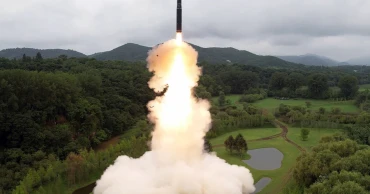
Kim vows to boost North Korea's nuclear capability after observing new ICBM launch
North Korean leader Kim Jong Un vowed to further bolster his country’s nuclear fighting capabilities as he supervised the second test-flight of a new intercontinental ballistic missile designed to strike the mainland U.S., state media reported Thursday.
Kim’s statement suggested North Korea would ramp up weapons testing activities to expand its arsenal in response to recent U.S. steps to enhance its security commitment to ally South Korea.
“The present unstable situation in which the security environment on the Korean peninsula is being seriously threatened by the hostile forces every moment,” Kim said, according to state media. “(That) requires more intense efforts to implement the line of bolstering nuclear war deterrent.”
The U.N. Security Council scheduled an open meeting late Friday afternoon to discuss the ICBM launch at the request of the United States, Albania, France, Japan, Malta and the United Kingdom.
The Korean Central News Agency reported Kim's comments a day after the launch of the Hwasong-18, which was first test-fired in April and which Kim has called the most powerful weapon of his nuclear forces.
The road-mobile ICBM has built-in solid propellant, which makes it more difficult to detect in advance than liquid-fueled missiles.
Kim says North Korea’s 1st spy satellite is ready for launch
KCNA said the launch was meant to reconfirm the technical credibility and operational reliability of the missile. Kim called the launch “another important stride” in efforts to boost the North’s strategic forces, KCNA said.
Kim supervises N. Korean troops simulating attack on South
According to KCNA, the missile was launched on a high angle to avoid neighboring countries. It flew 74 minutes and a distance of 1,001 kilometers (622 miles) at a maximum altitude of 6,648 kilometers (4,130 miles) before landing in a targeted area in the open waters off the North’s east coast.
The missile’s flight time is the longest recorded by any weapon launched by North Korea. If launched on a standard trajectory, the missile could fly to the mainland U.S. though some experts say North Korea still has some technologies to master to acquire functioning nuclear-armed missiles.
South Korea, Japan and the United States criticized North Korea over the launch that they said posed a threat to regional and international peace. Adam Hodge, a spokesperson for the U.S. National Security Council, said in a statement that the U.S. will take all necessary steps to ensure the security of the American homeland and South Korean and Japanese allies.
Kim wants N. Korea to make more nuclear material for bombs
Kim set for unspecified tasks for the North’s national defense sector, saying North Korea will take “a series of stronger military offensive” until the U.S. and South Korea “admit their shameful defeat of their useless hostile policy toward (North Korea) in despair and give up their policy.”
That signals Kim will intensify his push to modernize his missile arsenals with sophisticated weapons like the Hwasong-18. Other weapons on Kim’s publicly stated wish list are a multi-warhead missile, a hypersonic weapon, a spy satellite and a nuclear-powered submarine.
North Korea has been focusing on reinforcing its nuclear capability after Kim’s high-stakes nuclear diplomacy with then President Donald Trump collapsed in 2019 due to disputes over U.S.-led sanctions on North Korea.
KCNA accused the U.S. and South Korea of recently taking “frantic confrontation attempts” and bringing “a new chain of nuclear crises” on the Korean Peninsula.
North Korea often issues such harsh, warlike rhetoric in times of tensions with its rivals. The KCNA dispatch cited a U.S.-South Korean agreement to strengthen the allies’ deterrence capabilities such as the periodic docking of a U.S. nuclear-armed submarine in South Korea and the establishment of a new bilateral nuclear consultative group, whose inaugural meeting is slated for next week in Seoul.
The United States has expanded military drills with South Korea and taken steps to enhance "regular visibility” of U.S. strategic assets to the Korean Peninsula in response to the North’s advancing nuclear arsenal. North Korea conducted about 100 missile tests since the start of last year. Experts say Kim eventually aims to use his enlarged arsenal to win greater concessions in future diplomacy with the United States.
Wednesday’s ICBM launch came two days after Kim’s sister and senior adviser, Kim Yo Jong, threatened “shocking” consequences to protest what she called provocative United States reconnaissance activity near its territory. The U.S. and South Korean government dismissed the North’s accusation groundless and urged it to refrain from escalatory actions.
2 years ago

More people can't afford nutritious food and 148 million children are stunted by hunger, UN says
The U.N. delivered grim news on global food security Wednesday: 2.4 billion people didn’t have constant access to food last year, as many as 783 million faced hunger, and 148 million children suffered from stunted growth.
Five U.N. agencies said in the 2023 State of Food Security and Nutrition report that while global hunger numbers stalled between 2021 and 2022 many places are facing deepening food crises. They pointed to Western Asia, the Caribbean and Africa, where 20% of the continent’s population is experiencing hunger, more than twice the global average.
“Recovery from the global pandemic has been uneven, and the war in Ukraine has affected the nutritious food and healthy diets,” Qu Dongyu, director-general of the Food and Agriculture Organization said in a statement. “This is the `new normal’ where climate change, conflict, and economic instability are pushing those on the margins even further from safety.”
FAO chief economist Maximo Torero said the FAO food price index has been declining for about 15 months, but “food inflation has continued.” But he said not knowing if the deal that has enabled Ukraine to ship 32 metric tons of grain to world markets and is trying to overcome obstacles to Russian grain and fertilizer shipments will be renewed when it expires on July 17 “is not good for the markets.”
UN warns its development goals for 2030 are in trouble and 575 million people will remain very poor
If it isn’t renewed immediately “you will have a new spike for sure” in food prices, but how much and for how long will depend on how markets respond, he said.
According to the report, people’s access to healthy diets has deteriorated across the world.
More than 3.1 billion people – 42% of the global population – were unable to afford a healthy diet in 2021, an increase of 134 million people compared to 2019, it said.
Torero told a news conference launching the report that reducing the number of people eating unhealthy diets “is a big challenge, because it’s basically telling us that we have substantially to change the way we use our resources in the agricultural sector, in the agri-food system.”
According to the latest research, he said, between 691 million and 783 million people were chronically undernourished in 2022, an average of 735 million which is 122 million more people than in 2019 before the COVID-19 pandemic began.
Eliminate legal barriers to women owning land: UN chief
Torero said U.N. projections for 2030 indicate that 600 million people will still be suffering from chronic undernourishment in 2030, far from the U.N. development goal of achieving “Zero Hunger” by that date.
In the report’s foreword, the heads of FAO, the World Food Program, the International Fund for Agricultural Development, the U.N. children’s agency UNICEF and the World Health Organization wrote that achieving Zero Hunger “poses a daunting challenge.” They called for redoubled efforts “to transform agri-food systems and leverage them” to reach the target.
As for children, the report says they are continuing to suffer from malnutrition, with not only 148 million younger than 5 stunted but 45 million too thin for their height or “wasted,” while 37 million youngsters were overweight.
Torero said the five agencies also looked at increased urbanization and found that people in rural and semi-urban areas are also consuming mass market products.
“Normally, we used to believe that rural people will consume what they produce, but that’s not the case,” he said, explaining that in rural areas about 30% of the family’s food basket is purchased from the market, and in semi-urban and urban areas it is higher, which has implications for nutrition because of the consumption of more processed foods.
WFP chief economist Arif Husain told reporters in a virtual briefing that in 2022 when the war in Ukraine was ongoing the food situation didn’t get worse because the donor community stepped up with about $14.2 billion, and the agency was able to provide aid to 160 million people, up from 97 million in 2019.
Stop targeting truth, truth-tellers: UN Chief on World Press Freedom Day
“My concern is that moving forward we are looking at huge funding cuts,” he said, citing WFP donations of just $4.2 billion by last week, 29% lower than at the same time last year.
2 years ago