Foreign-Affairs
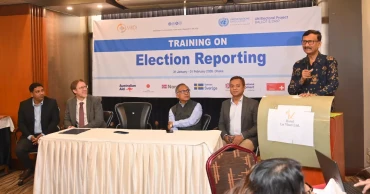
Minorities also citizens, govt must act on atrocities: Touhid Hossain
Apparently expressing displeasure over the way minority-related issues are reported, Foreign Affairs Adviser Md Touhid Hossain on Sunday said minorities are citizens of Bangladesh and it is the government’s responsibility to take action if any atrocities are committed against them.
“One point I have made very clear is that minorities in Bangladesh are Bangladesh citizens, and it is the responsibility of the Bangladesh government to take action if any atrocities have been committed against them,” he said while speaking at the closing session of a training programme on election reporting.
Hossain made the remarks while referring to an interview he gave to the BBC earlier in the day.
The Foreign Adviser said the voter turnout in the upcoming national election will be higher than 55 percent, which is more than that of the 1991 election.
Elections to be largely peaceful, hopes Foreign Adviser Touhid Hossain
Hossain acknowledged that incidents do occur from time to time but stressed that what matters most is that immediate action is taken against the perpetrators.
“This applies to all countries of the world. Minorities face challenges everywhere. Today’s issue is not specifically about minorities; I raised it only to demonstrate how the media can either make or break an issue through its reporting,” the Foreign Affairs Adviser said.
He clarified that this does not mean atrocities are acceptable, emphasising that any such acts are absolutely unacceptable.
Referring to his BBC interview, Hossain said the issue of a particular atrocity against a member of a minority community was raised.
He said similar or even worse incidents occur on the other side of the border (Bangladesh shares borders with India and Myanmar).
“Do those incidents become global issues in the same way? They do not. Ultimately, it is the media that amplifies these issues, and the media is often selective. This is something that cannot be changed overnight,” he said.
Hossain said he posed a counter-question during the interview, asking whether the prompt action taken by the government is reported with the same prominence.
An atrocity may receive widespread publicity, but the immediate actions taken by the government against the perpetrators often do not receive comparable media attention, he said.
Highlighting the media's role, he added, “The same incident can have very different effects - within communities and beyond - depending on how it is presented. Presentation is extremely important.”
Hossain said it is not uncommon for newspapers to acknowledge errors in reports through rejoinders, but such corrections are often published on inside pages in a single column. “That makes all the difference.”
Hossain said the government shares concerns over election-related violence and is trying to address them.
However, such concerns existed before every election in the past and the government always tried to prevent escalation.
“You know that elections in our country are highly competitive, and even if parties do not officially instigate violence, individual-level incidents can occur. This is not new; it happens in every election. We will continue trying to minimise such incidents and ensure a proper election,” he added.
Dhaka calls for early FTA talks with EU to attract more investment
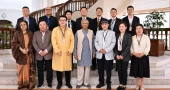
Diplomatic Correspondents Association, Bangladesh (DCAB) in cooperation with the UNDP and Media Resources Development Initiative (MRDI) hosted the training where former Bangladesh Bureau Chief of the Associated Press (AP) Farid Hossain was the facilitator of the two-day session.
UNDP Resident Representative in Bangladesh Stefan Liller, MRDI Executive Director Hasibur Rahman and DCAB President AKM Moinuddin also spoke at the event conducted by DCAB General Secretary Emrul Kayesh.
1 month ago

Elections to be largely peaceful, hopes Foreign Adviser Touhid Hossain
Foreign Affairs Adviser Md Touhid Hossain on Sunday said the forthcoming twin elections – national election and referendum – will be largely peaceful with an opportunity for people to express their will for a representative government, as no election in Bangladesh was fully peaceful.
“Let us hope that the elections will be held peacefully and people will have the opportunity to express their will and we shall have a representative government after the elections are held,” he said while speaking as the chief guest at the closing session of training on election reporting.
Diplomatic Correspondents Association, Bangladesh (DCAB) in cooperation with the UNDP and Media Resources Development Initiative (MRDI) hosted the training where former Bangladesh Bureau Chief of the Associated Press (AP) Farid Hossain was the facilitator of the two-day session.
UNDP Resident Representative in Bangladesh Stefan Liller, MRDI Executive Director Hasibur Rahman and DCAB President AKM Moinuddin also spoke at the event conducted by DCAB General Secretary Emrul Kayesh.
Bangladesh’s election narratives can influence global confidence: Stefan Liller
Speaking at the event, the Adviser, however, did not completely rule out the possibility of some violence during the elections and said the important thing is that the elections - by and large - must be peaceful.
He said the authorities, the Election Commission and the law enforcement authorities must take immediate steps so that these do not go out of hand.
Hossain said some incidents happened at night but that should be very limited and immediate actions need to be taken.
He said the media during the elections will play a very important role and noted that it is an extremely important event in national life as people have not been able to cast their votes for a long time.
The Adviser said steps are being taken so that the people really have the opportunity to go to the polling centers, and cast their votes without fear and without any disturbance.
“I'm sure this election will definitely reflect the will of the people even if there are small aberrations here and there. I am saying this because traditionally, we have seen that in each and every election scene - some undesired incidents do take place,” he said, adding, “I wish all of you a very vibrant day of reporting on that day.”
As Bangladesh approaches an important electoral milestone, Liller said, the role of journalists is both demanding and indispensable. “Democracy is sustained not only by laws and institutions, but by informed citizens. Journalists are central to that process.”
Liller, who is responsible for UNDP’s activities in the country, said electoral developments must be situated within Bangladesh’s constitutional and legal frameworks, as well as within its international commitments under the United Nations Charter, international human rights instruments and the Sustainable Development Goals, particularly Goal 16 on peace, justice and strong institutions.
He said responsible reporting helps ensure that moments of political contestation are understood internationally as part of a lawful, rules-based democratic process.
Liller said electoral processes are among the most technically and politically sensitive elements of democratic governance. “They involve complex legal frameworks, electoral codes of conduct, voter and candidate regulations, results tabulation systems, and complaints and dispute resolution mechanisms.”
In this context, the international development professional with over 20 years of experience said, journalists serve as a critical bridge between institutions and citizens.
When electoral processes are reported clearly, accurately and responsibly, Liller said, citizens are better able to understand not only what is happening.
He said at moments of heightened political competition, professional and ethical reporting contributes directly to public trust, democratic legitimacy and social cohesion.
Conversely, Liller said, misinformation or imprecise reporting can unintentionally amplify tensions and undermine confidence in electoral outcomes.
1 month ago
Dhaka calls for early FTA talks with EU to attract more investment
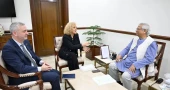
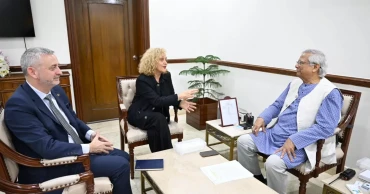
Chief Adviser Prof Muhammad Yunus on Sunday called for an early start to Free Trade Agreement (FTA) negotiations with the European Union, stressing the need for safeguarding Bangladesh’s trade preferences in its largest export market once the current duty-free access expires in the coming years.
The Chief Adviser made the remarks during a courtesy call by Nuria Lopez, Chairperson of the European Chamber of Commerce in Bangladesh (EuroCham), at the State Guest House Jamuna in Dhaka.
European Union Ambassador to Bangladesh Michael Miller took part in the meeting.
During the discussion, they discussed the need to accelerate European investment in Bangladesh, how to ensure smooth trade relations between Bangladesh and the EU, and the need for further reforms to improve the country’s business climate, said the Chief Adviser’s press wing.
They also discussed the upcoming elections and the deployment of international observers to monitor the polls.
Prof Yunus said the interim government has recently concluded an Economic Partnership Agreement (EPA) with Japan, paving the way for duty-free access for more than 7,300 Bangladeshi products to the world’s fourth-largest economy.
He said that Bangladesh is preparing to hold similar negotiations with other countries, including the European Union, to ensure continued duty-free access for its products, particularly ready-made garments, to the EU market for the foreseeable future.
“The EPA with Japan has opened doors for us. It gives renewed hope to our export items. We definitely hope to sign an FTA with the EU to expand our market,” the Chief Adviser said.
EuroCham Chairperson Nuria Lopez said Bangladesh needs to begin FTA negotiations urgently, as the country may lose its existing trade preferences in the EU, its largest export destination, after graduating from Least Developed Country (LDC) status.
She said that an FTA would attract more European investment to Bangladesh, create jobs and boost exports to advanced Western markets.
Lopez pointed out that India is signing an FTA with the EU, while Vietnam already has such an agreement, allowing both middle-income countries preferential access to the European market.
“We are advocating for an FTA. I will go to Europe to encourage private companies to invest in Bangladesh,” she said.
EU Ambassador Michael Miller said that the commercial relationship with Bangladesh will evolve after graduation but not before 2029.
He underlined the EU’s strong interest to bring European investment and technology to the country, an important market with a population of nearly 200 million, and spoke about the EU readiness to organise an EU/Bangladesh Business Forum in 2026.
“We are looking for early political signals that EU companies will be encouraged to come and will enjoy a level playing field,” he said.
The Chief Adviser also emphasised the relocation of factories to Bangladesh, noting that European firms can take advantage of the country’s large pool of skilled labour at competitive costs.
“We are building a free trade zone. Our aim is to turn Bangladesh into a manufacturing hub for global businesses. We want more European investment in Bangladesh,” he said.
Prof Yunus expressed satisfaction over the EU’s decision to deploy a large contingent of election observers to Bangladesh for the upcoming general elections and referendum.
“It is important that EU election observers are here. It is a huge vote of confidence in revitalising our democracy,” he said, adding that the overall picture of the election campaign was ‘very positive’.
Lamiya Morshed, SDGs Affairs Principal Coordinator and Senior Secretary of the government, was also present at the meeting.
1 month ago
Bangladesh’s election narratives can influence global confidence: Stefan Liller
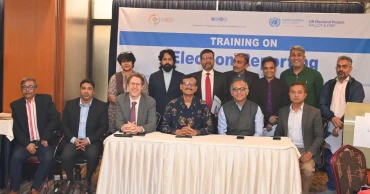
UNDP Resident Representative for Bangladesh Stefan Liller on Sunday said the election reporting today extends far beyond national borders and laid emphasis on maintaining three essential things - accuracy, neutrality and ethical judgment - while electoral reporting.
He said that reports produced by journalists in Bangladesh are closely followed by diplomats, international observers, development partners, investors and global media outlets.
“As a result, election narratives can influence international confidence, diplomatic engagement and perceptions of a country’s image and democratic maturity,” he said, adding that this places a particular responsibility on journalists covering elections in a diplomatic context.
Liller made the remarks while speaking at the closing session of the two-day training on election reporting, hosted by the Diplomatic Correspondents Association, Bangladesh (DCAB) in cooperation with the UNDP and Media Resources Development Initiative (MRDI).
1 month ago

Expat journeys made affordable; Saudi-Bangladesh flights at Tk 20,500
Visiting home just got easier for Bangladeshi expatriates, as a new initiative slashes one-way Saudi-Bangladesh airfares to a wallet-friendly Tk 20,500.
Commerce Adviser Sk Bashiruddin, who is also Adviser to the Ministry of Civil Aviation and Tourism, said a total of 80,000 tickets will be sold under this scheme covering both Saudi Arabia and Bangladesh.
While the initiative benefits expatriates, he said, it will also bring significant revenue to the state-owned Biman Bangladesh Airlines.
He explained that previously, one-way empty flights were operated during Hajj flights, but this arrangement will utilize them effectively, potentially generating over 10 crore taka in additional revenue for the airline.
Under this scheme, one-way fares for Madina–Dhaka and Jeddah–Dhaka routes are fixed at Tk 20,500, while return tickets on Madina–Dhaka–Madina and Jeddah–Dhaka–Jeddah routes are set at Tk 42,000.
The special fares will be valid for arrivals in Bangladesh from April 18 to May 25, 2026, and for departures from Bangladesh from May 30 to June 30, 2026.
Chief Adviser Prof Muhammad Yunus praised Sk Bashiruddin for the initiative, calling it a milestone in implementing expatriate-friendly policies.
Govt okays procurement of 40,000 mt fertiliser from Saudi Arabia
He said such practical steps will improve expatriates’ lives and contribute to the national economy.
He reminded that previous efforts had stumbled from poor management and urged full implementation of this programme to secure its success.
1 month ago

US Embassy issues security alert ahead of Feb election
The US Embassy in Dhaka has issued a security alert, urging US citizens in Bangladesh to remain vigilant, avoid demonstrations and exercise caution around large gatherings.
“US citizens should remain vigilant, avoid demonstrations, and exercise caution in the vicinity of any large gatherings,” the Embassy said in a notification on Friday.
Bangladesh elected Vice Chair of UN Peacebuilding Commission for 2026
Bangladesh is scheduled to hold parliamentary elections and a national referendum simultaneously on February 12, 2026.
During the election period, the Embassy warned that political violence or extremist attacks may occur, with possible targets including rallies, polling stations and religious sites.
1 month ago
Dhaka, Beijing cooperation must continue with new govt: Prof Yunus
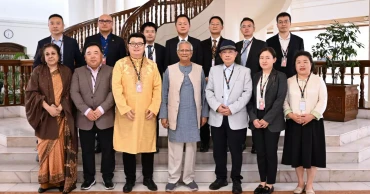
Chief Adviser Prof Muhammad Yunus has said the cooperation between Bangladesh and China must continue, although a new government will soon take office.
“In a few weeks, I will be out of this office and a new government will be formed, but the work between our two countries must go on,” he said during a meeting with a delegation from the China-Bangladesh Partnership Forum at the State Guest House Jamuna recently.
The delegation included senior Chinese academics, investors and industry leaders from the biomedical, infrastructure, digital, and legal sectors, said the Chief Adviser’s press wing on Friday.
Xin-yuan Fu, a leading Chinese biomedical scientist and Director of the West China School of Medicine at Sichuan University, commended Prof Yunus’ vision and said he was very much looking forward to working with Bangladeshi academics and contributing to improving people’s lives.
Bangladesh elected Vice Chair of UN Peacebuilding Commission for 2026
Andrew Zilong Wong, Senior Advisor to the Board of Directors of Walvax Biotechnology, and Yuqing Yao, Managing Director of Walvax Biotech (Singapore), shared their experiences and interest in working with Bangladesh. Walvax has exported its vaccines to at least 22 countries.
The company has established local subsidiaries in the United Kingdom and Indonesia and is exploring the localisation of PCV and HPV vaccines.
In Indonesia, it has signed an agreement with a business partner, indicating a move toward building local capacity.
The delegation also included Jinsong Wang, Vice President of the Robotics Society of Singapore; Yuan Feng, Chair of the Management Committee of Fordall Law Firm; Li Ran, Managing Director of Beijing Wutong Asset Management; Gao Zhipeng, Vice President for International Investment and Projects at China State Construction Engineering Corporation; Xu Tianzhao, Investment Director of China Hunan Construction Investment Group; Hua Jie, Vice President of China CCC Engineering Group; Chen Shujian, General Manager for Overseas Markets at PowerChina Overseas Investment Group; Professor Ma Xiaoyuan of Yunnan University; and Alex Wang Zekai, Secretary-General of the China-Bangladesh Partnership Forum.
They informed the Chief Adviser that they had engaged with several university students in Bangladesh on artificial intelligence and digitalisation and expressed admiration for the talent and potential of young Bangladeshi minds.
During the meeting, Prof Yunus recalled his long-standing relationship with China, which began through the microcredit movement.
“I had the opportunity to visit remote villages in China and see how people’s lives were being transformed. Later, the Chinese government launched its own programmes inspired by these principles,” the Chief Adviser said.
Recalling his visit to China in March, Prof Yunus said he had met President Xi Jinping during the visit.
“He told me that he had read my book and followed its principles. That was a very happy moment for me,” he said.
The delegation thanked Prof Yunus and discussed opportunities for collaboration in the health, infrastructure and digital sectors.
Highlighting the interim government’s priorities, the Chief Adviser said health remains the top concern.
“Our highest priority is healthcare—how to integrate digital technology so that doctors and patients can connect effectively, medical histories can be preserved digitally, and appointments can be accessed easily,” he said.
Dr Yunus also emphasised the need for social business models in the pharmaceutical sector.
“Medicines cost pennies to produce, yet are sold for dollars. We want to encourage the establishment of social business pharmaceutical companies that focus on helping people, not just profits,” he said.
About the COVID-19 pandemic, Prof Yunus recalled Bangladesh’s advocacy for patent-free vaccines.
“We raised our voices for patent-free vaccines and faced resistance. When the vote came, 10 countries abstained. They said rich countries would buy vaccines and donate them to poor nations. We said we don’t need gifts. People were dying while others were making money. This is a shame,” he said.
Rohingya crisis not receiving due attention, repatriation only solution: Prof Yunus
Prof Yunus also shared his vision of establishing a “health city” in the northern region of Bangladesh.
“During my visit to China, I proposed building a 1,000-bed international hospital in northern Bangladesh. It is a poor region but strategically located near India, Nepal, and Bhutan,” he said.
Dr Yunus explained that the proposed health city would include hospitals, medical colleges, research centres, vaccine production facilities, pharmaceutical industries, and medical equipment hubs.
“All health-related activities would be located in one city. People from India, Nepal, and Bhutan could also benefit by accessing quality healthcare facilities there,” he added.
Prof Yunus expressed his gratitude to the government of China for its continued support and cooperation.
Lamiya Morshed, SDGs Affairs Principal Coordinator and Senior Secretary to the government, was also present at the meeting.
1 month ago
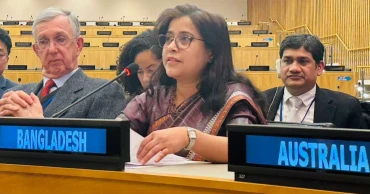
Bangladesh elected Vice Chair of UN Peacebuilding Commission for 2026
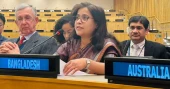
Bangladesh has been elected as the Vice-Chair of the UN Peacebuilding Commission (PBC) for the year 2026.
The election of the five-member bureau of the PBC was held at the UN Headquarters in New York on Thursday.
The members of the Commission during its first meeting of the 20th session elected Morrocco as Chair while Germany, Brazil and Croatia and Bangladesh were elected as Vice-Chairs.
The Peacebuilding Commission is an intergovernmental advisory body that supports peace efforts in conflict-affected countries.
Bangladesh needs to target visa fraud as brokers exploit social media
The Commission is composed of 31 member states, elected from the General Assembly, the Security Council, the Economic and Social Council and the leading troops and financial contributing countries to the United Nations system.
Bangladesh has been a member of the Commission since its inception in 2005 and had earlier served the Commission as chair in 2012 and 2022 as vice-chair in 2013 and 2023.
Bangladesh assumed charge today as Vice-Chair during the first PBC meeting of its 20th session after a brief ceremony. On this occasion, the President of the UN General Assembly and Chef de Cabinet, on behalf of the Secretary-General were present and delivered statements emphasizing the rule of the PBC.
UNDP to support Bangladesh’s capital market with thematic bond development
In a statement, Bangladesh delegation thanked members of the Commission for reposing their trust and confidence in Bangladesh for this important responsibility and reiterated its commitment to the UN’s peacebuilding efforts and activities as well as its future plan of action.
1 month ago
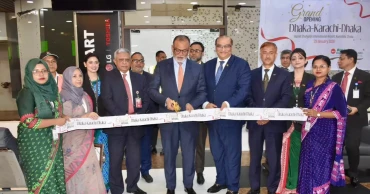
Dhaka-Karachi direct flight launched
Direct flight operations between Bangladesh and Pakistan commenced on Thursday as Biman Bangladesh Airlines launched its inaugural flight from Dhaka to Karachi.
The "fully packed" inaugural flight departed from Hazrat Shahjalal International Airport, Dhaka, for Jinnah International Airport, Karachi.
The flight was seen off by Civil Aviation and Tourism Adviser Sk. Bashir Uddin; High Commissioner of Pakistan to Bangladesh, Imran Haider; Secretary, Ministry of Civil Aviation and Tourism; Chairman, Civil Aviation Authority of Bangladesh; and Managing Director and CEO of Biman Bangladesh Airlines, along with other senior officials.
The launch of the direct flight is being hailed as a positive and long-awaited development, said the Pakistan High Commission in Dhaka.
Addressing the inaugural ceremony, the Adviser for Civil Aviation and Tourism underscored the importance of the Dhaka–Karachi route in enhancing connectivity, promoting tourism and strengthening people-to-people links.
He noted that Biman Bangladesh Airlines would gradually increase flight frequency and reduce airfares to make travel more affordable for the people.
He expressed hope that people of Bangladesh will visit Pakistan and explore its natural beauty, cultural heritage and diverse cuisines.
Speaking on the occasion, the High Commissioner recalled the vision of Professor Muhammad Yunus, Chief Adviser of Bangladesh and Muhammad Shehbaz Sharif, Prime Minister of Pakistan aimed at enhancing connectivity between Pakistan and Bangladesh.
3 transgender women shot dead in Karachi
The High Commissioner expressed gratitude to the Government of Bangladesh, Biman Bangladesh Airlines, and the Civil Aviation Authority for making the launch of the flight possible.
Passengers travelling on the inaugural flight expressed happiness and enthusiasm over the restoration of the direct air link, describing it as a milestone towards bringing the two countries closer, said the High Commission.
1 month ago
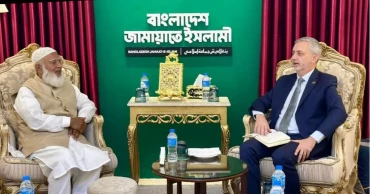
EU Envoy meets Jamaat Ameer, reaffirms support for Bangladesh’s democratic transition
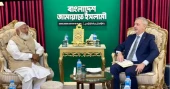
European Union (EU) Ambassador to Bangladesh Michael Miller on Thursday met with Jamaat-e-Islami Ameer Dr Shafiqur Rahman, reaffirming the EU’s support for Bangladesh’s democratic transition and reform process.
"We look forward to smooth elections and stand ready to work with whomever will form the next government to further strengthen EU-Bangladesh relations," said the EU Embassy in Dhaka after the meeting.
1 month ago